Tag Archives: Puerto Rico

8th April 2025

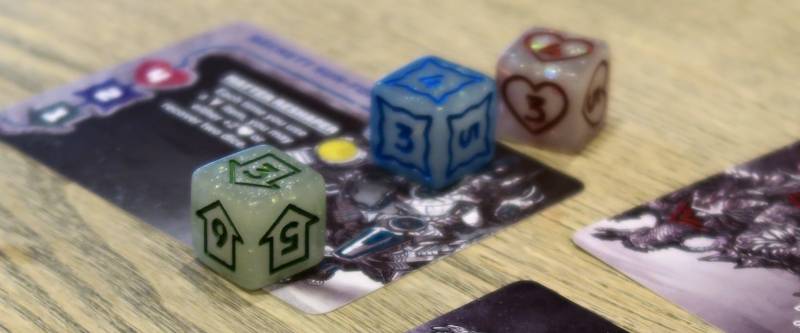
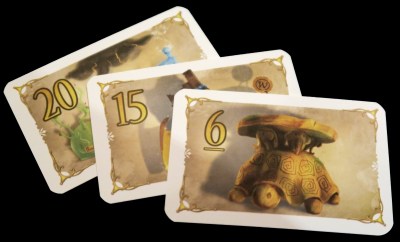
By the time everyone else started to arrive, Cobalt was already most of the way through losing his game of 20 Strong.  This is a solo-player deck-based game where the object is to progress through a shuffled deck of cards, each of which bears a unique challenge. This challenge could be in the form of an enemy, a unique scenario, or some other requirement which are completed by rolling a set of seventeen dice with different odds for a hit.  These dice, along with three adjustable stat dice, make up titular twenty dice.  Cobalt continued rolling his dice while others ordered food, chatted and ate.

20 Strong
– Image by boardGOATS

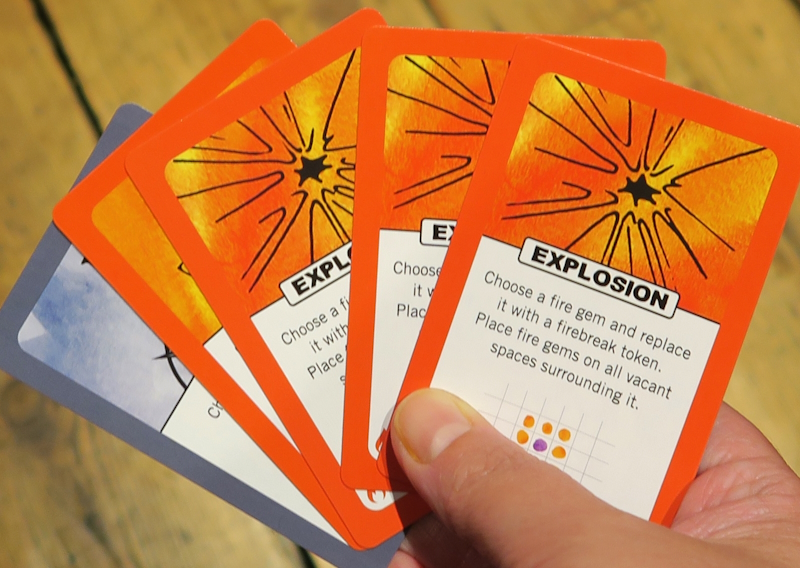
Before long players began splitting into groups, deciding what to play.  The first group was Blue, Pine, Mint and Pink playing the “Feature Game” which was to be Fire Tower.  This is a competitive game where players order air drops of water, and plan the building of firebreaks in order to combat a woodland blaze.  The rules are very simple:  players begin their turn by spreading the fire in the current wind direction then play one card from their hand (or discard all their cards) and replenish their hand.  There are four different types of cards, Wind, Fire, Water, and Firebreak cards.  Wind cards can be used to change the Direction of the Wind which affects which direction the fire spreads in.

Fire Tower
– Image by boardGOATS

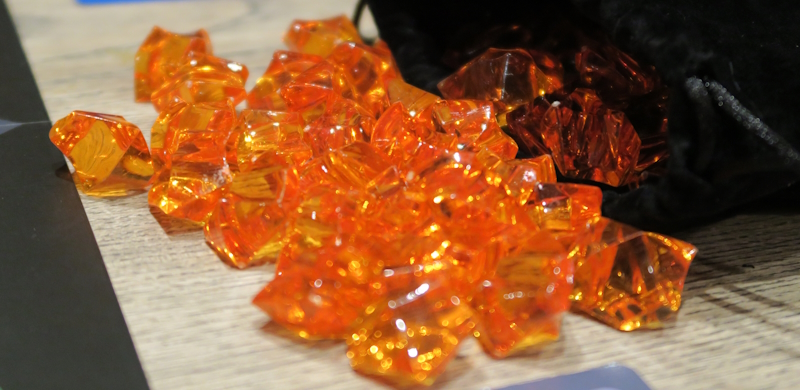
This can either be by playing the card and changing the Wind Direction to that on the card, or by rolling the Wind die and leaving it up to fate.  Alternatively, the player may place a fire gem on one empty space orthogonally adjacent to an existing fire space (or the central Eternal Flame), in the wind direction indicated on the card.  Fire, Water and Firebreak cards give a pattern of spaces that the fire must either spread in, is removed from, or fire break tokens can be placed in.  Firebreaks prevent fire from landing on or jumping over the spaces they occupy and can only be removed using a card that includes the De/Reforest action and cannot be placed in orthogonally adjacent to another Firebreak token.

Fire Tower
– Image by boardGOATS

Each player took the Fire Tower on one corner of the board with Pine sitting opposite Blue and Mint opposite Pink.  Blue went first followed by Mint, then Pine and finally Pink.  The base game is an elimination game, with the winner the being the last player who’s Fire Tower has not be burnt down.  The group decided to play without the events and keep the game as simple as possible to see how things worked.  Pink was the first to get knocked out with Firestorms proving to be disastrous for his Tower.  Pine quickly followed with before there was a long, determined rear-guard action by Blue.

Fire Tower
– Image by boardGOATS

Unfortunately, Mint started in a better position and despite her best efforts, eventually Blue’s Tower was also a moldering ruin.  Since Pink and Pine had spent quite a lot of time as spectators, the group decided to give it a second go, but this time working in pairs.  This time, Blue’s Tower was first to be destroyed with Mint’s next.  Eventually, only Pink’s tower was still standing giving a second victory to Mint, which was shared with Pink.  The game had been quite enjoyable, if very different to the usual fare.  There was still plenty of time left for something else though, so the group had a rummage in the bags and came up with Draftosaurus.

Draftosaurus
– Image by boardGOATS

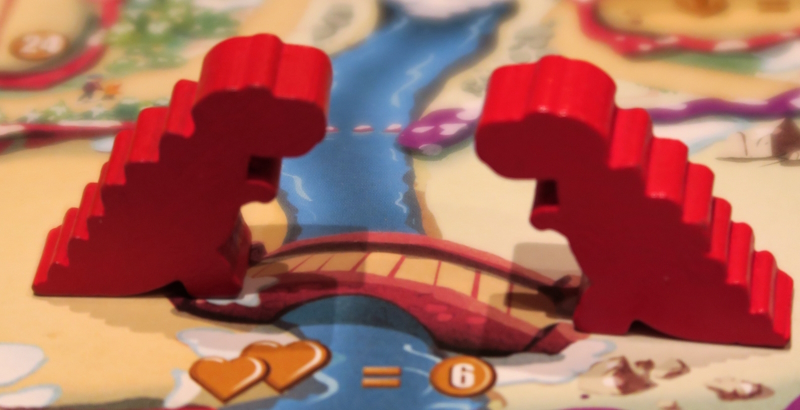
This is a very popular game where players start with a hand of dino-meeples, choose one and pass the rest on before placing them in their dinosaur park.  It frequently gets outings within the group, but on this occasion, for variety, the group decided to play with the winter setting which gives slightly different pens with slightly different placement conditions.  It was very tight, but as is often the case, Pine, who just seems to “get” this game emerged the victor with thirty-six points.  He was only one point ahead of Mint and Pink though, who tied for second place.

Draftosaurus
– Image by boardGOATS

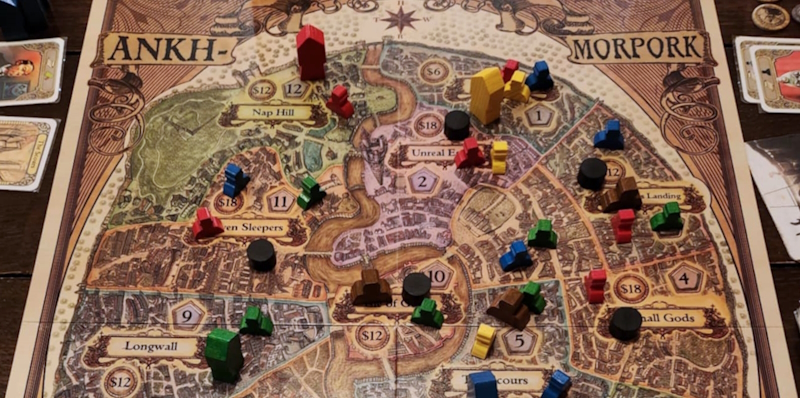
Meanwhile, on the next table, Green putting in a rare, but welcome appearance, was leading Black, Purple and Plum in a game of Discworld: Ankh-Morpork.  In this game, Lord Vetinari has disappeared and players control different factions which are trying to take control of the city.  Game play is quite quick and simple with players playing a card and doing what it says.  Most cards have more than one action on them, and players can choose to do some or all of these actions. Some cards also allow people to play a second card, so they can chain actions together.

Discworld: Ankh-Morpork
– Image by boardGOATS

In this game, Black was the Dragon King of Arms, looking for trouble, Green was Chrysoprase, trying to amass lots of money, Plum was Commander Vimes who was trying to play through the deck and Purple was Lord Rust, with an area control remit.  The game was over quite quickly with Black running out the winner in a game that is much under-rated and sadly very out of print due to IP issues.  This copy was a much cherished one, as it had belonged to Burgundy so it was nice for it to get another outing within the group.  There was time for a second game and this ended up being Faraway, a very clever, much more recent, card-driven game that has had a few outings since its release last year.

Faraway
– Image by boardGOATS

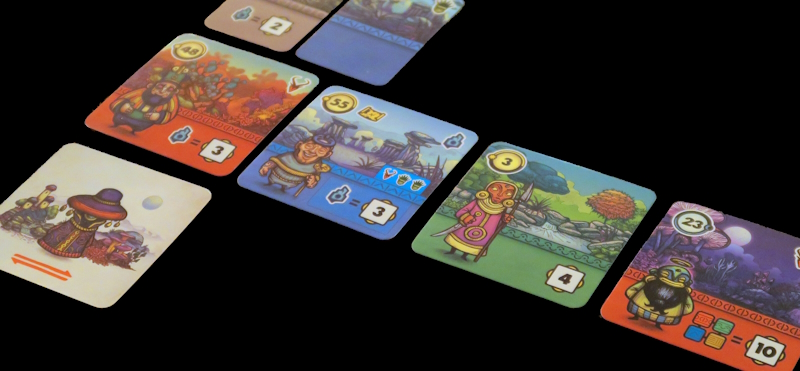
The idea is that players simultaneously chose one of the numbered cards from their hand and starting with the the player that played the lowest card (similar to 6 Nimmt! or Kingdomino), everyone takes it in turns to choose one from the market to add to their hand.  Players then simultaneously choose another card, and again, choose one to add to their hand.  The game ends after everyone has played a total of eight cards, and then everyone scores.  The clever part is that the cards are played left to right, but the scoring is from right to left.

Faraway
– Image by boardGOATS

At first glance, this looks like it makes things easy, because early in the game players find out what they need to get points and can then focus on getting the resources they need as the game progresses, but of course that is not the case.   This time, Purple had a really bad run where she kept getting the highest number cards, which meant she picked last, and then picked up the higher number cards left by others.  Once again, the winner was Black making it two out of two for him, while Plum was second by seven points with Green a little way behind her.

Faraway
– Image by boardGOATS

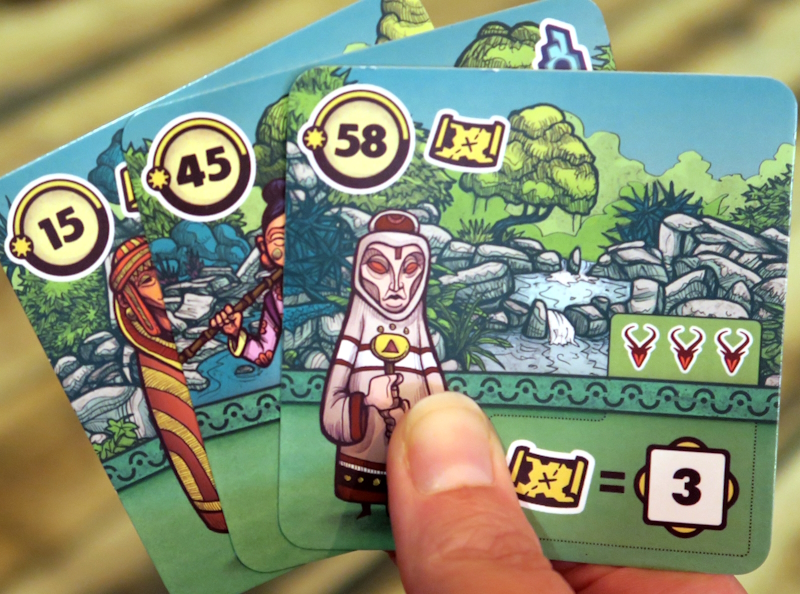
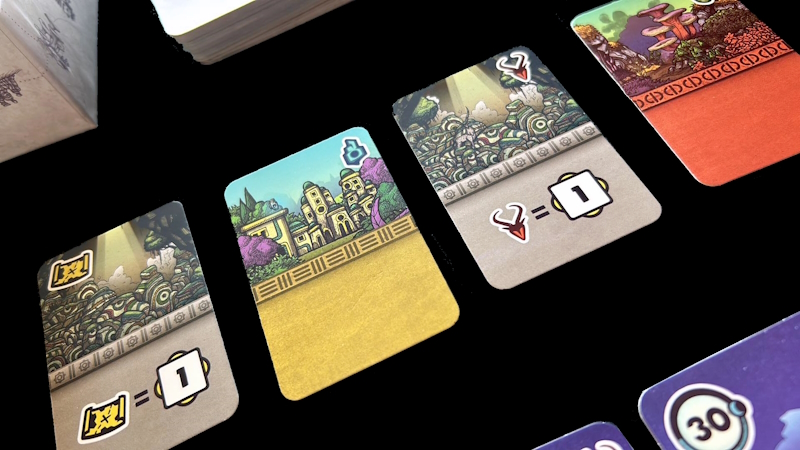
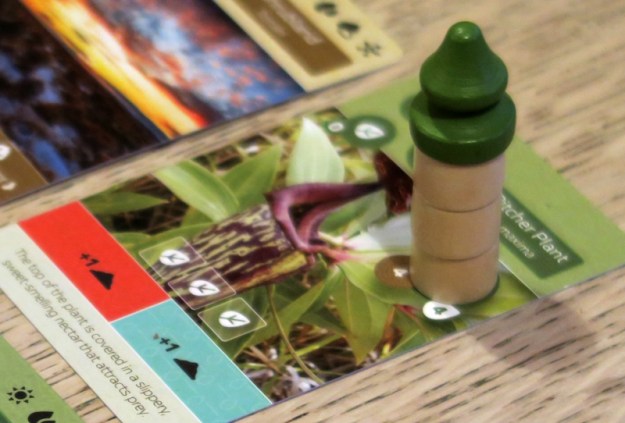
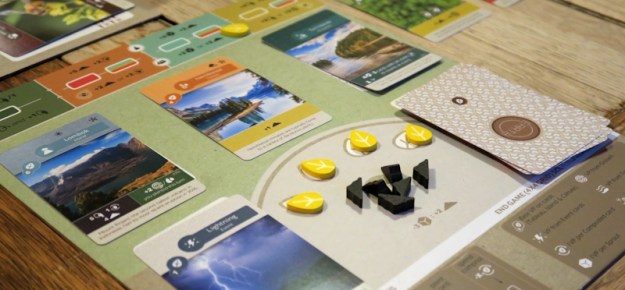
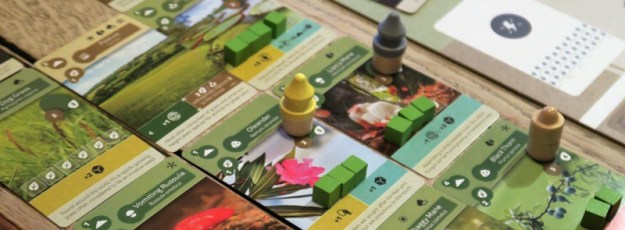
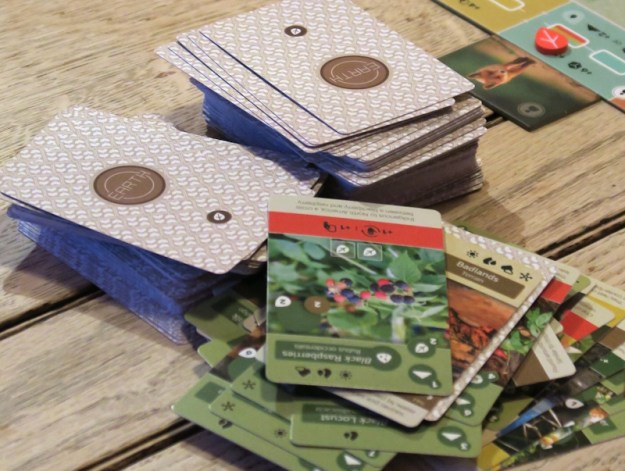
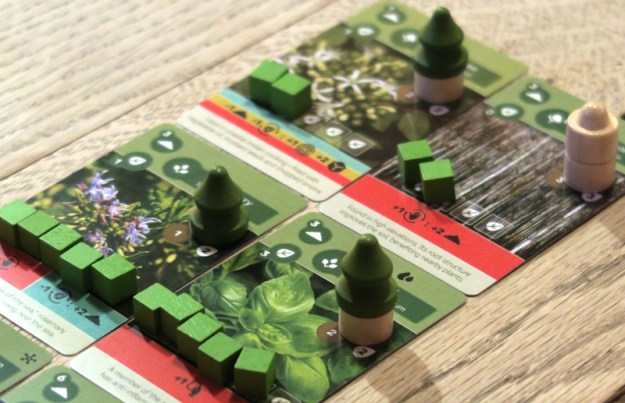
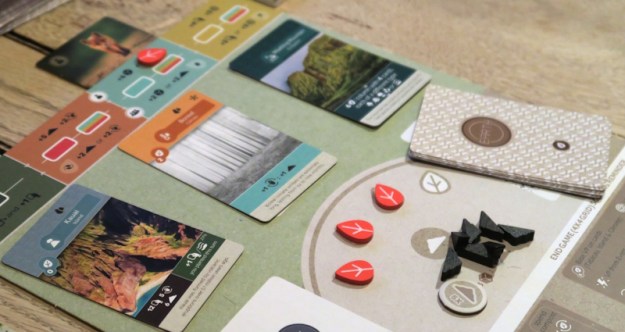
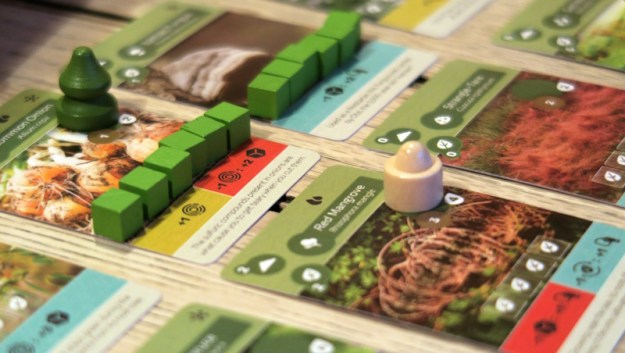
Meanwhile, the third group comprising Jade (fresh from his birthday celebrations), Sapphire, Teal, Byzantium and Cobalt spent the evening playing a five-playergame of Earth.  This is a is a sumptuously illustrated card-driven engine-builder game that is often compared to Wingspan, where players are building themselves an ecosystem.  The game itself is not actually all that complicated. Players are building a four by four grid of Flora and Terrain cards which represents their island and during the game they will plant flora, water it and allow it to grow.  On their turn, players do one of four things: Planting (paying the cost in Soil tokens), Composting (gaining Soil and placing cards from the deck in their discard pile), Watering (place Sprouts and gain Soil) & Growing (draw new cards and place growth tokens).

Earth
– Image by boardGOATS

A bit like Puerto Rico, once the active player has chosen which action they are taking, everyone else gets to do a subsidiary, slightly weaker version of the same action.  Once everyone has completed the action for the turn, everyone activates all the cards in their island that match the colour of the action chosen, starting with the card in the top left and working across each row in turn.  At the end of the game (triggered when one player has completed their island), players score points for each flora card, any Trunks and Canopies they have grown, their Sprouts and their pile of “Composted” or discarded cards.  Players also score points for achieving objectives on the Fauna cards revealed at the start of the game and for completing their island first.

Earth
– Image by boardGOATS

During the game, Cobalt built up the most points; his forty-two were some five ahead of Byzantium.  By far the most points come in the end-game scoring however.  A bit of a point salad there are seven scoring sections:  Teal scored best for Compost; Jade scored most highly for completing his Canopies; Byzantium top-scored for Terrain, and Cobalt out-scored everyone else for his Fauna.  As well as getting the most points for his Sprouts and Ecosystem Objectives, Sapphire also scored well in many of the other categories giving him a clear victory with one hundred and sixty-eight points, thirteen more than Byzantium who pipped Cobalt for second by a single point.

Earth
– Image by boardGOATS

Learning outcome:  Playing with fire may be fun, but you risk getting burnt.

21st January 2025

Blue and Pink were still eating as everyone else rolled up.  But as they did, like last time, there was an unusual amount of interest in the “Feature Game“, which, in a change to previous plans, was to be Heat: Pedal to the Metal.  This is a car racing game, in a similar vein to other games popular within the group like Flamme Rouge, Snow Tails, and Downforce.  Like Flamme Rouge and Snow Tails, as well as a racing game, Heat is also a hand management game.  The idea is that players simultaneously choose cards to play and then these are activated from the front of the pack (much like PitchCar).

Heat: Pedal to the Metal
– Image by boardGOATS

Players have a hand of seven cards drawn from their personal deck.  During the game, certain actions that are bad for their engine cause it to heat up meaning they pick up cards that block their hand.  Initially, Heat cards go into players discard pile, simulating the delayed effect engine damage can have, blocking their hand later in the game as the deck is recycled.  There are ways to cool the engine down, but these Heat cards cannot be discarded or played in the normal way.  What makes Heat slightly different to some of the other hand-management-racing games is that there is formally simultaneous play to choose cards and then players take it in turns to activate their cards and take a series of optional mini-actions.

Heat: Pedal to the Metal
– Image by boardGOATS

Players start by simultaneously adjusting their gear, staying put or shifting up or down one without penalty, or shifting two and picking up a Heat card.  The gear dictates how many cards a player must play – second gear means they have to play two cards for example.  Players then take it in turns to reveal their cards and move their car.  There are then five “situational” options: Adrenaline, React, Slipstream, Corner Check, and Discard, before the player replenishes their hand back to seven cards.  Adrenaline is a catch-up mechanism, where the player at the back can move one extra Space while adding one to their Speed value and/or gain one extra “Cool down”.

Heat: Pedal to the Metal
– Image by boardGOATS

“Cool down” is an important aspect of the game because it allows players to remove a Heat card from their hand and return it to their engine deck.  In React, players activate any additional symbols on the cards they have played or from the gear they are currently in or from the Adrenaline.  These include picking up cards because of Stress—players start the game with three Stress cards in the deck which represent lapses of concentration.  When a player plays these, they then have to draw cards from their deck to add an essentially random amount to their speed.  Of course it is not random, and a player who has an idea of what cards are still in their deck will be able to mitigate this.

Heat: Pedal to the Metal
– Image by boardGOATS

Further, Stress cards can also be used to postpone the effects of Heat, as any non-movement cards go straight into the discard pile.  Players can also control their engine heat by spending a period of time in a low gear by “Cooling down” their and removing Heat cards from their hand (three for first gear, two for second).  In contrast, players that have Heat cards available, may add an extra one to their discard pile to boost their speed by drawing an extra card as for Stress cards.  Once all these have been activated, players who end their movement along-side or immediately behind another car can Slipstream, that is move two spaces forward (this does not add to speed, it simply means the car moves further because it is moving more efficiently).

– Image by boardGOATS

If the player has crossed a Speed restriction line typically at a corner, they have to evaluate their Speed by summing the value of their cards and adding one for any Adrenaline bonus if they used it.  If this is more than the limit, players add the difference to their discard pile in Heat Cards.  Players that do not have enough Heat to pay for their excess Speed, pay all the Heat they have and then immediately spin out—move their car back to the last available space before the Speed limit line, take one or two extra Stress cards and change down to first gear.  Once all this is done, players can discard any cards they want that are not Stress or Heat cards before replenishing their hand, shuffling their discard pile if necessary.  The first player to cross the finish line triggers the end of the game and the player that travels the furthest is the winner.

Heat: Pedal to the Metal
– Image by boardGOATS

Although Blue and Ivory were keen to play, numbers meant they missed out and instead, Jade, led Teal, Pink and Lime.  A slight rules malfunction where the group were trying to play all the steps simultaneously meant the safety car did a lap before a restart, then they were off in earnest.  The group were playing on the USA track, which is generally recommended for a first play and is raced over two laps.  One thing that seems to be true for all race games is that once someone has got in front, it is very hard to haul them back, making it critical to get a good fast start.  This time, the good fast start was had by Jade and before long he had built that up and had gone one corner ahead, everyone else felt they were playing for placings and trying to work out how best to approach the corners.

Heat: Pedal to the Metal
– Image by boardGOATS

Instead of playing the end-game as written, the group decided to play it until everyone had crossed the line, so the game continued for some time after Jade had claimed victory.  Lime crossed the line second with Pink in hot pursuit, so much so that although Pink crossed the line in third, he finished his turn ahead of Lime and therefore was awarded runner-up (or first loser) status.  Teal just crossed the line, claiming a sympathy vote ensuring that everyone finished the race.  It had been a bit of a trial and Blue was still keen to give it a go, so Jade, who had been looking to pass it on, sold it to Blue on the spot, which means it will likely get a few more tries over the coming year.

Heat: Pedal to the Metal
– Image by boardGOATS

Blue and Ivory meanwhile, although keen to play Heat, had also been tempted by Roll for the Galaxy.  So, when Byzantium had commented that he hadn’t understood his first and only play, but had enjoyed it, the decision was made.  Roll for the galaxy is a dice game based on the card game Race for the Galaxy, which is itself a sort of space themed, card game version of Puerto Rico.  The thing all these games have in common is “Role (or Action) Selection”—the games have five or six phases or Roles and each player chooses one which will happen in the round.  Thus some things happen, and others do not.  A large part of these games is correctly gambling on others picking certain Roles or Actions and making them happen, so they can be piggy-backed.

Roll for the Galaxy
– Image by boardGOATS

The smaller the number of players, the more critical this can be.  So with just three players in Roll for the Galaxy, at least two will not be happening, possibly more.  The Actions are Explore (acquire world tiles); Develop (progress on building Development worlds); Settle (progress on building Production worlds); Produce (use Production Worlds to produce Goods), and Ship (sell Goods for money, or consume them for victory points).  In this game, the actions are all carried out using dice which are rolled in secret and placed behind the players screen to choose where those dice will get used.  This placement depends on the face shown, though any one die can be used to choose which Action will happen.

Roll for the Galaxy
– Image by boardGOATS

The dice are then moved to the Development or Settlement piles of tiles in their respective phases to progress building those worlds, or placed on Production worlds as goods.  Alternatively, they can be spent to pay for Exploring or Shipping in which case, they (along with any dice from any completed building projects or shipped goods) are placed back in their Citizenry.  Dice can be purchased into the player’s cup at a rate of one dollar each, so it is important for players to ensure their finances are healthy or their game will rapidly stagnate.  The game ends when, either someone has built their twelfth World, or the the pool of victory point chips has been exhausted.

Roll for the Galaxy
– Image by boardGOATS

The game was slow to get going at the start, but then Ivory raced to an early lead getting a nice array of Worlds in his tableau leaving Blue and Byzantium trailing in his wake.  But then, instead of finishing the game by building his final World, he appeared to pull up.  This gave Blue and Byzantium the illusion of a chance, but was of course because he had a plan.  Ivory had the Galactic Reserves Development World which gave an extra victory point for every Goods item on a World at the end of the game while also allowing each Production World to hold an extra Goods item.

Roll for the Galaxy
– Image by boardGOATS

So, the couple of extra rounds was to enable him to fill his Production Worlds and in the end, the game was brought to a close by Byzantium building his twelfth planet, although the victory point chips were also depleted by the end of that round.  Blue had taken a sizeable twenty-four of those victory points through trading goods, but hadn’t been able to build enough.  As a result, her planets were worth only eighteen points, barely twice those of Ivory’s and Byzantium’s thirty.  Byzantium had five victory point chips and a couple of points from his New Galactic Order, but Ivory was some distance in front, thanks to his thirteen points for his Galactic Reserves and Galactic Bankers Developments together with his eight victory point chips.

Roll for the Galaxy
– Image by boardGOATS

There was time to play something else, but rather than go through rules, as Roll for the Galaxy was already out, the trio decided to give it another go.  This time, with an element of time pressure, it was arguable that some of the decisions made weren’t as sharp and the scores were all lower the second time, though that might have been partly because there were notably fewer rounds.  Blue kept dipping into the bag to try to get Rare Element (brown) Worlds to go with her Mining League, but failed repeatedly and eventually gave up.  Ivory triggered the end game with his twelfth World and this time it was Byzantium who struggled to build enough.

Roll for the Galaxy
– Image by boardGOATS

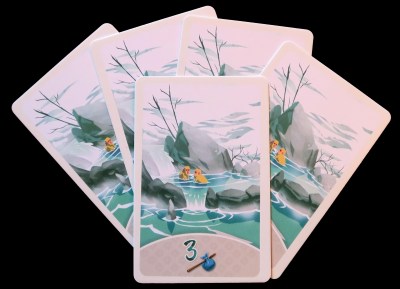
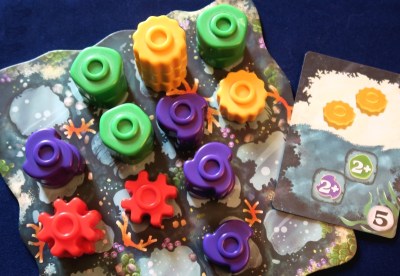
The scores were a bit closer on the second attempt, though the end result was still much the same, with Ivory again taking victory, though with half the winning margin.  By this time, the other games had also finished.  The first of these was Forests of Pangaia, in which Mint was joined by Pine and Plum.  This is a truly beautiful, tactile game, where players are trying to meet objectives to score Life Points; the player with the most Life Points at the end of the game is the winner.  The game has elements of set collection and area control and is played on a central map made of terrain hexagons.  Players take turns to perform three phases: Grow Seeds, take a Spirit Action, and finally add Treetops.  Once Seeds have grown and been turned into Trees, players carry out one of three possible Spirit actions.

Forests of Pangaia
– Image by boardGOATS

These are: Plant (moving their Spirit Pawn to a Lake space and planting seeds in adjacent spaces); Gather (moving their Spirit Pawn back to their player board and receiving a resource), and Prey (moving their Spirit Pawn back to their player board and playing their Ritual Card).  There are fourteen Rituals the Spirits can perform to collect Gaia’s Life Energy.  Once the Ritual card has been scored all the player’s Trees that were involved in the Ritual then partially or fully Decay (depending on the Ritual), either losing a level or rotting back to nothing and leaving a Seed.  The player then discards their Ritual card and draws a new one.  The game ends when the last Ritual card is taken by any player.

Forests of Pangaia
– Image by boardGOATS

Plum went first and spent most of the game collecting Sun tokens.  In contrast, Pine collected lots of Wind tokens inspiring lots of jokes about using wind to spread his seed.  The winner, however, was Mint with a nine point Trail Ritual due to excessive seed spreading giving her a total of twenty-eight points.  Pine just pipped Plum for second place by a single point.  It had been a really enjoyable game, however, made all the better by the gorgeous pieces. Meanwhile, on the other end of the same, albeit long table, Black, Purple and Sapphire played a game of last year’s winner of the Golden GOAT Award, Stamp Swap.

Stamp Swap
– Image by boardGOATS

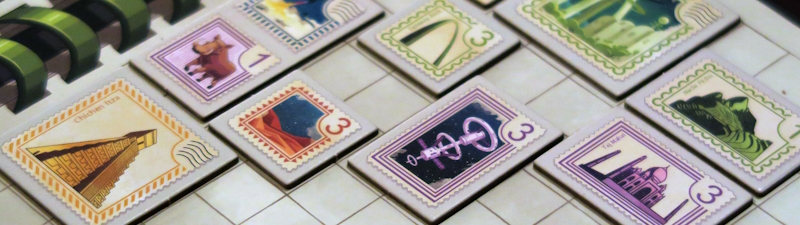
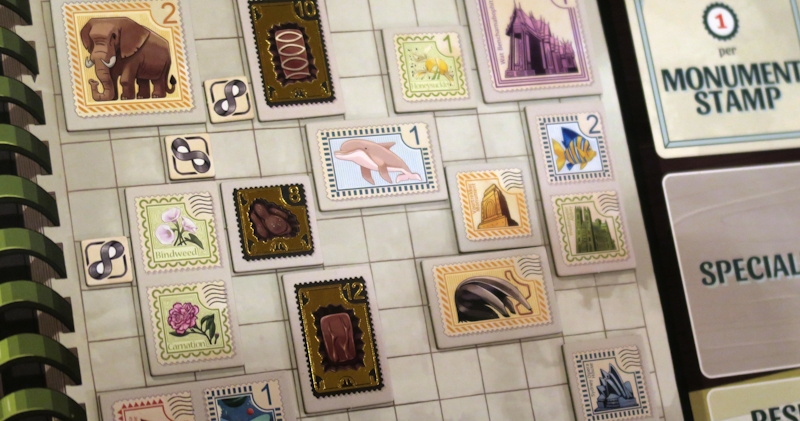
This is a really smooth tile placement centred around stamp collecting.  There is a lot of simultaneous play, which is nice because it minimises down time.  First, players take it in turns to choose items from the central Pool, then simultaneously divide them into two piles of offerings.  The player with the first player token, chooses and takes one of the piles offered by their opponents.  The opponent keeps their other pile and then chooses a pile from one of their opponents and so on.  Once everyone has two piles, players arrange the Stamps in their Album and then choose which of the four available end of round cards to score this time.

Stamp Swap
– Image by boardGOATS

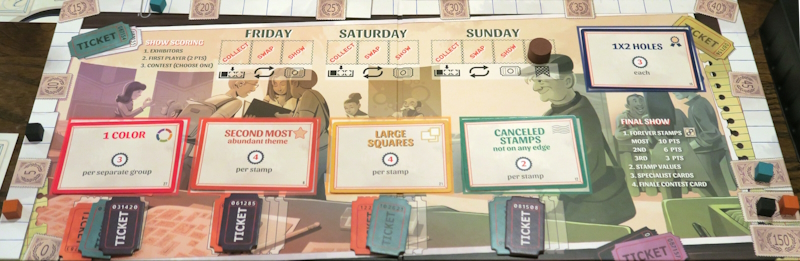
After three rounds, players score the end of game objective card and the player with the most points is the winner.  One of the clever parts about this game is how much difference the objective cards make to the way players arrange their Stamps.  The end-game scoring gave three points for each enclosed gap two spaces in size (i.e. a one-by-two hole).  More points were available during the game for cancelled stamps not on the edge of the page; for large square stamps; for each stamp in a player’s second most abundant theme, and for groups of a chosen colour.

Stamp Swap
– Image by boardGOATS

This time the game was very close.  Purple (specialising in Flowers) struggled to get the stamps she needed and Sapphire (specialising Space stamps) kept getting confused which way the turn went.  It didn’t seem to inconvenience him too much however as he and Black (Monuments) fought it out for first and second place.  Black picked up a lot of his points for Special Stamps—just three accounted for a quarter of his points, which contributed to his total of one hundred and seven points, just four more than Sapphire.

Stamp Swap
– Image by boardGOATS

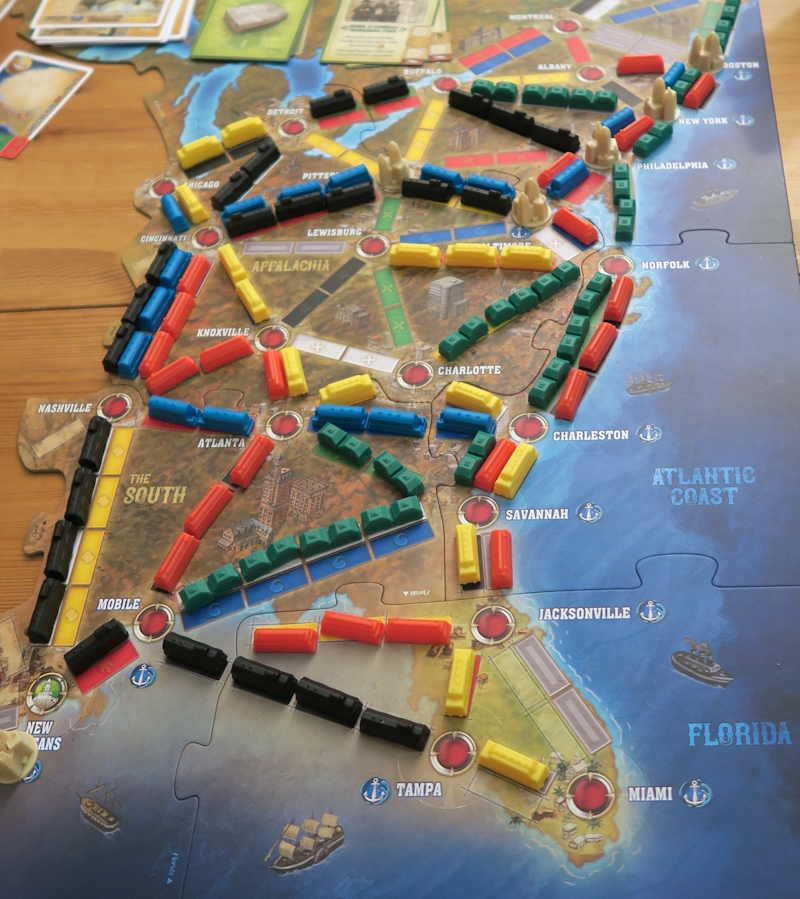
While everyone else was finishing up, there was some discussion about the continuation of the Ticket to Ride Legacy campaign that Blue, Pink, Black, Purple and Pine embarked on at New Year.  The campaign is played over twelve rounds and the group had managed the first two games on the first outing with the next two more recently on Saturday evening.  Spoiler alert—hover HERE to see details. The winner of the third round was Black, very closely chased by Pink with Blue taking third.  After a break for tea (lamb and vegetable tagines with millet), the group began their fourth game. Spoiler alert—hover HERE to see details.

Ticket to Ride Legacy: Legends of the West
– Image by boardGOATS

This was much less close than the third game. The winner was Pine, with Black six dollars behind and Pink a further fourteen points behind him, in third. Spoiler alert—hover HERE to see details. While chatting with the others, out of curiosity, Pine went through The Book and totaled up the scores for the first four rounds, which gave Black a lead of some twenty dollars. Something the rest of the group need to give some thought to next time, before he gets an unassailable advantage although there is a suspicion that as the campaign progresses, the games get longer and more points will be available in each round giving players a chance to catch up.  We shall see.

Ticket to Ride Legacy: Legends of the West
– Image by boardGOATS

Learning Outcome:  However you roll, when you race you need a fast start.

13th June 2023

Lime was first to arrive, soon followed by Blue and Pink, and then Pine who were all delighted to see the return of our favourite bar staff.  There was a lot of chat about the recent changes at The Jockey (which is currently managed by the Healy Group who also run the Punch Bowl in Abingdon), and as everyone else arrived, people seemed more interested in gossiping than playing games.  It was a relatively quiet night with quite a few people away.  Black and Purple sent a message to say they were thinking of us, but when Green received a photo from Black and Purple of their current view, it just made everyone else jealous.

Black and Purple in Cornwall
– Image by Black

Jade arrived with his shiny new copy of Earth which he’d picked up from UK Games Expo.  It is a game where players are building themselves an ecosystem and was to be the “Feature Game“.  Earth is a sumptuously illustrated, card-driven engine-builder that is often compared to Wingspan.  We played that Last time after a bit of a break, and remembered how much we liked it, so had decided to give Earth a go this time.  The heat was getting to some people, but Ivory was quite keen to give Earth a go, and they were soon followed to the next table by Green (who had played it online) and then Teal.  Everyone was pretty new to the game:  Ivory and Teal had not played it before and Green and Jade had only played a couple of times.

Earth
– Image by boardGOATS

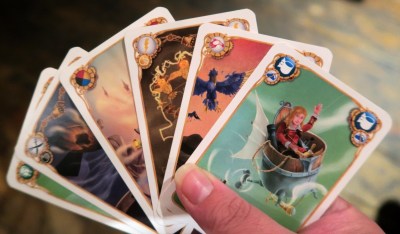
Although there is a lot to explain before starting, Earth itself is not actually all that complicated. Players are building a four by four grid of Flora and Terrain cards which represents their island and during the game they will plant flora, water it and allow it to grow.  On their turn, players do one of four things: Planting (paying the cost in Soil tokens), Composting (gaining Soil and placing cards from the deck in their discard pile), Watering (place Sprouts and gain Soil) & Growing (draw new cards and place growth tokens).  A bit like Puerto Rico, once the active player has chosen which action they are taking, everyone else gets to do a subsidiary, slightly weaker version of the same action.  For example, when Planting, the active player plants two cards, draws four and keeps one, while the other players plant one and draw one.

Earth
– Image by boardGOATS

Once everyone has completed the action for the turn, everyone activates all the cards in their island that match the colour of the action chosen, starting with the card in the top left and working across each row in turn.  This means, not only is it important which cards are played, but also where they are located in the player’s island.  At the end of the game (triggered when one player has completed their island), players score points for each flora card, any Trunks and Canopies they have grown, their Sprouts and their pile of “Composted” or discarded cards.  Players also score points for achieving objectives on the Fauna cards revealed at the start of the game and for completing their island first.

Earth
– Image by boardGOATS

As in Wingspan, Flora cards have actions that take effect when they are planted and when activated, many of the Terrain cards have ongoing effects and/or end-game scoring opportunities.  When Planting, players must place the cards either orthogonally or diagonally adjacent to an existing card, and although they can never exceed a four by four grid, like in Kingdomino, players can extend on either side of their island until the maximum size is reached.  Each Flora card has a maximum growth and when this is achieved the final wooden Growth token placed on it is a Canopy showing it will score extra points at the end of the game.

Earth
– Image by boardGOATS

The challenge in Earth is really in deciding what actions to do and which cards to play into your tableaux.  Teal found that simply building his tableaux was enough to think about without considering the extra goal cards and end game scoring.  Jade and Green both agreed that was the same for their first game too.  Ivory started and played his first few turns, selecting the green Plant action, so his tableaux filled up quickly. The rest of the group needed to choose other actions in order to get the soil and cards to play, so by the time it came back to ivory he was able to plant again.  He had already had his eye on the bonus cards and was quickly planting as many cards as he could, successfully—he was the first to claim a bonus.

Earth
– Image by boardGOATS

Green started with a high scoring climate card which gave him fewer cards at the start, but better in game bonuses, an approach to the game that nearly paid off. He went for the brown scoring cards, but Ivory just pipped him at the post for that particular shared bonus, which helped up his score as well.  Teal spent the first half of the game, learning and began to fall behind.  It wasn’t until Ivory claimed the first shared bonus that he remembered those cards.  Early on he gained lots of Sprouts which are worth points, however, it is possible to gain a whole lot of Sprouts in the latter stage of the game and use those early actions for other more beneficial things.

Earth
– Image by boardGOATS

Jade was quietly working away to build a tableaux engine that worked for him, but was falling behind Ivory and Green on the shared bonuses.  Jade managed to pick up some of the Fauna bonuses later, but mostly after the others so they weren’t as highly scoring.  Green went for brown scoring cards because he kept picking them up from his nearest pile (there were two draw piles), and eventually reverted to the other pile to find green Flora cards.  Unfortunately, he just couldn’t find the double powers he needed for the shared bonus.  On the opposite side of the table, Teal didn’t come across any brown scoring cards, only realising why at the end of the game—it seams the shuffling had left something to be desired. The Event cards also seemed to be clustered towards the bottom of the draw pile.

Earth
– Image by boardGOATS

Ivory came out on top with a very high score of two hundred and thirty-six with Green just eighteen points behind and Jade in third.  There was much discussion about similarities between Earth and other games. Green felt it was similar to Terraforming Mars, the others thought it was more like Wingspan.  After some thought, Green came round to this idea as it is about playing cards which then provide  more actions and bonuses that can be played on those cards (eggs in Wingspan, Sprouts in Earth; tucked cards & cached food in Wingspan, Growth in Earth).  The others could also see Green’s thoughts about Terraforming Mars though as the game has lots of pretty and individual cards that can be played or rejected, with some providing actions, some bonuses and the all important Events.  Everyone really liked it and definitely wanted to play it again, though better shuffling would be a good idea.

Earth
– Image by boardGOATS

Meanwhile, the rest of the group carried on chatting all agreeing they should play something, but nobody terribly keen to commit to anything.  Eventually, Blue suggested Bohnanza, and as Pine agreed, Pink had to go along with it.  This is an old favourite, though Pink had gone off it a bit as he felt he always did badly—unfortunate really given the number of copies of the game that he owns.  The game is very simple:  keeping their cards in the order they are drawn, players must plant the first bean card from their hand and may plant the second if they have space.  They then turn over the top two cards from the deck and can play these or trade them as they prefer.

Bohnanza
– Image by boardGOATS

Finally, once both of these have been planted, the active player may trade cards from their hand before drawing three replacement cards.  Players can harvest their Bean Fields whenever they like, but the amount of money they get depends on how many Bean cards it has in it and what the beans are—scarce ones give a better return, but are harder to get.  Everyone knows the game quite well, though Lime had recently acquired and been playing a new anniversary edition and it seems some of the rules are slightly different for that.

Bohnanza
– Image by boardGOATS

This time, everyone bought a third Bean Field (which makes it easier to hang on to the rarer beans a little longer).  Indeed, Lime was so determined to use his, he ended up not trading, just so that he had something to plant!  As usual it was quite a close game with fine margins.  So little things like Blue harvesting her Red Beans only to immediately draw another and Pine gifting Pink a Wax Bean or Lime trading with Pine instead of Blue made a difference in the final score, though nobody knew it at the time.  Ultimately, Pink was the victor, beating Blue by just two Bean Thalers with Lime a couple behind her in third.  On the plus-side, Pink can’t complain that he never wins any more.

Bohnanza
– Image by boardGOATS

Earth was still underway, and for once in a way, Bohnanza had played relatively quickly, so there was plenty of time for something else.  Nobody was very focused, and eventually the group settled on the cooperative game, Forbidden Desert.  This is a sort of sequel to Forbidden Island, which itself is a simplified version of the popular gateway game, Pandemic.  All three of these games use the same mechanism as Zoo Break, which we played recently.  Essentially, the active player carries out actions and then they reveal cards from a deck which generally make life difficult: releasing wild animals, causing the island to gradually sink, spreading disease, or in the case of Forbidden Desert, burying the play area with sand.

Forbidden Desert
– Image by boardGOATS

The premise of Forbidden Desert is that the team have crash-landed in the desert and need to find the components of a flying machine and take them to the launch pad to escape.  The game is played on a five by five grid of square Tiles, with a gap in the centre representing the sand storm.  Each player has a character with special powers.  This time, Lime was the Climber, Pink was the Navigator, Pine was the Explorer, and Blue was the Water Carrier.  On their turn, players can take up to four actions:  Move (one action per Desert Tile), Remove Sand from the Desert Tile they are on or an adjacent one, Excavate a Desert Tile (i.e. turn it over), or Pick up one of the four component parts of the flying machine.

Forbidden Desert
– Image by boardGOATS

Lime started.  Once he had cleared some sand and turned over a couple of Desert Tiles, he started turning over Sand Storm Cards.  These indicate which direction Tiles should move to fill the hole, and how many Tiles should be moved, one, two or three.  Each of the Desert Tiles moved then have a Sand Tile placed on them—a single Sand Tile needs to be cleared before the Desert Tile can be Excavated, but two or more additionally obstruct players preventing them from passing (except for Lime who, as the Climber, can cross Sand Dunes of any height).

Forbidden Desert
– Image by boardGOATS

Pine went next and used his special ability—everyone else could clear orthogonally adjacent Tiles, but he could to work diagonally as well.  It wasn’t long before the first “Sun Beats Down” card appeared.  These cause everyone to use water, so as the water carrier (and the only one who could make multiple visits to the Oases and collect water, Blue topped up Lime, who had started with less water than everyone else.  The group gradually started revealing tiles, finding a Duneblaster, a Solar Shield and a Time Throttle, but the Storm picked up and before long the group were turning over more Sand Storm Cards.  Pink located the Propeller for the flying machine and then the engine, the group were making progress, but it was all too slow.

Forbidden Desert
– Image by boardGOATS

Before long it became apparent that the Sand Storm was getting the better of the group and the hiding in the Tunnels wasn’t helping.  Determinedly, the group fought against the rising tide of Sand making good use of their Duneblaster, but it only delayed the inevitable.  Blue, Pine and Lime were discussing a plan to play a Storm Tracker, but when they were briefly side-tracked, Pink played on without it and everyone suffered as a result.  So Pine labelled him as a Saboteur as a consequence.  In such a finely balanced game at such a critical point, it could have made a difference, but in all probability it only hastened the inevitable demise as the group were sadly buried under the ever growing sand dunes and ran out of Sand Tiles (one of the end game conditions).  It was a deflating end to the evening, but given the heat, probably appropriate.

Forbidden Desert
– Image by boardGOATS

Learning outcome:  Shuffling is an important skill.

Boardgames in the News: Boardgames in Magazines

The “Hobby Magazine” has a long history, so perhaps it is no surprise that, over the years, there have been quite a few gaming magazines.  War-gaming magazines perhaps go back further, but one of the first general gaming magazines was the monthly Games & Puzzles, which started a little over fifty years ago, in May 1972.  Games & Puzzles was initially published by Edu-Games Ltd. before Willow House Press took over in 1978 moving to a quarterly distribution model.  Four years later AHC Publications took over moving to a bimonthly model and rebranding as The Gamer.

Games & Puzzles Magazine
– Image of unknown origin

This wasn’t the last of Games & Puzzles however, as it came back in 1994 for a brief last hurrah lasting sixteen issues before it was finally shelved completely in 1996.  By the time Games & Puzzles was no more, several other gaming magazines had been and gone in the UK.  These include Games Review which lasted about ten years and Games International which ultimately morphed into a computer games magazine called Strategy Plus. There were also a number less fancy, “fanzines”, mostly produced using a photocopier.  SUMO was one of the best of these and ran for almost ten years, from the pilot in October 1989 to the final one in February 1998.

SUMO Magazine
– Image by boardGOATS

SUMO was a subscription pamphlet including adverts, postal games, and reviews, produced by Mike Siggins.  As a mark of the times it served, it also included a rules translation request list for German import games, something which is no longer necessary as most manufacturers now release their own translations online.  The name and subscription list for Sumo was bought by the now defunct commercial Games, Games, Games! magazine, but its spiritual successor was the quarterly Counter which lasted nearly twenty years and seventy-eight issues—the final issue was released in January 2018.

Counter Magazine
– Image by boardGOATS

Although Counter was started by people in the UK, it included contributions from gaming enthusiasts from all over the world.  Counter was succeeded by The Spirit of Games and Gamers magazine, which was started in 2018 and released with the specific mission to “continue the tradition of Sumo and Counter magazines … writing about and reviewing boardgames”.  Now known as Tabletop SPIRIT, this is an online only magazine, which highlights the reason so many of the physical magazines have been and gone.  With the ready availability of blogging and vlogging, pretty much anyone can publish their own online magazine now.

Tabletop SPIRIT Magazine
– Image by boardGOATS

Mobile electronic devices also mean these can be read anywhere and are easily transportable as well as being relatively cheap to produce and therefore cheap (often free) to the subscriber.  Although most of these are amateur, many are very professionally produced.  One such recent online production, designed to raise the profile of older games and counter the so-called “Cult of the New”, is called The Cult of the Old.  The first edition of this e-magazine was published in February 2023 and included articles on Princes of Florence, Medici, Puerto Rico, Scotland Yard and Modern Art.

Modern Art
– Image by boardGOATS

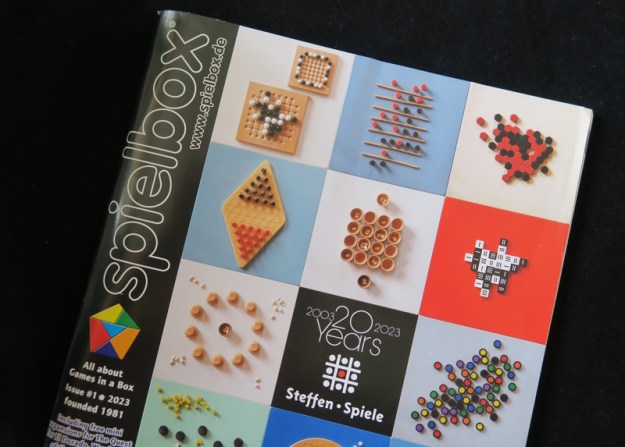
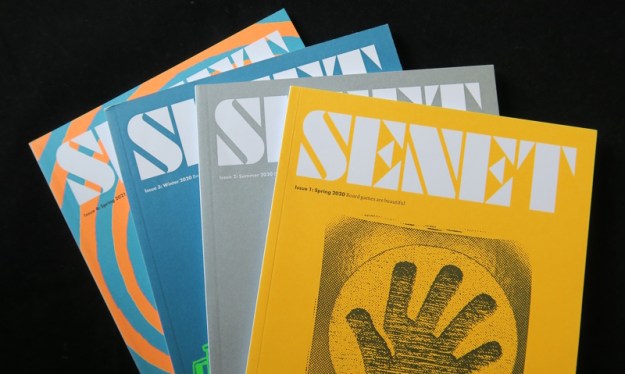
And yet, despite the advantages of the internet, there are still gaming magazines that publish physical copies and there are even new physical magazines coming out.  One of the longest running games magazine is Spielbox—although German in origin, since 2010 it has also had an English release.   Spielbox’s origins were in the earlier 1980s in Die Pöppel-Revue and its success (and also that of Spielerei) probably reflects the origin, history and cultural popularity of “Euro-style” games in Germany.  More remarkable than the success of Spielbox then, is that of the UK’s two commercially produced publications, Tabletop Gaming and the more recent release, Senet, the first edition of which came out in the troublesome spring of 2020.

SpielBox Magazine
– Image by boardGOATS

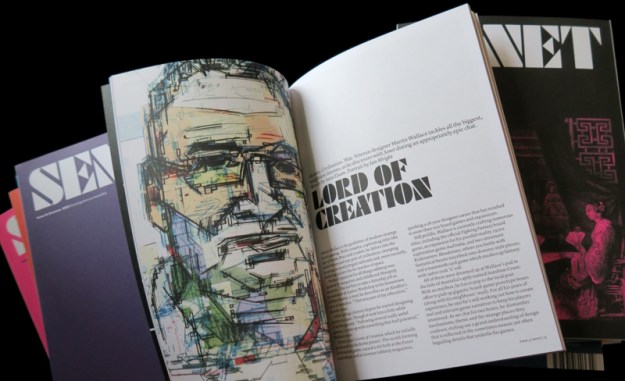
The pilot release for Tabletop Gaming came out in summer 2015 with, regular, quarterly releases starting a year later.  Its remit is, “every type of analogue gaming, from board games and RPGs to miniatures and wargames, with everything in-between.”  This makes it quite different in flavour from Spielbox and Senet, which focus almost exclusively on modern “Euro-style” games.  What makes Senet a little different to the likes of Tabletop Gaming and Spielbox is its focus on the craft, creativity and artistry of board games as well as on the games and gaming themselves.  While Spielbox and Tabletop Gaming are fairly typical, A4-sized, hobby-magazines, Senet is something of a throwback being A5-sized, with a matt finish and a quality, almost book-like feel; as such, it seems to have carved a bit of a niche for itself.

Senet Magazine
– Image by boardGOATS

While publishing a professional games magazine in the UK has been historically difficult due to the size of the market, it seems times may be changing.  Through crowdfunding, small enterprises now have an efficient way of both advancing funds and gauging interest levels prior to production.  During the relatively uncertain times of the last few years, Spielbox have used Kickstarter to finance their English Edition and in the coming months, there are plans to produce physical editions of Tabletop SPIRIT using the same means.  Together with the success of Senet and Tabletop Gaming, this suggests that our enjoyment of board games as a physical experience is mirrored in reading physical magazines about analogue games and gaming.  Whether there is enough ongoing demand to sustain all these publications remains to be seen.

Senet Magazine
– Image by boardGOATS

Boardgames in the News: The Best Game EVAR?!?!

BoardGameGeek is the largest and most comprehensive website dedicated to board and card games, with a database comprising nearly a hundred and fifty thousand games.  These games have a ranking based on ratings submitted by account holders.  While these rankings are obviously skewed by the characteristics of the contributors, the number one ranking game clearly has significance.  In the twenty-two years that the rankings have been in place, there have been just ten games to achieve the top rank, but as of today, there is an eleventh, with Brass: Birmingham taking the top spot from Gloomhaven.

Brass: Birmingham
– Image from boardgamegeek.com

Of these now eleven games, three held the top rank briefly, for a day or two only.  The first of these was The Game of Life, and it’s top rank was the result of a software bug when on 25th February 2006, a User gave it a rating of sixty-five thousand five-hundred and thirty-five out of ten.  Just over a year later, as an April Fool, another User encouraged his friends to give Monkey Auto Races a rating of ten.  With just three hundred ratings, this game went from unranked to number one overnight, only to plummet back down the rankings just a day or so later.  Three years later, the site owner pulled his own April Fool stunt and set the ranking equal to the data base number, making Die Macher number one for a day.

The list of eight genuine Number One Games and the date they first achieved the top ranking are:

Brass: Birmingham
– Image by boardGOATS

Deutscher Spiele Preis – 2022

The Deutscher Spiele Preis awards recognise the “Best Children’s Game” and a top ten list of the “Best Family and Adult Games”, the results of an open vote by games clubs, gamers and people in the industry.  They are awarded annually at the Internationale Spieltage in Essen and the winners are announced in advance.  As annual awards, the games named in the Deutscher Spiele Pris lists often intersect with the winners and nominees of Spiel des Jahres Award, but in many other ways, the awards differ.

Deutscher Spiele Pries 2022
– Image from
spiel-messe.com

The Spiel des Jahres winners are chosen by a committee with a list of strict criteria whereas the Deutscher Spiele Preis is more a list of the most popular games of the preceding year.  As such, games that are not eligible for the any of the Spiel des Jahres Awards often feature in the top ten list of “Best Family and Adult Games”.  For example, games that were considered at the time to be too complex or aggressive for the Spiel des Jahres awards have ranked number one in the Deutscher Spiele Preis list.  These include Tigris & Euphrates (1998), Puerto Rico (2002), Louis XIV (2005), Caylus (2006), The Pillars of the Earth (2007), Agricola (2008), Terra Mystica (2013), Russian Railroads (2014), Voyages of Marco Polo (2015), Mombasa (2016) and Terraforming Mars (2017).

Terraforming Mars: Hellas & Elysium
– Image by boardGOATS

Of all these great games, only Terraforming Mars even received a nomination for the Kennerpiel des Jahres award (though Agricola did receive a special “Complex Game Award”).  In contrast, over the last few years, there has been much more overlap with games like Azul (2018), Wingspan (2019) and The Crew (2020) all ranking highest in the Deutscher Spiele Preis list and winning either the Spiel or Kennerspiel des Jahres award.  Further, all the other winners of both awards including MicroMacro, Cartographers, Paleo, Lost Ruins of Arnak have featured high on the Deutscher Spiele Preis list and/or received Spiel/Kennerspiel des Jahres nominations.

Ark Nova
– Image by boardGOATS

This year, while there is still a lot of overlap between the lists, the top ranked game on the Deutscher Spiele Preis list is a bit of a throwback, being too complex even for the Connoisseur or Kennerspiel des Jahres award.  The Deutscher Spiele Preis winner, Ark Nova has been extremely popular amongst gamers creating a lot of “buzz”, so it is no surprise that it did well.  The strategy revolves round building card combinations and the theme, zoo building is very appealing—everyone loves animals.

The full Deutscher Spiele Preis list is:

  1. Ark Nova
  2. Cascadia (Spiel des Jahres Award Winner)
  3. Dune: Imperium (Kennerspiel des Jahres Award Nomination)
  4. Living Forest (Kennerspiel des Jahres Award Winner)
  5. The Red Cathedral
  6. Witchstone
  7. Beyond the Sun
  8. SCOUT (Spiel des Jahres Award Nomination)
  9. Golem
  10. Terraforming Mars: Ares Expedition
Ark Nova
– Image by boardGOATS

24th February 2022

Blue, Pink and Pine arrived early and while they waited for dinner to arrive, they had a quick game of Ticket to Ride Demo.  This is one of the “cut down” Ticket to Ride games which play in the same way as the full-sized versions, but are a lot shorter and often tighter.  As in the parent, players take it in turns to collect cards, or spend them to place trains on the board.  The Demo game has a double-sided map, but with events in Europe so much in the news, the Europe map was chosen.

Ticket to Ride Demo
– Image by boardGOATS

Pink and Pine began competing for the train-lines through the Benelux countries down to Bucharest, while Blue joined Warsaw to Madrid in the south east via a roundabout route. It was a really tight game, so much so that once the points for the tickets had been added, it was a three-way tie.  With just the Longest Continuous Path bonus to add, it was between Blue and Pine, with Blue just nicking it, to give her thirty-four points and victory.  There wasn’t time to dwell on it as Pine’s enormous platter of cheese had arrived and in that, he was definitely the victor.

Ticket to Ride Demo
– Image by boardGOATS

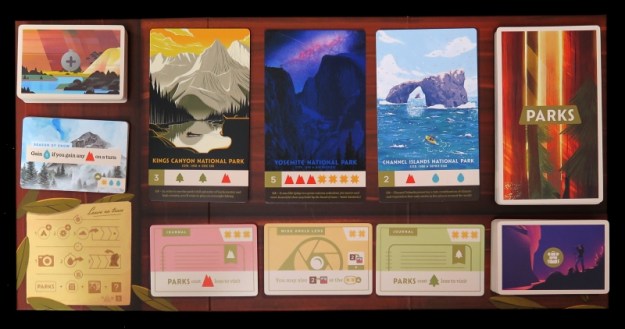
Sage was next to arrive, quickly followed by Purple and Black.  Expecting a quiet night (with lots of people away for half term) we were just deciding who was going to play what, when Lime arrived, so we split into two groups, a three and a four, with the larger group playing the “Feature Game“, PARKS.  The Nightfall expansion includes the seventeen National Parks cards that were omitted from the original base game, so these were added to the deck, though none of the other features were included in the game this time.  This is a game that Burgundy wanted to play, but sadly never quite managed to, so it we wanted to play it in his memory.

PARKS
– Image by boardGOATS

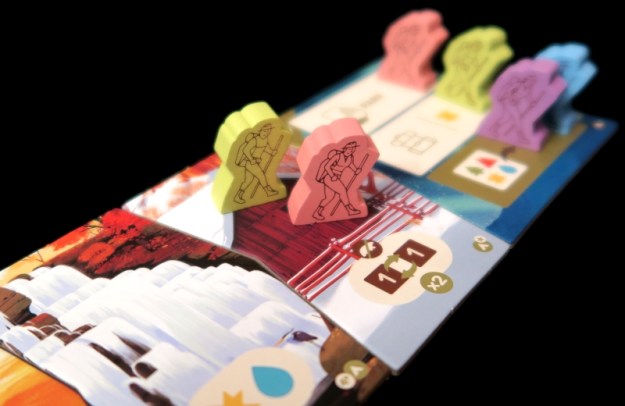
During the game, players take on the role of two hikers as they trek through the countryside over four rounds, or “hikes”.  Whilst on the trail, the hikers take actions and collect memories of the places they visit.  At the end of each hike, players can trade them in for a visit to a National Park.  Each round is set up with six basic trail tiles (five with fewer players) and one advanced trail tile shuffled together and laid out to make a path from the trail head to the trail end.  Players can move either of their hikers towards along the trail to any unoccupied space and then carry out the action on that space.

PARKS
– Image by boardGOATS

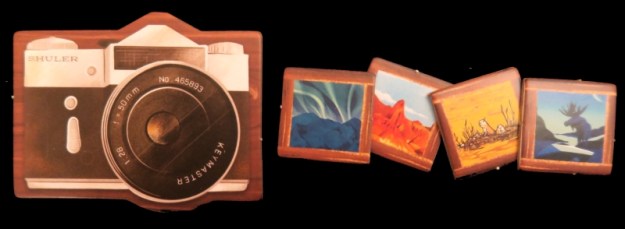
The basic locations are the mountains, forest, the valley, the sea, and a waterfall, visiting these give players wooden mountain, tree, sun or water tokens that can be exchanged for National Park cards at when their hiker reaches the end of the trek.  At the start of the round, the trail tiles are also seeded with additional tokens giving the first person to visit each one a bonus. The final basic location is the vista, which allows players to either take a new canteen card, or take the Camera token.  Canteen cards are special cards that players have that enable them to convert water into other resources or actions, once per round.

PARKS
– Image by boardGOATS

The Camera allows people to take photos, which are worth a point each at the end of the game.  When initially taking the Camera, a photo costs two wooden tokens, but thereafter, photos only cost the holder of the Camera one token, and the player holding the camera at the end of the round gains an additional photo opportunity. There are a couple of other “rule-breaking” rules, for example, each player has a single opportunity per round (or “hike”) to join another hiker at a location by putting out their campfire (turning the token over).  Additionally, players can also buy camping gear cards which alter actions or provide discounts when buying National Park cards at the end of the round.

PARKS
– Image by boardGOATS

There are additionally “Year Cards” which provide players with personal objectives, however, the group did not use these this time as Blue wasn’t making a great job of the rules explanation and it had taken quite long enough without adding more.  The round end is triggered when the penultimate hiker reaches the end of the trail.  The last hiker then moves directly to the trail end and, as usual can: reserve a National Park card from the market (and, if they are the first hiker to do so, take the First Hiker Marker); buy camping gear cards, or claim a National Park card (either from the market, or one reserved earlier in the game).  The game ends after four hikes, and players sum the total of their Parks points and photos to determine the winner.

PARKS
– Image by boardGOATS

The game started slowly as somehow it felt a little unintuitive.  Although play seemed very simple, it wasn’t immediately obvious how to excel and score lots of points.  Although they aren’t the only source, most points come from National Park cards.  As each player has two hikers and Parks cards are acquired at the end of each round, players have only eight opportunities to buy them.  With such a limited number of cards available, players have to try to maximise their takings by going for the most valuable cards.  If these are not reserved, however, there is a risk that someone else will take a desired/planned for card.  This is particularly perilous, as it can leave a player without a possible option and unable to take one of their very limited opportunities to take a Park card.

PARKS
– Image by boardGOATS

Pink started by asking what colour he was, and Blue pointed to the light purple campfire in front of him and explained it was the closest to pink.  Pointing to Lime’s “peach-coloured” pieces, he replied “Apart from the actual pink ones…”  And then there followed a heated debate as to which colour was “more pink”.  Eventually, Pine started tentatively, followed by Lime and then Pink (with his purple pieces) and finally Blue.  As the group felt their way, they realised that mountain tokens were valuable and difficult to come by.  So, after Lime had been unable to afford the camping gear card that gives a mountain discount, Blue snapped it up.  It took a while to understand the value of the Canteen cards, and some were definitely more useful than others.

PARKS
– Image by boardGOATS

Pink had a Canteen that gave him mountain tokens, which meant joining the battle for the mountain space wasn’t quite as necessary.  Lime had a canteen that allowed him to reserve Parks cards which was useful in terms of planning.  It also had the additional advantage of messing up other people’s plans, in particular, Pine’s who got caught several times.  During the second round, everyone started to get the hang of things, and began to work out what they were trying to do while keeping an eye on what everyone else was doing.  But then the “hand limit” of twelve tokens began to bite.  Some of the most valuable Parks cards need six or more tokens, so targeting these while keeping the ability to be flexible became increasingly difficult.

PARKS
– Image by boardGOATS

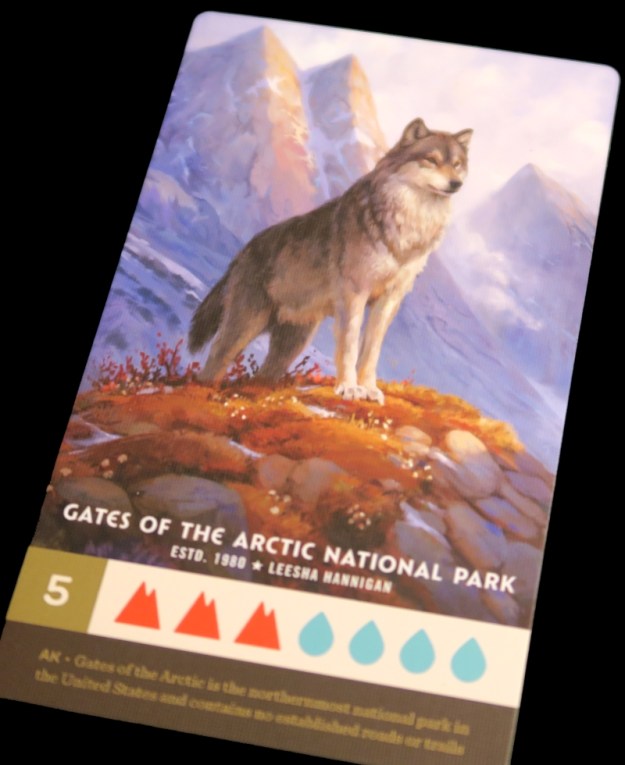
By the third round, Pink was questioning how Blue had managed to get “so many” cards, implying she was doing something that the others, in particular Pink, weren’t.  She had just managed to take every opportunity though, where others had been less fortunate.  Lime had a canteen that allowed him to reserve cards, which was a good use for excess water tokens.  Unfortunately, didn’t quite get the rest of his tokens right to make the most of it, and finished with lots of reserved, but unfulfilled National Parks cards.  Pine was unlucky and had Parks cards he was targeting taken at the last moment.  Still he managed to get a card with a nice picture of a wolf on it, which delighted him at the time.

PARKS
– Image by boardGOATS

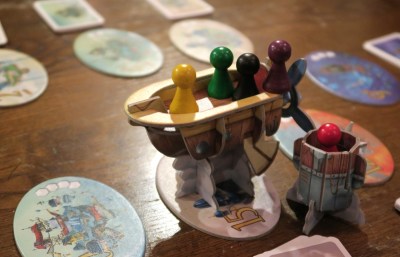
It was close for second place with just two points separating three players—Pine, tied for second place with Pink, decreed that his lovely wolf card was the tie-breaker and gave him the edge.  There was no question that Blue was the winner though, with thirty-two points, eight more than Pine.  Meanwhile, on the next table, Sage, Purple and Black had been playing Puerto Rico.  This is a much older game, once ranked the best game on the BoardGameGeek website, but now often forgotten.  We’ve played it a few times, but not since the global pandemic hit, and Sage was keen to play it again.

Puerto Rico
– Image by boardGOATS

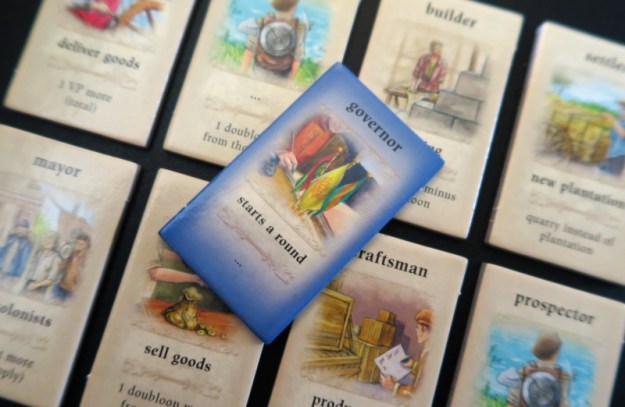
In many ways, Puerto Rico is the archetypal Euro game.  The idea of the game is quite simple in that on their turn, the active player chooses a “role” then everyone takes it in turns to carry out the action associated with that role.  Each role has a “privilege” which the active player gets which gives them a little bonus (as well as the opportunity to take the action first.  Once everyone has chosen a role, the remaining role cards are “improved” by the addition of money, the used role cards are returned to the pool and the start player (The Governor) moves one player to the left before the new Governor starts the next round.

Puerto Rico
– Image by boardGOATS

The aim of the game is to get victory points which are awarded for buildings and for shipping goods. However, to build, players need money, and before they can ship goods, players need to be able to produce the goods with a plantation (and where necessary process them in the appropriate building).  Each building/plantation has a special bonus, but for a player to receive this, the building needs to be occupied by a “colonist”. All these activities are carried out through the role cards. For example, the Builder enables players to construct a building, but the player who chooses the role gets the privilege of paying one doubloon less than they would have done otherwise.

Puerto Rico
– Image by boardGOATS

Other roles include the Craftsman (enables players to produce); the Captain (enables players to ship goods); the Trader (allows players to sell goods for money); the Settler (players can take a plantation tile and add it to their island); the Mayor (the ship of “colonists” arrives and they are divided amongst the players), and the Prospector (everyone does nothing except the person with the privilege who takes a doubloon from the bank).  The game ends when there are not enough colonists to fill the colonist ship, the supply of victory points is exhausted, or a player fills their twelfth building space in their city.

Puerto Rico
– Image by boardGOATS

Black was clearly an early front-runner, but while Sage was slightly slower to get his engine going, he was coming up fast on the inside rail when the game came to an end.  As a result, the end-game building scoring was critical.  Purple had built the Guild Hall giving her extra points for her production buildings while Sage built the Residence providing additional points for the plantations and quarries he had placed on his island.  Black had built and occupied a two large civic buildings:  a City Hall giving him points for his civic buildings, and a Customs House which increased his the victory points he had acquired during the game by twenty percent.

Puerto Rico
– Image by boardGOATS

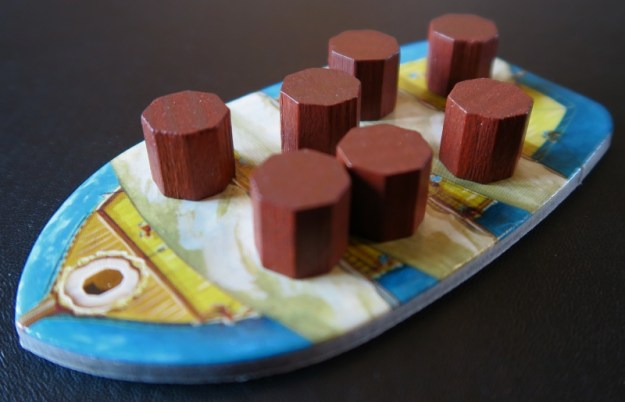
Unfortunately for Sage, it turned out that the game had ended a few rounds too early for him to overtake Black who finished with sixty points, five more than Sage in second place.  It had been fun though, and demonstrated that while some older games show their age, others still have it.  Puerto Rico and PARKS finished at much the same time, and although Lime left to make sure he got across the river before the drawbridge was lifted (commenting he’d like to give PARKS another go some time), everyone else was keen to play something light and quick.

Puerto Rico
– Image by boardGOATS

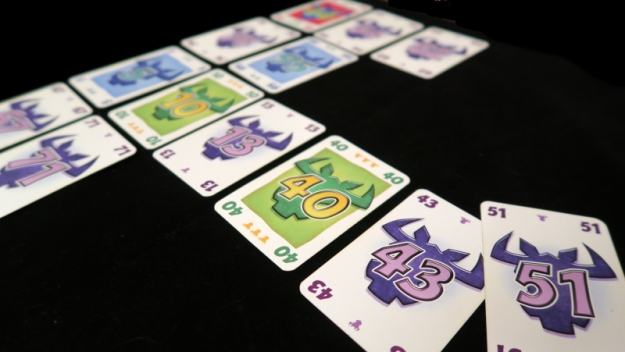
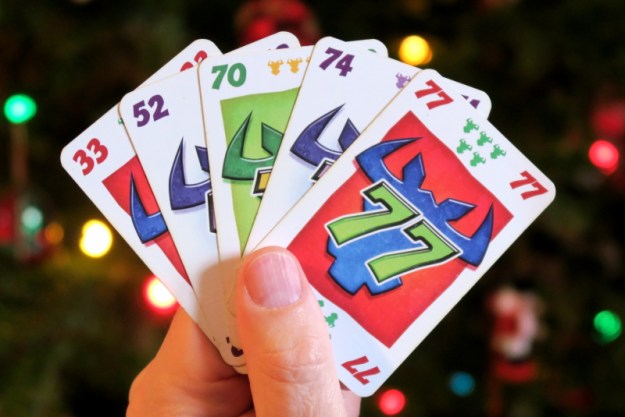
Despite Blue’s inevitable enthusiasm, Pine ruled out Bohnanza as too long, and with six players, 6 Nimmt! was the obvious choice.  We played this loads online, but it doesn’t seem to have dampened our enthusiasm for it, though we’ve mostly played the simple version in person since.  The idea is that players simultaneously choose cards from their hand which are then added in sequence to the four rows on the table.  In the original version, cards are added to the end of the row with the highest card that is lower than the card played.  In the professional version, cards can also be played on the low end of rows, upsetting other players’ plans (if players can claim to have plans in this game).

6 Nimmt!
– Image by boardGOATS

Although we all decided that it was too late for the complex maths that comes with the professional version.  Pine and Blue immediately commented that they regretted that decision when they looked at their hands.  It seemed most people struggled a bit in that round as everyone picked up points.  Blue and Pine were high scorers, but Pink managed twenty-seven nimmts off just nine cards, albeit very colourful ones.  Pink did better in the second half with a clear round, but the damage had already been done.  Purple and Blue top scored overall, with thirty-seven and thirty-nine respectively, but the winner was the very constant Black with just five from each round.

6 Nimmt!
– Image by boardGOATS

Learning outcome:  Not all games are a walk in the PARK.

19th February 2019

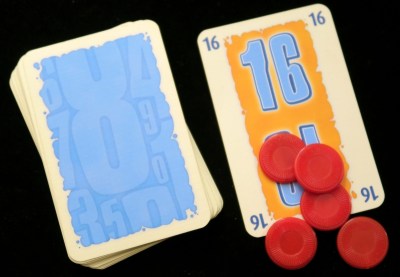
Blue, Black, Purple, Burgundy and Mulberry were just trying to squeeze in a quick game of No Thanks! before eating, when Green arrived with his parents.  They were quickly followed by the first round of food, so it wasn’t until they had finished that the carefully counted piles of chips finally got put to use.  The game is very simple:  players take it in turns to either take the card on the table or pay a chip to pass the problem on to the next player.  If they don’t have any chips left they must take the card when it is their turn (and any chips that are on it).  The game ends when the deck has been depleted and everyone scores the sum of the face value of the cards minus any remaining chips—the player with the lowest score is the winner.

No Thanks!
– Image by boardGOATS

Last time we played this, Pine dropped a chip, but a thanks to the kind generosity of the people at  Amigo Spiele, it had not only been very swiftly replaced, but they had kindly sent spares in case the something similar happened again.  And they were almost required straight away, when Black managed to send a couple of chips flying.  Having learnt our lessen from last time, we immediately took a quick intermission to play “Hunt the Game Piece”, finding one quickly, while the other perched precariously over the same large gap that the had been so disastrous last time.  The rogue chip was rescued without further calamity, but for the avoidance of other mishaps, we might have to put tissue paper down the hole for next time…

No Thanks!
– Image by boardGOATS

The game of No Thanks! was a bit incidental around all that excitement.  Burgundy took the first card in an effort to get ahead, but it wasn’t the best card to build from.  Purple and Blue were forced into trying to build runs from the ends, which is always risky, but can yield huge rewards.  This wasn’t going to be one of those times though and Purple’s problems were compounded by the fact that she only discovered the twenty-three in the middle of her long run was missing when it came to scoring.  Mulberry was very tempted by some if scoring cards, but despite the fact she was pushed to her last chip, she managed to avoid getting herself into a mess.  Black played a very canny game building a small medium value run, not tempted to take a chance on gaps.

No Thanks!
– Image by boardGOATS

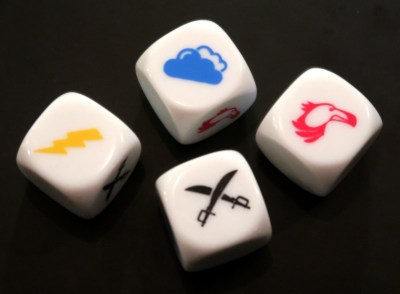
With everyone finished eating, it was time to decide what to play.  Black had suggested that Dixit might be suitable for Green’s parents.  However, Green was keen to play the “Feature Game”, Celestia (a remake of the older game, Cloud 9), and as Black was the only one who knew the rules, that meant he was up for that too.  Burgundy was less keen, so in the end, as Celestia is better with more players, and to avoid too much shuffling of seats, Blue, Mulberry and Burgundy left everyone else to board the airship.  In this game there is no board, instead there are nine city tiles making a path.  Players then take on the roles of adventurers exploring the cities of Celestia by airship.  At the beginning of each journey a new captain is identified and they begin by rolling the dice to discover the challenges they will face.  Before the Captain faces these challenges, however, however, each player must decide whether to stay on board, or leave the airship.

Celestia
– Image by boardGOATS

At each city there is a pile of treasure cards (mostly just victory points) which get better as the journey progresses.  When a player leaves the ship, they take a treasure card at that city, forfeiting the potential riches to come.  Once everyone has made their decision, the Captain has to deal with the challenges by playing equipment cards.  If the Captain is successful, the airship moves on to the next city where a new captain is identified who rolls the dice and so on.  If the Captain is unable to deal with the challenges they face, the airship crashes, returning to the first city and none of the passengers on board get any treasure.  Those passengers who left the ship then get back on board for the start of the new journey.  When one  player has a total of fifty points the game ends.

Celestia
– Image by boardGOATS

This time, the group added the A Little Help expansion which adds cards that players can use to help out the Captain.  There are a few extra cards like The Bandit and The Mooring Line as well, which players who are not on the ship can use to make life harder for those trying to get to the next city.  The group also added the lifeboat from the A Little Initiative expansion, which enables players to continue on their journey alone.  One of the key parts of Celestia is hand management as cards are scarce.  Players start with a hand of cards, six cards in a four or more player game and only get to draw a card when the journey ends, either due to a crash or arriving at the ninth city.  With the inclusion of the expansion cards, there seemed to be quite a bit to remember when learning the rules, but as ever, once underway the game flowed and the rules became clearer. Even so there was still a lot of double checking of which cards could be used when. Black and Purple had both played the game before and knew how quickly things could get difficult.

Celestia
– Image by boardGOATS

So Black and Purple cashed in their travel tickets early in the first round and hopped off the airship quite early on, leaving everyone else wondering if they were missing something as they sailed onwards. In contrast, Green and his parents (who had not played before) stayed on board and as a result took a lot of points.  This all seemed a little too easy and on rechecking the rules it became apparent that something was wrong. Players had been drawing cards after arriving at each city as the Captain changed rather than after it crashed, which meant everyone was awash with cards.  From then on the group played correctly, but the damage had already been done.  The balance of cards had been destroyed, and Green and his mum had an unassailable lead.  Green came out he victor with some canny play that allowed him to hop on and off the airship, but it was a hollow victory as those first twenty-five points were not fairly won.  The game definitely deserves another try though as it is a clever and fun game when played correctly.

Celestia
– Image by boardGOATS

While the airship was being filled, Blue, Mulberry and Burgundy debated what they were going to play.  Orléans was very tempting, but as Celestia was supposed to be relatively quick, the trio decided to play the shorter Tokaido instead.  This is a simple, but very clever game where players are traveling the East Sea Road from Kyoto to Edo (Tokyo), meeting people, tasting fine food, collecting beautiful items, discovering great panoramas, and visiting temples and wild places.  The winner is the player who discovers the most interesting and varied things and is the most initiated traveler.  The really clever part of the game is the turn order, because the player at the back goes first.  Although this is an unusual mechanism, it is not unique and is also seen in Glen More, an out of print game that is getting a face-lift and reprint this year as Glen More II: Chronicles.

Tokaido
– Image by boardGOATS

The idea is that each location on the road can only be occupied by one player.  Players only ever move forward and the player at the back has a free choice of which empty location they move to.  They can choose to stop at the first empty location which means they will be able to maximise the number of locations they can visit, or they can choose to skip a few locations potentially gifting these to their opponents, but ensuring they stop at the locations they will profit most from.  Thus the game is all about optimising movement, compromising visiting the best locations, visiting the most locations and preventing opponents visiting the locations they want by getting there first.

Tokaido
– Image by boardGOATS

Each player starts with a character card which gives them a different start condition and a special power.  Burgundy was positioned at the front playing Yoshiyasu enabling him to draw a second card whenever he encounters someone, and choose which one to keep Encounter cards give a one-off bonus, so being able to choose instead of relying on random draw is a nice advantage.  Mulberry started in second position on the track and as Kinko, was able to pay one Yen less for her food at mealtime.  There are several stops for food along the way and money is always scarce so anything that saves money is always good.  Blue began at the back (and therefore started), playing Sasayakko who gets the cheapest souvenir for free whenever she buys two or more when visiting the Village.

Tokaido
– Image by boardGOATS

In this game, it is essential that players make the most of their special powers, so Blue visited as many Villages as she could, collecting as many sets of souvenirs as she could.  To do this though, she need lots of money and money is not easy to come by.  Similarly, Burgundy stopped to make as many encounters as he could and coupled this with visiting the Hot Springs.  Hot Springs simply give a two or three point card drawn at random from a deck, with the three point cards depicting monkeys playing in the spring.  Somehow, every time Burgundy drew a Hot Spring card, it featured monkeys, while Blue and Mulberry received no monkey-love; after his fifth card it was something they really began to resent.

Tokaido
– Image by boardGOATS

Mulberry was the first to score points and Burgundy wasn’t far behind.  Blue was slowest off the mark, but eventually caught up and overtook the others, romping into the lead, helped by Burgundy who persisted in moving Blue’s token when he scored points.  That wasn’t the full story, however.  At the end of the game points are awarded to the players with the most Hot Spring cards, the most Encounter cards, the most Souvenirs, for donating money at the Temples, and for the player who spent the most on food.  With Burgundy taking the vast majority of these points, he caught up and, after several recounts, both Blue and Burgundy finished on eighty-one points with Mulberry not far behind.  With more achievement cards, Burgundy was the clear winner, but he’d tried to be generous with his points throughout the game and insisted on sharing victory with Blue (to go with the lack of sleep they shared).

Tokaido
– Image by boardGOATS

Celestia was still going and wasn’t looking like it was going to be finished very soon, so Blue,  Burgundy and Mulberry decided to try something else.  After a bit of discussion, they opted for a new game by the producers of the Spiel des Jahres and Deutscher Spiele Preis winner, Azul, that had been brought back from Essen late last year.  Blue had played Reef with Pink, Black and Purple after The Gallerist during a recent “Monster Games” session, but otherwise it hadn’t made it to the table.  It isn’t a complex game though and is very quick to teach:  on their turn, players can either take a card from the pool of face up cards, or play a card, adding the pieces of coral depicted in the top half to their reef and then scoring the pattern shown in the bottom half of the card.

Reef
– Image by boardGOATS

The reefs are a three by four grid and the pieces of coral can be played anywhere and can stack up to a maximum height of four.  Scoring the patterns is as viewed from above, and each one can be scored several times with different patterns worth different numbers of points.  This means there are two approaches to the game, scoring low but frequently, or building to one large score.  Mulberry opted for the first approach and facilitated this with single colour piles of coral.  Blue tried the alternative strategy, building to a large twenty-plus point score, while Burgundy tried a mixture.  As a result, Mulberry quickly built up a healthy lead, and the question was whether the others would catch her or not.  It was close, very close, with just four points covering all three players.  This time though, little and often was the winner, and Mulberry finished with forty-two points, one more than Burgundy.

Reef
– Image by boardGOATS

Celestia was still going, so Mulberry stayed to play one last game, San Juan.  This is an old game from the Alea Small Box Series that is sometimes referred to as the card game of Puerto Rico.  The idea is that on their turn, the active player chooses a role, Builder, Producer, Trader, Prospector, Councillor and then everyone takes it in turn to carry out the associated action.  The person who chose the action gets to use the privilege of the role (pay one less for building, trade or produce one extra item etc.).  One of the clever things about the game is that cards have multiple purposes, similar to Bohnanza where cards can be money or beans.  In San Juan, each card can be played onto the table as a building, but when in hand they can be used as payment, and during the game they can be used as produce as well.  Each card has a value when built and there are a small number of special buildings whose score depends on the other buildings in play.  The game ends when a player builds their twelfth building.

San Juan
– Image by boardGOATS

Mulberry was tired and really struggled, so Blue and Burgundy tried to help explain what she could do, certain she’d get the hang of it.  They stressed the importance of not getting left behind on the building, a message Mulberry took to heart, building at every opportunity.  Blue made life difficult for everyone though, building a Guardhouse reducing everyone else’s hand limit to six.  Burgundy saw one of the valuable six point plus violet building cards early in the game, but that was it, so he ended up building lots of production facilities.  Blue on the other hand built lots of violet buildings and with it a City Hall giving her one point per violet building.  In the meantime, Mulberry kept building so when Blue failed to spot she had eleven buildings she accidentally triggered the final round.  It was very, very tight, but somehow, Blue just kept her nose in front finishing with twenty-three points, one more than Burgundy and two more than Mulberry.

San Juan
– Image by boardGOATS

In the meantime, Celestia had finally come to an end.  With Green and his parents wanting to leave and Pine finally putting in an appearance after a long day bird watching in the West Country, the group we went for a very short game, one about birds: Pick Picknic.  This game combines simultaneous card selection with bluffing and a slice of luck.  The idea is that there are six farm  yards of different colours, if someone plays the only chicken card of a given colour, they get all the grain at that coloured farm.  If multiple players go for the same coloured yard, then players can either agree to share the corn in any way that is mutually acceptable or roll the die for all of it.  Foxes don’t eat corn, however, they only eat chickens, so if someone plays a fox card, they will eat any chicken cards of that colour.  This time there seemed to be a lot of hungry foxes, and lots of fighting birds.

– Image used with permission of BGG reviewer EndersGame

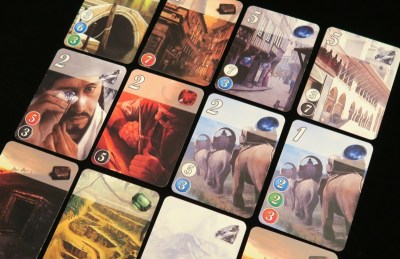
These were accompanied by the usual exclamations as people realised that their attempt to grab a pile of corn was stymied by someone else’s decision.  It was a close game, with four players within four points of each other.  It was tight at the front too with just a handful of points between first and second place, but it was Purple who just edged Green’s father into second place.  With that over Family Green headed off and, as Burgundy was still occupied playing San Juan, everyone else felt it was a good opportunity to play Splendor as someone else would have a chance to win.  Splendor is a game we’ve played a lot and it is ideal for late in the evening when everyone is tired because it doesn’t need too much thought.

Splendor
– Image by boardGOATS

Splendor is very simple:  players take it in turns to take gems (chips) or use the gems to buy cards from the display.  Cards can be used to buy other cards, but some of the cards also give points, and collecting certain combinations of cards allows players to claim a Noble tile giving more points.  Essentially, it is a race to fifteen points, though as players finish the round (so everyone gets the same number of turns), it is the player with the most points who wins.  This time the game started with everyone evenly matched.  There was a lot of overlap in the colours required to claim Nobles tiles, so they were claimed at much the same time.  Then Black took the lead and although both Purple and Pine were close to adding to their respective totals, Black’s score of nineteen was unassailable.

Splendor
– Image by boardGOATS

Learning Outcome:  Close Games are Good Games.

Boardgames in the News: 20 Years of Alea

Latin for “dice”, Alea is a brand of Euro games that celebrates their twentieth anniversary this year.  Alea is owned by Ravensburger, a company that has been around for nearly a hundred and fifty years producing everything from instruction manuals to children’s books under their familiar Blue Triangle trademark.  Alea is a more recent development intended to develop a range of strategy games distinct from their more family-friendly range.  Dating from 1999, the Alea range is credited with bringing a lot of “modern classics” to our tables, including Puerto Rico, Ra, Taj Mahal, San Juan, The Castles of Burgundy, Broom Service and one of our groups all time favourites, Las Vegas.  There are four series in the range, the “Big”, “Medium”, “Small” and “very Small” box games, each game in the series is numbered with the artwork on the covers designed to have a “book-shelf” look.

Alea Big Box Games
– Portmanteau image created by boardGOATS

It looked like the end was nigh when Asmodee bought Heidelberger Spieleverlag in 2017, and with it the distribution rights to the Alea brand.  However, Ravensburger reclaimed the rights last year, so to celebrate that and Alea’s twentieth anniversary, they are relaunching the line with new graphics.  They are starting with a new version of The Castles of Burgundy, a boxed set including all the current expansions, and Las Vegas Royale, a big-box version of Las Vegas, including selected elements from the Boulevard Expansion and some new action tiles.  It remains to be seen how many of the old familiar titles will also get a face-lift and make an appearance in the new line and how many new exciting titles will be introduced.

The Complete Original Alea Range
No. Big Box Medium Box Small Box
1 Ra (1999) Louis XIV (2005) Wyatt Earp (2001)
2 Chinatown (1999) Palazzo (2005) Royal Turf (2001)
3 Taj Mahal (2000) Augsburg 1520 (2006) Die Sieben Weisen (2002)
4 The Princes of Florence (2000) Witch’s Brew (2008) Edel, Stein & Reich (2003)
5 Hoity Toity (2000) Alea Iacta Est (2009) San Juan (2004)
6 The Traders of Genoa (2001) Glen More (2010)
7 Puerto Rico (2002) Artus (2011)
8 Mammoth Hunters (2003) Las Vegas (2012) &
Las Vegas Boulevard (2014)
9 Fifth Avenue (2004) Saint Malo (2012)
10 Rum & Pirates (2006) La Isla (2014) V. Small Box
11 Notre Dame (2007) San Juan (2014) The Castles of Burgundy:
The Card Game
(2016)
12 In the Year of the Dragon (2007) Broom Service:
The Card Game
(2016)
13 Macao (2009) Las Vegas:
The Card Game
(2016)
14 The Castles of Burgundy (2011) The Castles of Burgundy:
The Dice Game
(2017)
15 Bora Bora (2013) Puerto Rico:
Das Kartenspiel
(2018)
16 Puerto Rico with Expansions (2014)
17 Broom Service (2015)
18 Carpe Diem (2018)


27th Movember 2018

With the Festive Season now apparently upon us, the pub was once again packed and food was later than usual.  For this reason, we started with a quick game of No Thanks!.  This used to be one of our “go-to” filler games, but has been somewhat neglected of late, so was surprisingly unfamiliar to some people.  It is very simple though and very easy to learn on the fly:  everyone starts with eleven red chips and the first player turns over the top card—they can take it, or pay a chip for the privilege of passing the problem on to the next player.  The player with the lowest summed card total when the deck expires is the winner.

No Thanks!
– Image used with permission of BGG contributor msaari

There are are two catches, firstly, where a player has a run of consecutive cards only the lowest is counted and secondly, a small number of cards are removed from the deck at random.  Top scorer looked to be a toss up between Blue, Red and Mulberry, but Red took the dubious honour in the end, with forty.  It was tight between Pine and Burgundy, however, both of whom had a large pile of chips and a substantial run of high cards (between them they had nearly forty of the fifty-five chips and the cards numbered twenty-eight to thirty-five).  There were only two points in it in the end and it was Pine who took the honours.

No Thanks!
– Image used with permission of
BGG contributor ronster0

The group had been just about to start playing when Black, Purple and Green had walked in.  Since No Thanks! only plays five, so pre-empting a discussion of options, Blue chucked over a copy of Dodekka which the group obligingly settled down to play.   This is another light set collecting game where the aim is to get the highest score possible from one of the five colour suits, while ideally scoring nothing in all the other suits.  Gameplay is very simple:  take the first card on display, or reveal a card from the deck and add it to the end of the row (thus “passing”).  If the sum of the cards on display now totals more than twelve, the active player must pick up all of the cards on display. When the deck runs out, the winner is the player with the highest score (the total face value of one suit minus one for each other card).  It was very close at the top, with only one point separating Black and Purple, and much to Purple’s chagrin, it was Black who came out on top.

Dodekka
– Image by boardGOATS

Just as No Thanks! was coming to an end, food arrived, along with Ivory.  Dodekka was still going, so while some munched, those remaining decided to give The Game an outing (played with a copy of The Game: Extreme, but ignoring the special symbols).  This is a surprisingly popular game within the group, which is remarkable because it is cooperative and we generally prefer competitive games.  Another simple game, the idea is that the team have a deck of cards from two to ninety-nine and they must play each card on one of four piles:  two where the card played must be higher than the top card, and two where it must be lower.  There are just three rules:  on their turn, the active player can play as many cards as they like (obeying the rules of the four piles), but must play at least two cards before replenishing their hand, and players can say anything they like but must not share “specific number information”.  Finally, there is the so-called “Backwards Rule” where players can reverse a deck as long as the card they play is exactly ten above or below the previous card played on that pile.

The Game: Extreme
– Image by boardGOATS

Red started and it quickly began to go wrong with with Pine holding a “nice mid-range hand”.  With the help of everyone else he battled through though, and it wasn’t long before he had a “nice extreme hand” while all the piles were offering “nice mid-range options”.  It perhaps wasn’t surprising with this that the group didn’t win (i.e. play all their cards onto the four decks), but given that they had such a poor run of luck, they did well to exhaust the draw deck and ultimately have only eight cards they were unable to play.  Inevitably, Dodekka finished just after The Game started, so Black, Purple and Green killed time with a quick game of Love Letter.  This is the original “micro game”, consisting of just sixteen cards.  The idea is that each player starts with a single card, draws a second card and chooses one of the pair to play.  The cards are numbered one to eight (with more of the lower numbers), and each number has an action associated with it.  The aim is to eliminate all opponents, as the last man standing is the winner.
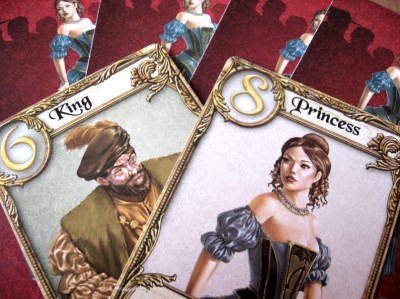
Love Letter
– Image by boardGOATS

Rounds only take a minute or two, so elimination is not a problem.  This time, each player won a round.  So with honours even and with the other game and food coming to an end, it was sudden death.  This time it was Purple’s turn to come up trumps, taking the final hand and with it, the game.  This started a big debate as to who was going to play what.  As it was likely to be Ivory’s last chance for a meaty game for a few weeks (with Christmas and his impending arrival), the “Feature Game” was Ambition, the expansion to one of his favourite games, Roll for the Galaxy.  With Burgundy fed-up with the feeling of confusion that Roll for the Galaxy always gave him and Black feeling that he’d played it a couple of times recently, for a while it looked like it was only going to be Blue and Ivory.  Eventually Black saw sense, and Green joined in, despite the fact that he felt he’d not played the base game enough to appreciate the expansion.

Roll for the Galaxy
– Image used with permission of BGG contributor punkin312

Roll for the Galaxy is the dice game of the popular empire building card game, Race for the Galaxy.  Both suffer from the same “iconography confusion”, but that aside, neither are actually complicated games.  The idea builds on the Puerto Rico/San Juan idea of different phases or activities that only happen if or when players want them to.  Roll for the Galaxy is almost a “worker placement” game where dice are the workers and have a say in what sort of work they do with players “spending” these dice to make actions happen.  Each player starts with a dice in their cup which they roll and assign, in secret behind a screen.  When dice are used they are placed into the player’s Citizenry and it costs a dollar to move them from the citizenry to back into the cup.  Each face of the worker dice corresponds to one of the five different action phases:  Explore, Develop, Settle, Produce, Ship.  Each player uses one die, any die, to select a single phase that they want to “happen”.  All the other dice are assigned to the Phase that corresponds to the face rolled.  Any that do not correspond to the chosen phase can only be used if another player chooses those phases to happen.  Any that are used move into the player’s Citizenry, any that are not used go back into the cup.

Roll for the Galaxy
– Image used with permission of BGG contributor punkin312

As such everyone is reliant on other players to help them out and the player who best piggy-backs other players’ choices usually does well.  It is not only about second-guessing what other players are going to do though: success also requires a good strategy, a complementary tiles (Worlds), an understanding of probability, the ability to effectively manipulate the dice rolled, and a modicum of luck.  Luck is everywhere, but there are ways to mitigate its effect.  For example, in Phase I (“Explore”), players draw tiles out of a bag.  These are double-sided with one side being a Development World and the other a Production World.  These are “Built” in Phases II & III (“Develop” and “Settle”) and the cost is paid in dice, anything from one to six (with expensive Development Worlds generally partnered with cheap Production Worlds).  These tiles are drawn at random in Phase I and a side chosen and the Worlds added to the bottom of their personal Development or Settle pile as appropriate.  The top World tile is the one that will be built first and if there is not enough to complete a building, that means there will be fewer dice available for the following rounds, until it is finished.

Roll for the Galaxy
– Image used with permission of BGG contributor punkin312

This may seem very harsh, with players potentially getting stuck with a high value building and a shortage of dice so that they struggle to complete it in a timely fashion.  However, clever use of the Explore Phase can ensure that this is not a problem, despite the luck involved.  Players can discard as many tiles as they like, drawing one extra from the bag.  Thus, an early round committing lots of dice to the Explore phase can enable lots of tiles to be recycled as better ones are drawn.  Dice assigned to Phase IV (Produce) are moved to Production Worlds where they will stay until Phase V (ship) happens and that player has dice assigned to it.  In this way, dice can get “stuck” in a similar fashion to dice involved in Developing or Settling.  Thus dice management is one of the key skills to the game.  Points come from building (a building that requires five dice is generally worth five points at the end of the game); from bonus points Development buildings which give points for some particular feature (e.g. one extra point for a particular type of Production World), and from victory points generated during Phase V (Shipping) by using the “Consume” option.

Roll for the Galaxy: Ambition
– Image used with permission of BGG contributor dotKeller

The Ambition expansion doesn’t change the game very much, simply adding a very small number of Worlds, some extra Starting Worlds, some in game Objective tiles and replaces one of each player’s starting white dice with a black “Leader” die.  The first player (and only the first player) to achieve each of the objectives receives “Talent” counters; these can be treated as single-use workers or as victory points at the end of the game.  There are also orange “Entrepreneur” dice—these and the “Leader” dice have some faces with two symbols allowing players to choose which of these Phases to assign them to and giving them the magic power of automatically switching to the alternative Phase if the initial nomination does not happen.  There are a couple of other little twists, for example on some faces the second symbol is a dollar sign signifying that if the die is used for its intended Phase then the die goes back into the Cup (not into the Citizenry) after use, making it effectively free to use.

Roll for the Galaxy
– Image used with permission of BGG contributor punkin312

Ivory was fastest out of the blocks with a large amount of liquidity from his “Doomed World” that gave him $8 start up.  Furthermore, his “Alien Artefact Hunters” start-world gave him $2 each time he consumed Alien goods, and Victory points (from Consuming).  For everyone else it looked like it was going to be over before it had begun when Ivory  was the first to achieve an Objective, adding the associated Talents to his already growing pile of victory points.  Although they were a little less obvious , everyone else’s Start Worlds were quite useful too however.  Black for example received extra cash every time he developed, Green had the ability to reassign two of his white dice as Explorers or Settlers and Blue could reassign any two dice to explore.  These special abilities were slower to take effect, but gradually, these, together with the lack of production on the “Doomed World” meant the group began to haul back Ivory’s rapid head-start.

Roll for the Galaxy
– Image used with permission of BGG contributor punkin312

Blue, and to a lesser extent Green, spent a lot of time Exploring (using their special abilities), carefully choosing which Worlds to build and stacking the deck to control the order, a tactic that paid dividends later in the game.  In Blue’s case, she used the Objectives as a target and then used the Talents to finish off Worlds quickly enabling her to grab a couple from under Ivory’s nose.  Green more or less ignored the Objectives as he was too busy trying to remember how to play the base game while fiddling with his phone.  Black was less fortunate, and really struggled with the luck of the dice and found it difficult to make use of his special ability to get his engine going.  Then suddenly it looked like Ivory might end the game as the Victory Point reserve rapidly depleted.  He couldn’t make it on the first attempt though and there were a couple more things he wanted to do in any case.  In the end it was Blue who ended it—building not only her twelfth World, but also an extra one giving her a massive forty points for that alone.

Roll for the Galaxy
– Image used with permission of BGG contributor punkin312

Although Blue had a couple of Victory Point chips and a handful of Talents left over, it paled into insignificance compared with the massive pile of chips in front of Ivory—the question was whether it would be enough though.  It was very close, but Blue’s last round just tipped it in her favour and she won by five points.  With that, Ivory and Green took their leave, leaving Black and Blue to consider their options.  While they had been playing with their dice, the others had played a full four rounds of Saboteur and moved on to their next game.  Saboteur is a fun little hidden traitor game where players are either Dwarves trying to find the treasure or Saboteurs trying to stop them.  We’ve played it quite a bit and in truth it plays best with more than six players, as the number of Saboteurs varies and there is an element of doubt.  With five their can be either one or two Saboteurs, and the odds are heavily stacked against a lone Saboteur, but in favour of a pair.  Nevertheless, the group were keen to introduce Mulberry to it.

Saboteur
– Image used with permission of BGG contributor mothertruckin

It is another quite simple game:  On their turn, players can play a tunnel card onto the grid in the centre, play a special card (a broken or fixed tools card on another player or a map card to look at the destination cards), or discard a card face down and then draw a replacement.  If the Dwarves don’t get to the treasure before the cards run out, the Saboteurs win.  In the first round, Burgundy was isolated as the Saboteur and despite his best efforts, he failed to disrupt an organised team of Dwarves.  In the second round Burgundy was joined by Pine, and with two of them the odds were much better and the pair took the opportunity to prevent the Dwarf team from getting to the gold.  As a group, we normally only play a couple of rounds, but everyone wanted to see if luck would deal Burgundy a Dwarf card.  The immediate answer was no, and in the end it turned out that the third rounds was a direct replay of the second with Pine joining Burgundy on the Saboteur winning team.

Saboteur
– Image used with permission of BGG contributor mikehulsebus

By this time the group had decided they would keep playing until Burgundy wasn’t the Saboteur, and in the fourth round they finally got their way when Mulberry was a lone Saboteur.  Inevitably she failed to break the will of the “gang of four” who easily found the treasure.  Normally we don’t bother sharing out the “gold” scoring cards as it is very arbitrary who goes first and in a low number of rounds it is purely luck who wins overall which takes some of the fun out of the game.  This time though, the group played the rules as written.  With Burgundy and Pine winning two rounds and sharing the spoils two ways (instead of three) it was inevitable that they would score well.  In the end it was Pine who did lightly better, thanks to the fact he had been on the winning Dwarf team in the first round.  As Roll for the Galaxy was still going (and Red and Mulberry had gone home for an early night), the group looked round for something else to play and Purple’s beady eye lit on Steam Donkey.

Steam Donkey
– Image by boardGOATS

Steam Donkey is a card game that involves building a seaside resort consisting of a four by three grid of attraction cards. The three rows represent the different parts of the resort:  beach (yellow), town (pink) and park (green).  Similarly, the four columns correspond to the different types of building: amusements, lodgings, monuments and transport.  In order to place a feature, it must go in the correct location and must be paid for using cards of the same type, as such it has similarities with games like Race for the Galaxy and San Juan.  As players build their resort, visitors arrive at the station and come to see the attractions. Each attraction can take a certain number of visitors, which are actually a row of face down cards that are used to replenish the cards in players’ hands. Thus, on their turn players carry out one of the following actions:  choose a colour and build as many attractions in that colour as they can/want paying with other cards from their hand; choose a colour and start taking cards in that colour from the “station” (a row of face down cards), or if there are no visitors of the chosen colour (or there are no spaces for the visitors to go), they can add visitor cards to their hand and refill the station platform with four new visitors.

Steam Donkey
– Image by boardGOATS

The colour of the visitor side of cards does not reflect the colour of the attraction on the other side, however, the type of attraction is indicated.  There is a hand limit of twelve though and this can actually be quite a serious impediment for players collecting cards to build the more valuable attractions.  At the end of the game, points are scored for each unique attraction built as well as for fulfilling individual goals and bonuses depicted on players’ resort posters.  It was a long time since anyone in the group had played it, and Pine hadn’t played it at all, so it took a while to get going.  It was close at the top with Burgundy and Pine scoring pretty evenly for their buildings and taking almost exactly the same number of bonus points too.  Burgundy just had the edge however, and took the game by three points, with a grand total of seventy.

xSteam Donkey
– Image by boardGOATS

When Roll for the Galaxy finally finished and Green and Ivory left Blue and Black alone it was clear that they were going to be waiting for a while, so they looked round for something that wasn’t too long and played well with two.  In the end, they settled on Kingdomino, but decided to add the new Age of Giants expansion acquired at Essen.  Kingdomino is a tile-laying game with a couple of clever mechanics.  Players take it in turns to choose a “domino” and add it to their “Kingdom”.  The clever part of the game is that the tiles are numbered with players who choose the high numbered (and therefore more valuable) dominoes taking their turns later in the next round.  In the two player game, players get two turns per round, so their first turn can be used to try to set up the second turn.  In the two-player game, each player is building kingdoms consisting of 7×7 arrays of “squares” rather than 5×5 arrays, which makes the game much more strategic.

xKingdomino
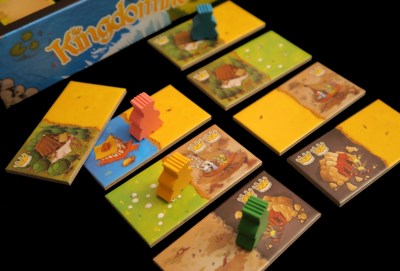
– Image by boardGOATS

The game ends when there are no more tiles to place.  Scoring is by multiplying the number of tiles in each terrain by the number of crowns in that terrain.  Thus a moderate sized area with plenty of crowns is worth more than a large area with very few crowns.  The Age of Giants expansion doesn’t change things as much as Queendomino, which we found managed to take all the fun out of the game and add a whole load of unnecessary complexity instead.  This expansion adds a small number of tiles that feature either a Giant or a Giant’s footprints.  When a Giant Tile is drawn, a large wooden giant meeple is placed on it.  When this is taken, the Giant is taken too and is placed over one of the crowns anywhere on that player’s area.  When a footprints tile is taken, a Giant of their choice moves from their Kingdom to another player’s Kingdom.

xKingdomino: Age of Giants
– Image by BGG contributor kalchio

There are two problems with this little addition, firstly, there is a rules tweak that means five tiles are drawn in the two player game and one is discarded.  Blue and Black found that this meant they just chose not to take tiles with Giants on them except when forced to right at the end.  Secondly, even when forced to take a Giant, there was almost always somewhere it could be poked that caused minimal damage, so it wasn’t really a big issue.  This was a real shame as the Giants are lovely.  As well as adding a fifth player there is also a a small pile of bonus-point tiles; both Blue and Black really liked these as they thought that they added a nice twist.  This time, they ended up with bonus points for Sea tiles adjacent to the castle and Marsh land on the corners.  Both players tried to accommodate these, though Black did a much better job than Blue.

xKingdomino
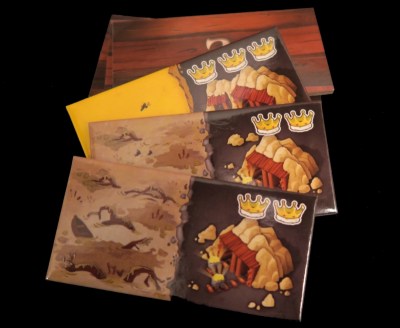
– Image by boardGOATS

It may have been that Black was focussing too much on the bonuses however, as he ended up unable to place all his tiles.  And although he scored well on the bonuses and for Sea and Pasture, he scored very little for Woodland, Marshland and Mountains.  In contrast, while Blue completely failed to score for Pasture, she scored well in every other terrain and made a killing with her Wheat fields, giving her a total of two-hundred and thirty-three, some sixty more than Black.  With that done and the epic game of Steam Donkey finally over, there was just time to arrange some of the details for the Christmas Party nest time before everyone went home.

xKingdomino
– Image by boardGOATS

Learning Outcome:  We like simple games: they can be quick to learn, but take time to master.