Tag Archives: The Game

26th July 2016

To celebrate Codenames winning the Spiel des Jahres Award, this week it was our “Feature Game”.   Although the game seems to be very, very popular, it definitely has the “Marmite Factor” amongst our group.  It also really needs a group of a reasonable size.  Since it is relatively quick, even the most reluctant agreed to give it a go, especially as Cerise had made it for the first time in ages and it was a game she had really enjoyed last time we played it.  It was also Turquoise’s first visit, so a team game seemed a good way of starting.  The idea of the game is that there are two rival teams of Spies, each with a leader or Spymaster.  The Spies are trying to locate their Agents, but these are only known by their Codenames, and only the Spymasters have the key to who is on which team.  The Codenames are laid out on the table in a five by five array where everyone can see them together with some innocent bystanders and an Assassin.  The Spymasters then take it in turns to give clues to their team so that the Spies can identify their own team’s Agents by pointing at them.

Codenames
– Image by boardGOATS

Clues are of the form “word; number”, where “word” is a clue that connects several cards and “Number” is the number of connected cards.  For example, the clue “bird; three” might connect “sparrow”, “beak” and “Naomi Campbell”.  The team then discuss the clue and point to code cards, one at a time.  If they get it wrong, their turn ends straight away, so ideally they should start with the answers they think are most obvious.  If the Codename corresponds to one of their agents, then the team can guess again, and keep trying until they have exhausted their theoretical maximum number cards that match the clue (three in the example).  Importantly, the only measure of “correct” is whether the Codename is one of the Agents, the agent chosen does not actually have to match the current clue.  So, a team who can’t make sense of a clue or identify all the Codenames may decide point to a Codename that matches a clue given earlier in the game.  For this reason, when a team get all their theoretical maximum number of Codenames for that turn right, they also get one extra chance.

Codenames
– Image by boardGOATS

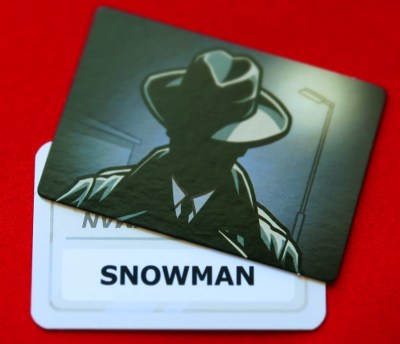
So, the trick is for the leader to come up with clues that cover multiple correct answers so that the rest of the team can identify the complete set before the opposition identify all theirs. Unfortunately, we had a particularly unconnected set of words and two Spymasters, Blue and Burgundy, who were particularly useless at this sort of thing.  Consequently there were lots of clues like “continent; one”, and when Blue got adventurous and went for “music; two” she totally confused her team and was perilously close to a hint that could lead to the Assassin (Codename “Snowman”) and bring the game to an abrupt end.  “Zooloretto; two” also fell on stony ground since nobody on Blue’s team had actually played it (where everyone in Burgundy’s team had).  The game remained finely balanced as Blue continued to try to give slightly more adventurous clues which her team didn’t always get, while Burgundy played safe with smaller clues that his team understood.
Codenames
– Image by boardGOATS

It all came to a head when, with only two Agents left to find, Burgundy decided to be adventurous and gave the clue “film; two”.  His team quickly got one of them, “Alien”, but the second was more tricky.  Green thought it was probably “forest” (as in “The Forest Moon of Endor”), but could also be several other things.  Cerise, on the opposite team leant a hand and suggested that it could be “wind” as in “Gone with the…”  or maybe “snowman”.  Meanwhile, Burgundy remained stony-faced, in what were very trying circumstances.  Eventually the team ignored Cerise (who had managed to suggest both the correct answer and the Assassin), which gave Blue and her team one last chance.  With only one Agent left to guess, there was only a short pause before they finished the game.  There was a big sigh of relief all round as everyone was put out of their misery, particularly Blue and Burgundy who had found the whole clue-giving experience very stressful indeed.  Unquestionably, with the right crowd Codenames could be great fun, but sadly, we just aren’t it, so it is unlikely to get another outing in the near future – definitely not our group’s Spiel des Jahres this year.
Codenames
– Image by boardGOATS

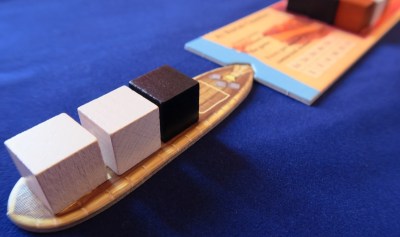
With that over, we decided to split into two groups.  Black and Purple were keen to give Imhotep a try (one of the other Spiel des Jahres Award nominees), as they had wanted to play it at the UK Games Expo, but it had been constantly booked out of the games library.  Burgundy had played it (also at Expo, with Blue and Pink), had enjoyed it and was happy to give it another go, so Green made up a group of four.  As well as being the key protagonist in the film, “The Mummy”, Imhotep was also a priest and a great architect.  So in this game, players take the role of builders in Egypt who are trying to emulate Imhotep.  The premise of the game is very simple.  On their turn, the active player chooses one of four actions:  procure new stones; load stones on a boat; sail a boat to a monument; or play an action card.  Players can only store a maximum of five stones and when they procure stones they can collect a maximum of three.  Stones are loaded onto ships one at a time, but which of the five possible destinations the boats end up at and the order they are unloaded in is vital, so timing and planning is everything.
Imhotep
– Image by boardGOATS

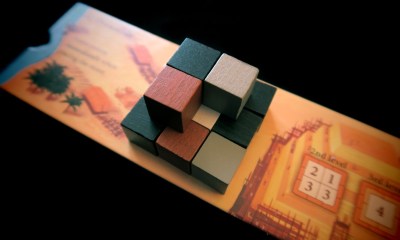
Admittedly the lovely big wooden blocks make this game feel like a “junior” board game, but Imhotep is anything but.  It is one of those games that is easy to learn but difficult to master. Although players have a range of options, trying to decide which one is best depends on what has already transpired, what opponents do and how the game will develop.  What makes it particularly tricky is that the best plans in the world can be crushed by opponents with one small action: when they take a boat to the “wrong place”.  It turns out the cubes are large for a good reason:  stacking cubes is a key part of the game and anything smaller would make a very wobbly obelisk.  There are four ships and five building locations, so one doesn’t get visited and the round ends when all four boats have sailed.  There are six rounds in total with points scored in different ways for the different buildings; the player with the most points at the end is declared the best builder in Egypt.

Imhotep
– Image by boardGOATS

Once everything was set up, the game got under way, but then almost stalled. Nobody had any idea what should be a good opening gambit.  Placing a cube on a ship was the easy choice, but which ship and in which position?  After some head scratching, everyone began placing cubes on boats, making plans where wanted the ships should go, waiting for them to be full, when suddenly, Purple jumped the gun and sent the first boat on its way.  She chose a boat with one cube of each of her competitors and sent it build an Obelisk, catching everyone by surprise.  It wasn’t a particularly bad place to go, but the obelisk doesn’t score until the end and since the highest scores are for the tallest towers, it might not actually be the most efficient use of a cube, especially so early in the game.

Imhotep
– Image by boardGOATS

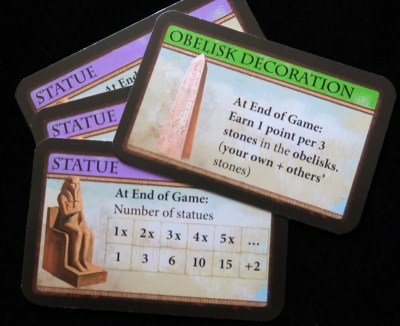
The rest of the first round continued to be a lesson in frustration as each of the other boats ended up somewhere other than where players had planned. The next boat went to the Burial Chambers (another scoring at the end of the game), the third to the Wall (scored at the end of the round, but only one point per cube) and the last went to the Market to get cards. As Green was first on the boat he had the first choice of the cards available and based on that first boat he chose the card that gave him an extra point for every 3 cubes in the Obelisk (any three cubes, not just his own).  Now no-one other than Green wanted a boat to go to the Obelisk.
Imhotep
– Image by boardGOATS

The second round began a little more cautiously.  Everyone had a better idea of how the round would go and began placing their cubes in particular positions on the ships.  The game continued to frustrate everyone as the ships just wouldn’t go where players wanted them to go.  This is frustration is similar to that in Zooloretto where players place animals on trucks, but have to wait until the next turn to collect them, if someone else hasn’t got there first, of course.  In Imhotep, it was usually pretty obvious where players wanted the boat to go, so someone else almost always got there first to send it somewhere else!
Imhotep
– Image by boardGOATS

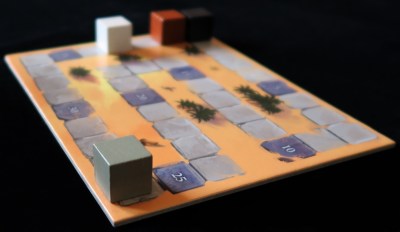
The unusual scoring of the Pyramid (not steadily increasing or decreasing points) meant that everyone tried to position themselves carefully for that optimum high scoring space, but no-one ever managed to get the boat set up quite how they wanted.  As a result, again no boat went to the pyramid.  The obelisks grew, and the pattern of the Burial Chamber was going in Black and Burgundy’s favour and the Wall scored a few more points, mostly for Purple. The Wall was beginning to show its strength as a cube placed there can score round after round until it is covered – potentially scoring well.  The market cards were dolled out, with Burgundy and Black both taking a blue extra action cards for later use. Green wasn’t sure what to take and ended up with a purple end game scoring card which would only come into it’s own if he could collect a few more.  In the third round the pyramid finally got started, in Black’s favour. The game continued in much the same way, individual plans were more and more obvious and as a result became harder and harder to fulfil.  The trouble was, in taking an action to scupper someone else it often helped a different player or upset their own plans.
Imhotep
– Image by boardGOATS

By the end of the game nobody was sure who the winner was going to be.   Before adding all the end-game scores, Burgundy was ahead of Black and Purple, with Green trailing behind.  Everyone had managed a couple of areas in the Burial Chamber, but despite best efforts to scupper him, Burgundy still had the largest area.  The Obelisks had become a fraught battle field at the end.  Black had thrown down the gauntlet to take a boat there which only had two of his cubes and pushed him into the lead, but in the penultimate round Green had sailed a sneaky little single cube boat which made his tower equal.  By making sure that he placed a cube in any boat that Black had used, Green then ensuring that he would at least share the Obelisk spoils. The presence of a single cube boat in that last round, was interesting, but no-one wanted to use it as it was guaranteed that the cube would get taken to the least useful dock, so in the end the Obelisk scores for first and second place were shared between Black and Green with Purple and Burgundy sharing the scores for third and fourth place.

Imhotep
– Image by boardGOATS

With Black now several points ahead, Burgundy and Green were vying for second with only the the green and purple end-game scoring cards left, though only Black and Green had any.  Black scored points for every three cubes in the burial chamber, which extended his lead and now looked unassailable.  Green got his Obelisk cubes score, which proved to be the same as Black took for the burial chamber, but with three purple cards giving him another six points he leap-frogged over Black to win by one point.  It was an incredibly close game which suggests that where cubes go may not matter as much as it feels like it should.  On one hand, this seems like a good thing as it relieves the pressure of all those boats going to the “wrong place”, but on the other hand it may suggest the game is a little too balanced making strategy play is less important, which would be a great shame.  Everyone really enjoyed it, however, and would definitely play it again especially as it plays quickly and the alternative tile options look as though they would add variety and new challenges to the game keeping it fresh.  For our group, from the nominations list, this would definitely have been our choice of Spiel des Jahres.

Colt Express
– Image used with permission of boardgamephotos

Meanwhile, everyone else was engaged in a brutal game of Colt Express, the worthy winner of last year’s Spiel des Jahres.  This is a programming game, where players take it in turns to choose the cards to they will play, but only action them after everyone has chosen.  Since everyone then takes it in turns to carry out their actions, the game is full of unforeseen consequences.  The game has a Western theme and is played on a fabulous three-dimensional train.  The idea is that each player is a bandit attacking the train trying to move about to pick up cash and jewels while avoiding the Marshall and shooting each other.  Although we’ve played this a few times, we had a couple of people who hadn’t played it before so we had a quick run-down of the rules first.  Each player starts with the same deck of action cards and six bullet cards.  A round card dictates how many cards will be played and how (face up or down; in pairs or singly) and players each shuffle their action deck and draw six cards.

Colt Express
– Image used with permission of boardgamephotos

Players then take it in turns to play the action cards.  At the beginning of a round everyone can see where everyone else is and it is easy to choose which card to play and predict its outcome.  Before long, however, things begin to become unpredictable and by the time players have to choose a second card it is highly likely that plans will have gone awry, though of course, nobody know this yet.  Once the cards have all been played, the pile of cards is turned over and the cards are actioned in the order that they were played.  It is only at this point that people realise the mistakes they’ve unwittingly made, shooting nobody or the wrong person, trying to pick up jewels that aren’t there or finding they’ve got nowhere to go because the Marshal is in the way and has screwed up their plans.  As the game progresses, things get worse too since shooting someone involves passing them a bullet card.  This is added to their action deck, but is a dead card and gives no possible actions.  Multiple bullet cards means the chance of drawing them increases making the action cards drawn all the more precious and adding pressure to make the maximum use of them.

Colt Express
– Image used with permission of BGG contributor punkin312

Colt Express is a light, fun game and inevitably, someone gets picked on.  This time Blue was the victim (playing the character Django).  Magenta (playing the innocent looking Belle) started using Blue for target practice, but Cerise (Doc) was very quick to join in the fun.  Blue did her best to escape and briefly managed to grab the $1,000 strongbox (gold bar in our version of the game) before Magenta biffed her soundly on the nose and nabbed it.  Meanwhile, Cerise and Turquoise were doing an excellent job of gathering up the loot and robbing the passengers blind, before they decided to try to empty their revolvers.  Obviously, this was mostly at Blue’s expense and with so many bullet cards she struggled to do anything, but that didn’t put people off of course.  Before long even the Marshall was getting in on the act and, much to her disgust, Blue finished the game with more bullets than action cards and no money or gems at all.

Colt Express
– Image used with permission of BGG contributor punkin312

For everyone else, however, the game was quite close.  Magenta had managed to hang onto the gold bar (aka strongbox) and one gem, but it wasn’t enough to compete with Turquoise and Cerise.  Turquoise had picked up a massive five money purses while Cerise added the Sharp Shooter bonus to her one gem and single purse.  Much to our surprise, both totalled $1,850 which meant we had to check the rules for a tie-breaker.  It turned out this was the number of bullets received, which meant that even though she was a long way from competing, Blue had an influence on the result.  As well as being a bullet-magnet, Blue had just about managed to fire a couple of shots in return.  Cerise had been one of the main attackers, so she had caught a few of Blue’s bullets as well as a couple of Magenta’s.  Since Turquoise had rarely fired at anyone, she had picked up just two bullets and with it, her second win of the evening, with Cerise getting her comeuppance.

Colt Express
– Image used with permission of BGG contributor lacxox

With it nearing “pumpkin time” for Magenta and Turquoise, there was just time for one last quick game and, almost inevitably, that was 6 Nimmt!.  How this game is still interesting for our group, is a bit of a mystery.  It is short, everyone is always happy to play it and, since it has such a small footprint, it gets brought every week which means it is there when the occasion is right, the mystery though is why people haven’t got bored when other games have long since fallen off the radar.  This time Purple started badly picking up twenty Nimmts in the first round while Turquoise began with a clean sheet.  Burgundy started well with just two Nimmts, but since he always has one good round and one bad, everyone was just waiting for him to start collecting cards in the second round.  Magenta and Blue both had consistently low scores, but they weren’t low enough, and while Purple also made a virtue of consistency, that’s not so good when the scores are both high.  Sadly, Turquoise was forced to pick up a couple of high-scoring of cards while Burgundy, very unusually managed to string two good rounds together.  With a clear round for his second, Burgundy took the game with a total of just two Nimmts, beating Turquoise into second place.

6 Nimmt!
– Image by boardGOATS

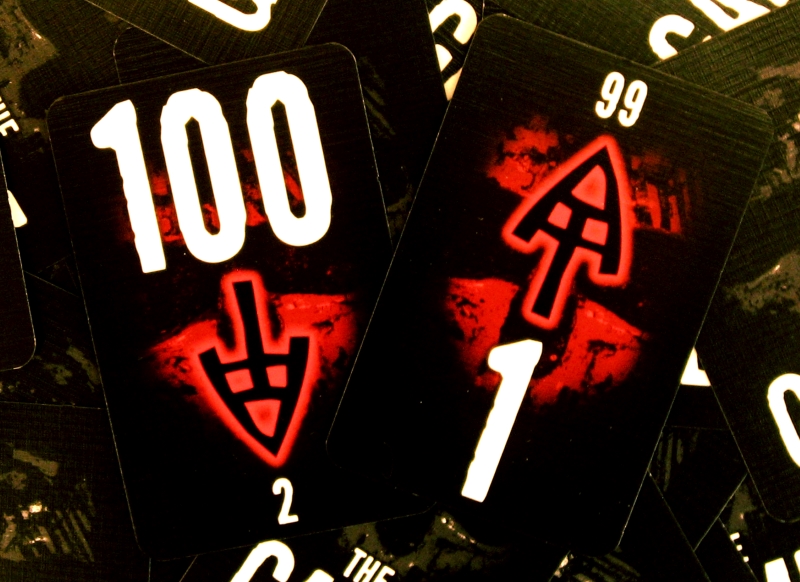
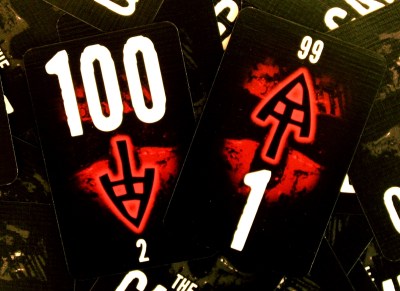
With Cerise, Magenta and Turquoise heading off, that left a short hour for something else.  Black was keen to play Isle of Skye, the winner of this year’s Kennerspiel des Jahres, but Green somehow hadn’t played it and we debated whether it would overrun.  Before long we’d prevaricated enough to definitely rule it out due to lack of time and we started hunting round for something else.  In the end we settled on The Game, a nice little cooperative card game that was nominated for last year’s Spiel des Jahres.  We played this quite a bit for a while, but somehow it has fallen out of favour a little of late, but for no very good reason.  The rules are simple: on their turn, the active player lays a minimum of two cards on any of the four piles following the appropriate trend – two piles must always increase, two decrease; the exception to this is if you can play a card where the interval is exactly ten in the wrong direction (known as “The Backwards Rule”).  Players can talk about anything so long as there is no specific number information given and the aim is to cooperatively get rid of all ninety-eight cards by playing them on to the four piles.

The Game
– Image used with permission of boardgamephotos

The Game started badly and then it got worse.  Before long we were wondering whether we were even going to get through the deck.  Our excuse was that the game is harder with five, but that may or may not actually be the case.  Eventually, we finally managed to exhaust the draw deck, leaving just the cards in hand, but it was inevitable that we weren’t going to be able to place every card as several players had lots of very low cards in a run.  In the end we finished with eight unplayable cards.  We felt we might have been able to place a couple more with a bit more planning, discussion and thought at the end, but everyone was tired and it was home time, so our collective competitive streak had deserted us.  Maybe it will come back for next time…
The Game
– Image by boardGOATS

Learning Outcome:  Prize-winning games can be a little bit hit and miss and depend strongly on the group too.

23rd February 2016

After another quick game of Love Letter (a resounding win for Magenta), we moved on to our “Feature Game”, Kobayakawa.   This is a simple little Japanese micro-filler game with elements of betting and push-your-luck.  The rules sounded unpromising, but it was much more fun on the table.  The idea is very simple:  from a deck numbered one to fifteen, each player is dealt a single card with one extra one face up in the middle.  Like Love Letter, players draw a card and chose which to keep, but the aim is different as players are trying to set themselves up for the second phase of the game.  In the second phase, players take it in turns in player order choosing whether to pay a token to join the bidding or not. The player with the highest card in hand wins the pot and the winner over all is the player with the most tokens after seven rounds.  There is a catch, however, as the player with the lowest card gets to add the face up card to their total.

Kobayakawa
– Image by boardGOATS

It is at this point that the little bit of strategy comes in:  in the first phase, players can choose to replace the face up card instead of drawing a card into their hand.  It is only a very little bit of strategy though, since play is strictly in player order and at the start of the round you have almost no information.  Thus, a player who has chosen to keep a low card can find their round is trashed when the last player in the round changes the face-up card from a high value to a low one.  That said, the game is not meant to be an intensely deep strategy game, and it was much more fun than it sounded on reading through the rules.  Pine took an early lead with Green crashing out as he ran out of tokens.  Although we enjoyed it, we felt the end-game could do with a little work as the rules say that everyone who has enough tokens must pay two to join in the last round of bidding (instead of one as previously).  This increases the value of winning the final round and means the preceding rounds can be essentially meaningless unless a player has managed to accrue more than half the number of tokens available (and in that case the final round is pointless instead).  We felt that maybe the game would be better with an early target, with the winner being the player to collect, say, three times the number of tokens as players, and if that hadn’t happened by round seven, then play the final round.

Kobayakawa
– Image by boardGOATS

This was followed by a short break during which we discussed what to play next and got side-tracked by an (unusually serious) conversation regarding the upcoming EU referendum.  As the debate disintegrated into general moaning along the lines of European stereotypes Green felt a game of Lancaster was in order, as it is a game where players are directing noble families from the time of Henry V, vying for power and favour amongst themselves, with a side order of fighting the French.  This is a game that has had a couple of outings recently since we first played it just after Christmas, but this time we decided to add the Reward Tiles mini-expansion.  Pine was the only one not to have played it before, so we had a quick run-through of the rules.  Players take it in turns to place their knights in one of three places:  in the shires; in their castle, or in the wars in France.  Once the knights have been placed, players then vote on and evaluate “the Laws” which give players a benefit just before they get their their rewards for knight placement.  After five rounds, the player with the most points wins.

Lancaster: Reward Tiles
– Image used with permission of BGG contributor Baartoszz

The mini-expansion added reward tiles which are drawn at the start of each round and placed next to a county on the game board.  During the rewards phase, the player who takes control of the county may collect the reward tile instead of the imprinted basic reward (collecting both the nobleman tile and the reward tile if they pay the extras).  Clearly these weren’t going to have a huge impact on the game, though they would make some of the benefits slightly more available during the game, something that had the potential to help out Purple who insisted that she never did very well as Green and Black always knocked her out of the castle improvement counties (something that was not denied).  The first round of knight placement was a benign affair as no-one seemed up for a fight. Black concentrated on beating the French, Purple inevitably went for castle improvements, Green wanted the starting token and Pine thought building up his knights would be a good start.

Lancaster
– Image used with permission of
BGG contributor kopernikus

Then came the first phase of voting for the Laws. Confusion abounded concerning quite how it worked, and having been fairly unanimous in our votes we prepared to discard two laws and replace them with two more. A quick check of the rules about how we do this indicated that we’d done it all wrong:  we should have voted for the new laws we wanted not the old laws we wanted to keep.  There was a little more discord at the ballot box when we tried again, but we still got two new Laws.  With that, the most complicated part of the game, out of the way for the first time, we went into the rewards round with players counties collecting knights, castle improvements, voting cubes and squires, and awarding points for the victory in France.  It was when we came to the rewards from the Laws that Green realised that all his calculations as to what he would get were wrong since number of squires and money had suddenly changed.  It was only when placing the knights in the second round that Green realised that the rewards from the Laws should be awarded immediately after the vote and before the rewards from the rest of the board.  We changed to follow the rules for the rest of the game, but did think that it could make an interesting variant as it provides an extra level of uncertainty into the game.

Lancaster
– Image used with permission of BGG contributor kilroy_locke

Over the next couple of rounds, Black continued his grudge against France, Purple tried to build her castle (largely unsuccessfully), Green gathered voting nobleman around his table and Pine built up his fighting strength.  By round three Purple and Black had both accumulated a lot of squires and Pine and Green found themselves being kicked out of a few counties and having to replace somewhere else and by the fourth round, the knives were really out and the counties were changing hands like “pass the parcel” at a birthday party.  Pine and Green had superior knight strength, but Black and Purple had the upper hand with squires; battles raged across the land and the rivers ran red with the blood of so many faithful soldiers.

Lancaster
– Image used with permission of BGG contributor henk.rolleman

The battles continued into the final round, however, Black had often swiped the nobleman from under the noses of the other players by judicious use the free nobleman king’s favour and the free nobleman alternative reward from the expansion (the only person to actually take advantage of it in the whole game). Eventually, everyone settled with several sending their knights home to treat their wounds, and the game ended except final scoring.  Black began the scoring several points ahead of the others and it looked like his fighting in France may have paid off, especially as he had managed to gain quite a table of nobleman as well. The superior knights of Green and Pine and the better castles of Pine and Purple brought them a little closer to Black prior to the nobleman scoring.  Black and Purple finished with the same number of nobles giving them fifteen points, but Green finished with two more which he had snuck in right at the end and took him to a near full compliment giving him an extra thirteen points and with it the win, leapfrogging Black in second place with Pine finishing just one point behind in third.

Lancaster
– Image used with permission of BGG contributor punkin312

In discussing the game after, Pine said he quite enjoyed it and we ruminated on how weak the castle improvements seemed to be, more because they were so hard to get early on, when they would provide the most benefit whereas later on they were of less use.  This brought in the idea of using the expansion extra reward tokens all at the beginning of the game rather than only one new one out each round.  We also wondered if placing them randomly rather than on specific counties could work, though that might need some thought.

Lancaster
– Image used with permission of BGG contributor punkin312

Meanwhile, Blue, mindful that Green and Burgundy had been keen to play Endeavour again, had produced that as a her offering for a game about international treaties.  With Green engaged elsewhere, Blue and Burgundy recruited Magenta to the cause and gave her a rules run-down as she had not played it before.  The game felt much less confusing than last time as it was fresh in Blue’s and Burgundy’s minds having played it within a month.  So, despite all the little bits that need to be set out, the perceived complexity of the game and the relative inexperience of the players, Endeavour was actually under way first.  The game is played over seven rounds, each of which consists of four phases:  Building, Population, Income and Action.  The idea is that players have four status tracks which correspond to Industry, Culture, Finance and Politics, which roughly correspond to the four phases and dictate what players are allowed to do at each stage.  The game is actually much less confusing than we made it last time, though there are a number of apparently little rules that have the potential to make a large difference.  For example, last time at least one player had multiple copies of one building which can significantly change the balance of the game as well as potentially making that building unavailable to other players.

Endeavor
– Image by boardGOATS

Players start by choosing a building:  although the choice is very limited at the beginning so everyone begins with only a slight variation in direction, we have a feeling that the choices made very early on in the game are critical.  Similarly, getting the first round of settling and shipping right is vital as this gives both position and a crucial fast start on the status tracks allowing players an early toe-hold in the game.  As such, Magenta was at something of a disadvantage not having seen the game play out before, though with just three players (compared to four last time) there was just a little more wriggle room.  Burgundy and Magenta began by building Shipyards, so Blue decided to do something different (largely just for the sake of it) and built a Market instead.  Although she didn’t plan it that way, it meant that she was first to start picking up cards from the Asset Deck in Europe, giving her an alternative method of building her status tracks.

Endeavor
– Image by boardGOATS

Meanwhile, Magenta and Burgundy were both engaging in shipping though Magenta was having the better of it managed use to build up her Population and Income tracks and quickly took the Governorship of South America.  Somehow, Burgundy had got things very slightly out of kilter and was unable to put them right.  Before long his Income status track had fallen behind which restricted his available population as well as blocking up his action spaces.  Magenta was on roll judiciously shipping, settling and picking up Asset cards, and generally playing a very canny game.  In the previous game, with four players, almost all the board had been opened up in what had been a very tight game.  This time, with only three players, large sections of the board didn’t get explored much at all.  This was exacerbated by Blue only starting her shipping slowly, so Burgundy had to make almost all the running in India, which was hard work, but necessary for him to build a network of settlements.  Matters were made worse for him with Blue pouncing on one of his key targets.

Endeavor
– Image by boardGOATS

Although everyone finished in much the same place, as before, with nearly complete status tracks and a near full set of cards, it was clear that Burgundy had struggled and Magenta had really done very well.  Blue’s position was less clear as she hadn’t done quite as well as Magenta on the status tracks (especially as she had to discard one of her cards at the end of the final round), but had picked up points elsewhere, in particular on her Asset cards.  In the final count, Burgundy was nowhere near as far back as we had thought and it was clear that if he had been able to increase his income just slightly, earlier in the game, he would have been way out in front.  As it was, Blue finished some twelve points clear thanks to her Asset card victory points and more cities than anyone else.

Endeavor
– Image by boardGOATS

Lancaster was still under way, so Burgundy, Magenta and Blue decided to play something small and quick that they all knew.  The minimal set-up time and its more relaxed feel commended The Game, and since the decision had to be made quickly, no-one really looked any further.  We’ve played this simple little card-laying co-operative game a lot, so the only thing we needed to check was the number of cards in the starting hand.  Unfortunately, an appalling deal quickly put paid to our “R&R” and the stress levels quickly rose as it looked highly likely that we weren’t going to even get through the deck.  In the event, we just about managed to get to a point where the draw deck was depleted, but that was it and we finished with seventeen unplayed cards.  Lancaster was drawing to a close, but scores still had to be tallied and there were a lot of bits to put away, so we decided to give it another go, with speed.  Not thinking seemed to help (or maybe it was the practice from the previous try), because we made a much better fist of it, finishing with just four unplayed cards.

The Game
– Image by boardGOATS

With Magenta heading home for an early night, there was just enough time (and people) for a quick game of one of our most popular fillers, Om Nom Nom.  The game is quite simple with players simultaneously choosing animal cards to try to eat as much possible:  for example, a cat will eat mice.  Similarly a mouse can eat cheese, but only if it is not eaten by a cat first.  The board is seeded with dice, after which there is a large dose of double-think as players try to guess whether everyone/anyone else is going to go for the largest tastiest helpings or not.  As usual, Green moaned about how badly he does in the game, and tried his usual array of randomly choosing cards and going for his second choice rather than his first, but for all that, he didn’t do so badly in the end, though he was some way behind Blue who just pipped Pine thanks to a large helping of carrots (which, it turns out score double) in the final round.

Om Nom Nom
– Image used with permission of BGG contributor msaari

Learning Outcome: Games can be very different when you change even the smallest of rules…

12th January 2016

With Red, Magenta and Blue moaning about work and only Burgundy waiting for real food, when Pine rolled up we began straight away with our “Feature Game”, the light filler, Las Vegas. This is a very simple dice game, but actually quite a lot of fun.  On their turn, each player begins by rolling their dice, then assigning some of them to one of the six casinos.  Each casino is numbered one to six and has a jackpot of over $50,000, drawn at random from a deck of money.  Thus, each jackpot could be anything from $50,000 to $180,000 and comprise one to five notes.  On their turn, players must use all the dice of one number to bet on the casino of that number.

Las Vegas
– Image used with permission of BGG contributor punkin312

Once everyone has placed all their dice the player who placed the most dice on a casino takes the highest value currency card. The player with the most money after four rounds is the winner.  The snag is that before any money is handed out, any dice leading to a draw are removed. It is this rule that makes the game interesting, raising the decisions above the trivial and, in our view, making it a better and much more fun game than Qwixx which we played two weeks ago.  Although the game only plays five (without the Boulevard expansion), Blue had added an extra set of purple dice just in case, so when Green walked in just before the game started, he was able to join in.

Las Vegas
– Image used with permission of BGG contributor punkin312

In the early part of the round, each player has to decide whether to conserve dice or whether to make a statement and go in big.  As the round progresses, players must choose where to place their bets then try to finesse their position before being forced to place their last die or dice based solely on chance.  The factors that go into the decision include the value of the rewards available, the current position and the number of notes as well as the probabilities of other players interfering.  The probabilities are non-trivial too, because rolling multiples can change the number of dice available for the next roll.

Las Vegas
– Image used with permission of BGG contributor ckirkman

In the first round, everyone made the same mistake and committed too many dice too early, but after that, we all got the hang of it and the game was quite close.  Players keep their winnings hidden, but since everyone had had rounds with lean pickings as well as generous ones, we all felt we were in with a chance.  The last round began with it all to play for and everyone taking it in turns to roll lots of sixes.  At the end of the game, we announced our totals in turn:  Green finished with $260,000, Pine with $250,000, Burgundy and Blue tied with £270,000, but Magenta just pipped them with $280,000.  Red, however, took longer to count up her cash for good reason and finished well clear with $360,000.

Las Vegas
– Image used with permission of BGG contributor joeincolorado

With the arrival of Black and Purple, we decided to split into two groups.  The only game that everyone really wanted to play was Isle of Sky: From Chieftain to King, so since we only had the one copy, five went for that leaving the three others to find something else to play.  Isle of Skye is a tile laying game where players play a sort of solitaire Carcassonne, bidding for tiles and scoring a the end of each of the six rounds.  We’ve only played the game once on a Tuesday in November, but it has proven to be very popular at other local meetings too, so everyone playing had played before and the game was quick to get going.

Isle of Skye: From Chieftain to King
– Image used with permission of BGG contributor henk.rolleman

Burgundy had played it a few times and, unusually, generally seems to struggle with this game.  This time he started well, and took the lead from the start, unfortunately however, he struggled to pick up scrolls, so suffered in the end game scoring.  One of the peculiarities of this game is the fact that from round three, at the start of the round players get one extra gold coin per player in front of them on the score track, increasing to four extra coins by the final round.  This really adds up, and a player who takes advantage of this bonus can have a large impact on the score track.  Black made hay on the bonus sitting at the back for most of the game, however, he failed to use the gold and finished with fifty-one unspent coins.

Isle of Skye: From Chieftain to King
– Image used with permission of BGG contributor Punkin312

Between Burgundy at the front and Black at the rear, Purple, Pine and Magenta were jostling for position.  Without sheep and cattle featuring strongly in the scoring tiles this time, Pine felt he would struggle, but he made a surge for the front in the final scoring.  Magenta who had spent a lot of the game at the back of the pack with Black gradually moved through the field in the later rounds and finished four ahead of Burgundy in joint first with Pine on sixty-six, with Pine taking it on the tie-breaker.

Isle of Skye: From Chieftain to King
– Image by boardGOATS

Meanwhile, Blue, Green and Red were playing an aggressive game of Citadels.  This is a slightly older, role selection game.  Everyone starts with a hand of district cards and the start player, “The King”, also has a hand of eight Character cards.   The Character cards are shuffled and one is placed face down blind.  The King can then choose one Character card and pass the rest on to the next player.  The cards are drafted in this way until (in the three player game) everyone has two and the remaining card joins the first card, face down to one side.  Thus, each player has two Character cards and each Character card has a number and a special ability.  “The King” then calls the characters in turn, by number and name, and the player who has that card then immediately carries out their turn.

Citadels
– Image used with permission of BGG contributor themilkcrate

A turn consists of either taking money or drawing two cards from the deck, then paying the monetary cost to build one of the district cards from their hand.  The game ends at the end of the round in which a player builds his eighth district card.  The scores are then added up with players receiving points for their buildings equalling the total cost to build them, plus bonuses for being the first player to build eight district cards, bonuses for having at least one district in each of the five colours and for achieving a total of eight buildings before the game ends.  We played with some of the Characters from the Dark City expansion so “The Witch” replaced “The Assassin”, “The Tax Collector” replaced “The Thief” and “The Navigator” replaced “The Architect”.  We also chose a random selection of the valuable “purple buildings”, a factor that turned out to be quite critical to the game play in the end.

Citadels
– Image used with permission of BGG contributor Nodens77

Blue took an early lead, building a couple of “purple buildings”, in particular, the very annoying Ball Room.  The “purple buildings are expensive to build, but generally come with some sort of special power, in the case of the Ball Room, if the owner is also The King, every player must say “Thanks, Your Excellency” before taking their turn otherwise it is forfeit.  Without “The Thief” in play, Blue was able to let her money build up and was hoping to build the Library, when Red played “The Magician” and swapped hands with her.  Unimpressed, in the next round Blue played the same trick, giving Red the apparently rather useless Armory in exchange.  To make sure Red didn’t nick it back, Blue built the Library quickly, her third purple building giving her a healthy lead though she, like Green was struggling to get the blue cards she wanted to pick up the bonus for having a building of each colour.  Green meanwhile was having other problems of his own, compounded by the fact that he forgot to be obsequious and therefore lost a turn.

Citadels
– Image used with permission of BGG contributor kilroy_locke

Red made persistent assaults on Blue, but it was when Blue had six district cards built and was trying to find a way to close out the game that Red decided to use that “rather useless Armory” to destroy Blue’s valuable Library.   Discussion ensued as Blue had originally decided to ditch the Armory as it was too restrictive, but Red wasn’t so sure.  Green resorted to looking it up on-line and found a wealth of discussion none of which really answered our questions.  After a brief hiatus, we decided to let Red go ahead as Blue was so far in front, although it wasn’t that far as it turned out.  Both Green and Blue hadn’t seen a blue district card all game so missed out on the three point bonus and, as Red completed her eighth building first, she also took an extra two points for that, finishing on thirty-seven.  Green and Blue tied for second place though arguably Green should not have been able to take his last turn since he forgot to “Thank, Her Excellency” again…

Citadels
– Image by boardGOATS taken from boardgamegeek.com

Citadels is one of those rare games that plays a wide player count, nominally from two to eight players.  However, while there is a consensus that it does not play all numbers equally well, the on-line jury is still out as to where its “sweet spot” is.  In fact, some people appear to think it is best with small numbers, while others prefer it with more players.  We’ve played Citadels a few times on a Tuesday, a couple of times with just two players, but also with five.  Blue and Green had been involved on each occasion and Blue in particular had quite enjoyed the game with just two players, but had hated it with five.  With two she felt it was a game where players could really try to get inside the head of their opponent whereas with five she felt it was horribly chaotic and difficult to follow what was going on.  Knowing this, Green had thought three might have some of the features of the head-to-head game while adding more dimension to the game play and, despite losing, Blue agreed, that three was an excellent number of players for this game.

Citadels
– Image by BGG contributor lolcese

While Citadels was finishing, the other players filled the time with a couple of rounds of an old favourite, Dobble.  The first round was a warm up which Magenta ducked out of as she has a bit of a reputation as the “Dobble Queen”.  This was played with the conventional “Towering Inferno” variant, where players call out matches and grab cards from the central pile.  In the second round, Magenta joined in so “The Poisoned Gift” variant was chosen, otherwise known as “Gang up on Magenta”.  In this version, instead of grabbing cards from the middle for yourself, you match them and stick them on someone else’s pile (usually Magenta’s), with the aim to finish with as few cards as possible.  Everyone accordingly rained cards down on Magenta who duly lost with Black winning by one from Pine and Burgundy.

Dobble
– Image used with permission of BGG contributor msaari

Time was ticking on, so we decided to play a quick game of Saboteur.  This is a team game where you don’t know who your team mates are.  With eight players, there is a team of five or six Dwarves trying to find the treasure, and two or three Saboteurs, trying to stop them.  On their turn, the active player can play a tunnel card to progress towards the three possible treasure locations, play an action card or discard a card face down (a very Saboteur-like action).  The action cards come in a variety of flavours:  broken tool cards that are played in front of other players and prevent them from laying tunnel cards; tool cards than cancel out broken tool cards; map cards that allow players to look at one of the possible treasure locations to see whether it contains the gold or not, as well as rockfall cards that allow players to remove tunnel cards that have already been placed.

Saboteur
– Image used with permission of BGG contributor mikehulsebus

The game is supposed to consist of three rounds with the winning team taking prize cards, however, last time we played, we decided that the addition of prizes meant the game inevitably outstayed its welcome.  We felt it would be better to play one round, and if we wanted, play a second, but treat them as separate games, which is exactly what happened this time.  In the first “game”, Magenta and Purple claimed the gold was at one side, while Black and Blue claimed it was in the middle – clearly we had two of our Saboteurs, but which pair looked guilty?

Saboteur
– Image used with permission of BGG contributor mikehulsebus

After a couple of rounds, Magenta showed her true colours and played a broken tool card in a Saboteur-like manner and she and Purple were promptly stomped on.  Suitably, after everyone had doubted him for so long, Black was the one to finally find the gold.  Green had had enough and headed off, but Pine, Red and Magenta agreed to stay for one more go.  This time Red decided to have a go at Pine from the very start – maybe it was the pointiness of his ears or the way he carried his pick axe, but she claimed he was definitely a Saboteur.  Everyone else was less quick to condemn, and before long it became clear that it was Red and Purple (again!) who were guilty and, although it was closer, the Dwarves still got to the gold first.

Saboteur
– Image used with permission of BGG contributor mothertruckin

With people leaving, there was just time for Black, Purple, Burgundy and Blue to squeeze in a quick game of The Game.  We started dreadfully, and two piles were very quickly closed off.  Somehow we managed to keep going though and, despite an appalling run of luck and a couple of us making dodgy decisions, Black was eventually able to draw the last card from the deck.  Playing just one card at a time made things a little easier, but we still had over twenty cards to get rid of.  Sadly, it was not to be; the poor start had done its damage and we finished with a total of eleven cards in hand.

The Game
– Image by boardGOATS

Learning Outcome:  When a game is *that* popular, bring it again!

29th December 2015

The pub was very busy, and with one chef down with the lurgy (which had got four of us as well), food was delayed. So, unusually, we started off with a quick game. Expecting more people, we decided to play something short, and opted for Qwixx. This game was designed by Steffen Bendorf who also designed The Game (which has been popular with the group this year) and was nominated for Spiel des Jahres in 2013. So, it has a good pedigree, however, when it was nominated there were a lot of comments about its suitability and eventually, it was beaten by Hanabi, which most people agreed was a better game. We finally got the chance to give it a go in October and generally felt that although the rules made for a promising sounding filler, the resulting game was disappointing. Given how some people continue rave about it though, we’d were keen to give it another try and see if we’d been mistaken.

Qwixx
– Image used with permission of BGG contributor punkin312

Qwixx is a very simple game: each player has a score card displaying the numbers two to twelve in the four different colours, red and yellow ascending and blue and green ascending.  On their turn, the active player rolls six dice, two white, and one of each of the colours, red, blue, green and yellow.  Every player may cross out the number corresponding to the sum of the white dice. The active player may then also cross out a coloured number corresponding to the sum of one white die and one matching coloured die. If the active player cannot or chooses not to cross off a number, then they must tick a penalty box, which costs them five points at the end of the game. The snag is that although numbers can be skipped, they must be crossed off in order, red and yellow ascending, blue and green descending.

Qwixx
– Image by boardGOATS

Points are scored for the number of each colour crossed out and penalties subtracted; the game ends when one player has picked up four penalties, or players have crossed off the last number for two colours locking them for everyone. Scarlet, an experienced local gamer who is usually unavailable on Tuesday evenings, commented that it was a bit like Yahtzee, but with slightly more decisions to make. This didn’t further endear the game to Blue, who has bad memories of playing Yahtzee as a child. Scarlet did manage to demonstrate a modicum of strategy when he chose to cross off a sixth red number rather than his first green number since that would give more points at the end. His discovery clearly gave him a bit of an edge as he took second place, eight behind Burgundy who won with eighty.  We had a bit of discussion about what strategy there was, but it was not really enough to rescue the game in anyone’s eyes and it now faces donation to a worthy cause.

Qwixx
– Image used with permission of BGG contributor punkin312

Meanwhile, Grey and Cerise had arrived and seeing everyone else engaged decided to play a quick game of Hey, That’s My Fish!. This is a cute little abstract with a penguin theme, and, in common with games like Carcassonne, although it plays more, in many ways, it is at its best as a two player game when it is most vicious. The game is played on a grid of hexagonal tiles, with each player starting with four penguin figurines which players take it in turns to move in straight lines across the tiles. When a penguin is moved, the active player gets the tile it was sitting on, leaving a gap that cannot be crossed. Thus, the ice flow progressively melts away trapping the penguins in increasingly smaller spaces.

Hey, That's My Fish!
– Image used with permission of BGG contributor aleacarv

A number of fish is depicted on each tile, and the player with the most fish at the end of the game, i.e. when there are no more valid moves, is the winner. This is just the sort of game that Grey likes, deliciously savage with plenty of opportunity to go for the jugular and for a while he had Cerise under the cosh. Her delight at the end was obvious though when the final reckoning put her four fish clear.  With food imminent for those who hadn’t yet eaten, and Green expected, we decided to split the group and start the “Feature Game”, Broom Service.  This game uses the role selection mechanic from Witch’s Brew (a game we played a few weeks ago), but adds much more with a board and a delivery mechanic.  Witch’s Brew was nominated for the Spiel des Jahres in 2008, but was beaten by Keltis (a boardgame equivalent of the popular two player card game Lost Cities), but its reincarnation, Broom Service, won the Kennerspiel des Jahres this year.

Broom Service
– Image used with permission of BGG contributor punkin312

Like Witch’s Brew, players start with a hand of character cards from which they simultaneously choose a subset in secret. The start player then chooses a card and announces they are that character declaring they are either “brave” or “cowardly”. The other players then must follow suit if they hold that card. If a player is cowardly they take a lesser reward immediately, but if they are brave, they must wait until the end of the round to see if they get a reward. Once everyone has declared their position, the last brave player takes a greater prize and anyone who was brave earlier in the round gets nothing.  The character cards come in three types, Gatherers (who provide ingredients), Witches (who allow players to travel to an adjacent region) and Druids (who deliver potions to the towers). There is also the Weather Fairy who charms away clouds using magic wands.

Broom Service
– Image used with permission of BGG contributor punkin312

The rules are modified by event cards that are revealed at the start of the round, and with less than five players, the game is also made tighter by the inclusion of “bewitched” roles (cue Burgundy and Pink demonstrating how to wiggle-twitch their noses like Tabitha). The game is considerably more complex than the cute theme and artwork imply. Compared with Witch’s Brew, there are also a number of small rules that it is difficult to remember at the start, though they are in keeping with the theme.  The game ends after eight rounds, and, although points are awarded for delivering potions during the game, there are extra points for weather clouds and sets of potions collected.

Broom Service
– Image used with permission of BGG contributor punkin312

Grey quickly got his nose in front delivering potions early, but Scarlet and and Cerise followed suit and kept the points difference down. It didn’t last however, and before long, Grey had moved his witches away from everyone else’s into the south-east corner of the board where he was able to score heavily without competition.  Despite Cerise’s best efforts with the Weather Fairy and Scarlet’s set collecting, Grey had an unassailable lead and finished nearly thirty points clear with ninety-three points. Second place was much closer, however, Scarlet taking it by just two points from Cerise.

Broom Service
– Image used with permission of BGG contributor punkin312

Meanwhile, once the matter of food had been dealt with, Blue, Pink and Burgundy were debating what to play. It had been narrowed down to Snow Tails or Snowdonia (with Pink requesting an expansion to add interest), when Green appeared, newly arrived from visiting relations over Christmas. He was keen to play Snowdonia, so that sealed the deal, with the Jungfraubahn expansion added as a sweetener.

Snowdonia
– Image by BGG contributor duchamp

The base game is not that complex and we’ve played it a few times, however, it is one of those games that somehow everyone struggles to remember how it works. With both Burgundy and Blue suffering with Seasonal Lurgy, adding the expansion was always going to make things more complicated too.  The idea is that players take it in turns to place their workers in the seven possible actions, which are then activated in order. These actions include, visiting the stockyard; converting iron ore into iron bars; digging to remove rubble from the track-bed; laying track; building part of a station; taking contract cards; and surveying the route.

Snowdonia
– Image used with permission of BGG contributor aleacarv

There are two twists: the weather and the game. The stockyard is refilled from a bag, and there are small number of white cubes in the bag which, when drawn cause the game to play itself. This mechanism came about because the designer dislikes players who hoard resources, so in this game, if people don’t keep things moving, the likelihood of white cubes coming out increases and the game moves along on its own. The other interesting mechanism is the weather which increases and decreases the digging and track laying rate making players’ timing key.

Snowdonia
– Image used with permission of BGG contributor winterplum

Green, Pink, Blue and Burgundy were still setting out the game and trying to work out what modifications the Jungfraubahn expansion made, when Broom Service finished, so Grey, Cerise and Scarlet played a quick game of Cosmic Encounter. This is a game they were all familiar with, though we’ve not played it on a Tuesday night before.  The game is reasonably straight forward, with each player leading an alien race trying to establish colonies on other players’ planets with the winner the first player to have five colonies on planets outside their home system.

Cosmic Encounter
– Image by BGG contributor RRunner

On their turn, The active player becomes “The Offense”. The Offense encounters another player on a planet by moving a group of his or her ships through the hyperspace gate to that planet. They draw cards from the destiny deck which contains colors, wilds and specials. The Offense then takes the hyperspace gate and points at one planet in the system indicated by the drawn destiny card. The Offense and The Defense both commit ships to the encounter and both sides are able to invite allies, play an encounter card as well as special cards to try and tip the encounter in their favour.  The game was close with lots of too-ing and fro-ing, but Cerise was the one to finally successfully establish five colonies, with Grey and Scarlet finishing with four and three colonies respectively.

Cosmic Encounter
– Image used with permission of BGG contributor kilroy_locke

By this time, the other group had finally sussed out what they were doing and had got under way with Snowdonia.  The Jungfraubahn expansion changes the game quite considerably replacing fog with snow which adds rubble to the track that must be cleared again before track can be built.  It also introduces dynamite which can be used to remove large amounts of rubble as well as being used to initially clear a route through the mountains before the track-bed is prepared. Added to these, the new contract cards, seemed to introduce even more bad weather than “north-wet” Wales!

Snowdonia
– Image used with permission of BGG contributor winterplum

Blue and Burgundy were both a bit slow off the mark and struggled to really get going. In contrast, Green quickly picked up an engine and Pink got a couple of valuable contract cards. With Grey and Cerise leaving, Scarlet was left as an interested spectator. Eventually, Blue and Burgundy got going, but it was a bit of a rear-guard action.  With the expansion, the game was taking slightly longer than expected, so Green, decided to take the opportunity to play Scarlet as a substitute and went home leaving the rest to finish the game without him. He had set out his plan and Scarlet did an excellent job executing it, however, Pink just had the edge.

Snowdonia
– Image used with permission of BGG contributor ansi

Green/Scarlet took a massive seventy-nine points in bonuses and with twenty-nine points for station building together with the maximum for his surveyor, they finished with one hundred and twenty-two.  The break down for Pink was nearly completely reversed with him taking seventy-eight points for station building and nearly sixty more in bonuses, giving a total of one hundred and thirty-eight, and the game.

Snowdonia
– Image used with permission of BGG contributor winterplum

Learning outcome: Lurgy does not improve gaming ability.

15th December 2015

It was a bit of a disparate night: Blue was late thanks to a disastrous day at work and Black and Purple were able to come for the first time in ages, but arrived even later and hadn’t had any supper.  So after Red, Burgundy and Magenta had finished discussing JunKing, Red, Burgundy, Magenta, Pine and Green played a quick game of The Game.  This simple cooperative game has very simple rules:  Play a minimum of two cards on any of the four piles following the appropriate trend – two piles must always increase, two decrease; the exception to this is if you can play a card where the interval is exactly ten in the wrong direction (known as “The Backwards Rule”).  Players can talk about anything so long as there is no specific number information given and the aim is to cooperatively get rid of all ninety-eight cards by playing them on to the four piles.

The Game
– Image by boardGOATS

With a hand of just six cards and some players staring with nothing but high cards and others with only cards between forty and sixty, it was always going to be challenging.  In our experience, playing with five is also more difficult, so as a result, at the start of the game expectations weren’t high.  As usual, there were howls of horror as players were forced to play cards that others didn’t want.  Magenta started out with a really nice combo of four cards, but after that everyone just stepped on everyone else’s toes.  Eventually though, much to everyone’s surprise, the deck was gradually whittled down and before long the final cards were drawn from the deck and players were looking to maximise the number of cards they were going to play from their hand.  With only one playable pile at the end it was always going to be difficult and unfortunately, Burgundy was forced to bring the game to a close leaving a combined holding of five cards.

The Game
– Image used with permission of BGG contributor henk.rolleman

With Blue finished and Black and Purple just arriving, we decided that the week’s “Feature GameBetween Two Cities would be nice and quick.  Sometimes (like last week) “nice and quick” turns out to be “a bit slow”, but this one has simple rules and rattles along at a good pace.  The game is set in the early 1800s, a time of immense construction and urbanization with players designing new cities.  It is an unusual game as players work in pairs building two cities, one with the each person they are sat next to.  The cities are made up of square tiles and the final layout is a four by four grid.  Since players gradually add tiles to their city, the amount of available space decreases and players have to be more discerning about where they build.

Between Two Cities
– Image by boardGOATS

The game is played over three rounds.  The first and third are tile drafting rounds, similar to games like 7 Wonders and Sushi Go!, except that players are drafting small square tiles instead of cards.  So, in these first and last rounds, each player begins with seven tiles, everyone simultaneously chooses two, and passes the rest on.  Once everyone has chosen, players can discuss what to play and where, before placing one tile in each of their cities and then picking up their next hand.  In the first rounds cards are passed to the left, in the third round to the right.  Between these two rounds, players are dealt three double sized tiles each from which they choose two to play.  Since these must be placed the right way up and can be in either horizontal or vertical configurations, the choice and placement of these is quite critical, and are probably key producing the best city.

Between Two Cities
– Image by boardGOATS

Each city is scored separately at the end of the game and the winner is the player with who gets the most points for their lowest scoring city.  Points are awarded to each city for each building in it, but the score depends on the type of building and where it is placed.  For example, yellow shops score when placed in a row.  A single, isolated shop will score just one point, but two adjacent shops score five and three in a row score a total of ten.  Similarly, the first green park tile will score just two points, but if three are placed in a group, they will score twelve points.  The scoring for some buildings depends on what else is present in the city however.  Houses flourish best when there are a variety of other types of building nearby, so their score depends on the number of different buildings across the whole city.  On the other hand, nobody likes living next to a factory, so a brown house tile next to a grey factory tile will score just one point regardless of everything else.

Between Two Cities
– Image by boardGOATS

Only Burgundy and Green had played the game before, but as Burgundy explained when people asked for advice, although he’d played well and even won in the past, he never had any idea how.  So everyone was on their own pretty much,  and when the first hand of tiles were dealt out, it felt like a bit of a lottery.  As the game progressed, everyone discussed what they were trying to do with their neighbours and, before long players were struggling to find the best tiles to play to maximise their final scores.  Magenta was trying to decide which of her two cities (shared with Blue and Red) should have the final entertainment establishment and a complete set, and Pine and Burgundy were busily industrialising their city to pick up a few extra points.

Between Two Cities
– Image by boardGOATS

In the final scoring, it was Blue and Magenta who’s city came out best with sixty-three, though the winning city is usually irrelevant.  In Between Two Cities, players total up the points for both cities, but it is their lowest score that is compared and the higher is only a tie-breaker.  Thus, players are trying to maximise both cities equally.  In this case however, the second best city was built by Blue and Burgundy, so Blue took first, with Magenta in second place.  This game was a win all round though as everyone had enjoyed it.  The game was originally funded though KickStarter, and these games often feel a bit incomplete and lacking in finishing touches.  This one, however, had a really good feel about it, the right amount of length for its depth and beautifully executed – definitely a game that will come out again.

Between Two Cities
– Image by boardGOATS

With Black and Purple finished and ready to play, there was some debate about what to go for.  Green had been desperate to play Rockwell for about three years, so when he heard Blue had brought it, he was keen to give it a go.  Meanwhile, Purple had been feeling aggrieved at the fact that Snow Tails had been shouted down at the previous Didcot Games Club meeting, so when Black said he would play it with her that pretty much set the games and everyone divided into two groups, with Magenta and Red joining Black and Purple to race dog sleds.

Snow Tails
– Image used with permission of BGG contributor punkin312

Snow Tails is a fun dog-sled-racing game where players built round a deck building and control mechanic.  Each player starts with a sled drawn by two huskies.  At the start of the game, each dog has a speed of three, and the break is also applied at a level of three.  Thus, the sled-speed is the sum of the dogs minus the value of the break, i.e. everyone begins with a speed of three so and move three spaces forward.  In addition, since the dogs are pulling evenly, this movement is in a straight line, but the also sled achieves a bonus equal to their position in the race.  On the other hand, if the left dog had a speed of four and the right hand dog had a speed of two, although the sum would be the same, the difference of two means that the sled must also drift two lanes to the left.  This “drift” can be applied at any point during the sleds move, so two of the moves are diagonal rather than just straight ahead.

Snow Tails
– Image used with permission of BGG contributor punkin312

Each player begins the game with the same deck of cards  – five sets of cards numbered one to five, shuffled, from which they draw a hand of five cards.  On their turn, the active player must play at least one card, but may play up to three cards, so long as they all have the same value.  These cards are used to update either or both dogs, and/or the break.  When they have completed their move, players draw cards from their personal deck back up to the hand-limit of five.  Thus, players use their cards to navigate their sleds round the avoiding obstacles and attempting to observe the speed restrictions.  Failure to do either incurs penalty “dent” cards which go into the player’s hand reducing the number of playable cards.  This reduces their ability to control their sled and increasing the chance of them hitting obstacles and getting more dent cards, thus chaos reigns.

Snow Tails
– Image used with permission of BGG contributor punkin312

The track is custom built, and we started off trees and finished with a sharp bend.  Black got the best start and, got lucky through the pines giving him a healthy lead which he held throughout.  The race for second place was very tight however, with Purple, Red and Magenta taking it in turns at the front of the pack.  Eventually, Red lost ground round a sharp corner and Purple finally got her nose ahead of Magenta to take second place.

Snow Tails
– Image used with permission of BGG contributor punkin312

Meanwhile, it was quickly becoming clear that Rockwell was a much more complex undertaking.  Not only were there an enormous number of pieces to sort out, it was also a few weeks since Green had read the rules.  The rules were quite complex and Blue’s, Burgundy’s and Pine’s very puzzled expressions had changed to confused bemusement long before Green had finished explaining.  The gist of the game is that players are the managers of a mining company, each with four drilling teams.  Each round is made up of four phases:  first players deploy their two managers, then they deploy their drilling teams, next they can sell or buy resources in the market and finally players can buy upgrades, for example, making their drilling teams more effective.

Rockwell
– Image by boardGOATS

Thus, at its heart, the game is a worker placement and it is all about how players deploy their managers and then how they use their resources once they have got them.  These are just the sort of game Green likes best and also the sort of game Burgundy excels at.  In the fiddling with the small rules, however, we’d sort of lost sight of how players actually win:  basically there are achievement tiles and when people manage to fulfill the requirements of an achievement tile, they take the top one off the pile.  Since these are sorted so that their value decreases, there is an advantage to getting there first.  The achievements are a little strange and it took Pine a moment to grasp that, for example, players only needed to have eight zinc and eight copper to qualify for a tile; they did not need to actually spend the resources.  Players can also trade resources for points in the upgrade phase, though in this case, the resources are returned to the main supply.

Rockwell
– Image by BGG contributor Rayreviewsgames

There  are definitely a few very clever mechanics in the game and it is also beautifully produced with a lot of thought going into the design and rendition.  The game board is circular, but is made of slightly curved tiles forming concentric layers so that the layout is different every time and players don’t know which resources will be produced where.  Players move their mining teams around and between the strata and a layer is mined when an appropriate number of miners are there.  Since each player starts with four teams of one spread out evenly around the surface and the first layers need a total of three or four, this means there is necessarily cooperation and player interaction in the game.  Once the total for a given mine has been exceeded, the tile is turned over, and a corresponding card drawn indicating the resources to be allocated.  Unusually, these resources are divided up equally regardless of the number of miners each player has contributed, however, the left-overs (dubbed “The Lion’s Share”) are given to the player with “priority”, a point we mostly never truly got to grips with.

Rockwell
– Image by boardGOATS

It was always going to be one of those games.  The other table were well under way before Green had even finished reading the rules and once he had, everyone was still a bit clueless as to what to do, so it was largely through chance that Blue managed to pick up the first achievement tile.  At which point, perhaps in shock, Green dropped a pale blue zinc cube on the floor and the next half hour was punctuated by people hunting for it.  Black took a couple of breaks from the husky racing and made curiosity type noises as he passed and tried to work out how the game was going.  After the first couple of rounds, players finally began to understand what they were trying to do, though the rules of who got “The Lion’s Share” remained pretty baffling right up to the end.

Rockwell
– Image used with permission of BGG contributor punkin312

Before long, Burgundy was also picking up achievement tiles followed by Pine, but by this time Snow Tails was coming to an end.  This led to a discussion about how much longer Rockwell was going to take, at which point, Blue realised her watch had stopped and it was nearly midnight…  Yes, it was definitely one of those games!  Green decided we were unlikely to make it to the end, the game would take some time packing up and his curfew was approaching.  So in the end we just scored what points we had and left it at that.  Everyone felt they were on the way to pulling in points, but it was Burgundy who had the most with fourteen, four clear of Blue with ten.  Despite his confusion, Pine had picked up five points and only Green had failed to score, largely because he was focusing on the rules.  It was a very unsatisfactory end and we definitely have unfinished business with Rockwell.

Rockwell
– Image by boardGOATS

Packing up didn’t take as long as predicted, and Pine did eventually find the missing zinc cube only for Blue to throw a white cube on the floor instead and the Great Cube Hunt to begin again.  With Red and Magenta waiting for their lift, there was some discussion about starting a quick game of Bellz!, but despite its festive feel, there wasn’t really time even for that.  So it was Christmas Greetings all round and time for home.

Rockwell
– Image by boardGOATS

Learning Outcome:  Don’t start long complicated games after 9.30 pm, especially if they are new!

6th October 2015

This week we started out debating the poor performance of the England Rugby team compared with Ireland who had hitherto failed to beat a team in the top ten, but were still likely to go through to the quarter final stage of the world cup (thanks largely to the vagaries of the draw).  While Blue and Pink finished their pizza Magenta, the Dobble Queen, schooled everyone else in a quick round of Dobble, before we split into two groups.

Dobble
– Image used with permission of BGG contributor msaari

The first group played Grog Island.  This is an unusual game that it quite hard to get your head round because a lot is going on.  The theme centers on retiring pirates who are trying to work out how to spend their ill-gotten gains. The game is played on a board that represents the five peninsulas of “Grog Island”, which is where pirates that have survived to retirement can go to invest their spoils by buying pirate-like properties.  The key feature however is the innovative bidding mechanism.

Grog Island
– Image used with permission of BGG contributor henk.rolleman

On their turn, the active player rolls five coloured dice, and then places their first bid.  Bids are placed by selecting any number of the dice with the value of the bid equal to the sum of the number of pips on the upper-most face of the dice.  The bid must be less than the players total amount of gold.  The clever part of the bidding is that the dice that form the bid are placed in descending order, with each dice placed in one of the five available spaces, starting on the left with the highest value dice. If they can afford it, the next player may increase the bid, by increasing the total number of pips visible on the dice.  To do this they can add dice, replace dice, even completely rearrange the order of the dice, so long they do not change the number on any die and the dice remain arranged in descending order starting from the left.  The position and colour of the dice have a number of consequences, both for the eventual winning bidder, and for players who withdraw from the round early.

Grog Island
– Image used with permission of BGG contributor Wout

The player who eventually wins the bid gets to carry out the actions associated with the dice according to their final position.  These include placing pirates on the island and blocking spaces on the island, but the peninsula is restricted to the colour of the die placed in the location associated with that action.  Pirates’ positions on the island are important, because these are the primary way players get points during the game, but since those points depend on the victory cards handed out at the start, everyone has a different combination of goals.

Grog Island
– Image used with permission of BGG contributor PZS69

Losing a bid can be useful too, however, as players who drop out of the bidding early get resources corresponding to the colours of the dice in the current bid.  Thus, if the current bid is comprised of the yellow, blue and green dice, the player receives lemons (yellow), fish (blue), and coconuts (green).  These resources can then be used to carry out one of the options on the shipping track.  Black and Purple had played the game before, though always with four players.  Red on the other hand was new to it and felt a bit overwhelmed trying to get her head round everything that was going on.  For this reason, while Black and Purple began collecting victory point cards and planning a strategy, Red kept it simple and played tactically, gathering resources and using them as best she could.  It was really close and it went right down to the wire, Red finishing with thirty-three, with Black and Purple two and five points behind respectively.  The discussion at the end suggested that different tactics might be necessary with different player counts.  On the other hand, the winner was was the player who had no idea what she was doing last time we played too, so maybe keeping it simple is the way forward with this game.

Grog Island
– Image used with permission of BGG contributor Wout

Meanwhile, everyone else played the “Feature Game”, Tokaido.  This is a game where players take the role of pilgrims crossing the Japanese “East sea road”, meeting people, tasting fine meals, collecting beautiful items, discovering great panoramas, and visiting temples.  It had been Pink’s choice as he lives so far away that he rarely makes it to games nights and was able to come this time as he was on his way to Essen.  He chose the game because he had played it a couple of times with two and wanted to see how it played with more as he felt it was probably very different.

Tokaido
– Image used with permission of BGG contributor henk.rolleman

The game is quite simple with fairly straightforward actions, but despite this there is a surprising amount to think about.  The idea is that players are travelling along a path, but only one player can stop on each space.  Each space allows the active player to carry out a predefined action which will usually give them some combination of money and/or victory points.  Since the player at the back goes first they have to choose whether to move to the closest available space and get the maximum number of moves, or whether to pick a space for its action, either to improve their own position or to obstruct someone else’s plans.  In practice of course, it is inevitably a compromise but one that is often based on marginal decisions.

Tokaido
– Image used with permission of BGG contributor kilroy_locke

There are a number of possible actions, some of which involve drawing cards from one of the available piles with players scoring more for collecting sets.  Players can also donate money to at the temple in return for victory points, but as money is quite scarce, this can be quite difficult.  At intervals along the route there are also inns, where players have to try to buy a meal, which are worth six points, however, each meal must be different.  The first player to arrive draws a hand of meal cards which have varying costs, and they get to select which meal to buy giving them the chance to to make live very difficult for everyone else.

Tokaido: Eriku
– Image used with permission of BGG
contributor changeling

At the start of the game, each player draws a character card:  Burgundy took Sasayakko; Pink got Zen-Emon, Magenta took Umegae and Blue got Eriku.  Since nobody could work out what Eriku did (he was a promotional item and came without rules), Blue drew a second card and ended up with Hiroshiga.  Sasayakko and Zen-Emon both had special powers allowing the cheaper purchases of souvenirs from the village, which meant that Burgundy and Pink were fighting for the same spaces on the path.  Umegae allowed Magenta to take an extra point and coin every time she drew an encounter card, while Hiroshiga gave Blue a free panorama card at the three intermediate inns, which ultimately gave her two of the panorama bonuses.

Tokaido
– Image by BGG contributor asdoriak

Since the character cards drive the strategy, Burgundy and Pink both started out collecting souvenirs while Blue went for panoramas.  Magenta was the only one who was completely new to the game and, as it is very different to anything else we’ve played, she struggled to find a strategy in the first few turns.  As Umegae ensured that she had an extra source of money, Magenta managed to avoid getting into financial difficulties and quickly built up an unassailable lead at the temple and, by buying the expensive meal cards, managed to secure that bonus too.  Money was much more of an issue for Blue as she started out with less than everyone else and really struggled to ensure she had enough to buy a meal at each of the inns.  Burgundy also had a bit of a cash-flow crisis as he was buying souvenirs at every possible opportunity, but at least he was doing well picking up points.

Tokaido
– Image used with permission of BGG contributor henk.rolleman

Pink didn’t escape financial worries either and, as he was losing out to Burgundy for the village spaces, he wasn’t picking up as many points.  The game finished with a clear win for Burgundy who’s souvenir buying strategy clearly paid off giving him a lead of ten points over second place.  It was much closer than it had looked earlier in the game however, and only two points separated Pink in second and Blue at the back.  It was a game we all enjoyed though, and it does indeed play very differently with two and “lots”, for two main reasons.  Firstly, with two players, controlling the dummy player is a key part of the game, but he is not used with three or more people.  Secondly, with more than three, some of the spaces have a sort of “siding” that can be used by a second player.  This second player is remains behind the first person to arrive, which messes with the turn order and takes a little getting used to.

Tokaido
– Image used with permission of BGG contributor henk.rolleman

Tokaido finished first, so we played a quick game of Love Letter with the winner decreed as the person with the most points when Grog Island finished.  The usual hilarity ensued as one player managed to take out another by shear blind chance using the guard, or occasionally by clever deduction.  It was all level with one hand each, when Grog Island came to an end and it all came down to the last hand which was taken by Burgundy.

Love Letter
– Image by BGG contributor thatmadgirl

Red and Magenta were preparing to leave, but we managed to persuade them to stay for a quick game of one of our current favourite fillers, 6 Nimmt!.  This is such a silly game:  clearly there is more to it than just chance, but none of us can really work out what, which is why it continues to keep us intrigued.  We usually play this in two rounds, each with half a deck, and typically, whoever does really well in the first round (generally Burgundy) does appallingly badly in the second.  Everything went according to the script with Burgundy winning the first round taking just the one “nimmt”, and then starting the second round picking up cards.  However, that’s where it stopped and Burgundy finished with just eight, the clear winner.

6 Nimmt
– Image by boardGOATS

With the departure of Red and Magenta, and Blue and Pink wanting an early night because they were travelling the next day, we decided to play another short game and opted for one of our current “go-to fillers”, The Game.  We’ve played this a lot recently, but only actually won once.  This time we started very, very badly indeed with nobody really having any very high or very low cards.  Then the inevitable happened and about half of us only had very high or very low cards.  We’ve known for some time that this game is a lot more difficult with more players and with five it is especially challenging.  Nevertheless, despite doing so appallingly badly at the start, the end result was not as bad as we expected and we finished with three cards left.

The Game
– Image used with permission of BGG contributor henk.rolleman

Learning Outcome:  Some games play very differently with different numbers of players.

22nd September 2015

It was a quiet night and, like last time, while we were waiting for people to arrive, we started off with the cooperative card game, The Game.  This time it was only a three-player game and we had a terrible start when Blue’s initial hand had nothing below forty or above sixty.  Things got worse when, a few rounds later she was left with little between ten and ninety.  We struggled on manfully, but we finished with a total of twelve unplayable cards left at the end – we were not even close to matching our recent success.

The Game
– Image by boardGOATS

With the arrival of Black and Purple, we decided to move onto our “Feature Game”, Notre Dame.  This is one of the first games published by the highly prolific game designer, Stefan Feld, who also designed some of our other favourite games including The Speicherstadt and Amerigo.  Feld’s games are often referred to as “point salads” – i.e. games where players can build their score from lots of different sources and Notre Dame is one of these games.  The round starts with the revealing of three character cards which can be hired at the end of the round.  This is followed by drafting three action cards:  each player draws three action cards from a personal deck of nine, keeps one and passes the other two to the player on their left.  From the two they receive, they then choose another one to keep and pass the remaining card on so that everyone finishes with a hand of three cards, one card from each of the two players to their right.

Notre Dame
– Image by boardGOATS

Beginning with the start player, there are then two rounds where each person plays one card, discarding the third.  One way of looking at this is as worker placement where the card drafting is just a novel way of restricting choices.  The actions include things like collecting victory points, collecting money, moving the players carriage and so on.  However, in order to be able to carryout the action, players must place a “worker” (called influence cubes in this game) on the corresponding sector of their map.  The clever part is that the reward yielded (i.e. how many victory points they get, how much money they receive or how far the carriage can move etc.) depends on the total number of influence cubes in the sector.  Thus, for placing the first cube in the banking sector, a player will get one coin, but if they later add a second cube, they get two coins, and so on.

Notre Dame
– Image by boardGOATS

At the end of the round, players can then hire one of the characters for the fixed cost of one coin.  Finally, once everything else has been dealt with, everyone increases their rat population according to the number of rats shown at the bottom of the character cards (which were first displayed at the start of the round).  If a player exceeds nine rats, then nasty things happen including loss of influence cubes and victory points.  Every third round, the cathedral is scored.  This is an area of the board that everyone can place an influence cube in, in exchange for a donation to the church.  When it is scored, a set number of points is divided amongst the players depending on how many influence cubes they have in the Cathedral area.  For example, in a five-player game, twelve points are up for grabs; when four of the players each have one cube in the cathedral, they will get three points a piece, but if there is only one player with a presence in the cathedral, that player will take all the points.

Notre Dame
– Image used with permission of BGG contributor punkin312

Like most good worker-placement type games, players always want to do more things than they can.  For example, if a player does not have sufficient cubes in their personal supply, then they can move them from somewhere else.  That means the original action has one influence cube less, however, and consequently will yield less reward.  So, one of the actions is to get additional influence cubes.  For this reason, players have to try to make sure that they maintain a sufficient supply of cubes by carrying out the corresponding action.  With only two actions per round though, this is difficult.  Similarly, without money players cannot hire one the characters and at the end of the round, the rat population increases so it is essential that players stay on top of that too.  Meanwhile, the winner is the player with the most points at the end of the game, so players also have to try to collect victory points whenever they can.

Notre Dame
– Image used with permission of BGG reviewer EndersGame

Everyone started out a little unsure of what to do, but we got the hang of it quite quickly.  Black started out best, having played before he had an idea of what all the actions could do and how the game would develop.  At the end of the third round, the Cathedral points were shared evenly between Burgundy, Blue, Green and Black.  Meanwhile, Burgundy was trying to collect messages with his carriage with the idea that they would allow him to get points as well as maintain his cube supply and control his rat population.  However, this plan backfired and he got stuck without money which meant he couldn’t hire characters.  Green had a plan to try to alternate between picking up cubes and money, but somehow couldn’t quite make it work.  Blue was just picking up what she could when she could, and then got lucky picking up all the Cathedral points at the end of the sixth round.

Notre Dame
– Image used with permission of BGG contributor GogTad

Totaling up the scores showed that the game was much tighter than we all thought, but ultimately difference was caused by the Plague.  Blue and Green invested heavily in keeping their rat population under control, ensuring the plague never broke out and did best.  There were only eight points between second and last.  Being the sole beneficiary of the second batch of Cathedral points put Blue eight points clear of Green in second which annoyed him as he felt he could have shared the points if he’d spotted it (or listened to Black who had pointed it out just before his last turn).  We all really enjoyed the game, finding it a bit different with very tight  choices, especially at the end.  Definitely a game to try again sometime soon.

Notre Dame
– Image used with permission of BGG contributor punkin312

We finished the evening with a quick game of one of our current favourite “push-your-luck -fillers”, Om Nom Nom.  Burgundy won the first round with fifteen by taking a whole bunch of carrots unchallenged. Green declared that he disliked this sort of game because it was far too luck dependent.  The second round was much tighter; Green decided to try a new strategy – choosing two cards playing the one he least liked, but although this sort of worked for the first card or two, it didn’t after that.  Blue was the clear winner of the final round with sixteen, thanks to a swarm of flies.  This gave her a total of thirty-two, eight more than Burgundy in second and a clean(ish) sweep for the evening.  Green finished last – Luck?  What luck…?

Om Nom Nom
– Image used with permission of BGG contributor msaari

8th September 2015

We were late starting and, since we were expecting more, we decided to split into two groups and play something quick and light to start.  By coincidence, both groups began with cooperative card games.  Green, Grey and Cerise started with Hanabi – winner of the Spiel des Jahres a few years ago.  At the time we played it quite a bit, but Grey and Cerise had never been involved.  The idea of the game is very simple:  collectively, the players have to lay five cards in each of five colour-suits in numerical order.  The catch is that players are unable to see their own cards and instead turn their hand round so everyone else can see it.  As a group they then have to use deduction to work out which cards to play and in what order.

Hanabi
– Image used with permission of BGG reviewer EndersGame

On their turn, a player can do one of three things, play a card, give a clue or discard a card.  The number of clues is finite, though discarding cards buys extras.  When a card is played, the player doesn’t have to know what it is they are playing, so long as it can be added to one of the suits.  If it can’t, the group lose one of their three lives.  We have never been able to successfully complete the challenge of laying all twenty-five cards, so the group score is the sum of the highest card placed in each suit, or current maximum being twenty.   As a group we gelled well and through judicious use of efficient clues we were able to get lay all five cards for three colours and three cards for the other two.  This gave a total score of twenty-one, a new club record – definitely deserving of a “Very good! The audience is enthusiastic!”.

Hanabi
– Image used with permission of BGG contributor bovbossi

Meanwhile, Red, Blue, Cyan and Burgundy were playing the altogether less stressful, but equally puzzling, strangely eponymous, The Game.  Similarly, everyone has a hand of cards and they have to be played in numerical order, but in this case every card as to be played on one of four piles, two ascending and two descending.  There are two additional rules:  Players can say anything they want so long as they don’t give specific number information, and if they have a card exactly ten more or less than the top card of the pile they are playing it on, they can ignore the ascending/descending rule.  On their turn, players must play at least two cards before replenishing their hand, but can play as many as they want.

The Game
– Image used with permission of BGG contributor henk.rolleman

This was nominated for Spiel des Jahres this year and we’ve played it a few times since then.  Our best result was in a two player game a couple of months ago, when we had one solitary remaining card, however, we felt at the time that it might have been slightly easier with just two as you can plan better.  This time, it seemed were were doomed from the start with first Red, then Blue having nothing but really, really low cards and no-where to play them.  We managed to survive that though, and with a couple of really effective uses of the “Backwards Rule”, we managed to exhaust the draw deck.  Blue checked out first, quickly followed by Cyan and Burgundy leaving Red to play her last few cards and close out our first victory.  Next time we will have to play with one less card in hand…

The Game
– Image used with permission of BGG contributor joeincolorado

The games finished pretty much simultaneously and then a great debate began as to what to play next and how to split the group given that there were people who didn’t want to stay late.  Green proposed Eketorp, but this is one of Blue’s least favourite games, so she was looking for an alternative when Grey asked whether we had anything that would play everyone.  Blue mentioned Bohnanza, but although Red’s eyes lit up and Cerise looked interested, this time Green was not keen.  Grey wanted to play something with “fighting” and eventually, Green and Grey got fed up with the discussion and decided to play a head-to-head game of Carcassonne.

Carcassonne
– Image by BGG contributor ldaponte

Carcassonne is probably one of the best known of the modern, Euro-games, and is often considered to be “nice” – this is not true when it is played with just two however.  The idea of the game is that players take it in turns to draw and place tiles on an ever-growing map.  They can then add a meeple to any features on that tile before scoring any features that have been completed as a result of placing it.  Players have a finite number of meeples and, with two players, muscling in on someone else’s city is just as effective as building one yourself, making it very definitely, “nasty”.  And so it proved.  Playing with the first expansion, Inns & Cathedrals, Grey started with a few meeples on roads while Green placed a couple of early farmers. Green then took an early lead by completing a city with a cathedral, but then seemed to stutter. Grey continued to plug away eventually catching and passing Green nearly lapping him.  Green was hoping to reap the rewards of the early farmers, but with his last two tiles Grey placed a cheeky farmer and then joined it to the big field.  This cancelled out the huge farm bonus and put the game beyond doubt by sharing Green’s massive thirty-three point farm, finishing forty-one points ahead.

Carcassonne
– Image by BGG contributor Hayzuss

On the other table, discussion had finally ceased an everyone had settled down to one of our current favourite filler games, 6 Nimmt!, another “laying cards in the right order” game.  Somehow, this is a really confusing game, but it is this feeling that you sometimes have control but not being sure why that makes it so compelling.  The game is played with a deck of cards numbered from two to one hundred and four, each of which features a number of “Bulls Heads” (mostly just one, but some have as many as seven).  The idea is that everyone then simultaneously chooses and reveals a card from their hand.  Then, starting with the player who played the lowest card, players add their cards to the four rows on the table.

6 Nimmt
– Image used with permission of BGG contributor punkin312

Each card must be added to the row which has the highest card that is lower than the one to be played, i.e. if rows end with ten, twenty, thirty and forty, then card thirty-five should be added to the row containing number thirty.  If the card played would be the sixth card in that row, then the player “wins” all the cards and the played card becomes the first card in the new row.  The winner is the player with the fewest “Bulls Heads” or “Nimmts” at the end of the game.  We generally play the game in two rounds with half the cards dealt out at the start of the first round and the rest for the second.

6 Nimmt
– Image used with permission of BGG contributor punkin312

With two players new to the game, chaos was inevitable, however, it was Blue who ended most out of synch, collecting twenty-four Nimmts in the first round, and Burgundy who managed to keep it together and escape without picking up a single card.  Roles were reversed in the second round with Blue winning with just six Nimmts while Burgundy picked up thirty-two!  Overall though, it was consistency that won through for Red who finished with a total of nineteen, five ahead of Cyan in second place.

Coloretto
– Image used with permission of BGG contributor punkin312

Carcassonne was still going on the next table, so Cerise mugged Grey for the house keys and headed off with Red and Cyan, leaving Burgundy and Blue to play a quick game of Coloretto.  This push-your-luck set-collecting game has had a few outings recently, and although three or four are much better numbers, we feel it plays surprisingly well with just two.  The idea is very simple, either you draw a coloured chameleon card and add it to a truck, or take a truck.  Players score positively for three sets and negatively for the rest, so the idea is to try to load trucks with coloured cards you want.  This time Blue started badly and from there it just got worse, finishing with Burgundy giving her a comprehensive thrashing, winning by more than twenty points.

Port Royal
– Image used with permission of BGG contributor jsper

Carcassonne and Coloretto finished together and Burgundy, Green and Blue decided there was time to give Port Royal another go.  We played it about a month ago, when it took a surprisingly long time for a quick filler, everyone said they’d like to try it again, and Green worked out a strategy based on Expedition cards that he was keen to try.  In summary, the game is played in turns with the active player turning over cards.  They can keep turning over cards until either they choose to stop or they draw a second ship card that they cannot repel.  Assuming they choose to stop, they can then take a ship card or buy a character card before the remaining cards are offered round the table with players paying the active player one doubloon if they choose to buy/take a card.

Port Royal
– Image used with permission of BGG contributor punkin312

Last time we had found some issues with the rules which we had not really been able to resolve.  The question was, since the Admiral allows a player to take two cards, does that mean they apply the Jester/Governor special powers twice?  On reflection, after the last game we had felt that the way we played (by a strict reading of the rules) was incorrect as it meant the combination was exceptionally powerful.  So for our second try we didn’t allow this and subsequent checking online appears to suggest that we played the way the designer intended this time.

Port Royal
– Image used with permission of BGG contributor punkin312

Another question we’d had was, could a player repel a card if it was the first of a colour to be drawn, or is it only the second card that can be repelled?  Strict reading of the rules appeared to allow this, so this time we played this way.  Blue was the main beneficiary of this rules “change”, as she quickly added not one, but two Admiral cards to her earlier Sailor.  The ability to repel cards before it was essential makes it much more likely that a player is going to be able to draw five cards without going bust.  Since this gave Blue four doubloons every time, it meant she was never short of cash to buy the high value cards. Meanwhile, Green struggled to get his strategy to work with three (partly due to the lack of Expeditions) and Burgundy, who had wiped the floor with everyone else last time round, couldn’t get the cards he needed to get going quickly (not helped by the fact that he initially didn’t use the full power of his Jester).

Port Royal
– Image used with permission of BGG contributor punkin312

This time with just three it was a much, much quicker game and it played quite differently.  In the first couple of hands almost all the tax cards came out giving everyone extra money and it wasn’t until near the end that any of the mission cards were drawn.  It quickly seemed like Blue had the game in the bag although in the event, it wasn’t quite that cut and dried.  Blue brought the game to an end, but Green and Burgundy couldn’t quite get the cards they needed.  The game finished with Blue winning by five points and Burgundy taking second place on a tie-break.

Port Royal
– Image used with permission of BGG contributor msaari

Since Port Royal had played so quickly, we decided to give Zooloretto: The Dice Game a quick go.  This is a game that we’ve got out a couple of times, but then decided not to play because other people have arrived.  It was a while since we’d actually played it so we had to have a quick read through of the rules.  Each player rolls two dice, and like Coloretto or Zooloretto, they then place these on the trucks.  Alternatively, players can take a truck and tick off animals on their score sheet.  Bonuses are awarded for being the first player to complete an animal collection, but if the maximum is exceeded, then players lose points.  The game ends when one player has completed four of their animal collections and have only one space left in the last enclosure.

Zooloretto: The Dice Game
– Image used with permission of BGG contributor kilroy_locke

Burgundy started off well, with Blue and Green struggling to get any really helpful dice.  Burgundy both completed most sets first and also brought the game to a close, so the writing was on the wall:  he finished six points clear.  It was only when we were scoring, however, that we realised that Green hadn’t quite understood – he’d been going for lions assuming the bonus was lots more as you needed more of them to get the set.  Oops; blame the person explaining the rules…

Zooloretto: The Dice Game
– Image used with permission of BGG contributor henk.rolleman

Learning Outcome:  We like deep games, but little games can be a lot of fun too.

14th July 2015

It was a relatively quiet evening, which started off with food (yet again):  Blue and Burgundy finished their dinners while everyone else began a game of Om Nom Nom.  This fun little double-think game looks like it is going to be a popular filler following its two outings on one night last month. The game is quite simple with players simultaneously choosing animal cards to try to eat as much possible:  for example, a cat will eat mice.  Similarly a mouse can eat cheese, but only if it is not eaten by a cat first.

Om Nom Nom
– Image by BGG contributor jancis

There are three food chains, each with three tiers.  Dice are used to start off the bottom two tiers and cards are played to represent the top two tiers.  The simultaneous card play coupled with the random nature of the initial dice roll is what introduces the double think:  players have to decide whether to play a mouse card and go for the enticing large pile of cheese, or hope everyone else will play mouse cards and that their cat will get a good feed…  Purple, Black and Grey introduced it to Magenta and Flint and clearly did the job well as they took first and second respectively.

Om Nom Nom
– Image used with permission of BGG contributor msaari

Meanwhile, since Blue and Burgundy had finished their supper before the rules explanation was over, they decided to see if they could finish a quick game of The Game before the others.  We played this last time and since it was nominated for the Spiel des Jahres award, it seemed appropriate to try again.  The Game is a simple game:  on their turn, players have to play two cards from their hand onto one of four piles (the numbers increase for two piles and decrease for the other two).  Since the idea is to play all the cards and (although we’ve only played it a couple of times) we’ve never got more than about half-way through the deck, finishing first was thought to be quite likely.  However, ten minutes later, despite having been absolutely certain of catastrophic failure for most of the game, Burgundy played his last card leaving Blue with the just one, the unplayable sixty-four.  And just as Om Nom Nom was finishing too.

The Game
– Image used with permission of BGG contributor henk.rolleman

The “Feature Game” was to be Colt Express, which won the Spiel des Jahres award last week.  Although there were seven of us and the game plays a maximum of six, everyone was keen to give it a go, so Black and Purple teamed up.  When it came out of the box it was clear why Colt Express had won the award:  the game is played on an amazing 3D train with bandits moving from one car to another, running along the roof and dodging bullets in an effort to steal the most loot.  The game is played over five rounds, each of which is played in two parts.  First there is the planning stage where everyone takes it in turns to play a card, usually face up onto a deck of cards.  In the second phase, the deck is turned over and the cards are played one at a time by the person who played the card.

Colt Express
– Image used with permission of BGG contributor henk.rolleman

Although that sounds quite simple, there are quite a few fiddly bits which take a little bit of getting used to.  The five rounds are played according to cards:  these are drawn from a small deck at the start of the game and modify the number of action cards everyone plays and how they play them during the round.  Starting with the start player, each person places their first action card on the communal deck, then they all take it in turns to place the next and so on.  However, although the general case is that everyone plays one card face up in clockwise order, sometimes two cards are played instead of one, or it might be played face down and some are even played in reverse order.  At the end of the round, sometimes there is also an event – all this adds to the interest increasing replayability, however, it also adds to the complexity on the first play through.

Colt Express
– Image used with permission of BGG contributor punkin312

Players have ten action cards each, but they start each round with only six in hand, though they can draw an extra three instead of playing a card on the communal deck.  The action cards allow players to move along the train, between the levels (roof and carriage), shoot, steal, punch another player or move the marshal.  These actions are also a little tricky to get to grips with, especially since each player has a special ability and the card actions depend on where they are played.  For example, if a player can only move one carriage when inside the train, but up to three if on the roof.

Colt Express
– Image used with permission of BGG contributor punkin312

This is fairly straight-forward, when compared with shooting though.  Inside the train, one player can shoot a player of their choice in an adjacent carriage, however, on the roof any player within “line of sight” could be the targeted.  In this context, “line of sight” means there is no other player standing in the way.  Players cannot shoot through the roof unless they are playing the character Tuco and nobody can shoot Belle unless she is the only available target.  When a player has been shot, they receive a bullet card from the shooter and this is added to their deck potentially reducing the number of useful cards they have in their hand.  In addition, if the shooter is Django, the victim is also pushed back by the force of the shot.

Colt Express
– Image used with permission of BGG contributor henk.rolleman

Trying to plan during the first stage of the round, keep all these possibilities in mind and remembering all the cards played is impossible, especially when there are a lot of players. Since action cards are mostly played face up, however, it feels like you have some control over what is going on, until the second part of the round, that is, when even the best laid plans need rearranging!  Once everyone has got their head round the rules, the unpredictability all adds up to a lot of fun though and our first game was no exception.  Team Purple-Black (Belle) were robbed of their last gem by Grey (Cheyenne) leaving them with nothing, although they picked up the $1,000 for sharpshooter.  Magenta (Tuco) finished with $500 in purses, but failed to add to it. Blue (Ghost) did better having looted $1,850 in purses, and finished just behind Burgundy who took $1,000 for the joint sharpshooter and the same in purses.  Although Flint (Django) took the strong-box and managed to hang on to it until the end of the game, he was pipped to the post by Grey (Cheyenne) who made good use of his pick-pocket ability and ended the game with $3,100.

Colt Express
– Image used with permission of BGG contributor punkin312

We all enjoyed the game though with hindsight, we’d have set the table out slightly differently, putting the train at one end and the communal card pile in the middle of the table so that everyone could see what action cards were played (although it would have helped if we hadn’t had seven people round a six-player game of course).  It is a very well presented game, however, it would have been nice if the icons on the cards had been a little more helpful, or alternatively, the bonus player mats could have acted as a player aid.  With the number of small rules, inevitably, it turned out that we’d made a mistake.  It was not a large one, but it might have impacted the lead as Grey had been using his power to pick-pocket gems as well as purses.  We tried to work out what would have happened if he’d taken purses instead and Grey claimed he would still have won, but that just means we’ll have to play it again and make sure he doesn’t “cheat” next time!

Colt Express
– Image used with permission of BGG contributor punkin312

With Grey and Magenta leaving, we decided to introduce Flint to Coloretto, an old game, but one that has stood the test of time and that we’ve played a lot recently.  A simple set collecting game, on their turn, players can either pick up a chameleon card from the face down deck and add it to a truck, or take a truck (passing for the rest of the round).  The innovative part of the game is the scoring which uses the triangular number sequence (one point for the first card, three points for two cards, six points for three cards etc.), with positive points for three sets and negative for the rest.  It was a tight game which finished in a draw between Flint and Blue, however, on the recount, Flint finished with twenty three, one point clear of Purple and two ahead of Blue.

Coloretto
– Image by BGG contributor SergioMR

We finished with yet another go at The Game, which is proving strangely compelling.  As a group, it is clear that we are beginning to work out some of the tricks we can use to extend the game and get closer to winning.  For example, players are now watching out for cards that are ten apart so that they can use the backwards rule.  In this way, we have been able to play three or even four card combinations that do minimal damage to a pile or even leave it better than where it started.  Of course, this only works when you have the cards and, since you have to play two cards each turn, it’s not always possible to wait to play things optimally.  This time we didn’t match our current best of one card, however, that was achieved with two players and we felt it is probably more difficult with four.  We did better than our previous attempts with more players though, and finished with eleven unplayable cards.

The Game
– Image used with permission of BGG contributor henk.rolleman

Learning Outcome:  Chaos can be a lot of fun.

30th June 2015

Continuing the theme from last time, food was a priority, so we didn’t get started until well after eight o’clock.  We split into two groups, the first playing Steam Donkey again as it turned out that we had played it wrong two weeks ago. This card game involves building a seaside resort consisting of a four by three grid of attraction cards.  The idea is that players build the attractions from their cards in their hand, then take passengers from the station who visit their attractions, which they then take from their tableaux to become cards in their hand.  The more popular attractions get more passengers, thus yielding more cards.  Unfortunately, it turns out that on their turn, each player can do only one of these three actions instead of all of them!  It was still a tight game though, with Burgundy and Magenta drawing for first place on fifty-two points.  As, Magenta commented though, “Playing it right is better…”

Steam Donkey
– Image by boardGOATS

Meanwhile, Grey, Green, Cerise and Blue tried an older game, Gheos, which is new to the group.  When Cerise and Grey introduced it, Blue (who had played it a very long time ago) commented that all she could remember was that it was a bit like Carcassonne, but the tiles were triangular and it was a lot nastier.  In this game, players have three tiles in their hand and on their turn place one extending the play area, or replacing one of the existing tiles.  The tiles form land rivers which make islands (land comprising two small sections of land surrounded by water) and continents (larger areas of contiguous land).  Unlike Carcassonne, all the edges are the same so every tile can go anywhere, but some places are better than others of course.

Gheos
– Image by BGG contributor Gonzaga

When a player places a tile, if the continent has not already been settled, they can choose to place a settlement receiving followers equal to the total number of wheat sheaves shown on that continent.  If a player doesn’t start a new settlement, placing a tile allows the active player to recruit a single follower of their own choice.  Followers are important because they dictate how many points players get during scoring.  Everyone scores points when epoch tiles are drawn and each player has three cups tokens which they can play at the end of their turn triggering allowing them to score alone.  Epoch scoring gives players points equal to the number of pyramids on a continent multiplied by the number of followers they have for the tribe settled on that continent.  Cups tokens work in a similar way with points awarded for every follower multiplied by the number of cups on the continent, but only the active player gets to score these.

Gheos
– Image by BGG contributor Outside Lime

Since tiles can be replaced, rivers can be moved creating islands, and merging continents, creating war, causing migration and even leading to extinction (since islands are to small to sustain a tribe and continents can only support one tribe).  This is what makes the game nasty since a players’ followers are immediately lost.  The complexity of the rules associated with migration and war coupled with the different triggers for scoring meant that it took Blue and Green a while to get their heads round it.  Despite Cerise’s protestations, she showed them the way to score taking an early lead.  Grey’s experience showed in the latter stages, however, giving him the first place, eight points ahead of Blue in second.

Gheos
– Image used with permission of BGG contributor KSensei

Green had been desperate to play his new game, Fresco, so had agreed to play Gheos with Grey on the condition that he would play Fresco next.  This is a game where players are master painters working to restore a fresco in a Renaissance church.  Each round begins with players deciding what time they would like to wake up for the day. The earlier they wake up, the earlier they are in turn order, and the better options they get.  However, if they waking up early too often, the apprentices become unhappy and stop working as efficiently. Players then decide their actions for the turn, deploying their apprentice work force to the various tasks:  buying paint, mixing paint, working on the fresco, raising money to buy paint by painting portraits, and even going to to the opera to increase the apprentices’ happiness and inspire them. Points are scored mostly by painting the fresco, which requires specific combinations of paints.  For this reason, players must purchase and mix their paints carefully and beat the other players to the store to buy the pigments and fresco segments they would like to paint.

Fresco
– Image used with permission of BGG contributor Toynan

As a new game, that claimed to take an hour, it was clear it was not going to be quick, so Blue decided to help things along by reducing the number of players and joined the other group to play something shorter before Magenta had to leave.  Although Fresco  was not difficult to explain the other group had nearly finished their first game before play actually started.  With only three market stalls in the three player game and a possible three actions in each section for each player, the game very quickly fell into a routine where the earliest player went to the market to buy paint, with each assistant closing the stall afterwards. This left the other two players painting portraits for money and visiting the theatre to enhance their mood. This rotated around as the paint buying player completed retouching the fresco for tile points and thus pushing into the lead on the score track and moving down the order to choose when to get up.  This did not feel right and the consensus was that maybe the three player game was broken and it needed a fourth player to work. Nevertheless, in a game that nobody had played before, Cerise made it her own, winning by nearly twenty points.

Fresco
– Image used with permission of BGG contributor Toynan

Meanwhile, the other group were playing another new title, confusingly called The Game, which is a cooperative card game nominated for Spiel des Jahres this year.  In this game, players have a hand of five cards from a deck containing cards numbered two to ninety-nine and there are four piles: two starting at 100 and decreasing, two starting at one and increasing.  On their turn, players must play at least two cards and can play more as long as they obey the basic rules.  The cards can be played on any pile so long as it is lower in number than the top card of a decreasing pile or higher than the top card on the increasing pile.  Alternatively, if the card is exactly ten more or less than the the top card on the pile, the “backwards rule” can be invoked and the pile can be pushed back.  The aim of the game is to place all cards on the four piles and it is much more difficult than it seems.  The Game is often compared with Hanabi because it is a cooperative card game, however, the game play and the atmosphere it is played in are very different. In Hanabi, the best games are played in near silence where everyone is trying desperately not to give away any unintended information.  In The Game, players can say anything they like, so long as they don’t give away any specific number information.  This makes it much more chatty, though it took us a while to work out what was useful information and we only got about halfway through the deck before Magenta was unable to play a card.  Clearly one to try again to see if we can do better.

The Game
– Image used with permission of BGG contributor henk.rolleman

Fresco had only just started, so down to four players, Black Fleet came out for another outing.  This is a beautiful over-produced game that we played a few weeks ago, where each player has a merchant ship which they use to collect goods from one port and take to another port earning money.  However, each player also has a pirate ship which they can use to take goods from the merchants.  This also earns players money, but they must beware of the navy vessels which every player can manipulate to sink pirates and use to try to protect their merchants.   On their turn, the active player plays one card which moves both of their ships and one of the navy ships, during which, each ship may perform one action.  The idea of the game is that players can also play fortune cards which modify their actions and also use their money to buy  advancement cards which change the rules of the game, sometimes dramatically.

Black Fleet
– Image used with permission of BGG contributor The_Blue_Meeple

This time, Black got his nose in front buying the first advancement card, but it wasn’t long before Blue and Burgundy caught up.  While Purple was struggling to get anything and kept falling victim to everyone else, Blue moved into the lead with her very effective use of her False Colours and Secret Plans advancement combo (which together allowed her to swap her pirate with one of the navy ships and then earn four doubloons for attacking a merchant).  Burgundy pushed hard with his Delivery Bonus and judicious use of the Pirate Hideout (which allowed him to move his pirate more unpredictably), but could not get enough money to buy his last card leaving Blue to win.  Despite being the first to buy advancement cards, Black finished last as his cards felt relatively under-powered.  So maybe next time, now we all know how to play, we’ll try drafting the cards at the start.  That way there is less chance of one player getting more than their share of the best cards,

Black Fleet
– Image by BGG contributor lacxox

Fresco had finished first, and Green moved over to watch the last moves of Black Fleet, commenting sadly on how the game was broken with three players, which elicited the automatic response of, “Have you checked the rules?”  Whenever anyone online says a game is “broken” that is always the response and it often turns out that they weren’t playing right.  So despite his protestations that they had played correctly, while the last ships were being sunk, Green double checked and found what was wrong. Each player may have three assistants visit the market stalls, but they all visit the same stall and buy one tile, rather than buy one tile from each stall. Thus there will always be a stall open for each player.  This made a lot more sense and will really open the game up for those difficult decisions of timing and tasks. The rules check also brought to light an error in the way the bishop moves:  he was supposed to jump to the retouched or claimed tile each time rather than just staying put.  Although that was a much more minor mistake it was enough to make the choosing of tiles less interesting.  Another game to play again, and correctly this time!

Fresco
– Image used with permission of BGG contributor Toynan

Learning Outcome:  Games are better when played according to the rules…