Tag Archives: Ticket to Ride

UK Games Expo 2019 – Not as Hot as Last Year, but that’s a Good Thing…

Last weekend was the thirteenth UK Games Expo (sometimes known as UKGE, or simply Expo), the foremost games event.  Every year it grows bigger, and this was no exception. Historically, Expo is focused on gamers playing games rather than publishers selling new games, however, the exhibition aspect has been growing, and this year there were two halls full of vendors selling games and demoing wares.  Last year, there was an issue with the air conditioning on the Friday which, combined with the thousands of “hot water bottles” walking about looking at games, made it unbelievably hot.  This year, working facilities and a little more space made it much, much more pleasant, although Saturday was busier than ever!

UKGE 2019
– Image by boardGOATS

This year the hot games included Wingspan, copies of which were flying off the slightly wobbly shelves following it’s recent Kennerspiel des Jahres nominationFoothills, a two player Snowdonia game by UK designers Ben Bateson and Tony Boydell (designer of the original Snowdonia, Ivor the Engine and Guilds of London) was another extremely popular game.  Foothills is produced by Lookout Spiele, but there were sixty copies available from the designer’s Surprised Stare stand, which sold out in less than forty minutes (though there were a small number of copies to be had elsewhere for those that kept their eyes peeled).

Foothills
– Image by boardGOATS

Surprised Stare were also demoing Foothills and another Snowdonia-based game, Alubari, which is due for release later in the year (hopefully).  There was a new Ticket to Ride game available (London) as well as another instalment in the Catan series (Rise of the Inkas); the new expansion for Endeavor: Age of Sail was also available to see (coming to KickStarter later in June) and “old” favourites like Echidna Shuffle were there to be played and bought too.  There were some very good deals to be had from some of the third party sellers as well, including some of the Days of Wonder games for just £15.

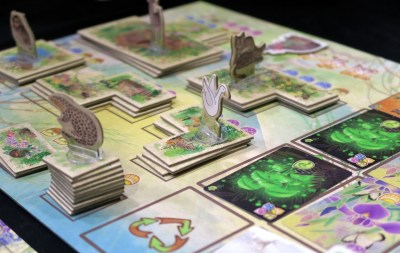
Horticulture Master
– Image by boardGOATS

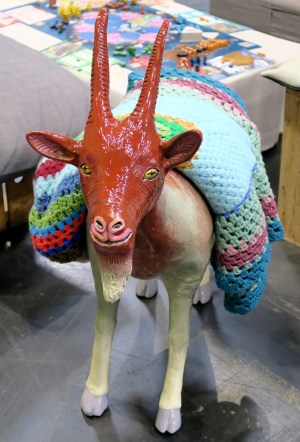
One of the reasons for attending conventions is the opportunity to see and play games that are not available elsewhere.  One example was Horticulture Master, a cute little Taiwanese game with beautiful artwork, which combined card collecting elements from Splendor with Tetris-like tile laying from games like Patchwork and Bärenpark.  Another cute little game was Titans of Quantitas from Gingerbread Games, a clever two player strategy game based round the old fashioned digital rendering of the number eighty-eight.  What really made this game special though was the fact that the stall was guarded by a fiberglass goat!  Not everything was quite as wholesome though, as one Games Master was thrown out and banned for life for including content in a role-playing game that allegedly involved sexual violence and played on the shock factor.  This is definitely the exception rather than the rule, however, and UK Games Expo is a great place for family and friends to spend a weekend.

UKGE 2019
– Image by boardGOATS

30th April 2019

For a while, it looked a lot like the “Feature Game”, Lewis & Clark , wasn’t going to happen – it’s a longer game and one that requires a specific type of gamer.  Of the usual candidates for this sort of game, Burgundy had given notice that he was feeling under the weather, so wouldn’t be coming; Blue was in attendance but was feeling a bit off-colour too; Black wasn’t in the mood for something heavy; Mulberry was recovering from jet-lag so needed an early night, and Green and Ivory hadn’t arrived by 8pm.  Inevitably though, we were just deciding what else to play when Green and Ivory turned up and looked keen to give Lewis & Clark a go.
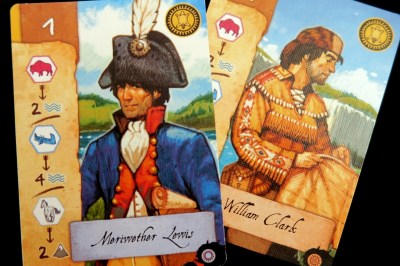
Lewis & Clark
– Image by boardGOATS

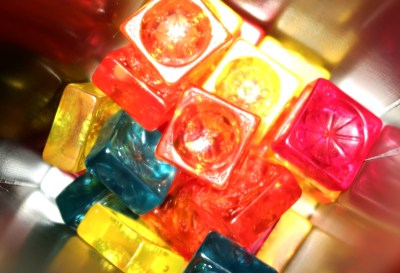
With Blue joining them, that left Black, Purple, Mulberry and Pine (who was celebrating coming off his antibiotics again), to come up with something to play.  While everyone played musical chairs, suggested games and admired Blue’s shiny new copy of Roll for the Galaxy: Rivalry (freshly muled from the US by Mulberry), the foursome decided to play Azul: Stained Glass of Sintra.  This is the new implementation of last year’s Spiel des Jahres winner, Azul, which features the same market, but with glass pieces instead of ceramic tiles.
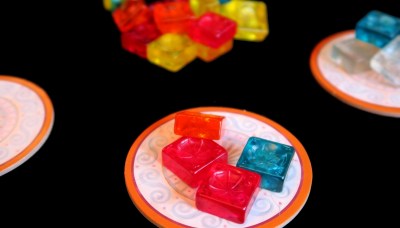
Azul: Stained Glass of Sintra
– Image by boardGOATS

The differences are more than cosmetic though – instead of placing their pieces in a row and moving them onto a grid, pieces are placed directly into the player’s window.  This is modular consisting of the double-sided strips laid out at random so everyone has a different starting setup.  There are restrictions on how the pieces can be placed though:  tiles must be placed in the strip immediately below their Glazier meeple, or in a strip to its right.  The Glazier is then placed above the strip the tiles were placed in,, so he gradually moves to the right. Instead of taking tiles, players can choose to reset the Glazier’s position, moving him back to the left most strip.
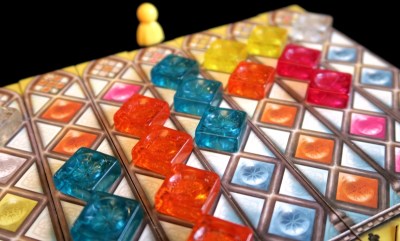
Azul: Stained Glass of Sintra
– Image by boardGOATS

Players get points when strips are completed scoring the sum of the score depicted below the strip and any strips to the right that have already been completed. There is also a colour bonus—each round has a colour drawn at random at the start of the game, and any tiles that match the colour for the round score extra. Once a strip has been completed, it is flipped over; after it has been filled a second time it is removed. Any left over tiles that cannot be placed are placed into the glass tower and yield a penalty with players moving along a negative score track which has small steps at the start that gets larger. When the market is empty the round ends and the round indicator tile is also dropped into the glass tower which is emptied when the .  There are also end-game bonus points with two variants available, one colour dependent and the other rewarding completing adjacent strips.
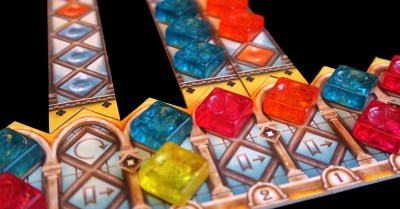
Azul: Stained Glass of Sintra
– Image by boardGOATS

Mulberry was new to the game and had not even played the original Azul, despite it having been so popular within the group.  Pine, Purple and Black had, of course, played the original game many times, but were less familiar with the Stained Glass of Sintra variation and Pine at least had played it just once.  It was a tight game and it wasn’t clear who was going to win until the end of the sixth and final round when it became apparent that Black was in a good position to make a killing and probably take an insurmountable lead.  Unfortunately, for him, he snatched defeat from the jaws of victory by putting his red glass pieces in the wrong place.  Pine meanwhile had made  a bit of a mess of things elsewhere which left him a score of minus ten for his unused tiles, but this wasn’t enough to knock him of the top of the podium where he sat two points ahead of Black in second and a few more ahead of Mulberry in third.
Azul: Stained Glass of Sintra
– Image by boardGOATS

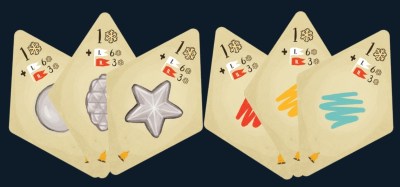
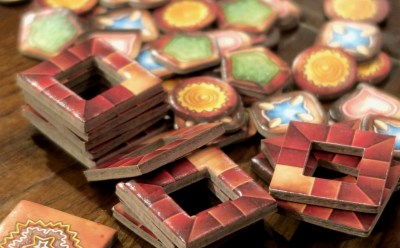
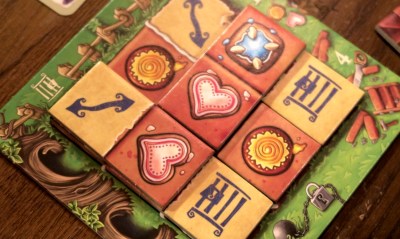
Mulberry needed an early night to help with the jet-lag and Lewis & Clark was still underway, so the remaining three decided to play a recently released game, Gingerbread House.  In this game players are witches in the Enchanted Forest, building their gingerbread house and attracting hungry fairy tale characters with colorful gingerbread.  Each player has a player board showing a three-by-three grid of building spaces with a symbol on each space.  They also have a pile of rectangular tiles each featuring two squares showing two symbols, a bit like dominoes, which are placed face-down in a stack with the top three turned face up (a little like the train cards in Ticket to Ride).  On their turn, players draw one of the face up tiles and place it on their player board, then carry-out the effect of the symbols they covered up.  The most likely symbol is one of the four different types of gingerbread, which means they collect a token of that type.

Gingerbread House
– Image by boardGOATS

Sometimes a player wants to cover two squares on different levels, in which case “stair” tiles can be used as a spacer; players can also receive these as an effect of placing tiles, or they receive two stair tiles if they forfeit their turn.  Other effects include the opportunity to swap one type of gingerbread for another or cage a fairy tale character.  If the two symbols covered are the same, the player gets the effect three times instead of twice adding a positioning element to the tile placement.  Once a tile has been placed, the active player can use some of their gingerbread tokens to capture fairy-tale characters, either from the face up character line or from their “cage” trap near the gate of their cottage.  If placing tiles completed a level, the active player may take a bonus card (up to a maximum of three).
Gingerbread House
– Image by boardGOATS

Pine, who had not played the game before went for a very tall house combo, taking a “Chimney” bonus tiles which reward players with eight or more levels (complete or incomplete) and a “Treasure Chest” bonus which would give points if his had at least four complete levels.  Black started off capturing the most valuable fairy tale creatures and then added the “Magic Wand” bonus card which gave him even more points.  Purple meanwhile, also concentrated on the characters she was capturing, taking the “Cauldron” bonus, which rewarded her for catching non-human characters.  Black’s strategy was very effective and, although the characters are hidden once they are taken, so it was no surprise that he was well in front, scoring as many points for his characters alone as Purple and Pine scored in total.  It was really close for second place, however, but Pine just pipped Purple by a single point.
Gingerbread House
– Image by boardGOATS

Meanwhile, on the next table, Ivory, Green and Blue had been playing the “Feature Game”, Lewis & Clark.  This is a resource collecting race game, with a deck building element.  Players are explorers trying to get from St. Louis to Fort Clatsop, traveling up the Missouri River over the Rocky and Bitterroot Mountains through Montana and Idaho, and down the Columbia River to the Oregon coast.  Players do this by playing character cards from their hand which provide actions including gathering resources, traveling or converting primary resources into secondary resources.  There are several very unusual things about the game.  Firstly, each card has a power as well as an action.  Whenever a character card is played it must be empowered either by playing a second card and using it’s power rating, using natives, or a combination of both.  This dictates how many times the action is carried out (up to a maximum of three).
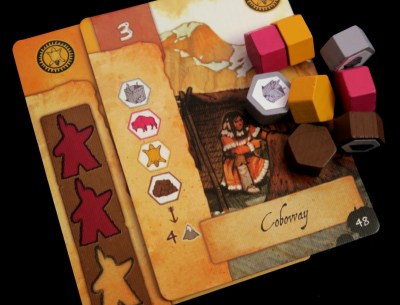
Lewis & Clark
– Image by boardGOATS

Once a card has been played, either as an action or to activate another card, they are placed on the player’s personal discard pile, so there is also an element of deck-building to the game, with more characters available through the “Journal” .  Of course, the most exciting cards are those with the highest rating, so using them to activate other cards may be efficient, but means that action will not be available until the deck is recycled.  This is another interesting and clever aspect of the game:  each player has their “Scout” and their “Camp”, and they move their scout along the rivers and through the mountains and then, when they “make camp”, they move the camp to join the Scout and pick up all their used cards.  This is a similar mechanism to that used in K2 where players have tents to shelter in, however, in Lewis & Clark the key part is that there are “time penalties” that penalise inefficiencies, like any unused character cards.
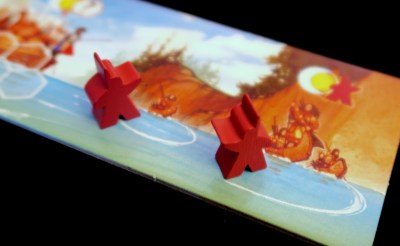
Lewis & Clark
– Image by boardGOATS

As well as the cost associated with inefficient use of their characters, there are also penalties for hoarding resources.  In order to travel players need buffalo (or bison…?), canoes, and horses, Acquiring canoes and horses require other resources and these must be transported to the new camp by boat—the more resources a player has when their camp moves, the more costly it will be.  Each player’s expedition also has a number of natives, and these also travel by boat.  Players start with five boats three that will hold resources and two for the natives; transporting two resources and one native is free, but the costs increase significantly when more travel.
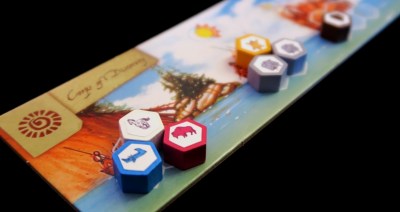
Lewis & Clark
– Image by boardGOATS

Another interesting mechanism used in the game is way players gather some of the resources.  Each player starts with action cards that generate the four primary resources, wood, equipment, fur and food (depicted by buffalo, or bison—what’s the difference?  You can’t wash your hands in a buffalo…).  These have a brown, grey, pink or yellow icon associated with them and each character card depicts one of these.  When a player plays, for example, a lumberjack card, they get wood equivalent to the number of visible brown icons visible in front of them, but also those displayed by their each of their neighbours.  Thus, if a player has two wood icons in front of them, and their neighbours have another two each, they would get up to six wood (enough to make four canoes), and if they activated that card three times, that would increase to eighteen.  If both neighbours decided to make camp, however, they would pick up all their cards and playing that lumberjack activated once would then only yield two wood.  Thus, timing is critical and one turn can make all the difference.

Lewis & Clark
– Image by boardGOATS

Instead of playing a character card, on their turn, players can take a village action by placing a native on the board.  Some of these locations, like the Hunter space, can only hold one native, so the player can only take the action once and nobody else can visit the Hunter to get food and fur until the space has been vacated.  Other spaces like the Canoe Maker, can be visited many times, so a player who has a lot of wood can turn them into up to three canoes.  Natives can also visit the Shaman, which enables players to repeat another player’s Character card.  This turned out to be really important as spaces are only emptied when a player plays their Interpreter card.  The Interpreter calls all natives on the board to a powwow in the middle of the village and then as many of these natives as desired can be recruited for that player’s expedition.
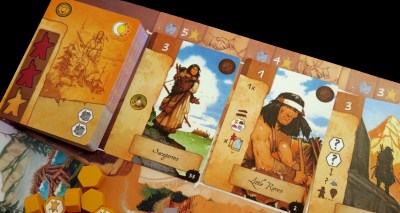
Lewis & Clark
– Image by boardGOATS

Once per turn, before or after the compulsory action (playing a Character card or deploying a native in the village), players can make camp and recruit new Characters from the face up cards drawn from the Journal deck.  Each character has an intrinsic cost in equipment, as well as a cost in fur dependent on it’s position in the Journal.  There is a potential for hands to become full of unwanted cards, however, it is possible to use one card to pay part of the cost.  Additionally, there is a location in the village, “Farewell” that players can use to discard cards and also refresh the Journal.
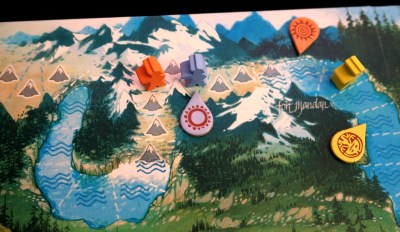
Lewis & Clark
– Image by boardGOATS

Although the game seems to take an inordinately long time to play, it is not actually that complicated.  Essentially, players are trying to gather resources and use these to recruit helpful Characters and acquire secondary resources (horses and canoes) and then use these to travel along the rivers and through the mountain.  Although it seems simple, planning and timing is absolutely critical—getting it wrong can easily mean that a Scout finishes his round behind his camp so that the expedition fails to move forward.  The location of the mountains can mean that even a successful forward movement may be inefficient as The Commander (the movement Character card everyone starts with) only allows players to use canoes to move four spaces along the river and horses to move two spaces in the mountains.
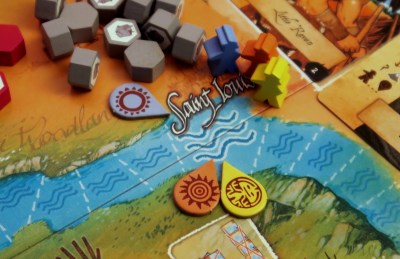
Lewis & Clark
– Image by boardGOATS

Ivory went first and began by collecting resources, followed by Blue and then Green.  Blue was the first to move and headed off up the river from St. Louis and then made camp.  Ivory and Green weren’t far behind, but when they came to make camp the time penalties they accrued meant they actually went backwards.  This is not always such a bad move in this game if it is due to building a robust engine for later in the game.  So in the first few rounds it looked like Blue had a massive lead, but that didn’t last as the others began the chase.

Lewis & Clark
– Image by boardGOATS

Blue was first into the mountains and then realised she had mis-read her expedition leader  card and found that horses would only move two spaces each through in the mountains, not four (like canoes).  The mountains are key to the game and particularly changing ovement and avoiding wasting moves.  Green thought he had it sussed with his Cut Nose Character card, but hadn’t checked the rules and just assumed that it would allow him to move one space through the mountains without needing any resources.  That would have made it a very powerful card, as trading for horses to get through the mountains requires three nonequivalent primary resources per horse (which moves two spaces).  He was very disappointed and, like Blue had to completely reconsider his options.
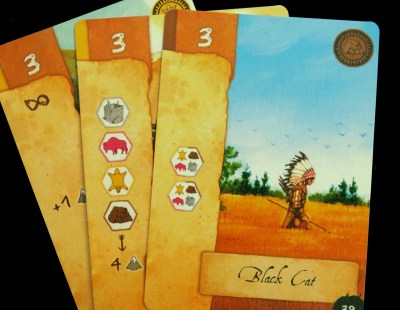
Lewis & Clark
– Image by boardGOATS

Meanwhile, Ivory had a plan to get his expedition through the mountains.  His combination of the Black Cat and Coboway Character Cards meant he could collect any missing resources he needed easily and then use them to move fast through the mountains.  Inevitably, with Blue mired in the mess she had made, Ivory galloped into the lead, but he still had the Colorado river to negotiate before he could get past fort Clatsop and make camp.  For this he needed natives, but so did Blue.  Unfortunately for Blue, the fact that Ivory was ahead of her in the turn order meant he was able recruit more natives and it wasn’t long before his expedition paddled past the finishing line, and, despite a large time penalty, made camp on the Oregon coast, a very worthy winner in what had been a very enjoyable game.  Definitely one to play again.
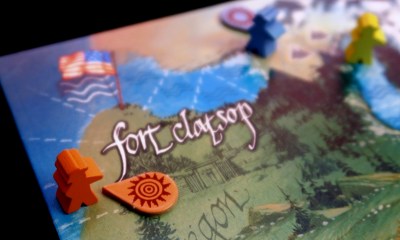
Lewis & Clark
– Image by boardGOATS

Learning Outcome:  Many native Americans have unpronounceable names.

11th December 2018

Since this was the last meeting before Christmas, we did what we did last year and arranged to eat a little earlier so we could all share an “Un-Christmas Dinner” together, complete with festive crackers and party poppers.  Plans were nearly derailed by gridlock in Oxford that delayed Blue (and by extension the crackers, party poppers, cards and the “Feature Game”), and motorway traffic that slowed Pink in his long trip from the frozen north.  Between their arrival and food appearing, there was just time to play a little game of “Secret Christmas Cards” – the idea being that everyone got a suitably festive goaty card and a name, and write the card to that person signing it on behalf of the group.  Once we’d got over the lack of pens, the “game” seemed to go very well, though a lot of people didn’t open their card, saving the excitement for later.  Green arrived and his announcement that his divorce had come through was greeted with a round of applause.

Pizza at the Horse and Jockey
– Image from horseandjockey.org

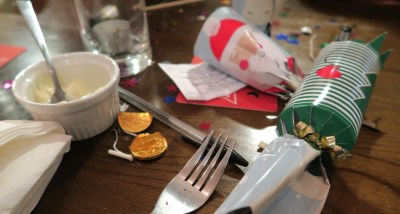
Once the cards, pizza, “half a side of pig with egg and chips”, burgers and ice-cream had been dealt with, it was time for crackers.  We had been just about to pull them when food arrived, and knowing what was in them, Blue suggested they’d be better left till the end of the meal as people might not want cracker contents as a topping to their pizza!  It was just as well, because when everyone finally grabbed a couple of cracker ends and pulled, there was an explosion of dice, mini-meeples, wooden resources, tiny metal bells, bad jokes, party hats and festive confetti that went everywhere.  The table went from mostly ordered to complete devastation at a stroke, to which party popper detritus was quickly added.  It was immediately followed by everyone trying to work out where the bits from their cracker had ended up and as some people ferreted under the table, others began to read the jokes (which turned out to be quite repetitive).  While the table was being cleared, subject of the “Golden GOAT” award came up.  This had first been mentioned a few weeks back by Ivory who had suggested we should have a game that we’d played during the year that deserved an award (presumably he was completely unaware that “Golden Goat” is also a strain of marijuana).

"Un-Christmas Party" 2018
– Image by boardGOATS

Pine suggested that there should also be an award acknowledging the worst game of the year, which eventually became the “GOAT Poo” award.  Unfortunately there wasn’t really a plan for how to go about doing this.  In the end, Ivory and Green tore up some slips of paper and passed them round with the book so everyone could “vote”.  The rules were quite simple, only games played at a GOATS games night in 2018 (i.e. appear in the log book) could be nominated and everyone got just one vote. There was real concern that we were just going to end up with a list of different titles and two nine-way ties, but surprisingly, that did not happen.  As the votes were read out, it became clear from the appreciative noises round the table that many of the picks were very popular choices, including Yokohama and Keyflower: The Farmers.  A couple of games managed the feat of appearing in both lists winning the unofficial “GOAT Marmite-factor” Award, namely Endeavor and Yardmaster.  The winner of the “2018 Golden GOAT” however was AltiplanoQueendomino took the “GOAT Poo” award with a third of the group nominating it (remarkable since only four of the people present had actually played it).

Golden GOAT - 2018
– Image by boardGOATS

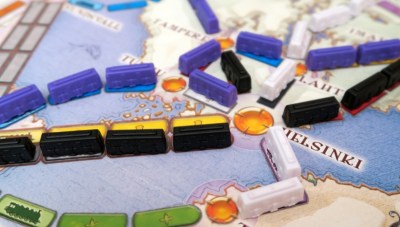
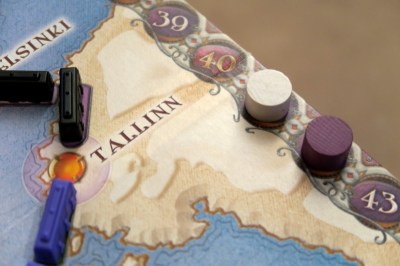
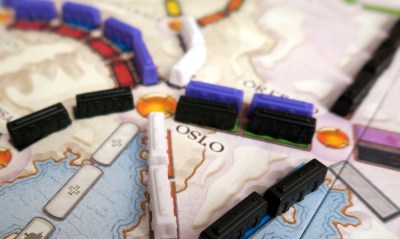
There was also a special award for “possibly the best and worst moments of the year” which went to Purple and Green’s inability to play Rock-Paper-Scissors (during Walk the Plank! a few weeks back) and Burgundy, the perennial Saboteur name last time.  Eventually, the table was cleared and the inaugural “Golden GOAT” awards had been announced, so people’s thoughts turned to playing games.  This year Ticket to Ride: Nordic Countries was a hot choice and with two copies, two games were quickly underway.  This is a variant of the very popular train game, but with a nice tight map designed specifically for two or three players and featuring a snowy festive theme.  The game play is almost exactly the same as the other versions, with players taking it turns to either draw carriage cards, or spend sets of carriage cards in appropriate colours to place plastic trains on the map.  There are a couple of things that really make the Ticket to Ride games work:  firstly, the longer the route, the more points it gets.  This often makes the longer routes very enticing, but this has to be set against the desirability of tickets (the second thing).

Ticket to Ride: Nordic Countries
– Image by boardGOATS

At the start of the game everyone chooses from a handful of ticket cards each depicting two cities and a value: players who manage to join routes together to connect the two cities get the depicted number of points at the end of the game.  The catch is that any tickets that players keep that are not completed successfully score negatively, and the swing can be quite devastating.  Ticket to Ride is a game everyone knows well and although we don’t play it often it is always enjoyable (perhaps because we don’t play it too frequently).  The familiarity means that everyone always fancies their chances at it though, which tends to make for very competitive games and the group really benefits from the variation that the different maps and versions offer.  On the first table, the game started out in much the same way as all Ticket to Ride games.  Ivory placed trains first, but Mulberry and Green followed soon after.  It wasn’t long before Ivory was drawing more ticket cards (instead of taking carriage cards or placing trains) and Green soon followed with Mulberry taking a little longer.

Ticket to Ride: Nordic Countries
– Image by boardGOATS

As is usual, the colour cards that players wanted, just seemed to refuse to come up and everyone’s individual hand of cards grew even as the board filled with more tickets taken at regular intervals.   In the early stages the trio were fairly well matched.  Green was starting to pull ahead and then for some reason abruptly stopped and his hand of cards grew and grew.  He had said that he was going for it and it would either pay off or he would lose abysmally. Mulberry and Ivory had nearly twice as many points as Green when he finally laid a train:  the nine-carriage route giving him twenty-seven points and propelling him into the lead by more than his previous deficit.  Everyone still had lots of trains left though, so the game was far from over.  Eventually, Mulberry brought the game to a sudden halt when she placed her last three trains, catching the others by surprise.

Ticket to Ride: Nordic Countries
– Image by boardGOATS

With their last turn they scrabbled for the longest route they could manage.  Since Green still had a handful of cards he was able to take a six-carriage route for a healthy fifteen points, however, that meant he had to abandon his twenty-four point ticket as he still needed two, very small routes to complete it.  The group decided to forgo recounting the points for placing trains and decided to assume they had kept on top of the scores during play.  Green was ahead in points for train placement by quite a margin, but Ivory and Mulberry had completed more tickets and Green was crippled by the forty-eight point swing caused by his incomplete ticket.  Mulberry took bonus for the the most completed tickets (by only one) and ended just one point behind Ivory.  With the score at the top so close they decided they had to double check all the scores and after a complete recount, there was a reversal and Mulberry edged Ivory out by one solitary point.

Ticket to Ride: Nordic Countries
– Image by boardGOATS

On the next table the story was a little different, with Pink, the “Prophet of Doom” goading Pine offering him advice to give in before he’d even started as he was in for a torrid time playing against Blue and Burgundy.  Pine didn’t see it like that however, and as he likes the game, he really fancied his chances.  Fortune favours the brave, and he was out of the blocks like a greyhound with a fifteen point placement in just his second turn.  From then on, it was fast and furious with players fighting to secure the routes they needed to complete their tickets.  Blue and Pine kept fairly level and began to pull away from Burgundy, but neither of them dared to get complacent as he usually has a master-plan that he’s waiting for the perfect moment to enact.

Ticket to Ride: Nordic Countries
– Image by boardGOATS

Pine drew more ticket cards and Blue followed, keeping pace every step of the way while Burgundy kept drawing carriage cards.  Eventually Blue drew ahead in the “taking tickets” race, but it was one set of tickets too far for her as she drew three moderate to high scoring cards that were all unplayable.  Fearing she’d pushed her luck one step too far, she kept the lowest scoring card (i.e. the one with the fewest negative points) and pondered her options.  Pine took tickets and it was clear he had hit a similar problem though at least two of his were playable, if difficult.  In the end, he took a twenty-one point ticket that needed a little work, giving Blue an interesting choice.  In addition to the unplayable ticket, she had one low-ish scoring ticket left that she only needed one card to complete.  She’d been waiting for that single yellow carriage for a while though and persisting could allow Pine time to complete his new ticket.

Ticket to Ride: Nordic Countries
– Image by boardGOATS

Although she didn’t know the value or difficulty of Pine’s final ticket Blue felt sure it was high scoring and that he would need a few turns to complete it.  With a large set of pink cards and not many trains left, it gave her a chance; by placing a largely arbitrary route she triggered the end of the game.  Burgundy squeaked, although it had looked for all the world like he was trying for the long route, in fact he was really hunting for a locomotive (wild) card or a single orange carriage to complete his route into Narvik (though he came very close to getting nine cards necessary for the long route by accident).  The irony was that Blue had picked up loads of locomotive cards in her hunt for the single yellow, but hadn’t wanted them and had been unable to find yellow cards because Burgundy had them all!  In his penultimate turn, Burgundy had finally drawn his last orange card enabling him to finish his final, long ticket on his very last go.  Pine on the other hand was less fortunate and fell short, taking a swing of forty-two points which more than off-set Blue’s incomplete tickets.

Ticket to Ride: Nordic Countries
– Image by boardGOATS

The group recounted the train points and found a few extra points for Blue, but it was still very close and all down to the tickets.  Blue had mostly low-scoring cards; where Pine had one fewer, they were more valuable.  In the end, Blue finished twenty-three points ahead of Pine, but she had managed to complete one extra ticket which had given her the ten point bonus – had it gone to Pine there would have been a twenty point swing and the second group might have had a recount too.  Both Ticket to Ride games finished at much the same time and while the third game was finishing off, the two groups compared notes.  It was then that the first group realised they had not played quite correctly, as there is a rules change in this version that means locomotive cards can only be used as wilds on tunnel and ferry routes, not on ordinary routes.  This explained why Green had managed to succeed at his long route when Burgundy had failed. While playing correctly would have changed the game, there was no accusation of cheating as Ivory and Mulberry who had been playing that game had played by the same rules.

Christmas Tree
– Image by boardGOATS

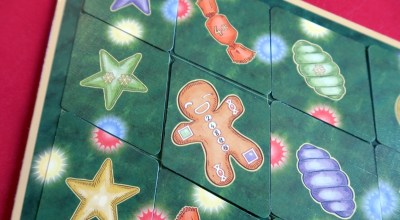
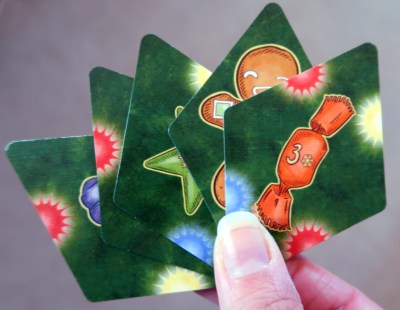
Meanwhile, while the two ends of the table were playing with their train-sets, the trio in the middle were decorating their Christmas Tree.  This game is a cute little card drafting game that originated in Hungary.  The game takes place over three rounds during which Christmas decoration cards are drafted. After each card is chosen, the player puts it anywhere they like on their tree.  After seven cards, the round ends and the trees are evaluated.  Decorations include gingerbread men, glass ornaments in different shapes, wrapped sweets and, of course, festive lights.  The gingerbread men have different markings on their hands and feet and the more that match the adjacent decorations, the more points they score.  Some glass ornaments and all the sweets score points directly; lights only score if both halves match.

Christmas Tree
– Image by boardGOATS

The decorations only score at the end of the game though;  objective cards are evaluated at the end of each round.  At the start of the game each player receives four objective cards and at the start of each round everyone chooses one; these are shuffled and before the round begins.  The trees are therefore evaluated at the end of each round according to these objectives.  and then decorations score at the end.  One of the things about this scoring mechanism is that it’s often not obvious who is in the lead during the game as there are so many points awarded at the end.  This game was no exception, and was ultimately very close as a result.  It is one of those games that benefits from experience, and Black and Purple’s who had both played before took first and second, in that order.

Christmas Tree
– Image by boardGOATS

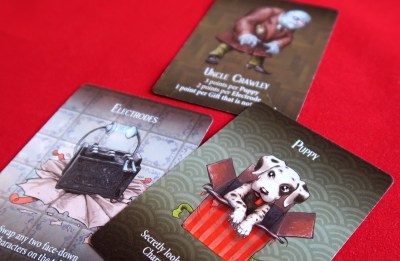
There was time for something else.  Inevitably, we threatened Pink with Bohnanza (he has possibly the smallest amount of love for the game per copy owned), but it’s lack of festiveness, meant it was a hollow threat.  We still had the “Feature Game” to play anyhow, which was Giftmas at Dungeon Abbey.  This is a mad game by a local gamer and member of the Didcot Games Club, Rob Harper set in a world that is a sort of cross between Downton Abbey and the Adams Family.  The artwork is suitably gruesome, though it was very clear from the start who the Countess D’Ungeon was a caricature of!  Played over several short rounds, each player takes the role of one of the various eccentric and unpleasant family members grasping for whatever feels like the best present.  To this end, players begin with a character card and a couple of gift cards, all face down on the table in front of them.  On their turn, the active player may either swap one of their face-down cards with one elsewhere on the table, or turn a card face-up, possibly activating a special action on the gift cards.

Giftmas at Dungeon Abbey
– Image by boardGOATS

The round ends when all a player’s cards are face up at the start of their turn or a bomb is revealed, at which point everyone scores points if they have collected the gifts wanted by their characters.  With six people playing nobody had a clue what was going on and mayhem reigned.  Ivory and Pine jointly took the first round giving them a point each, but after that, the gloves were off.  Purple took one round and Pine and Ivory took another each, so it was all down to the last round.  Green had spent most of the game trying to furnish Little Eugenia with two bombs, so when Blue realised he had the cards he needed to win the round, she made it her business to try to obstruct his plans.  Needless to say he spent the round getting his cards back.  With Blue and Green playing silly beggars in the corner, everyone else fought it out, but there was nothing everyone else could do to stop Ivory taking the point he needed to win.

Giftmas at Dungeon Abbey
– Image by boardGOATS

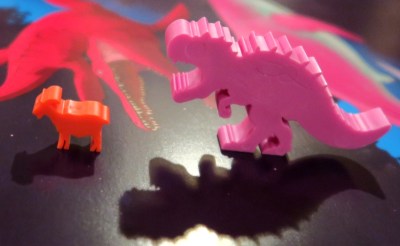
There was still time to play something else, but nobody was really in the mood so, instead, Blue and Ivory drooled over the fabulous pink dinosaurs from Ivory’s new arrival, Dinosaur Island.  Blue had nearly KickStarted the second edition, but had withdrawn when she’d heard Ivory was already committed to the project.  Needless to say, Ivory had brought his copy to show it off at the earliest opportunity, including plastic goats as well as dinosaurs.  And of course it will undoubtedly be a “Feature Game” sometime in the new year.

Dinosaur Island
– Image by boardGOATS

Learning Outcome:  Christmas Crackers can make an awful lot of mess.

Boardgames in the News: Who are PAI Partners and what do they want with Asmodee?

A couple of months ago, Reuters reported that according to un-named sources, investment bankers had been hired to run the sale of Asmodee.  The claim was that the sale “could value the company at over €1.5 billion”, but there was no credible information as to who the potential buyers were.  This mystery has now been solved with the announcement that PAI Partners have entered into exclusive discussions to acquire Asmodee, a company with an enterprise value of €1.2 billion.  So, who are PAI Partners and what do they want with Asmodee?  Well, PAI is a European private equity company, that grew out of the merger between the French banks, BNP and Paribas in 1993, with a management buyout completed in 2001.  They have invested in a wide range of companies covering everything from yoghurt (Yoplait) to tyres (Kwik Fit) to cargo handling (Swissport).  Obviously PAI are interested in making money from Asmodee, but at this time there is no evidence to suggest that would by by asset stripping.  Price increases would be almost inevitable however, as the Studios would be under pressure to provide a good return on the investment.

PAI Partners
– Image from paipartners.com

Boardgames in the News: Asmodee For Sale‽

Over the last few years Eurazeo have developed Asmodee from a small French games company primarily known for a clever little kids game called Dobble, into an industrial conglomerate swallowing up the likes of Days of Wonder, Fantasy Flight Games, Z-man Games, Mayfair, and Lookout Spiele.  In the process, Asmodee added some of the most high profile modern boardgames to their portfolio, including Ticket to Ride, Carcassonne, Pandemic, Agricola, Star Wars X-Wing Miniatures Game, SplendorDead of Winter, Settlers of Catan (now known simply as “Catan”) and as of this weekLove Letter.  Speculation as to the end result has been rife, here and elsewhere.  Indeed, three months ago we raised the question:

…it would seem that Eurazeo is not looking to hold onto Asmodee for the long haul, instead they will be looking to maximise Asmodee’s growth and then make their exit, probably in the next two to five years.  So the big question is, how are Eurazeo going to make their “controlled exit”?

Reuters now reports that according to un-named sources, the answer is, “Sell Asmodee”.  Apparently, investment bankers have been hired to run a sale process which they claim could value the company at over €1.5 billion (quite a return for Eurazeo who originally paid €143 million for Asmodee in November 2013).  As yet, there is no credible information as to who the potential buyers may be, but if the news that Asmodee is to be sold is true, there will no doubt be plenty of speculation over the coming weeks and months.  Possibilities range from a major toy manufacturer like Hasbro or Mattel wanting to add expand their range of boardgames, to venture capitalists companies going for maximum short term profits, leading to reduced quality and increased prices.  No doubt, time will tell…

Asmodee Logo
– Image from
escapistmagazine.com

Boardgames in the News: Osprey Plays Games at Blackwell’s

On 28th April 2018, Blackwell’s Bookshop in Oxford are holding their second games night in collaboration with Osprey Games, a small games publisher based up Cumnor Hill.  Originally owned by Berkshire Printing, part of Brooke Bond, the tea company, Osprey was formed in 1969 to publish “Aircam Aviation“, a series of books that grew out of the aviation illustrator Richard Ward’s work on the collectable tea cards.  In 1998, Osprey became an independent company and moved from London to Oxford and began focusing exclusively on publishing on warfare and military history books.  Over the last ten years, Osprey has been publishing the Bolt Action rules used for World War II simulation games, but more recently has also engaged in reprinting some of the lesser classic board/card games.  This includes Martin Wallace’s London, Reiner Knizia’s High Society and Patrick Reid’s semi-cooperative game, Escape from Colditz.

Osprey Games
– Image from tabletopgamingnews.com

Blackwell’s is a very well known independent Oxford bookshop, but given the increasing popularity of board gaming in Oxford, they have jumped on the band-waggon and now stock a moderate range of modern board games including staples like Ticket to Ride and Carcassonne.  Last October when London was re-released, Blackwell’s had copies available for pre-order for significantly less than they were being sold for at Essen a couple of weeks later.  Since then, Blackwell’s have had good deals available for other Osprey games as well, including Star Cartel and The Lost Expedition.  It is clear that Blackwell’s and Osprey Games are building a strong working relationship which was consolidated back in February when they held their first joint board games evening at Blackwell’s Bookshop on Broad Street.  This was clearly very successful, as there is now a second games evening planned for Saturday 28th April, 7pm-10pm.  There is a £4 entry fee, but that includes a free drink at the bar.

Blackwell's Bookshop Oxford
– Image from theguardian.com

Boardgames in the News: What is Asmodee’s Grand Plan?

Four years ago, Eurazeo bought a small French games company called Asmodee from the investment firm, Montefiore.  Asmodee were a small company hitherto primarily known for a clever little kids game called Dobble.  With the financial might of their parent company behind them, over the next few years, Asmodee proceeded to gobble up many larger, well-established companies, including Days of Wonder, Fantasy Flight Games, Z-man Games and most recently, Lookout Spiele.  Those companies produced some of the best known modern games including Ticket to Ride, Carcassonne, Pandemic, Agricola and Star Wars X-Wing Miniatures Game.  Not content with that, they also acquired the rights to the English language version of the Settlers of Catan (now known simply as “Catan”) and all the related Catan games as well as gobbling up a number of smaller and/or newer companies like Space Cowboys (producers of Splendor and Black Fleet) and Plaid Hat Games (producers of Dead of Winter and Mice and Mystics) and entering into a distribution agreement with many others.  There are now very few games companies of any substance that are not somehow tangled in the Asmodee web.

Star Wars: X-Wing Miniatures Game
– Image used with permission of BGG contributor adamfeldner

The last major purchase was F2Z Entertainment in 2016, and since then it has been relatively quiet.  With the new year comes a new wave of acquisition, however, so at the end of January Asmodee announced that they were in exclusive negotiations with Rebel.  Rebel is a relatively small, Polish company responsible for games like K2 as well as Polish editions of many popular games like 7 Wonders and Codenames.  Perhaps more importantly, Rebel also produces the Polish language versions of many of the Asmodee games and is the largest distributor in Poland.  And Poland is a big country, smaller than France or Germany, but bigger than Italy and the UK,  globally Poland is the thirty-forth largest country by population.  That is a lot of Poles and they do like playing board games in Poland.

K2
– Image used with permission
of boardgamephotos

This announcement was almost immediately followed by the bombshell that Asmodee had acquired all the residual assets from Mayfair and with it, Lookout Spiele. Although this is by far the largest deal in recent months, Asmodee have not been resting on their laurels and there has been a lot going on behind the scenes.  In December last year they announced that Esdevium was to be renamedAsmodee UK” bringing them in line with the “Asmodee North America” and “Asmodee Canada” brands.  At around the same time, Eurazeo announced that French publisher Purple Brain Créations would be joining the Asmodee Group.  Furthermore, they have also been streamlining their distribution network in North America.  Having reduced the number of distributors they deal with to five in 2015, in June last year Asmodee North America announced an exclusive distribution deal with Alliance Game Distributors, effectively creating a monopoly of supply within the USA.  This coupled with their Minimum Advertised Price policy (or MAP) gives them a stranglehold on the US market in a way that would never be allowed in Europe.  Whether they are planning to take that one step further and acquire Alliance themselves still remains to be seen, but that looks like a real possibility.  Finally, they have been pushing in a new direction, developing electronic versions of some of the most popular games through their studio, “Asmodee Digital“.

Asmodee Logo
– Image from
escapistmagazine.com

So what is Asmodee‘s Grand Plan?  Where will it all end?  Well, there are still a couple of other large manufacturers out there that are not yet part of Asmodee.  Looking at the companies they have already absorbed there is a clear trend: they typically have one particular feature that Asmodee are interested in.  In the case of Days of Wonder, that was the Ticket to Ride series, with Z-man Games it was Pandemic and Carcassonne, and with Rebel, it was probably their distribution network that caught the eye of the executives at Asmodee.  Going forward, the most obvious targets are probably Rio Grande Games, Czech Games EditionQueen GamesHans im Glük and maybe 2F, or Pegasus Spiele (who have just announced a partnership with Frosted Games).  For example, it would be surprising if Rio Grande Games have not been approached given the popularity of games like Dominion and Race/Roll for the Galaxy.  Similarly, Czech Games Edition are a small company with some very juicy morsels including Galaxy Trucker, Dungeon Lords/Petz, and the hugely successful Spiel des Jahres winner, Codenames.

Codenames
– Image by boardGOATS

Ultimately they may or may not add some or all of these to the Greater Asmodee Empire, but it is clear that at some point, eventually, there will be nothing left worth taking over and growth of the company will plateau, so what happens then?  And this is the crux of the matter. Some have speculated that the aim is to add Hasbro to Asmodee’s ever growing dominion, but Hasbro has a market value of $11.9 billion—Asmodee are mere minnows in comparison.  On the other hand, the parent company, Eurazeo are worth approximately $5.7 billion, which at least puts them in the same ball park, although even they are small by comparison.  According to the “Vision” page on the Eurazeo website:

The purpose of Eurazeo is to identify, accelerate and enhance the transformation potential of the companies in which it invests, even long after its exit. An active and committed shareholder, Eurazeo assists its holdings in the long term – 5 to 7 years – with control over exit timing. An extensive role enabling it to combine business development and corporate social responsibility.

So, it would seem that Eurazeo is not looking to hold onto Asmodee for the long haul, instead they will be looking to maximise Asmodee’s growth and then make their exit, probably in the next two to five years.  So the big question is, how are Eurazeo going to make their “controlled exit”?  With this in mind it seems unlikely that acquiring Hasbro is on the agenda, but making Asmodee attractive to Hasbro just might be…

Hasbro Logo
– Image from stickpng.com

Boardgames in the News: Radio 2 and Online

Over the last few years there has been a lot of anecdotal evidence that modern boardgames are becoming less of a niche activity, with a large number of reports in local and national media.  Last month alone, there was a prime-time article on BBC Radio 2‘s flagship Breakfast Show, where Chris Evans interviewed Dicky Duerden, Head of Games at the Chance & Counters Games Cafe in Bristol.  The interview took place shortly before 9am (2hrs 13 mins into the show) and discussed classic games like Connect Four and Kerplunk as well as their most popular games, Scrabble and Jenga.

Chris Evans
– Image from bbc.co.uk

The interview included a couple of nice little anecdotes, for example, Dicky Duerden explained that Battleship began life as a French game called “L’Attack” and was renamed twice, changing to “Salvo”, then “Broadside” before finally becoming “Battleship”.  He was also asked whether they have problems with players having temper tantrums and whether people lose pieces or walk off with them.  Apparently, Chance & Counters has heavy unflippable tables with shelves to store the games and cup-holders to help prevent spillage.  So, the most damage they’ve had to a game was when someone stole all the marbles from Hungry Hungy Hippos—presumably the thief couldn’t stand the noise!

Hungry Hungry Hippos
– Image from medium.com

Modern boardgames have also featured in print and other media channels.  For example, the literary and cultural commentary magazine, The Atlantic, recently reported how U.S. sales of boardgames grew by twenty-eight percent between spring 2016 and spring 2017.  They put this increase down to the rise in popularity of card games like Cards Against Humanity, Secret Hitler, and Exploding Kittens as well as what they initially refer to as “hobby” boardgames.  Although the article is written from a US perspective, it includes a nice commentary from Phil Eklund, head of Sierra Madre Games and designer of Pax Porfiriana, Greenland and Bios: Megafauna amongst others.  The interview with Phil Eklund is excellent and well worth a read; it includes discussion of Essen and Spiel des Jahres as well as discussion of a wide range of games including Power Grid, Biblios and El Grande rather than just the usual Settlers of Catan and Ticket to Ride.

Biblios
– Image by BGG contributor Schaulustiger

Every report about the growth of modern boardgames hides something less cheerful:  the number of stores that have closed in recent time.  As demand for modern games increases, so does their availability at places like Amazon, and that increases the pressure on an already squeezed niche.  In the last year or so, several excellent and well established stores have closed including Shire Games and Northumbria Games.  With prices continuing to rise—a new big-box game is rarely below £50 these days—and the growth of crowd-funding, more and more gamers are looking for discounts where they can.  The boardGOATS are lucky to have three excellent outlets locally, Eclectic Games (in Reading), Thirsty Meeples and The Gameskeeper (both in Oxford).  Perhaps the Chris Evans interview will encourage more people to pay them a visit.

Money
– Adapted from Image by Petras Gagilas (flickr.com)

Essen 2017

It is that time of year again when the gamers’ minds turn to Essen and – The Internationale Spieltage.  To Gamers worldwide, Essen is synonymous with the largest games fair in Europe and, arguably, the world.  The fair runs Thursday to Sunday in mid/late-October every year and is the one of the biggest and most significant of all the boardgame conventions with many new releases and timed to coincide with the end of October.  This year the first day will be this Thursday, 26th October and games, publishers and their wares are all making their way to Germany for four days of fun and games.

Essen
– Image from merz-verlag-en.com

Last year several of the group went, and they came back with a lot of expansions for well-loved games like Istanbul, Colt Express, and Orléans and picked up some new games like Key to the City – London, Ticket to Ride: Rails & Sails and Cottage Garden.  This year, new games include Queendomino, Indian Summer, Altiplano and Keyper, with expansions to old favourites like Isle of Skye, Imhotep, Ticket to Ride, Terraforming Mars and Splendor as well.  Once again, several locals are going and they are sure to bring back some interesting toys to play with over the coming months.

– Image used with permission of designer Richard Breese

Game Plan: Rediscovering Boardgames at the V & A Museum of Childhood

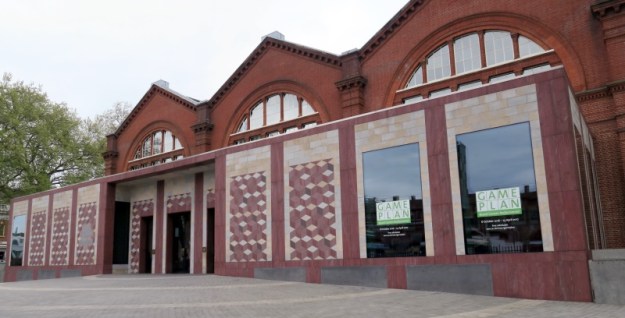
Inspired by the recent articles on Saturday Live and the Today Programme, on Easter Sunday, Pink and Blue decided to visit the V & A Museum of Childhood to see their “Game Plan: Board Games Rediscovered” exhibition.  Catching a train from Oxford Parkway and negotiating the London Underground, they arrived in Bethnal Green.  With its vaulted ceiling and exposed metal work, the Museum building looks for all the world like a re-purposed Victorian Civil building, a train station, swimming pool or maybe some sort of pumping station.  Much to their disappointment, however, after extensive discussion and investigation, it turned out that the building was designed for the purpose, albeit after relocation of parts from “Albertopolis” on Exhibition Road.

Game Plan: Board Games Rediscovered
– Image by boardGOATS

The exhibition itself was well presented and occupied a sizeable portion of the overall floor space.  Although it was located in one of the upstairs galleries, the exhibition was well advertised and, from entering the main hall, games were brought to the visitors’ attention with table space and signs offering the loan of games should people want to play.  It wasn’t an idle promise either, as there were several family groups making full use of the opportunity, albeit playing what might be called classic games rather than more modern, Euro games.

Senet
– Image by boardGOATS

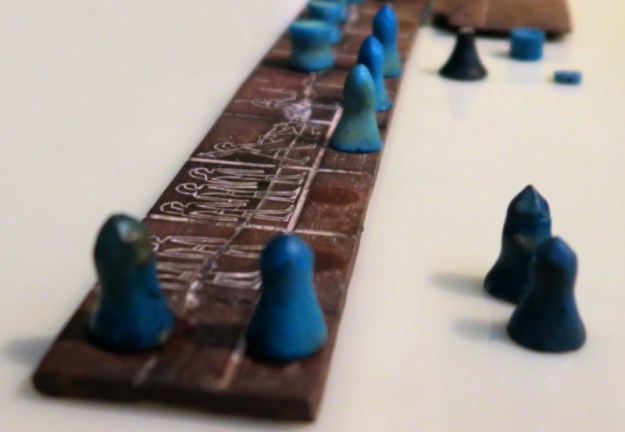
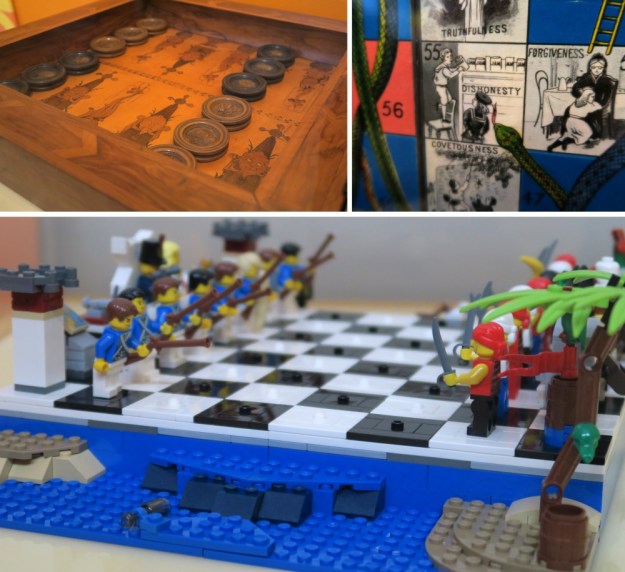
A quick look at the model train cabinet and brief spell side-tracked by one or two other exciting toys preceded entry to the exhibition which was shrouded by an eye-catching red screen.  The first exhibit was a copy of Senet, arguably one of the oldest games in the world – so old in fact that we’ve lost the rules and nobody knows how to play it.  This was followed by some traditional games including a beautiful wooden Backgammon set made in Germany in 1685 and decorated with sea monsters and a lot of fascinating Chess sets, old and new.  Next, there were some ancient copies of Pachisi (which evolved into Ludo) and Snakes and Ladders, both games that originated in India and were originally played seriously by adults.

Game Plan: Board Games Rediscovered
– Image by boardGOATS

Further round there were many other curious games, for example, The Noble Game of Swan from 1821, which was an educational game for children, itself developed from the much older, Game of the Goose.  Education was a bit of theme and there were a lot of games from the nineteenth and early twentieth century designed to teach geography in some form or another.  These included Round the Town, a game where players had to try to cross London via Charing Cross, and Coronation Scot, a game based on travelling from Glasgow to London inspired by the eponymous 1937 express train made to mark the coronation of George VI.

Game Plan: Board Games Rediscovered
– Image by boardGOATS

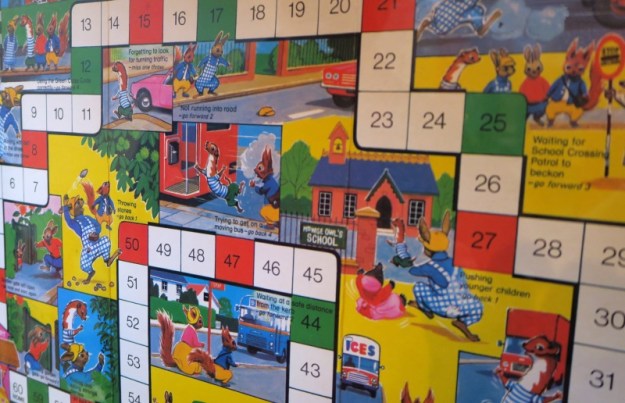
Education didn’t stop there either:  for those that had been members of RoSPA‘s “Tufty Club“, there was a game promoting road safety featuring Tufty the Squirrel and his mates Minnie Mole and the naughty Willy Weasel.  However, when designing this roll-and-move game, they clearly ran out of imaginative “adventures” with a road safety message, as they had to resort to “Picking and eating strange berries – Go back three spaces…”

Tufty Road Safety Game
– Image by boardGOATS

Progressing through the late twentieth century, there were the inevitable copies of the childhood classic games, including Game of Life, Risk, Cluedo, Mouse Trap, Trivial Pursuit, Connect 4, Scrabble and the inevitable Monopoly, all of which risked bringing a tear to the eye as visitors remembered playing them as children.  The exhibition eventually brought us up to date with modern Euro-style games, presenting copies of Ticket to Ride, Carcassonne and Settlers of Catan.

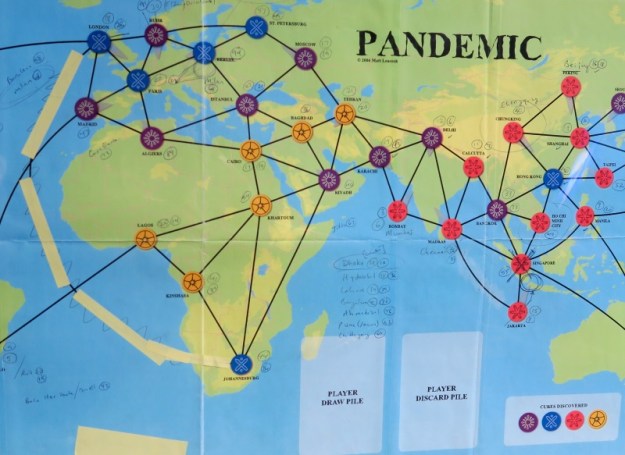
Pandemic
– Image by boardGOATS

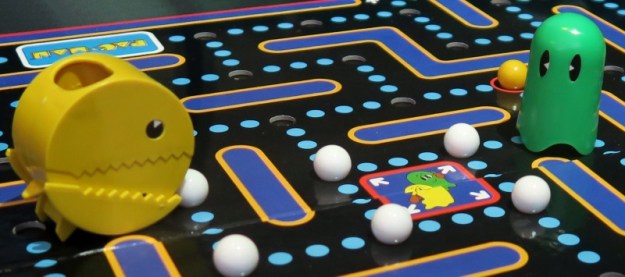
More interestingly, there was also an original prototype of Pandemic supplied by the designer, Matt Leacock, complete with his scribbles and bits of paper stuck over infection routes he decided to remove as the game developed.  One of the final display showed how the influence boardgames have had on the computer gaming industry is sometimes strangely reciprocated, with a copy of the Pac-Man game, including the title figure wrought in sunshine yellow plastic.

Pac Man
– Image by boardGOATS

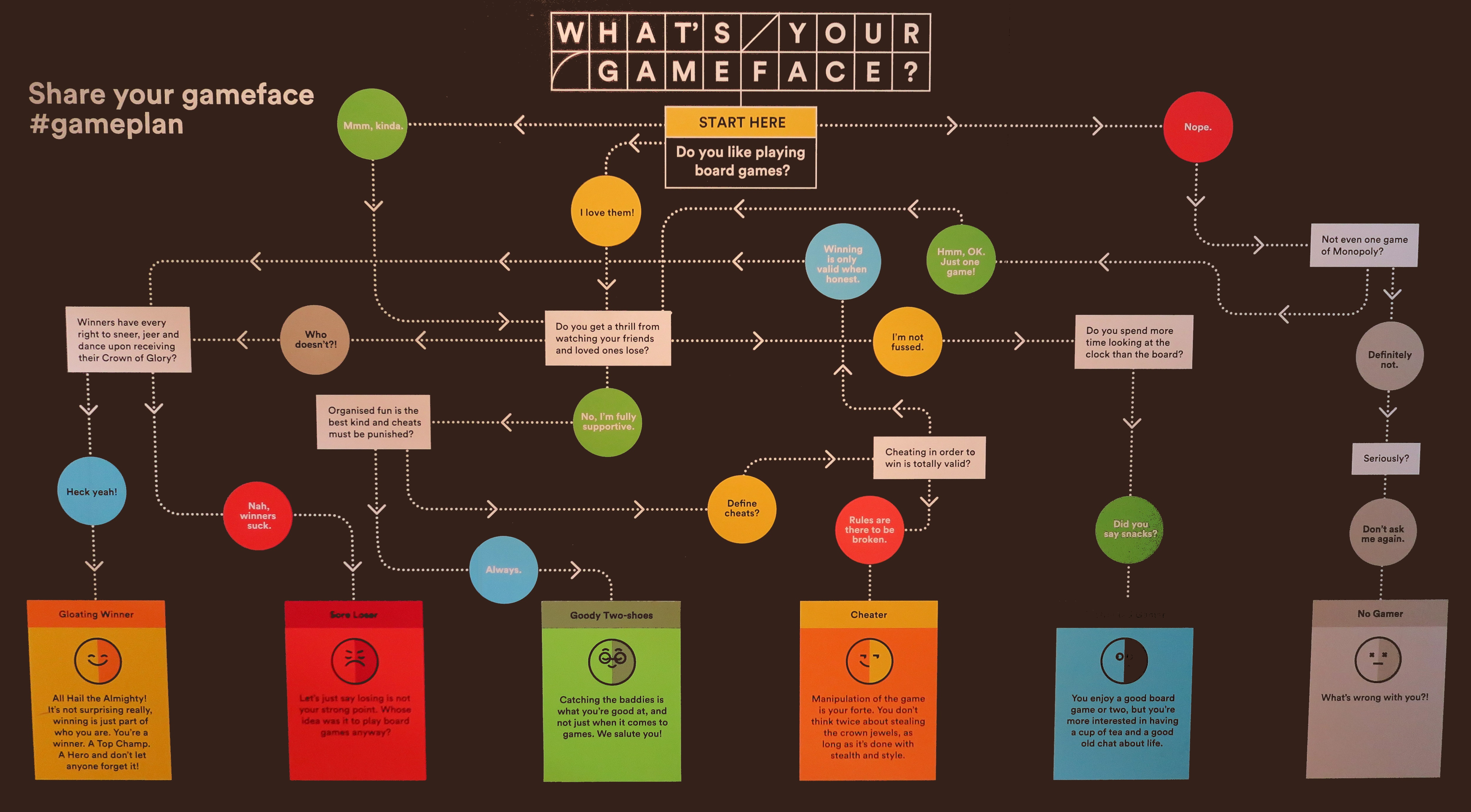
Leaving the exhibition, there was just one last game – “What’s Your Gameface?“.  This cute flow chart entertained Blue and Pink for far longer than is should have as they tested it out with all their friends, relatives and fellow gamers (nobody came out as “Cheater”).

Game Plan: Board Games Rediscovered
– Image by boardGOATS

With the exhibition done, there was still time for a wander round the rest of the museum and a quick cuppa in the cafe.  Reflecting on the exhibition, perhaps one of the best aspects had actually been the quotations that adorned the walls.  It seems luminaries from Plato to Roald Dahl have all had something to say on the subject of games.  Perhaps George Bernard Shaw supplied the most thought provoking comment though, when he said, “We don’t stop playing because we grow old; we grow old because we stop playing.”  With this in mind, we did what gamers do when they travel, so tea and cake was accompanied by two rounds of Mijnlieff, the super-cool noughts and crosses game.  With the museum closing, it was time to head home, but there was still time for a game or two of 3 Sind Eine Zu Viel! on the train back to Oxford…

Game Plan: Board Games Rediscovered
– Image by boardGOATS

The Exhibition is only open till 23rd April 2017, so there isn’t much time left and it is well worth a visit.