Tag Archives: Wingspan

Michael Parker (1958-2021)

Michael Jonathan Parker (mostly known as Mike in gaming circles) was the only son of Stan and Pam and was born on 27th August 1958 in Oxford at the Nuffield Maternity Home (part of the old Radcliffe Infirmary).  Brought up in the Botley area, he went to Mathew Arnold School where he was one of just three pupils who took O-Level Astronomy—a first for the school and pretty unusual anywhere at the time.

Mike Parker
– Image by Pushpendra Rishi

In 1976, Mike went on to study electronic engineering at the University of Hull, after which he returned to Oxfordshire to work in the developing world of IT.  Mike spent the rest of his life in the county, living in Botley until 2015 when he moved a short way down the A34, to Didcot.  Mike had many interests, including music and American football where he was a statistician for Oxford Saints.  One of his most enduring past-times though, was playing games.

Mike Parker & The Magic Folk
– Image from Mike Parker (origin unknown)

It was as a young man that this interest first developed, when he played Chess with his father.  They played regularly, both together and with friends.  Then, when the Oxford Magic: The Gathering scene started in the mid-1990s, Mike became hooked on that.  In the early days he played at events and tournaments, but more recently his passion was his Cube, the curated set he used for drafting.

Mike Parker
– Image from Didcot Games Club (origin unknown)

Mike worked hard on balancing his Cube, introducing new cards with each new release and attended every pre-release event in Oxford.  He also bought premium foil versions of cards, making his a very special Cube to play with.  Mike was well-known for favouring green when drafting, so if you were sat next to him at the table, you could usually be fairly certain that colour would be taken before you saw it.  Mike’s Cube Sundays were legendary and he continued to draft weekly until events intervened.

Mike with Mike and Joe setting up a new club
– Image from Mike Parker (origin unknown)

Around the turn of the millennium, every Friday night, Mike was playing Magic in Didcot.  So, when one of the Magic players started Didcot Games Club in 2001, Mike joined them too.  He was there from the first night, and took responsibility for looking after the finances.  His interest in the collectable nature of Magic quickly transferred, and he developed a fondness for Killer Bunnies and the Quest for the Magic Carrot, and later Dominion which Mike collected all the expansions for and also played often.

Mike Parker
– Image from Didcot Games
Club (origin unknown)

As well as playing at Didcot Games Club, he was also an occasional visitor to the Oxford Meeples meetings and always attended the quarterly “Big DoG” events that they run.  Over the years Mike also put in appearances at other conventions including OxCon and UKGE.

Mike Parker
– Image by Pushpendra Rishi

In time, he became a much valued regular at boardGOATS too (where he was “Burgundy” on the website, and known as “Ham, Egg & Chips Man” by the staff at The Horse and Jockey).  When he moved from Botley to Didcot after he retired from working at Sophos, Gweeples became his local group and he soon started playing games there as well.  In fact, if there was a local group playing games, it was highly likely that Mike would be a regular.

Mike Parker and firends at Thirsty Meeples
– Image from Mike Parker (origin unknown)

Mike was an omnivorous gamer: while he loved playing complex strategy games, he also really enjoyed lighter games.  Aside from Magic, Concordia and Orléans were two of his favourites and he was well known for his good-natured grumbling, muttering and moaning just before his strategy paid off and he emerged victorious.

Mike Parker
– Image by Pushpendra Rishi

As well as complicated fare, Mike was equally at home playing family-friendly games like Bohnanza, Wingspan, Ticket to Ride, and 6 Nimmt!.  Indeed he was almost unbeatable at Splendor and at one point held a two year unbroken streak.  The only games he really wasn’t fond of were “social deduction” games, but even then he’d cheerfully join in if that was what someone else wanted to play.

Mike Parker
– Image by Daniel Monticelli

Mike sadly passed away suddenly, but peacefully, in December 2021 (funeral 4pm on Friday 28th January in Garford).  Right up to the end he was engaged in his gaming passion, playing in person and also online via Steam (where he was mike_parker), and researching material on Board Game Arena and Board Game Geek (where he was Bored_Mike).  Below are some of the comments from friends and fellow gamers who will all miss his unique blend of humour, gaming brilliance, and kindness.  Very simply, Mike was a lovely man who has gone too soon.


I’m going to miss Mike Parker, those of you who knew him from Magic he was around from pretty much the beginning of the scene in Oxford.

This guy had a heart of gold.

– Seraphina Namine Lorell, Oxford Magic


Mike was very welcoming when I first started playing with the Oxford Magic group back in 2001. I remember the many occasions we compared our RG builds at pre-releases and drafts! (Before Gruul was invented 😉)

– Mark Walker, Oxford Magic


Mike was always lovely to see and play against at prereleases – kind and friendly with a great sense of humour (especially if his pool or your pool was bad).  He was a lovely man and my dad always loved seeing him at magic events as the “older crowd” too.

– Alice Walker, Oxford Magic


I am really sorry to hear about Mike 😢

Mike to me was a really gentle man even when he was completely destroying you at a game! I am really going to miss his complaints that the game was already going horribly wrong on turn one before proceeding to beat us all! I have many great memories playing against him.  He was friendly and warm and will be sorely missed.

– Tom (Ivory), boardGOATS


Mike was such a lovely person. I’m so sad to hear this.

– Katie Roberts, Oxford Magic


I’m gutted. Mike was such a lovely man. Gentle, kind and welcoming. His Cube Sundays were legendary and I will miss him dearly.

– Jamie Ball, Oxford Magic


Such sad news, Mike was a true gentleman and all round great person. I fondly remember seeing him and interacting with him at pre-release events for every new set, and loved playing against him, as well as his legendary Cube sessions held over the years, I will miss sitting down at the table, seeing all the packs laid out and of course, the box of mini rolls that he always seemed to have readily available. I also saw him quite often when he still lived in Botley as he would often come to my checkout when I was working in the co-operative food store there.

Needless to say, he will be greatly missed and will stay in our hearts for all time. Rest In Peace Mike ❤️

– Aaron Williams, Oxford Magic


Mike was always willing to play any game with anybody whether they were hardened gamers or new to the joys of boardgames. He was definitely one of the good guys, he even put up with me calling him Eric for several of our days of gaming until Joanne (my wife) asked me why I was calling him that when his name was Mike.  Mike, the gentleman that he was, never corrected me and just carried on as if it was normal. Every time we met up we joked about it.

Joanne, said that he was a kind man, and she always enjoyed gaming with him; she knew she was going to have a good time, no matter what the outcome.  She’ll miss the muttering when a card draw went badly, or someone sneaked in and took the space/card/resource he wanted. He played a mean game of Concordia, a favorite game for both of us, I know because he beat me on many many occasions. I was also part of the 2 year Splendor losing streak 🙂 and so were a lot of the other attendees at our events.

I never got to play his favorite game Orléans with him, but I do know that some of my friends bought the game after his teaching of it, which I think says a lot about him.

– Andy Gordon, Oxford Meeples


Really sad to hear a great person has left us 😥
Rest well Mike you will be missed by the MtG community

– Andrew Gardner, Oxford Magic


Mike would often give me advice on what to do in a game if he saw I was struggling. Quite often I would take a resource/place a dobbie/pick a card that he was after, and he would mutter, grumble, and be gracious about it. In all the short years that I have known him, he had always been gracious, and good humoured. He will leave a gigantic hole in the Oxfordshire gaming family.

– Purple, boardGOATS & Didcot Games Club


That’s awful news. Mike was such a lovely bloke, always had a top time going round his place to play his Cube.

– Huw Morris, Oxford Magic


This is such sad news. He was instrumental in inducting myself and many other Gweeples friends to heavier Euros like Concordia and Orléans. He will be sorely missed.

– Daniel Monticelli, Gweeples


His steady presence and gaming skill will be missed. I can’t tell you how many times he beat us at Concordia and Splendor. Happy gaming Mike.

– Pushpendra Rishi, Gweeples


When I first started to play in the local magic tournament scene Mike was my opponent to beat. Our Mike-Mirror-Matches will be amongst the fondest of memories of my early years in Didcot.

The generosity Mike showed to new and young players was characteristic. He often donated many of his drafted cards to those just starting into the hobby. Years later I saw the room he had dedicated to storing the larger portion of his collection, and I can understand that the moving of those excess cards might not have been purely altruistic. 😀

Mike was a good friend. As he moved to Didcot my wife, Nikki, and I lived just around the corner. We had him over for many a games night. The Christmas before my daughter was born we had Mike over for a Christmas meal, all our plans had been messed around due to ill timed hospital visits. So, missing our family we reached out to him. Had we not been in the mix of the pandemic we had hoped to invite him this year too. As it was everyone here went into isolation for the first two weeks of 2022 so we were clapping ourselves on the back for not exposing him. When we found out he’d passed, that felt hollow… on top of the grief.

– Mike Hargreaves, Didcot Magic & Gweeples


Mike was a large part of our gaming community being an active and respected member of every group between Didcot and Oxford (and likely a few more we do not yet know about!). He was a patient teacher and introduced many of our members to games such as Orléans and Concordia… but will likely be remembered for his skill at Splendor, a game I have lost to him many times.

In our community there is a well known phrase that when playing a game the goal is to win, but it is the goal that is important, not the winning. Mike embodied the virtues of this statement and will be missed by many.

– Dave Stephenson, Gweeples


Mike was a structural part of boardGOATS, always present, and always happy to play any game from Love Letter through to Terraforming Mars with great skill and commitment. I can honestly say, if I managed to beat Mike at anything, it would be an occasion to come home feeling that I had really achieved something.

– Anon., boardGOATS & Didcot Games Club


Gutted. Mike was such a nice guy.

– Max Gilbert, Oxford Magic


So sad, but so many fantastic memories. Like standing in the pub car park after games night, freezing to death for well over an hour and getting a crick in the neck spotting Perseids. Or playing games remotely with Mike who didn’t have a camera, and everyone instantly knowing his dice roll hadn’t gone the way he wanted by his immediate response—he could so easily have changed the result and we’d all have been none the wiser, but that would never have occurred to him which made it all the funnier. Or recently, when we did the Quiz, Mike indignantly marching off with his stick to correct the Landlord and Question Master because their answer to a question on NFL wasn’t right (he got the verdict overturned). And so many more great memories.

Mike was such a lovely chap, kind, funny, modest and unassuming. He was competitive and brilliant competition, but always magnanimous in victory or defeat, even if he had been hard done by (though he generally won more than he lost).

We will all miss him so very much.

– Blue, boardGOATS & Didcot Games Club


I first knew Mike from Magic tournaments 20 years ago…

– Jonathan Challis, Oxford Magic & Gweeples


Mike was very welcoming when I joined the group a few years ago. I will miss his good natured grumbling about how badly he was doing, often before he pulled off a masterstroke and won the game.

– Jez (Pine), boardGOATS


He will be missed. He was such a lovely gentleman.

– Kirsten Christensen, boardGOATS


Mike was a very good game player. He was one of those who it was challenge to beat. Whether he won or lost he just seemed to be happy to have played. When he started muttering and huffing about his in game choices anyone who didn’t know him would think he was doing badly and was going to lose, but for those who played him regularly we knew that he was most likely going to win with a big margin. I’ve been playing games with Mike for nearly 10 years now. He was amiable and fun to play against, a joke and a laugh about the game was never far away.

An abiding memory of Mike I will always have was actually when our game group did the pub quiz. When the answer to an American Football question was not what Mike had told us, he went straight up to the quiz master to inform him his information was out of date. It was funny as we had never seen Mike so forceful before! The point was given after all.

We will miss Mike at BoardGOATS, as a gamer and as a friend.

– Chris (Green), boardGOATS & Didcot Games Club


Rest well Mike. You were a lovely person to know and it’s a huge shame I hadn’t seen you in a long time since I moved away. He was a wonderful man.

– George Youens, Oxford Magic


I didn’t get out to gaming events very often, but pretty much every time I did, whether in Stanford, Didcot, or around Oxford, Mike was there. We seemed to have pretty similar tastes in board games, so played together a good many times, and I enjoyed every one of them, with a sense of friendly rivalry and appreciation of a game well played.

As things return to normal and we get back to seeing people to play games again it will seem wrong to not have him there. Mike was a lovely guy and will be very much missed.

– Rob Harper, Didcot Games Club


I’m very sorry to hear about Mike. He had a great sense of humour and was guaranteed to win any game of Splendor he played. However, he would do it with such a cheeky smile that you could not be angry at him for long. His knowledge of and interest in board games was profound, and it was always great to chat about the moving and shaking in the board game world.

He will be greatly missed by everyone at boardGOATS, and I am sending my best wishes to all his family and friends.

– Claire Murray, boardGOATS


He was a very enthusiastic MtG fan and good guy in general. A blow to the community for sure.

– Felix Lloyd Read, Oxford Magic


We will miss you Mike; Ham, Egg and Chips will always have your name on it – as will the end seat at the Jockey – may you spread your wings wide to play Wingspan again – onward and goodbye.

– Stuart (Lime), boardGOATS


We would like to say in a few words:
Mike was a huge and unforgettable part of GOATS;
What’s the best way for Mike to start the games or quiz
Than having his Ham, Egg and Chips?!

Mike would never follow Twitter,
But we always liked the way he wittered;
It was never silent during games,
Once you found out that Mike was in his winning place;
Mike and Splendor?
Brace yourselves as you would always have to surrender.

If you want to play the Wingspan game,
Just think of Mike, as it would be the winning name;
And if you want to play some more,
Be prepared for it, as Mike would always score!

And in case you don’t know this —
But Mike the wizzer was also an excellent quizzer:
Mike would score a lot of points
For our incredible Team, “GOATS”;
And we all know where Mike was also at his best,
It would be his American football interest.

Mike’s American football passion
Scored the points for GOATS in a matter of seconds;
This became clear to us and averted disaster,
When Mike decided to approach the quiz master!
Do you know anything about the Washington Football Team?
Mike could definitely tell you,
As he had American football expertise.

And with a great honour to our friend
We will always play his favourite game in Mike’s name;
Mike was our very precious friend
And without him, GOATS will never be the same.

We all know when playing a quiz or a game,
we will think of Mike as he was the best gamer friend.

Mike was such an amazing and humble gentleman.
He will be greatly missed by all,
And the gap will never be filled.
He might be gone, but never forgotten.
Rest in peace, Mike. 💜

– Jirina (Lilac), boardGOATS


Huge thanks to everyone who contributed, especially those who helped with information and detail without whom this would not have been possible—you know who you are and your help is greatly appreciated.


Golden GOAT Award Winners – 2021

Just before Christmas, the boardGOATS meet for food, have a bit of a party, and decide the winners of the GOAT Awards.  Sadly, that wasn’t possible last year, so this year we made up for it with lots of crackers, cards, and lots of festive treats.  While waiting for food, the group voted for our favourite game of the year.  As in previous years, we awarded two prizes:  the Golden GOAT for our favourite game and the “GOAT Poo” award for our least favourite.

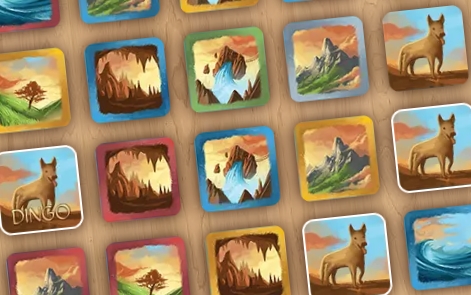
Dingo's Dreams
– Image by boardGOATS from boardgamearena.com

As usual, everyone had three points to hand out for the Golden GOAT Award plus a bonus if wearing Festive Attire, but we limited each person to a maximum of two points per game (after a little controversy over the voting last time).  Everyone could also nominate up to two individual games for the GOAT Poo Prize.  This year, there were several nominations for  GOAT Poo, but the clear winner was Dingo’s Dreams.  This is probably quite a clever game that we would normally enjoy, but we played it online with lots of people, none of whom had any idea what they were trying to do.  As a result, the complete chaos made for a very un-fun experience all round.

Golden GOAT - 2021
– Image by boardGOATS

With all the online games, there was less competition than usual, but the 2019 winner, Wingspan, was very nearly the first game to win the Golden GOAT award twice.  In the event, it was just pipped to victory by Praga Caput Regni – quite an achievement given that only four people in the group had played it.  While discussing possible candidates for Moment of the Year everyone fondly reminisced about the time Lime accidentally joined an online game of 6 Nimmt! with a bunch of Frenchmen, but that was last year.  The GOATS have long memories though, and it would seem that they still haven’t forgiven Pink for stealing everyone else’s gems in Niagara, despite his repeated assertions that he was “just following the rules”.

Niagara
– Adapted by boardGOATS from image by
BGG Contributor El_Comandante

18th Movember 2021

The evening began with news—the landlord of our beloved Horse and Jockey , Charles, and his wife Anna, who have been trying to retire for years, are finally succeeding.  This time next month, the pub will be under new management.  In due course, we will find out what this means for our little group, but in the meantime, we Keep Calm and Carry On Gaming.  And Blue and Pink, who were first to arrive started off with a quick game of NMBR 9, with Pink aiming to get his revenge for last time (before the Quiz).

NMBR 9
– Image by boardGOATS

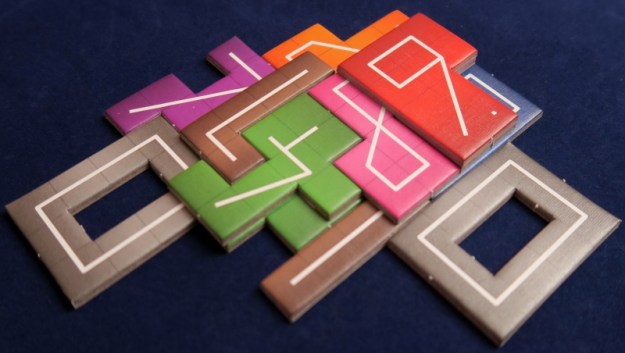
NMBR 9 is a very simple tile laying game, but the pieces cleverly fit together, except when they don’t.  The idea is that tiles must be placed in layers with pieces placed on higher levels worth more.  Each tile is a stylised number and the number multiplied by the “storey” is its score.  Each numeral, zero to nine appears twice in the deck of cards, so players can place each twice during the game, with the order dictated by the order the cards are drawn.  This time, Pink scored more than last time and Blue scored less, but sadly for Pink, even with Burgundy’s assistance, he was unable to beat Blue’s score of eighty-eight.

NMBR 9
– Image by boardGOATS

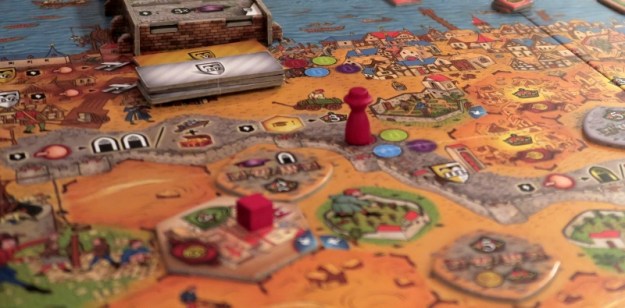
Blue, Pink and Burgundy were joined by Pine who’d had a particularly tiring week, and was therefore delighted to be able to avoid cooking.  As they finished, Green popped up and started setting up Praga Caput Regni.  In this game, players take the role of wealthy citizens who are organizing various building projects in medieval Prague. By expanding their wealth and joining in the construction, they gain favour with the king. Players choose from six actions on the game board, the “action crane”.  The actions are always available, but are weighted with a constantly shifting array of costs and benefits. By using these actions, players can increase their resources, improve the strength of chosen actions, build “New Prague City”, the Charles Bridge, the city walls, or participate in the construction of St. Vitus Cathedral.

Praga Caput Regni
– Image by BGG contributor PZS69

Praga is one of those games with lots of pieces and takes a little while to set up.  Green had agreed to play it with Ivory and Lilac in advance, but were one person down and there was less enthusiasm to play it from the others, so in the end there were just three with Black joining in.  There was quite a lot to explain:  Green had played a few times and Ivory had watched a video, but Black came into it completely cold.  When the game finally started, random selection gave the first turn to the least experienced player, Black.  Although there a lot of things that can be done in this game, each turn usually only provides a small choice (unless you want to pay for the chance to do something specific that isn’t available for free).  With a little advice Black was able to make his choice reasonably quickly and the game was underway.

Praga Caput Regni
– Image by BGG contributor PZS69

Black’s game was a tactical one, trying to do the best that he could each turn rather than following a recognised strategy.  With only one upgrade to his actions tile (building The Kings Road), he ended up with four wall tiles and made it to the top step of the City Walls.  Although he had upgraded his Kings Road tile it was late in the game and he only managed the third step along the road, not quite reaching the Charles Bridge. He did not try for the education tracks, but his mines progressed reasonably well.  Green tried to go for a City Walls/Cathedral strategy, but didn’t manage it very well, reaching only the second tier of the Cathedral and only one step on the City Walls.

Praga Caput Regni
– Image by BGG contributor PZS69

As that strategy just wasn’t working Green switched to completing the King’s Road and managed to get his piece onto the final step of the Bridge.  He upgraded a couple of actions, stone mine and (much later) Town tile actions, but could only manage two walls (rather surprising considering he built his first wall early on). Green did manage to reach the top of the University track and half way up the Knowledge path though.  In contrast, Ivory went very quickly for the Kings Road strategy, which he completed as well.  Like Black he ignored the Learning tracks, but did manage to get his Gold mine to the top, although (strangely) never managed to unlock his six gold bonus cube.  He also only did one Upgrade (the Gold mine action), but completed three walls.

Praga Caput Regni
– Image by boardGOATS

Ivory also concentrated on the City Walls and manage to climb to the top tier, but completely ignored the St. Vitus Cathedral.  Within the Town, Green placed most tiles, but only two plaza’s were ever completed, and no one built on the Old Town section North of the Road.  Ivory won the game, with Green a second on a tiebreaker.  Everyone kept forgetting the extra point bonuses from the Upgrades and Books, but it was clear that Ivory was the victor.

Praga Caput Regni
– Image by BGG contributor PZS69

Everyone enjoyed the game, Black in particular liked it much more than he thought he would. Ivory also liked it as did Green though the fact that players seem unable to do very much through the game frustrates him.  Overall it appealed to the group’s idea of strategy planning. Although it seems complex with lots that can be done, it is actually relatively straight-forward to play, with the complexity coming from working out what they want to do and which route will provide the best outcomes later in the game.  It is possible that the key is getting the Golden Arches and therefore extra free actions, but they seemed very lacking this time.

Praga Caput Regni
– Image by boardGOATS

The prior arrangement to play Praga meant there weren’t enough people to play the “Feature Game” (Nusfjord), particularly as neither Pine nor Purple fancied it.  Unfortunately, there was no alternative mid-weight game that everyone felt up to playing, so, after half an hour of debate, Pine insisted on sitting out leaving the rest to play what is now a bit of an old favourite, Wingspan.  We’ve played this a lot as a group since it was released two years ago, but Pink and Blue had not yet had the opportunity to play the newest, colourful birds expansion, Oceania.

Wingspan: Oceania Expansion
– Image by boardGOATS

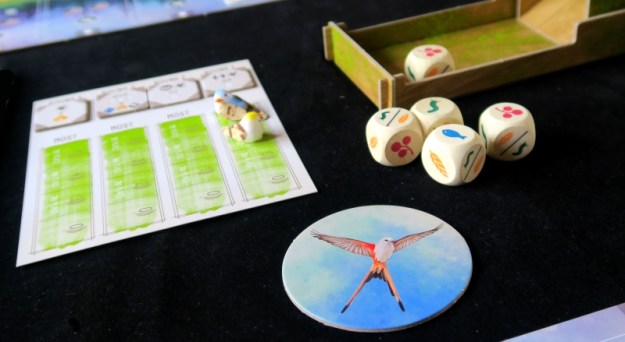
Wingspan is a fairly straight forward, card driven engine-builder with players collecting bird cards and playing them into their reserve.  To play bird cards in their reserve, players need to encourage them to stay by providing the right food as payment.  Thus there are four actions that players can take on their turn:  Play a card; Collect food, Lay eggs and Pick up cards.  The last three of these are associated with habitats.  Each card has a special power, some come into force when they are first played, some when the habitat is activated, and others when another player carries out an action.

Wingspan
– Image by boardGOATS

In addition to special powers, each bird card also gives points and holds eggs.  At the end of the game players receive a smorgasbord of points for each bird, for “tucked cards” (those placed under their bird cards as part of an action), for food stored by birds on cards (also as part of an action), for eggs laid on cards, all added to any end of round bonuses achieved and any bonus points from character cards.  The first expansion, with European birds, additionally adds cards which take effect at the end of each round, some of which are very powerful, and the new Oceania Expansion adds a new food type—Nectar.

Wingspan: Oceania Expansion
– Image by boardGOATS

Nectar can be used as a substitute of any other food type, but it is used in a different way and cannot be carried over from one round to the next.  There was no need to go through all the rules because everyone was familiar with the game, it just needed a summary of how Nectar worked and how the game changed, including the scoring with players who use it the most picking up bonus points at the end.  The expansions mostly add more cards, and although these change the flavour of the game they don’t significantly add to the complexity, so both expansions were included this time along with the cards from the Swift-Start Promo Pack.

Wingspan: Oceania Expansion
– Image by boardGOATS

This time, there were almost no birds of prey cards in the game, which was unfortunate for Pink because his Black-Billed Magpie went hungry.  He had the help of Pine, however, who stayed long enough to see his favourite bird, the Black Woodpecker put in an appearance, landing in Blue’s reserve.  Pink went on to concentrate on using Nectar and Character cards, the Omnivore Expert and Fishery Manager, both of which give points for the type of food birds eat.  Burgundy also focused strongly on his bonuses from Character cards (Citizen Scientist and Bird Counter) and both he and Pink scored more than twice Purple’s and Blue’s bonuses.

Wingspan: Oceania Expansion
– Image by boardGOATS

This is a relatively small part of the scoring, however.  Purple concentrated on making sure she had plenty of eggs at the end of the game and the purpleness of her reserve with all it’s purple eggs was a sight to behold.  Everyone made good use of Nectar, but Pink cleaned up winning two of the three categories and coming second in the third.  Burgundy took a lot of points for his tucked cards and had lots of his scoring birds in his reserve.  Blue had more birds and more valuable ones too, nearly filling her reserve.  The question was whether her huge pile of eggs was enough to offset the points others had taken elsewhere.  In the event it was, and she finished with just enough to knock Burgundy into second place, slightly ahead of Pink.  And with that, it was home time.

Wingspan: Oceania Expansion
– Image by boardGOATS

Learning Outcome:  Don’t put all your eggs in one nest.

23rd September 2021

Burgundy and Blue were just finishing their supper when Teal introduced himself.  The three were chatting when Lime, who hadn’t been able to come for over a month, also joined the group.  It was expected to be a quiet night with Green and Lilac away on holiday, Pine working late, and Pink stuck somewhere on the Warwick bypass.  So, there was a lot of chat, but eventually, the group decided to play something and settled on Love Letter.

Love Letter
– Image by boardGOATS

This is a very simple little game that we’ve played a lot, but somehow Lime had missed out.  So, there was a very quick rules explanation:  players start with a hand of one card, draw a second and choose one to play and do the action on the card.  The cards are numbered and the aim of the game is to finish the round with the highest card, or more commonly, avoid being knocked out.  There are only sixteen cards in the deck (and one of those is removed at the start of the round), so it doesn’t take long.

Love Letter
– Image by boardGOATS

The group were only three rounds in when everyone else turned up (including Pink who had escaped the roadworks), so Lime was declared the winner with two tokens and everyone else was introduced to Teal and started to discuss what to play.  In the end, Burgundy took matters into his own hands and started a game of Wingspan, so while Pink waited for his pizza to arrive, Blue explained the “Feature Game“, Mini Rails.

Mini Rails
– Image by boardGOATS

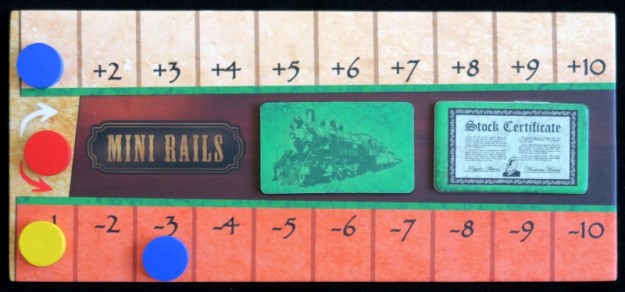
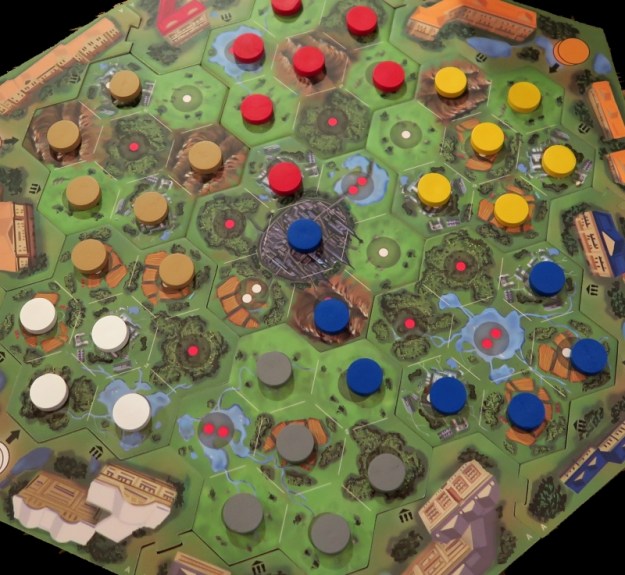
Mini Rails is a very simple little stock-buying and track-laying train game that compresses a lot of the game play of long and complicated games like the 18xx series into under an hour.  Players have two turns in each round, on one they buy shares in one of the companies and on the other they extend the “track” of one of the networks.  If it is built on a white space, players with holdings in that colour increase their value by the marked amount.  If the network is built on a red space, the stocks in that company are decreased in value.

Mini Rails
– Image by boardGOATS

The game is very simple, but there are a couple of clever little tweaks.  Firstly, there are two “tracks”, one is the turn-order track, while the other holds train disks drawn at random from a bag.  On their turn, players choose one of tokens and decide which action to use it for, “build track”or “buy shares”.  The position of the token that is taken dictates where they will be in the turn order in the next round.  Manipulating this turn order is one key aspect of the game, as is deciding whether to buy and then build, or build and then buy.

Mini Rails
– Image by boardGOATS

Perhaps the most complicated aspect of the game is the end-game scoring.  At the start of each round train discs are drawn from a bag; one more than there are turns.  This means everyone always has a choice, but the token the last player does not use is put to one side indicating they have paid “taxes”.  For the companies that have “paid taxes” any negative dividends are erased and positive dividends are counted.  For those companies that have avoided paying their taxes the reverse is true and negative points will be scored while positive points are lost.

Mini Rails
– Image by boardGOATS

This means it is in the interest of players with both large positive or significant negative scores to forgo building track or buying shares and leave a potentially valuable token as taxes.  Similarly, if a player is left with a choice of two tokens, it may be in their interest to buy/build a relatively unfavourable track to deprive other players of points.  With three players, the game doesn’t take too long to play, and with more it would likely become quite random.

Mini Rails
– Image by boardGOATS

Lime took an early lead, though of course lots of early points are… pointless, if the company doesn’t pay taxes.  In the end it was extremely tight, but in the end, Blue just pipped Lime by a single point.  With just three there isn’t much downtime and the game rocks along nicely with plenty of interaction, though as Pink said, “That’s one hell of an abstraction for a train game.”  Blue pointed out that this was what a lot of gamers thought of when someone said “Train Game”.  Pink felt disappointed at the lack of actual trains and tracks so to make it up to him, the group moved on to play Ticket to Ride Demo.

Ticket to Ride Demo
– Image by boardGOATS

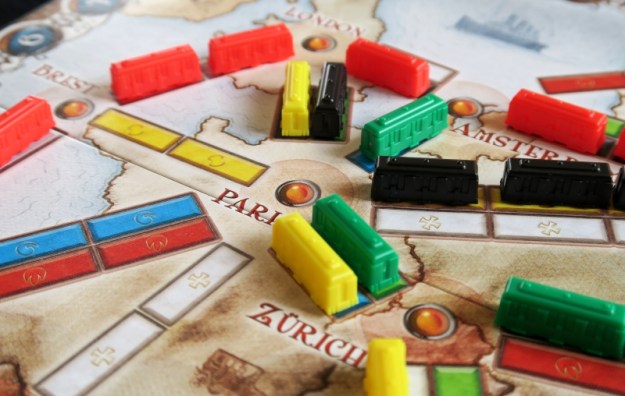
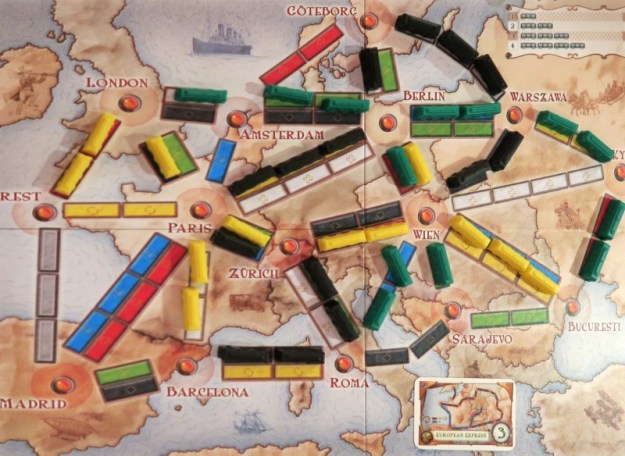
Ticket to Ride Demo is one of the small games based on the Spiel des Jahres winner, Ticket to Ride Europe.  The Demo game has an interesting history—it was designed as a sales tool and had only a small print run.  It was so popular though, that it ultimately spawned a new range of small “City” games, New York, London and Amsterdam.  These games are essentially played the same way as the full-sized versions, but with fewer pieces on a smaller map which means they typically take less than half the time.

Ticket to Ride Demo
– Image by boardGOATS

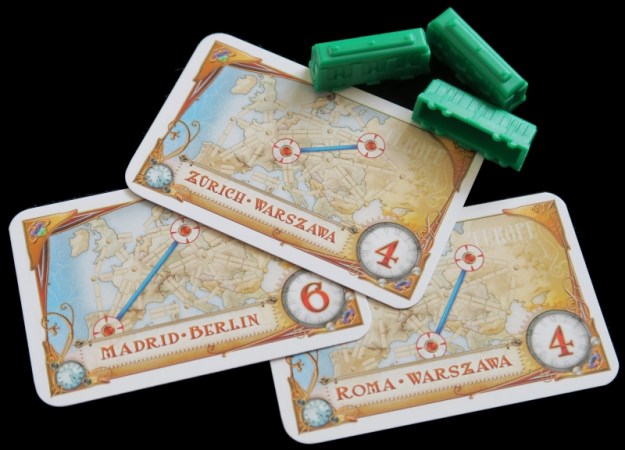
On their turn players can do one of three things:  take cards from the market, spend cards to place trains or take tickets.  Players score points for placing trains, but also for connecting the places on their tickets.  The catch is that any tickets that are not completed score negative points.  The small versions of the game are much tighter with less room for error.  Unlike the others, Ticket to Ride Demo has a double sided map, one USA and one Europe.  This time the group played the Europe map.

Ticket to Ride Demo
– Image by boardGOATS

Compared to the full-sized equivalents, all the little games are like a knife-fight in a phone-box, and this game was no exception.  Lime only completed three of his four tickets as Blue brought the game to a quick and sudden end.  Pink completed all four of his tickets and they were high-scoring too.  Blue’s tickets were less lucrative, but she managed to place all her trains and took the European Express bonus points for the longest continuous route, and with it victory, by just two points.

Ticket to Ride Demo
– Image by boardGOATS

Meanwhile, on the next table an epic, five-player game of Wingspan was underway.  We’ve played Wingspan quite a bit since it came out and always found it very enjoyable.  We’ve played it enough that we’ve also explored the European expansion, but thanks to the restrictions over the last year or so, this was the first opportunity to play the new Oceania expansion.  The base game is a reasonably light, card-driven, combination building game.  On their turn, players can place a bird card from their hand in one of the three habitats, or activate all their cards in one of the habitats and carry out the associated action.

Wingspan: Oceania Expansion
– Image by boardGOATS

The habitats are Woodland, Grassland and Wetland and the actions associated with them are collecting food, laying eggs or collecting cards (respectively).  Once the action has been carried out, the active player activates each card in the habitat in turn.  The game is played over four rounds, with a decreasing number of actions per round as the game progresses.  At the end of each round there are goals and each player also starts with a personal bonus card which is evaluated at the end of the game.

Wingspan
– Image by boardGOATS

The European expansion really only adds extra cards, though this includes a number of birds with abilities that are activated at the end of rounds, and others that increase player interaction.  The new Oceania expansion also adds more cards, but additionally mixes things up a little more with the addition of a new food type, nectar.  Nectar can be used as wild food type, although some of the new bird cards have nectar specified in the cost.  Whenever players spend nectar though, they don’t put it back in the supply, instead they store it in the habitat they spent it on.

Wingspan
– Image by boardGOATS

At the end of the game, the player with the most nectar stored in each habitat scores five points at the end of the game with the player coming second scoring two points.  Nectar is therefore a very important resource giving a potential fifteen points at the end of the game, although it requires some skill to use it effectively as it can’t be carried over between rounds.  Burgundy and Black really invested in nectar and managed to make good use of it during the game as well as take the lion’s share of the nectar points at the end of the game.

Wingspan: European Expansion
– Image by boardGOATS

Burgundy and Black also prioritised valuable birds and tried to ensure they stayed in the running for the end of round bonuses.  Three out of the four of these involved eggs, which fitted with Ivory and Teal’s strategies which focused on an end-of-game egg rush.  Ivory also picked up a lot of points from his Common Starling which enabled him to discard up to five bits of food and tuck a card for each one.  With a maximum of twenty points, Ivory did well to take eighteen during the game, but it was only enough for third place this time though.

Wingspan
– Image by boardGOATS

It was very close at the top between Black and Burgundy.  Burgundy had four bonus cards one of which proved quite lucrative.  The big difference was in the value of the bird cards, however, while Black edged it in many departments Burgundy had a ten point head start.  This wasn’t simply because he had high value birds, more that he had lots of them.  In the end, Burgundy finished five points ahead of Black with ninety-five, in a good game that had been enjoyed by everyone round the table.

– Image by boardGOATS

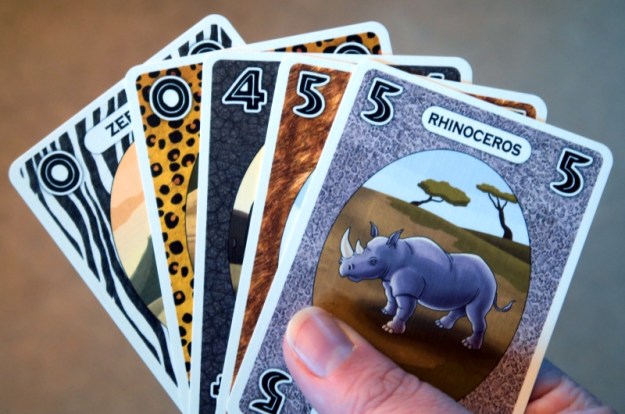
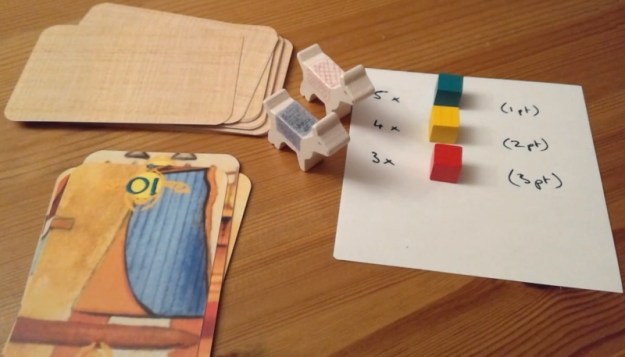
Wingspan was still only on its third round when Ticket to Ride Demo came to an end.  At around the same time, Pine pitched up, so the, now foursome settled down for something else which ended up being a game of Reiner Knitzia’s Botswana (aka Wildlife Safari).  This is an unusual auction-like game made all the better by the inclusion of plastic animals.  Played over several rounds, players are dealt a hand of cards and on their turn play a card and take an animal of their choice.  The cards are numbered zero to five and come in five different animal suits.

Botswana
– Image by boardGOATS

The cards are played in the centre of the table in suits and the game ends when all six cards of one suit have been played.  The top card in any suit is the current value of that animal.  Thus, if the top zebra card is a five, a player that has three zebras will earn fifteen points for them if the game ends.  However, if the zero just before the game ends, the zebras will become worthless.  It is a deceptively simple, yet fun little game.  Blue thought she’d won until a recount docked her ten points and she finished just two points behind a delighted Pink.

Botswana
– Image by boardGOATS

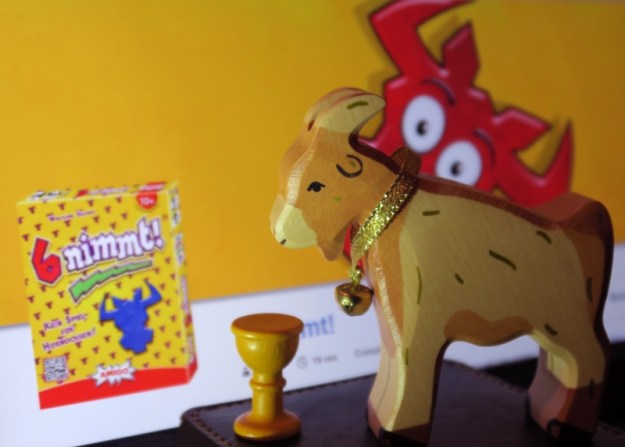
As Botswana came to an end, so did Wingspan, and although time was marching on, and Lime and Ivory took an early night, there was still time for everyone else to play one last game.  After a little discussion, we settled on 6 Nimmt!, a game we all know and love.  Players simultaneously choose a card and these are sequentially added to the end of four rows of cards, specifically the row with the highest number that is lower than the card itself.  If the card is the sixth card in the row, instead, the player takes other five and adds them to their scoring pile.  The player with the lowest score at the end of the game is the winner.

6 Nimmt!
– Image by boardGOATS

We’ve all played this a lot online over the last year, but doing the maths ourselves was a little daunting, so we decided to go back to playing the non-professional version.  We play over two rounds using half the deck in first and the other half in the second.  This time Teal top-scored in the first round with nineteen, while Burgundy kept a clean sheet with Pink just behind.  Blue’s killer thirty-three in the second round gave her a total of forty-eight, but the winner for the second time in the evening was Pink with just four points.  And with that, it was bedtime.

6 Nimmt!
– Image by boardGOATS

Learning Outcome:  Today’s railway industry is no longer about trains and tracks. ☹

20th July 2021 (Online)

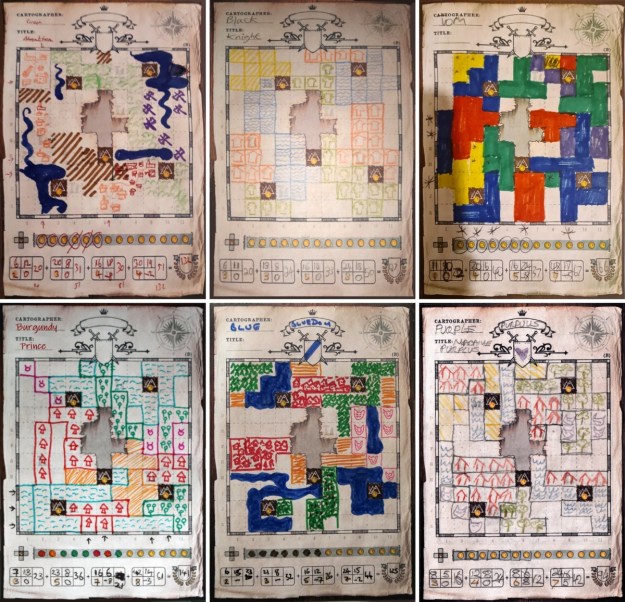
Since last time, there had been quite a bit of debate about returning to the Horse and Jockey, but there was a little hesitancy and with the extremely hot weather, staying at home this week turned out to be the right choice all round.  As the decision had been just a little bit last-minute, we chose to keep the “Feature Game” simple and opted for the Skills Mini Expansion for Cartographers.  We have played Cartographers several times and everyone has really enjoyed it.  With the Spiel des Jahres winners announced this week, this was also the nearest we could get to playing a game to mark the occasion (it received a nomination for the Kennerspiel award last year).

Cartographers: A Roll Player Tale
– Image by boardGOATS

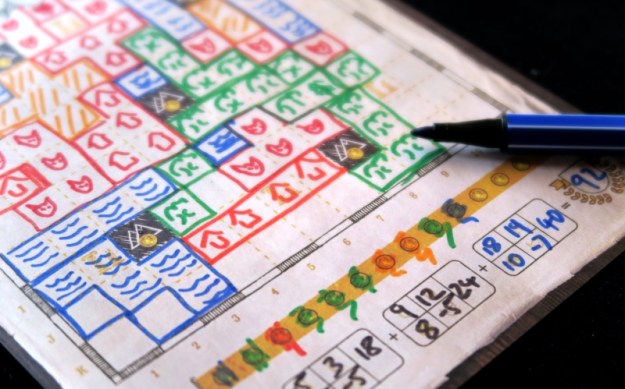
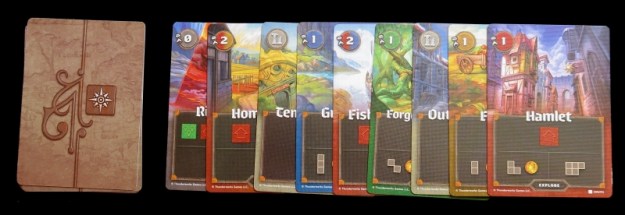
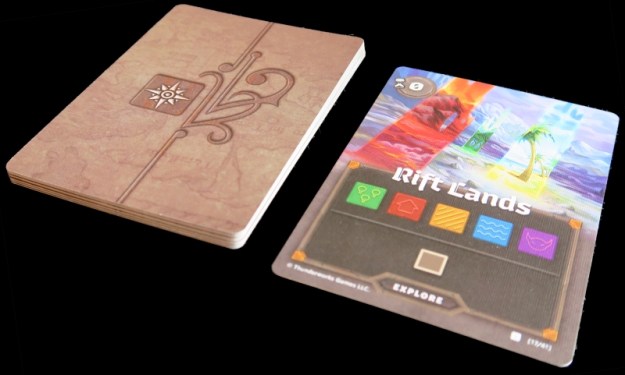
Cartographers is a “Roll and Write” type of game, but one with more of a “gamery” feel than most.  It is based on Tetris, with shapes revealed on the flip of a card in a similar way to other games we’ve played this year like Second Chance and Patchwork Doodle.  However, the thing that makes Cartographers more “gamery” than these is the addition of terrain and players usually have to make a choice, either of the shape or the terrain.  The terrains are tied in with goal cards, four of which are revealed at the start of the game.  Two goals are then scored at the end of each of the four seasons, in a similar way to another game we like, Isle of Skye.

Cartographers: A Roll Player Tale
– Image by boardGOATS

There are lots of other little aspects of the game that make it interesting—the presence of Ruins and Ambush Cards in the deck, for example, deliver a curved ball, just when players feel they are in control.  Players can also build their income by surrounding mountain ranges and choosing to play certain shapes; this gives more points at the end of each round.  The Skills expansion gives players a way to offset this income for special actions which potentially give players other ways of achieving their goals, further adding to the decision space.

Cartographers: A Roll Player Tale
– Image by boardGOATS

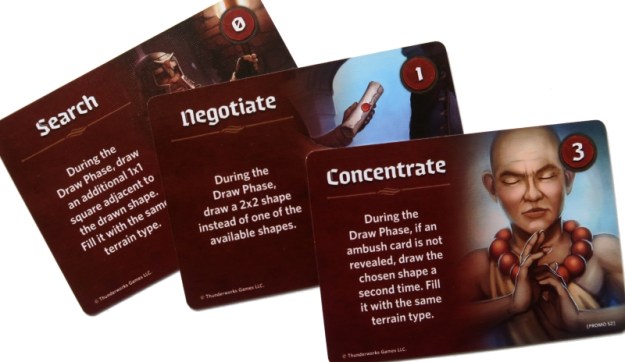
One of the most impressive things about Cartographers is the amount of variety that is built into the game, which means every play feels different and the game stays remarkably fresh.  So, there are two different player maps and four of each type of goal card.  This variety is carried through to the Skills expansion; there are eight cards of which three are chosen at random.  This time we chose the B side of the map (with empty “wasteland” spaces marked) and drew the Greenbough, Mages Valley, Wildholds and Borderlands goal cards together with the Search, Negotiate and Concentrate skills cards.  These skills cost anything from free (like Search) to three (like Concentrate), and each can be played multiple times per game although only one can be played each Season.

Cartographers: Skills Mini Expansion
– Image by boardGOATS

We quickly realised that the expensive skills like Concentrate are only likely to be played in the final round, as the cost is in “income” and that income is generated at the end of every round.  So, playing Concentrate at the start of the game will ultimately cost a player twelve points, while playing it in the final round will cost three just three points.  For this reason, the free Search skill was always likely to be used by almost everyone in almost every season (and so it proved).  Of course, the higher tariff reflects the increased power though:  Search allows players to increase the size of the shape they are drawing by a single square; Negotiate (which costs one) allows players to draw a two-by-two shape, and Concentrate allows players to draw the shape a second time.

Cartographers: A Roll Player Tale
– Image by boardGOATS

As well as the skills which we had not played with before, several of the goal cards were new to us as well, including Greenbough (which rewards gives players one point per row and column with at least one Forest square in it) and Mages Valley (which gave points for each space next to a Mountain—two points for each Lake and one point for each Arable).  We’d played with the Wildholds goal before though (which gives six points for each Village of six or more spaces) and, although Borderlands was new to us (which give points for each completed row or column), we’d played The Broken Road goal which is similar (giving points for completed diagonals).

Cartographers: A Roll Player Tale
– Image by boardGOATS

The game began much as usual, and Pink, who was watering the tomatoes in the “mini-market-garden”, commented that he could hear Burgundy muttering, sighing and generally sounding stressed from outside.  Although we had played with “Wastelands” before, we had all focussed on how the fact some of the spaces were already full would help.  We had all forgotten how much the Wastelands obstruct plans and generally make life considerably more difficult.  Blue made a bit of using the ruins spaces to give her more flexibility later, but had forgotten that it would reduce the number of spaces she would be able to fill later in the game.

Cartographers: Skills Mini Expansion
– Image by boardGOATS

It was clear after the first round that Ivory was going to be tough to beat, a feeling that was cemented after the second round.  Unusually, Burgundy was the first to post a score, with a total of one hundred and forty-one.  Although this was high enough to earn him second though, when Ivory’s score came through he was a massive twenty-five points ahead.  Once again, it had been a very enjoyable game, and as we tidied up there was a little bit of chit-chat about the skills and what they added to the game.  Since they are not compulsory, the consensus  was that we should add them every time, though it was clear that they had been widely used because of the presence of the free Search skill, which everyone had used, and some in every round.

Cartographers: Skills Mini Expansion
– Image by boardGOATS

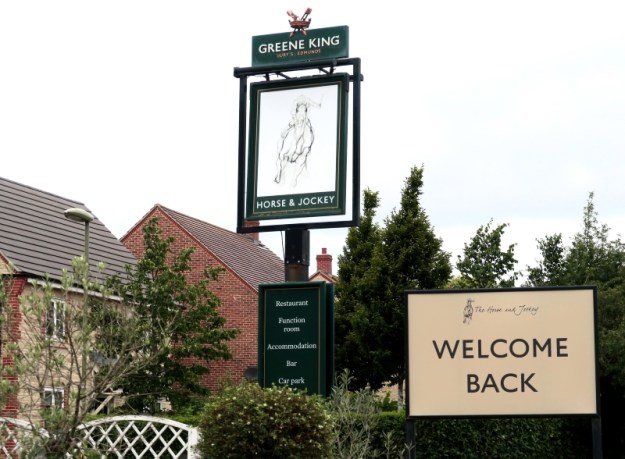
With Cartographers over, we had a bit of a discussion about moving back to our much loved and greatly missed, Horse and Jockey.  We’d conducted some anonymous surveys over the preceding week to try to gauge opinion trying to ensure that nobody felt under pressure to do anything they weren’t comfortable with.  Some of the group had been back on occasional Thursdays, playing old favourites like The Settlers of Catan, Wingspan, and Roll for the Galaxy and new games like Red Rising, Mercado de Lisboa, Ticket to Ride: Amsterdam, Tapestry (with the Plans and Ploys expansion), Ginkgopolis, Everdell, and Draftosaurus (aka “Sushi Go with Dinosaurs”).  Others, however, had not been to the pub for nearly eighteen months.  After some discussion, we decided that we’d schedule a trial visit in ten days time, so that those who had not been out could see how they felt without committing, and those that went could report back to those that were feeling a little more reticent.

The Horse and Jockey
– Image by boardGOATS

After that, we moved onto Board Game Arena.  It was a quiet night without both Pine and Lime, and once Green and Ivory had left as well, we were down to five which gave us a lot of options.  Coloretto was one, but in the end we chose Niagara, a game we’ve all played quite a bit, but never online, and we were keen to see the new Board Game Arena implementation and whether losing the tactile moving river would leave the game lacking.  A strong element of the game is the element of simultaneous play, however, and this was a large part of the appeal this time.  Players simultaneously choose a Paddle Tile which dictates how far their canoe will move in the round.  Then, in turn order, players move their canoe up or down the river, paying two movement points to pick up a gem from the bank (or drop one off).

Niagara
– Image by BGG contributor El_Comandante
adapted by boardGOATS

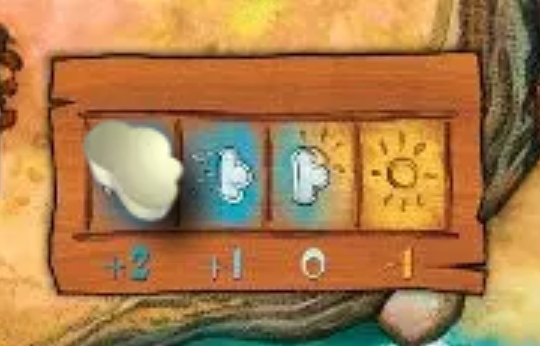
The winner is the player to get four gems of the same colour, five gems of different colours, or any seven gems safely home and into the shallows.  On the face of it, this is relatively simple, but the really clever part of the game is the movement of the river.  In general, the river moves at the speed of the slowest boat—if the lowest numbered Paddle Tile is a two, then the river moves two spaces and all the boats move with it.  However, one of the Paddle Tiles is a weather tile which enables players to increase or decrease the rate to make life harder or easier.  Since everyone has to play all their Paddle Tiles before they can recycle them, the timing of their weather tile is critical: players who leave it to the end run the risk of the river running fast and losing boats over the cascade because they can’t do anything about it.

Niagara on Board Game Arena
– Image by boardGOATS
from boardgamearena.com

And it wasn’t long before that’s exactly what happened, when both Blue and Black got their timing wrong and lost boats over the falls, so had to pay hard earned gems to get new ones.  Then, to add insult to injury, Pink sneakily crept up on Blue and stole another gem from her.  Players can only steal if they land on the same space as another boat while travelling upstream, and even then it is a choice.  There was much ill feeling especially from Blue, but she wasn’t the only one.  And with that, the gloves came off and everyone tried to redress the balance and ensure that such bad behaviour would not go unpunished.

Niagara on Board Game Arena
– Image by boardGOATS from boardgamearena.com

Pink was abreast of that though and had a plan.  Knowing his bad behaviour would make him a target he collected gems in one boat letting others take them while he stole the gems he wanted and got them to shore quickly.  Much to everyone’s disgust, he soon had five different gems and there was nothing anyone could do to stop him getting them home.  Burgundy actually had more gems giving him a nominally higher score, but his set of six did not include five different colours and Blue’s set of five included three nuggets of amber.  The victims of Pink’s grand larceny were unimpressed with his terrible behaviour, and as it was getting late, we decided to call it a night.

Niagara on Board Game Arena
– Image by boardGOATS
from boardgamearena.com

Learning Outcome:  Theft is totally unforgivable.

16th March 2021 (Online)

Purple, Black, Pine and Green chatted while Blue reminded herself of the rules for the first game.  Green showed everyone his new game, Fossilis, which comes with little plastic dinosaur bones, tweezers, and even a tiny plastic scorpion—one to play when we get back to the pub, along with the very newly released Red Rising, the Oceania Expansion for the really popular Wingspan, and a whole host of other games that we’ve been waiting over a year to play.

Fossilis
– Image by boardGOATS

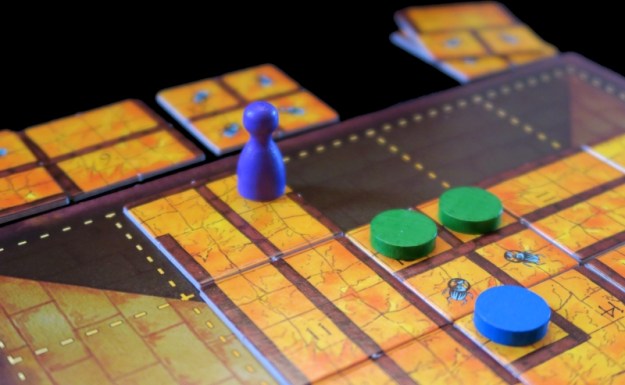
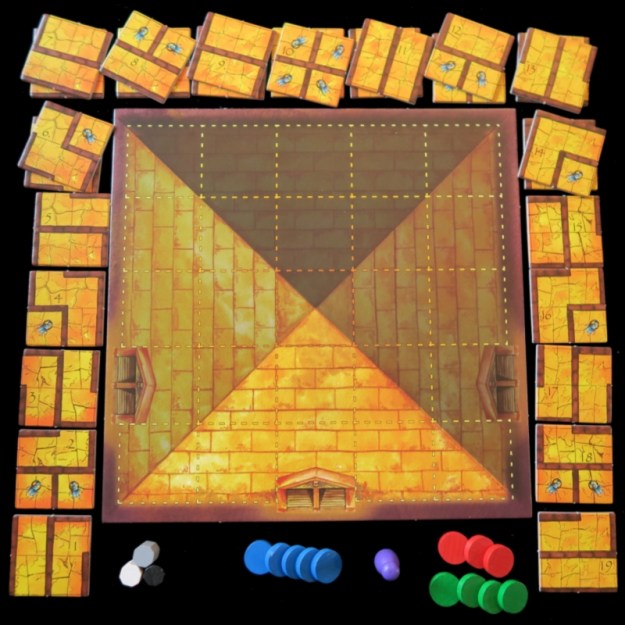
And sadly, with the realisation that it was a year and a day since a very small group met at The Jockey for the last (unofficial) games night there, we moved on to playing the “Feature Game“, Das Labyrinth des Pharao.  Das Labyrinth des Pharao is a tile laying game in a similar vein to Take it Easy! which we played a few weeks ago, or the Spiel des Jahres nominee, Karuba (which we last played about five years ago).  In Das Labyrinth des Pharao though, players are exploring a pyramid and collecting treasure.

Das Labyrinth des Pharao
– Image by boardGOATS

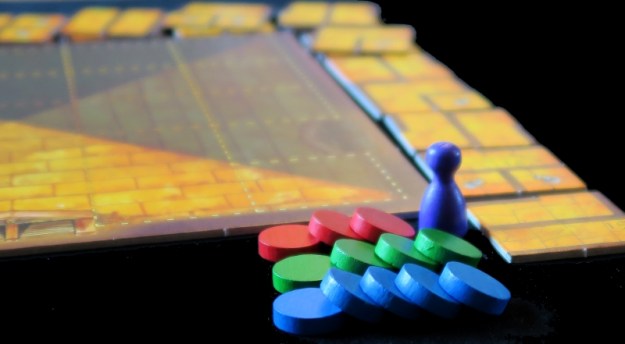
Although we’ve not played it on a Tuesday, some of the group have played it before at the Didcot Games Club (November 2015 and September 2016).  Like all the games that we’ve found that work well played online, Das Labyrinth des Pharao is quite simple to play, but it is a little bit “thinky” relying on planning and a little bit of luck.  Everyone had the tiles and board that were delivered a few weeks back, and they had found their Tiny Towns cubes and a meeple from one of the special Christmas crackers we’ve had at one of the unChristmas Parties during happier times.

Das Labyrinth des Pharao
– Image by boardGOATS

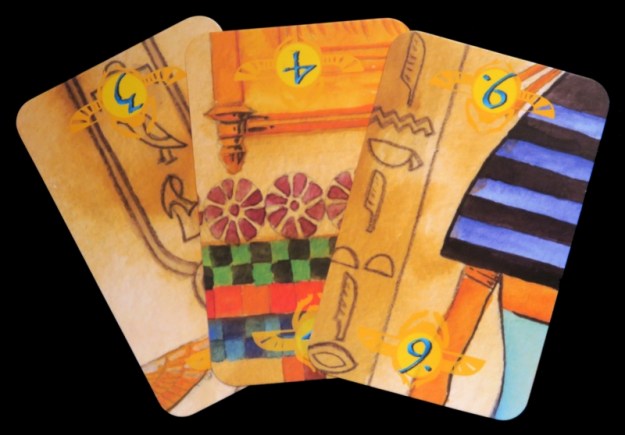
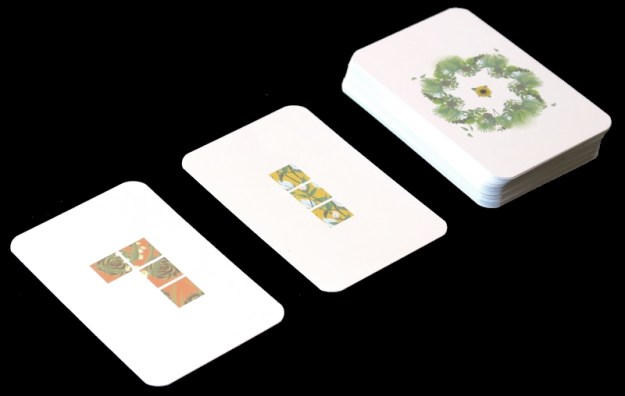
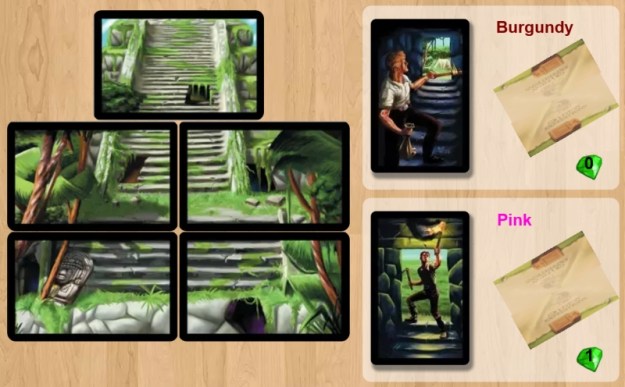
The first thing to do was lay out the tiles around the board, in number order—some appear more than once, so these are stacked.  Players then counted out five, four and three of their cubes as treasures.  Once everything was set up, Blue explained that Pink would turn over one of the beautifully decorated number cards (each part of a polyptych), and everyone had to place the corresponding tile on their board.

Das Labyrinth des Pharao
– Image by boardGOATS

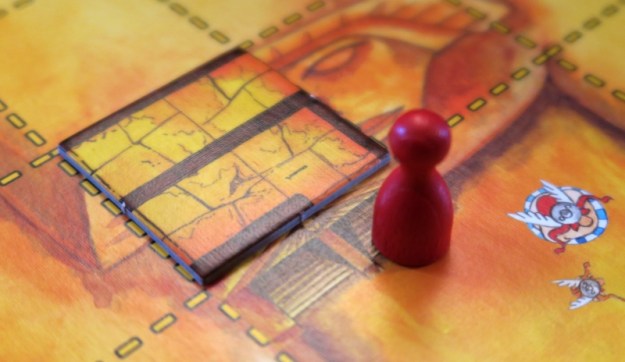
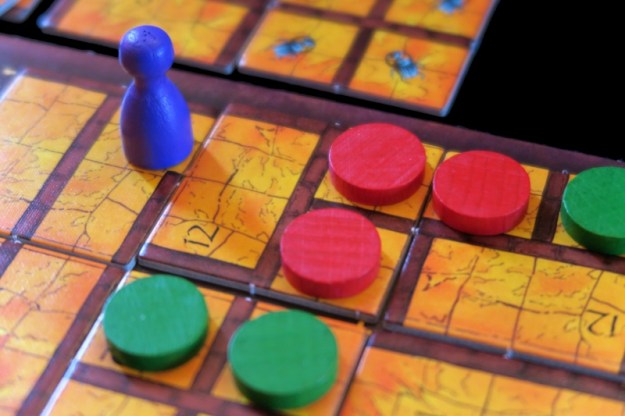
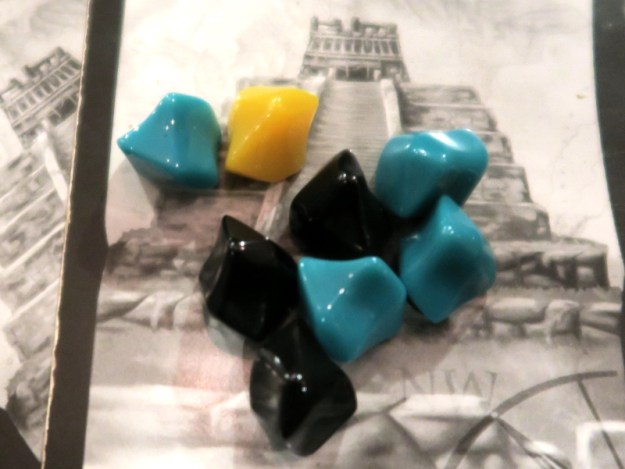
They can place the tile anywhere on their board, in any orientation. Some of the tiles have scarabs depicted on them—players can place treasures on these, but must start with the lowest value treasures first.  So, only when all five one-point treasures had been used, could players move on to the four two-point treasures, and finally the three-point treasures (blue, green and red disks respectively, though we were playing with turquoise, yellow and red cubes).

Das Labyrinth des Pharao
– Image by boardGOATS

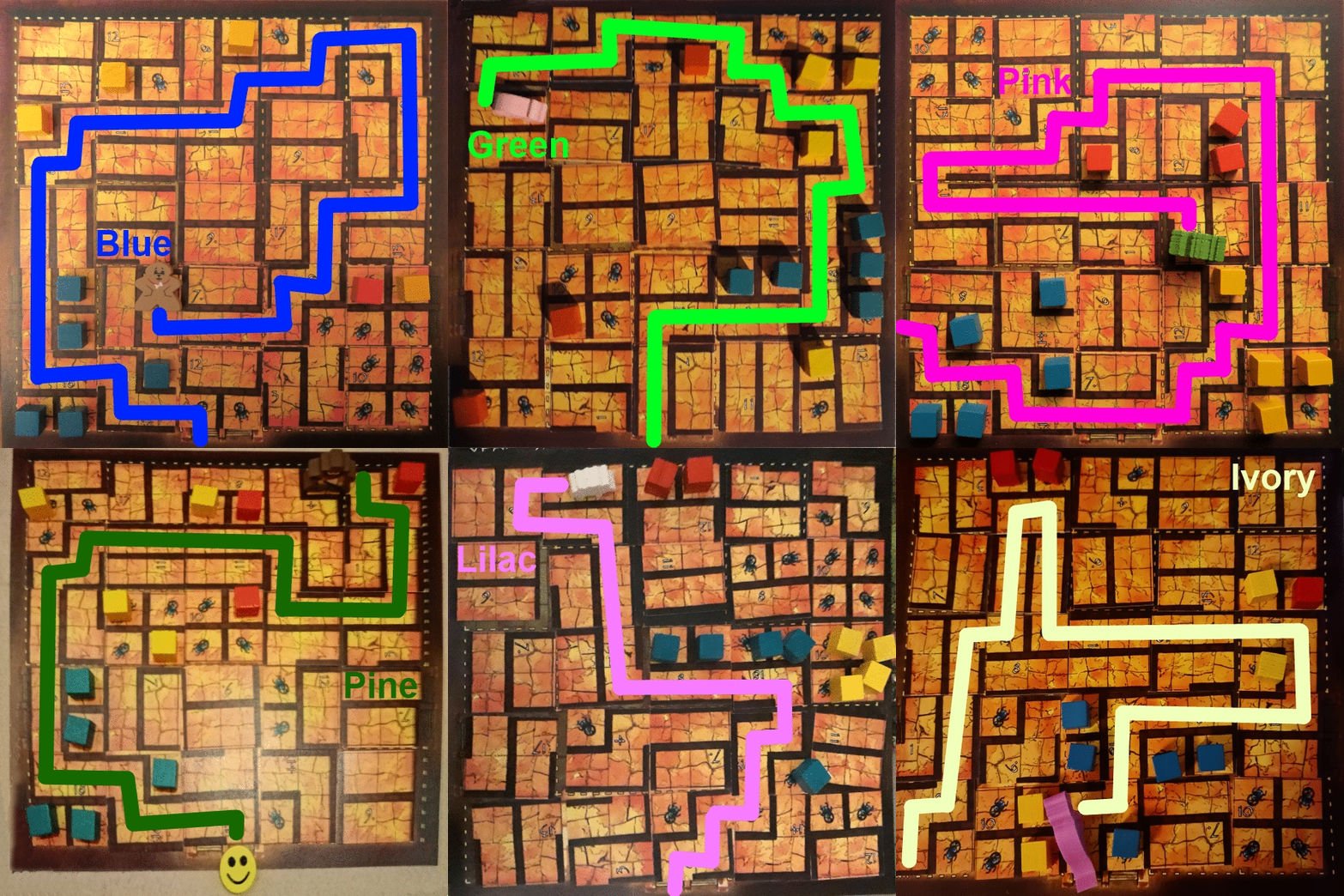
After the third round, players have to choose which of the six possible entrances they are going to start from and then progress their “explorer meeple” along the path as far as they can.  In the rules, players mark the path at intervals so everyone else can see how far the explorers have travelled, but given the added difficulties associated with playing remotely and the fact that players could count their own path at any time, we omitted this.

Das Labyrinth des Pharao
– Image by boardGOATS

The game ends after twenty-five of the twenty-eight cards have been revealed and then people add up their scores.  Firstly, they score one point for each quarter tile their tunnel extends along.  Next they score points for each treasure chamber their tunnel passes, that is a chamber that contains one treasure surrounded by walls on all four sides.  As usual, the player with the most points is the winner.

Das Labyrinth des Pharao
– Image by boardGOATS

The game was a bit of a tale of people missing cards and having to try to correct it, and for a change, it wasn’t just the usual suspects.  As the game progressed, it became clear that most people had tried to follow Blacks advice and tried to place as many of their treasure tokens as they could.  The problem with this is that they aren’t worth anything unless players have managed to enclose them in a chamber and ensure their route passes alongside.

Das Labyrinth des Pharao
– Image by boardGOATS

In fact, one of the biggest problems for some turned out to be connecting valuable parts of their tunnel to their chosen entrance to ensure their treasure hunter was able to explore the temple.  Pine and Pink seemed particularly afflicted, and as the game drew to a close, Burgundy and Pink in particular were getting increasingly desperate for tile number fourteen.  The final tile was number six, which did most of the job and with that, everyone had to work out their scores.

Das Labyrinth des Pharao
– Image by boardGOATS

As usual, Ivory posted his score first, setting a competitive target of fifty, made up of thirty-one from his path and nineteen in treasure.  In general, the scores were quite close, with almost everyone scoring between forty and fifty.  The longest path was thirty-seven and the most treasure collected was nineteen.  In most cases, those that had a long path (like Blue and Burgundy) had few treasures, while those with a lot of treasure (like Pine and Green) had not explored as deep into the temple.  The exception was Pink, who managed to do well at both and finished with a total of fifty-four.

Das Labyrinth des Pharao
– Image by boardGOATS

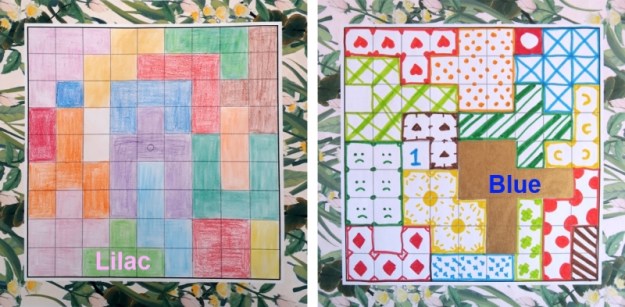
It had been a fairly short game, and as it was a while since we’d practised our colouring, we moved onto a quick game of “Roll and WriteTetris, in the form of Second Chance.  We’ve played this quite a bit since we first started playing online, but the last time was just before Christmas, so we decided to give it another go.

Second Chance
– Image by boardGOATS

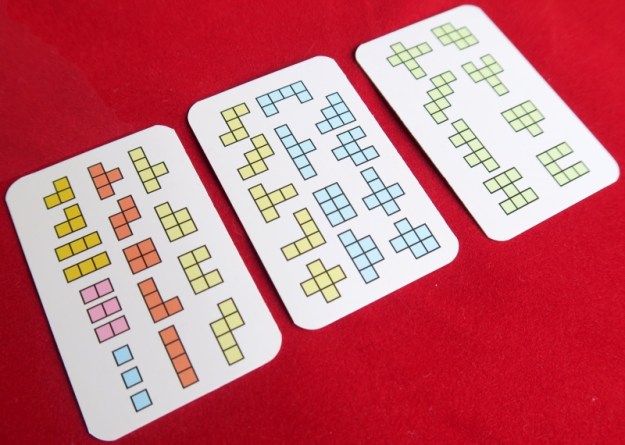
The idea is that two shapes are revealed and players must draw them in their nine-by-nine grid.  The shapes come in different sizes and the game rewards efficiency in packing.  If a player is unable to play either shape, they get a second chance: one card all to themselves.  If they can play that, then they can carry on, but if they are unable to play that as well, then they are eliminated.

Second Chance
– Image by boardGOATS

Unusually, being eliminated is not necessarily a guarantee of failure in this game:  the winner is the player with the fewest unfilled spaces at the end, which is when the deck of cards runs out.  So, in this game, a player can be knocked out, but still win.  This time, there were a couple of people who threatened to need a second chance, but then suddenly in one round, nobody was able to place either shape and everyone needed a second chance.

Second Chance
– Image by boardGOATS

That round took out everyone but Green and Black, but as there were no cards left, it turned out to be the final round, and that was that.  The scores varied from eleven to two, with a tie between Lilac and Blue for first.  Pink suggested a vote based on the quality of the art-work, but nobody wanted to choose between them and a tie it remained.

Second Chance
– Image by boardGOATS

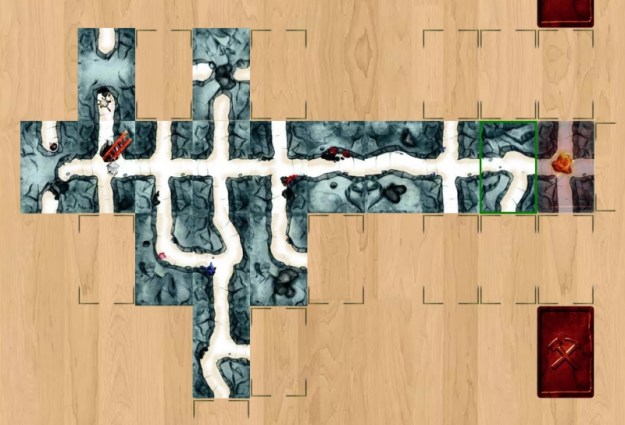
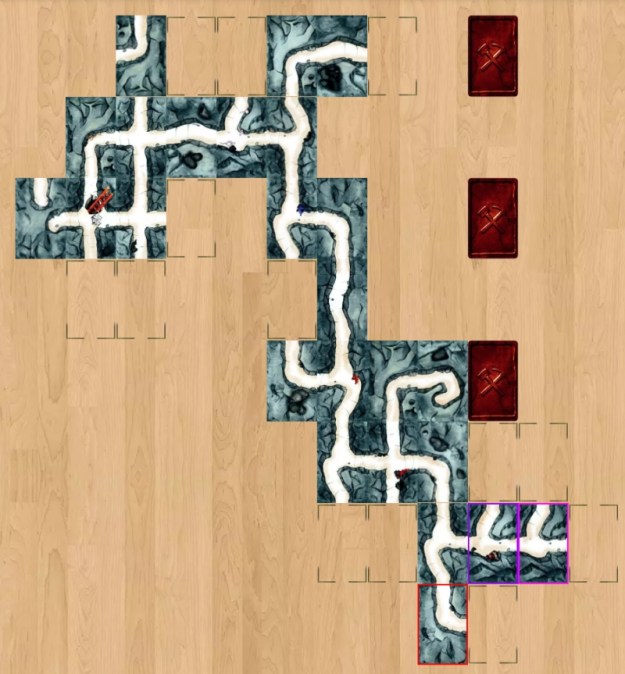
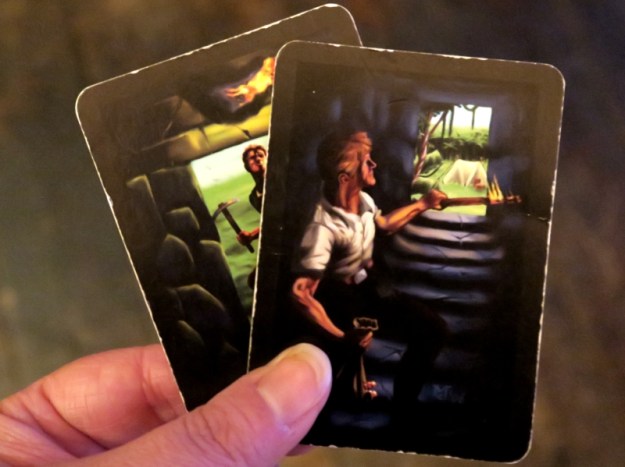
From there, Ivory and Lilac took an early night, while the rest of the group moved to Board Game Arena for a game of Saboteur.  This hidden traitor game is one we’ve played a lot online over the last year.  The idea is that players are either Good Dwarves or Evil Saboteurs, with the Dwarves trying to play cards to build a tunnel and find the treasure, while the Saboteurs try to stop them using blocking cards and by breaking the Dwarves’ tools.

Saboteur
– Image by boardGOATS

It is always extremely difficult for the Saboteurs to win, but we live in hope and everyone is always pleased to get the opportunity to try.  The first round it was Blue’s and Black’s turn to try.  With seven players, there can be two or three Saboteurs—with just two it was pretty much guaranteed to be gold for the Dwarves, and so it proved.  The Dwarves headed straight for the gold, and despite a desperate rear-guard action the round was quickly over.

Saboteur on Board Game Arena
– Image by boardGOATS from boardgamearena.com

The second round was much closer.  The evil Pine, Pink and Green made life extremely difficult for the Dwarves very effectively blocking their first route to the gold and forcing them to go all around the houses before they found the gold.  Early in the game, Pink caused chaos by disagreeing with Pine as to where the Gold was, and the ensuing confusion made it very close.  The Saboteurs had a lot of cards that worked in their favour, but they still couldn’t quite stop Purple from finding the gold in the end.  The third and final round was a different story though…

Saboteur on Board Game Arena
– Image by boardGOATS from
boardgamearena.com

Initially, the tunnels made good progress, but largely by chance, the tunnel headed towards the top card, when the treasure (it turned out) was at the bottom.  Things were made worse for the Dwarves when paranoia meant they turned on each other early.  There was more confusion about where the gold was and the Dwarves were in disarray.  Eventually, Pine revealed his colours, and then Black, and finally Burgundy.  For once, the cards went the Saboteurs’ way and they played them really well too.  Despite a desperate effort, there was nothing the Dwarves could do against such wickedness, and after a year of trying, the Saboteurs took their first victory.

Saboteur on Board Game Arena
– Image by boardGOATS from
boardgamearena.com

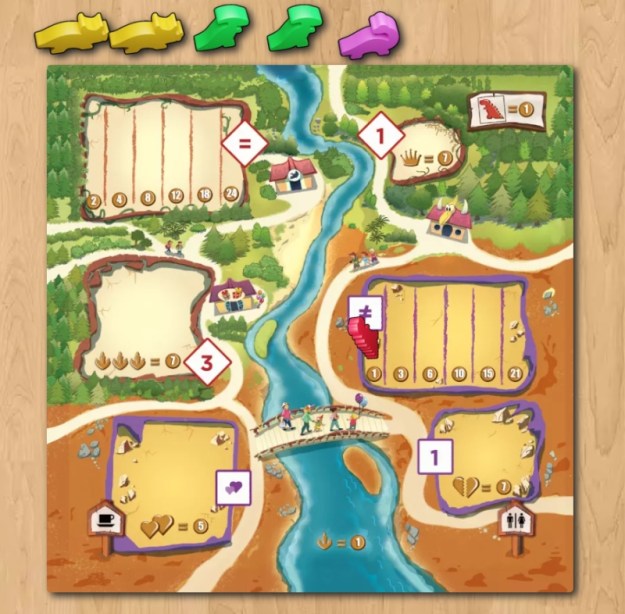
Time was marching on and we were looking for one last game to play, something perhaps a little different from the usual 6 Nimmt!.  After some discussion, Green and Black ducked out and everyone else played Draftosaurus—a game that Blue and Pink have very nearly picked up on several occasions, including Essen in 2019, just after it first came out and that Pine described as “Sushi Go! with dinosaurs”.  With that description, nobody could resist giving it a go.

– Image by BGG contributor kalchio

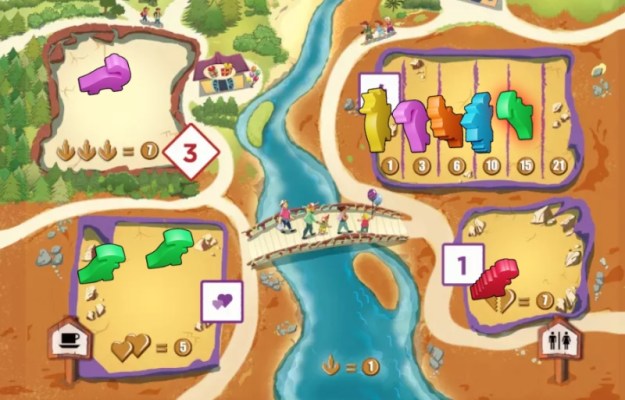
By this, Pine meant the main mechanism is drafting.  In Sushi Go! players have a hand of cards, then simultaneously, they choose one to keep and pass the rest on.  In Sushi Go!, players are collecting sets of cards, but in Draftosaurus players are drafting little wooden dinosaur meeples and placing them in their dinosaur park, on their personal player board.  The clever part, and what makes it different to Sushi Go!, is that the scoring is driven by the different park locations.

– Image by BGG contributor kalchio

Before each draft, a die is rolled that restricts where players can place their chosen dinosaur and the seven locations all score for different combinations of dinosaurs.  This means that players can want the same dinosaurs for different reasons, or different dinosaurs for the same reasons.  The game is played over two rounds, drafting six dinosaurs drawn at random from a bag, first clockwise and then anti-clockwise.  In the Board Game Arena rendering, this is all done electronically and the tactile nature is lost, however, the graphics are charming.

Draftosaurus on Board Game Arena
– Image by boardGOATS from
boardgamearena.com

For those who were new to the game, it took a couple of turns to work out where the scoring opportunities  are and how to make the best of them, and also to work out how the dinosaurs are passed round and how players could affect each other.  Pine was the only one to have played before, and therefore had a better grasp of how things worked.  Rather than use this experience to beat everyone else’s faces into the dirt, he helped keep everyone else straight and offered help and advice as required.

Draftosaurus on Board Game Arena
– Image by boardGOATS from boardgamearena.com

Draftosaurus rocks along at quite a pace, and it wasn’t long before the game was coming to an end.  Burgundy and Pink had got to grips with the game best and quickest and there was only one point in it.  Although they had mostly tried different approaches, both had also tried to collect different dinosaurs in the Meadow of Differences.  Burgundy had the edge though, and took victory with thirty-eight points.

Draftosaurus on Board Game Arena
– Image by boardGOATS from boardgamearena.com

Everyone had really enjoyed it and fallen a little bit in love with the charming graphics, quick game play, and what’s not to like about building a dinosaur park?!?!  This is definitely one to get and play once we can meet up properly again.  And on that positive note, looking forward to playing together with tactile dino-meeples after a year of gaming from home, it was time for bed.

– Image by BGG contributor kalchio

Learning Outcome:  Pharaohs and Dinosaurs, what’s not to like?

22nd December 2020 (Online)

For our last meeting before Christmas, we usually meet for food and have special Christmas Crackers. This year, this wasn’t possible of course, so instead of crackers everyone had a Box of Delights to be opened simultaneously at 8pm (similar to the Birthday Boxes we’d had in October).  The boxes included a range of chocolates and sweets, home-made gingerbread meeples, a miniature cracker, a meeple magnet, and a selection of dice and other goodies.

2020 Christmas Gingerbread Meeples
– Image by boardGOATS

With several little people attending, we decided to play something straight-forward first, so we began the evening with Second Chance.  This is a very simple Tetris-style game game that we’ve played a few times this year.  Players choose one of two cards depicting shapes and draw them in their grid.  If a player cannot draw either shape, another card is revealed and if they are unable to draw that one as well, they are eliminated.

Second Chance
– Image by boardGOATS

Once the rules had been explained and everyone had been given their unique starting shape, the group settled down with their colouring pens and pencils and concentrated on trying to fill their grid.  Pink was the first one to take a second chance card, and when he couldn’t place that shape either he was the first to be eliminated and took his bonus space.  The winner is the player with the fewest empty spaces, so while being first out is not a guarantee of anything, obviously players who stay in the longest are likely to do better.  And it was a long time before anyone else was eliminated.

Second Chance
– Image by boardGOATS

As people gradually found their space was increasingly limited, there were the usual pleas for something nice, which became more desperate as people needed second chances.  Then there was jealousy as players like Pine were eliminated with outrageously large shapes while others, like Little Lime, stayed in when they got the much coveted small pieces.  Meanwhile, everyone else concentrated on beautifying their art with Christmas colours and embellishments.

Second Chance
– Image by boardGOATS

Eventually, Purple, Pine, Burgundy, Blue and lastly Green were also eliminated leaving just five when the game came to an end because the deck ran out.  Then it was just the scores.  Most people did really well, though some, not quite so much.  More than half finished with single digits though, including excellent performances from Little Lime and Little Green.  There was some beautiful artwork from Lilac (as usual), but festive offerings from Green, Purple and Black too.  There was a three-way tie for second place between Black, Blue and Green.  On his own with only one single empty space though, was Ivory.

Second Chance
– Image by boardGOATS

With the first game over, we moved on to discussing the important matter of the GOAT Awards.  Every year, we give the Golden GOAT to our favourite game played during the year and the GOAT Poo award to our least favourite game.  Last year, Wingspan won the Golden GOAT Award and 7 Wonders took the GOAT Poo Prize.  This year, the unanimous winner of the GOAT Poo was Covid and its effect on 2020—nobody could deny that Covid was definitely the worst thing to happen to games night this year.  As Covid wasn’t a game, Camel Up took the award on a tie break from Terraforming Mars and Welcome To….

Camel Up
– Image by boardGOATS

Terraforming Mars just missed out on the GOAT Poo prize, but in coming fourth in the Golden GOAT competition, won the unofficial “Marmite award”, for the most divisive game.  Kingdomino and and last year’s winner Wingspan both made the podium for the Golden GOAT, but controversially, the winner was 6 Nimmt!.  The controversy wasn’t caused by the worthiness of the game, just that Blue ensured it’s emphatic win by placing all four of her votes in its favour.

Golden GOAT - 2020
– Image by boardGOATS

Although 6 Nimmt! is an old game, we’ve played it at the end of almost every meeting on Board Game Arena since March.  In a year with little smile about, it has given us more fun and entertainment than almost all of the other games put together and was responsible for moment of the year.  That was back in May, when Lime joined a game of 6 Nimmt! with a bunch of Frenchmen by mistake.  That is just one of many memorable moments we’ve had with 6 Nimmt! this year though.  Furthermore, since we discovered the new professional variant the game has gained a new lease of life, so it seemed an entirely appropriate, if strange win for a strange gaming year.

6 Nimmt! on Board Game Arena
– Image by boardGOATS

While Pink did the count for the GOAT Awards, Blue reminded everyone of the rules for the “Feature Game” which was to be the Winter Wonderland edition of Welcome To….  The fact that Welcome To… had nearly won the GOAT Poo award was an inauspicious start, especially since the main protagonist was Pine who had struggled last time.  A lot of the ill feeling was due to the dark colour of the board for the Halloween edition which we played last time it got an outing, so the pale blue colour of the Winter Wonderland version was always going to be an improvement.

Welcome To... Halloweeen
– Image by boardGOATS

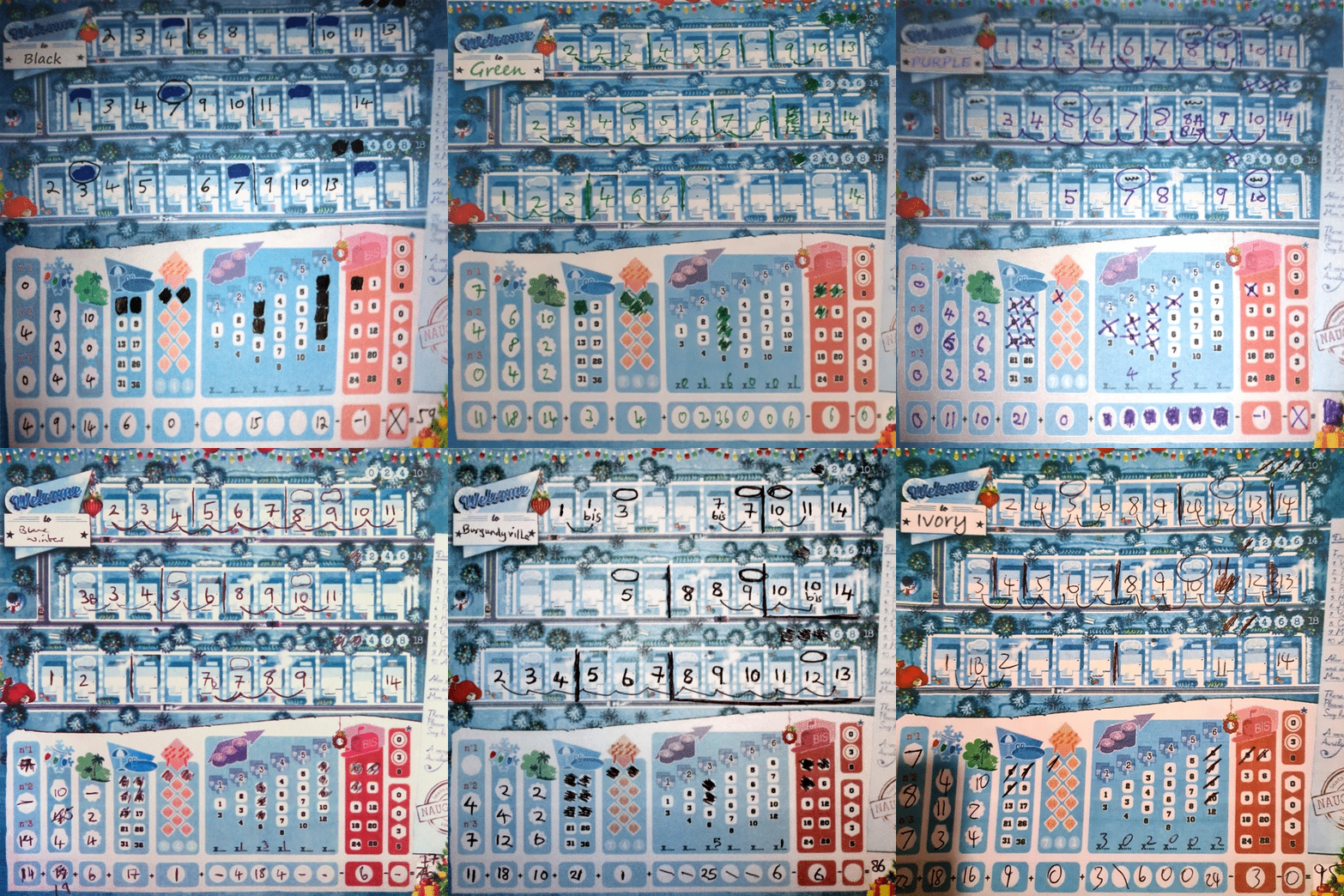
Welcome To… is one of the more complex games we’ve been playing online.  The idea is that players are developers building part of a town in 1950s USA.  Mechanistically, it is simple enough—the top card on each of three number decks is revealed and players choose one of the three numbers to play.  They mark this on one of the three streets on their player board.  The house numbers must increase from left to right and each number can only appear once in each street.

Welcome To...
– Image by boardGOATS

Each card is paired with the reverse of the previous card drawn from that deck, which gives a special power.  The special power can be rule breaking, enabling players to write a number a second time in a street, or give some flexibility in the number they must write.  Alternatively, the special power can directly provide players with extra points through the building of parks or swimming pools.  Finally, the special power can facilitate the achievement of extra points by enabling players to build fences separating their street into “Estates”, or increasing the number of points each “Estate” provides at the end of the game.

Welcome To... Winter Wonderland
– Image by boardGOATS

Aside from the colour scheme and artwork, the main difference between the base game and the Winter Wonderland Version was the addition of fairy lights as a means to get bonus points.  These are added to to a player’s board joining any houses where the numbers are consecutive.  At the end of the game, players get one point for each house in their longest string of lights.  Additionally, the third planning card selected gave a lot of points for anyone brave enough (or perhaps daft enough) to successfully connect an entire street with lights.

Welcome To... Winter Wonderland
– Image by boardGOATS

Little Lime and Lime took their leave, and Lilac and Little Green also decided to give it a miss, but that still left eight players, albeit one who was very sceptical.  Pine had nominated Welcome To… for the GOAT Poo Prize, and felt that didn’t bode well, but was prepared to give it a go.  The Plan Cards, give players points during the game as well as being a trigger for the end of the game.  As well as the street full of lights from the Winter edition, there was also one that gave points for a pair of estates (comprising three and six houses) and for players completing all six end houses.

Welcome To... Winter Wonderland
– Image by boardGOATS

The game started with a lot of “Bis” cards and quite a few high and low numbers.  It wasn’t a huge surprise then, when several people completed the end of street plan.  Ivory was first to complete the estate plan and eventually, Blue who felt that the Christmas element should be accentuated, completed the fairy lights plan.  The question was, who would be first to finish all three and when, as that was the most-likely end-game trigger.

Welcome To... Winter Wonderland
– Image by boardGOATS

It was towards the end that Purple commented that Black had been eliminated.  It wasn’t immediately clear what she was on about, but eventually it was apparent that one of his furry friends had decided that they wanted to be the subject of his attention and had firmly sat on his player board, very effectively obstructing play.  That cat-astrophe put paid to any successful involvement in the game by both Purple and Black, but it wasn’t long before Green announced that he’d finished all three of the Plans and was ending the game.

Welcome To... Winter Wonderland
– Image by boardGOATS

With that, everyone totalled up their scores.  Pine said that despite his scepticism, he had actually really enjoyed the game and felt he had done reasonably well and indeed was a long way from coming last.  It was very close for second place with Green just beating Burgundy into third by two points.  The clear winner, for the second time of the night, was Ivory who finished with an exceptional ninety-five points. And with that, he decided to quit while he was ahead and everyone else decided it was only appropriate that they should play the newly-crowned Golden GOAT6 Nimmt!.

6 Nimmt!
– Image by boardGOATS

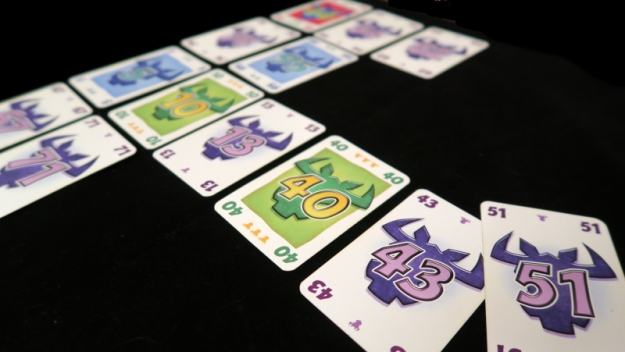
6 Nimmt! is so very simple, yet so much fun.  Players simultaneously choose a card from their hand and these are then revealed and, starting with the lowest card, added to one of the four rows.  Cards are added to the row with the highest number that is lower than the card played, i.e. the nearest lower number.  When a sixth card is added to a row, the owner takes the first five cards into their score pile, leaving the card they played as the new starting card.  The player with the fewest Bulls’ Heads at the end is the winner.

6 Nimmt!
– Image by boardGOATS

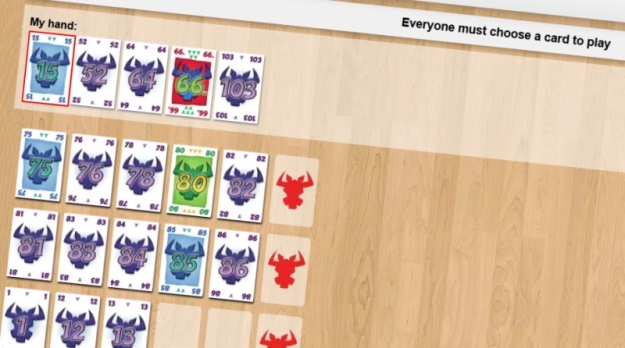
Board Game Arena implements the game with everyone starting with sixty-six points and the game ending when someone reaches zero.  It also adds a couple of other variants, the most exciting of which is the “Professional Variant”, where players can add cards to either end of the row.  Because Board Game Arena deals with all the up-keep, it makes this variant much easier to manage, and the results often come as a complete surprise.

6 Nimmt! on Board Game Arena
– Image by boardGOATS from boardgamearena.com

The reason 6 Nimmt! won the Golden GOAT, is that in a year where there has been so much to be miserable about, this game has provided more fun than anything else.  This time, poor Burgundy went from jointly holding the lead to sixth place in just a couple of turns and threatened to beat Purple to the bottom and trigger the end of the game.  As it was, he didn’t quite make it, and left Green who had only picked up seven “nimmts” in the whole game, to win.

6 Nimmt! on Board Game Arena
– Image by boardGOATS from boardgamearena.com

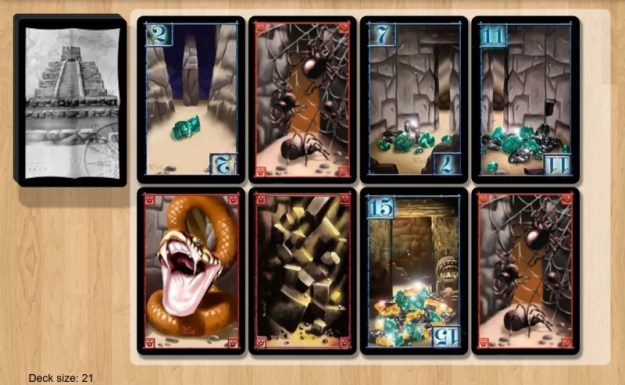
With seven players, the number of options were limited to more 6 Nimmt!, Saboteur, or something we hadn’t played before.  In the end, we went for a sort of compromise in Incan Gold which most of us knew, though we’d not played it on Board Game Arena.   This is a fairly simple “Push your Luck” game where players are exploring a temple.  Simultaneously, players decide whether they are going to stay or leave the temple.  Players who are in the temple will get shares in any treasure cards that are drawn that round.  These are divided evenly between the players and any remainders are left on the card.

Incan Gold
– Image by boardGOATS

As well as fifteen treasure cards, there are also Hazard cards in the deck:  three each of five different types.  When a second Hazard card of any given type is drawn, the temple collapses and buries everyone in it and they lose any treasure they have collected.  Additionally, there are five Artefact cards in the deck—these can only be claimed by players leaving the temple.  Any players that leave before it collapses, keep the treasure they have collected hitherto, and take a share in any remainders left on cards. If they leave alone, they also take any artefacts, but only if they leave alone.  Having left the temple, however, they will get no more treasure in that round.

Incan Gold
– Image by boardGOATS

The game is played over five rounds and the winner is the player with the most treasure at the end of the game.  The game is extremely random, but can be a lot of fun with the right people.  This time it was particularly random though.  The first two cards drawn were both Hazards and the first round ending after just five cards with only Green getting out in time.  The second round was even worse with three Hazards in a row terminating the round before it had begun.  On the plus-side, having had two rounds ended by Mummies, two of the three Mummy cards were removed from the deck, making it impossible for the mummies to end another round.  There were plenty of other Hazards though…

Incan Gold on Board Game Arena
– Image by boardGOATS from boardgamearena.com

The third round wasn’t much better, lasting only three cards with a second snake ending another round and only Pink taking any treasure.  The fourth round started with an Artefact, but when Burgundy, left, he was joined by Pink and Purple, so none of them were able to take it home.  Just three cards later, a second Giant Spider card brought down the temple and everyone finished with nothing (again).  The final round lasted a little longer, but two players still managed to finish the game without any treasure.

Incan Gold on Board Game Arena
– Image by boardGOATS from boardgamearena.com

Purple made an early escape and grabbed a couple of gems from the floor.  Burgundy and Pink escaped shortly after and Black managed to sneak out as the Giant Spiders closed the temple for good.  As a result of the unusually large number of Hazard cards, the game was especially low scoring.  It ended in a tie between Pink and Green on ten, with Black two points behind in third.

Incan Gold on Board Game Arena
– Image by boardGOATS from boardgamearena.com

With Incan Gold done, there was still time for one more game and it was only fitting to close with another game of 6 Nimmt!.  Having done so well in the last two games made Green the target this time, not that anyone really had enough control to manipulate their own position, much less target anybody else.  Pink, who had also done well in recent games, made a bit of a beeline for the bottom, and it was not much of a surprise when he triggered the end of the game.  This time, Green could only manage third, and it was a two-way tie for first place between Black and Pine (who always does well in 6 Nimmt!, and always denies it).  And with that, we brought our first online Christmas Party to a close and wished everyone a Very Merry Christmas.

6 Nimmt!
– Image by boardGOATS

Learning Outcome:  A box of sugar and exciting trinkets is ideal improving your concentration.

Golden GOAT Award Winners – 2020

Usually, just before Christmas, the boardGOATS meet for food, have a bit of a party, and decide the winners of the GOAT Awards.  Unfortunately, that wasn’t possible this year of course, but we still had a bit of a party online with festive treats for everyone, and chose our favourite game of the year.  As in previous years, we awarded two prizes:  the Golden GOAT for our favourite game and the “GOAT Poo” award for our least favourite.  As last year, everyone had three points to hand out for the Golden GOAT Award (plus a bonus if wearing Festive Attire), and everyone could nominate up to two individual games for the GOAT Poo Prize.

Terraforming Mars: Hellas & Elysium
– Image by boardGOATS

This year, the unanimous winner of the GOAT Poo was Covid and its effect on 2020.  As this wasn’t a game though, Camel Up officially took the GOAT Poo on a tie break.  Terraforming Mars won the unofficial “Marmite award”, just escaping the GOAT Poo, but also coming fourth overall for the Golden GOAT.  Kingdomino made the podium and last year’s winner, Wingspan, was runner up.  The winner though, was 6 Nimmt!.

Golden GOAT - 2020
– Image by boardGOATS

Although 6 Nimmt! is an old game, this year we’ve played it on Board Game Arena at the end of almost every meeting, and it has provided so much fun and entertainment in a year that has otherwise been sorely lacking in that regard.  Certainly, moment of the year went to Lime accidentally joining a game of 6 Nimmt! with a bunch of Frenchmen, but that is just one of many memorable moments we’ve had with it.  Since discovering the “Professional Variant” the game has been rejuvenated for us too, so it seemed an entirely appropriate win for a strange gaming year.

6 Nimmt! on Board Game Arena
– Image by boardGOATS
from boargamearena.com

10th Movember 2020 (Online)

With Blue and Pink otherwise engaged, the early arrivals were left to talk amongst themselves to begin with.  Eventually, everyone joined the table talk and admired the new, very yellow arrival that was the Oceana Expansion for Wingspan.  Sadly it will likely be a while before it gets an outing with the group, but it gives us something to look forward to.
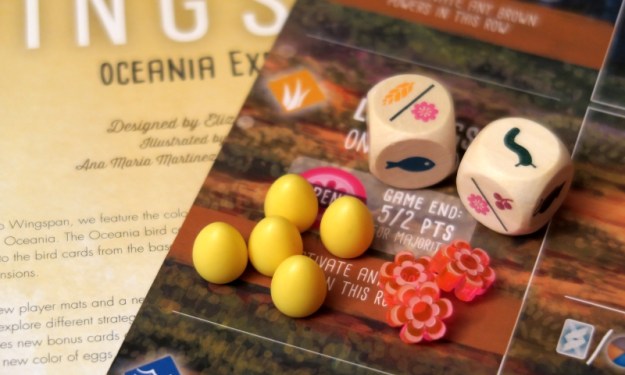
Wingspan: Oceania Expansion
– Image by boardGOATS

Once the yellow eggs had been put away, it was time to start the “Feature Game” which was to be HexRoller.  This is another of the “Roll and Write” style games and is a relatively recent release.  The game is quite simple in concept, though the scoring is quite involved and it is quite different to anything else we have played in this vein.  The idea is that a handful of dice are rolled and “binned” into according to value.  Players then choose two numbers rolled and write those numbers on their player board as many times as that number was rolled.

HexRoller
– Image by boardGOATS

This means if three and five are chosen and they appear once and twice respectively, the player will write three down once and five twice.  The game is played on a pre-printed sheet with a play area made of hexagons (because they are the bestagons, obviously).  Some of these have numbers written on them.  Once a player has chosen a number, they start writing in a hexagon next to a number already on the board, with every subsequent number written next to the previous, making a chain.

HexRoller
– Image by boardGOATS

Once per turn, players can also use one of three special actions, each of which can only be used once per game.  These allow players to write one of their chosen numbers an extra time; write a two anywhere, and choose a third set of dice from the pool.  At the end of the game players score from a smorgasbord of opportunities.  There are points for filling all seven hexagons in one of the coloured groups; for filling all the orange hexes in the central area; for connecting pairs of pre-printed numbers, and any left over, unused special actions.
HexRoller
– Image by boardGOATS

Additionally, every round a player picks two numbers and one is written in a box in the top row in the bottom left corner with the other written in the bottom row.  At the end of the game, a “straight” starting from three, score points equating to the highest number in the straight.  In other words, a set of two threes, a five, a four, a six, and a couple of eights would score six points.
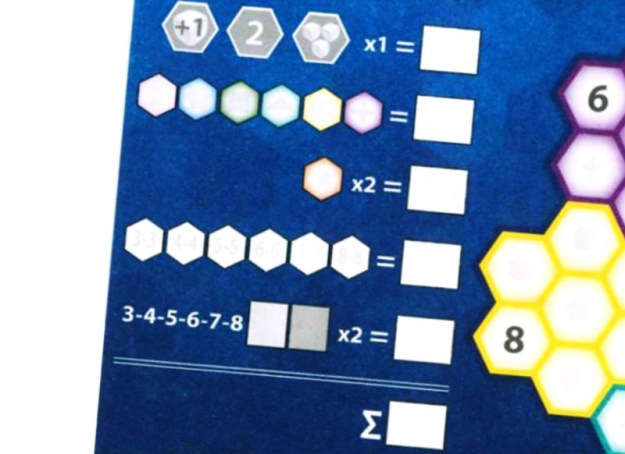
HexRoller
– Image by boardGOATS

Explained, the game sounds extremely complex, however the scoring is outlined on the sheet and in practice, it is actually quite easy to play, though challenging to play well.  That said, it is very different to any of the other games we’ve played and nobody really had much idea how it would pan out.  There are two different boards and with different layouts.  We started with the slightly more challenging, “seven dice” board, but only realised we were using eight dice after we’d already started, and that probably made it quite a bit easier.
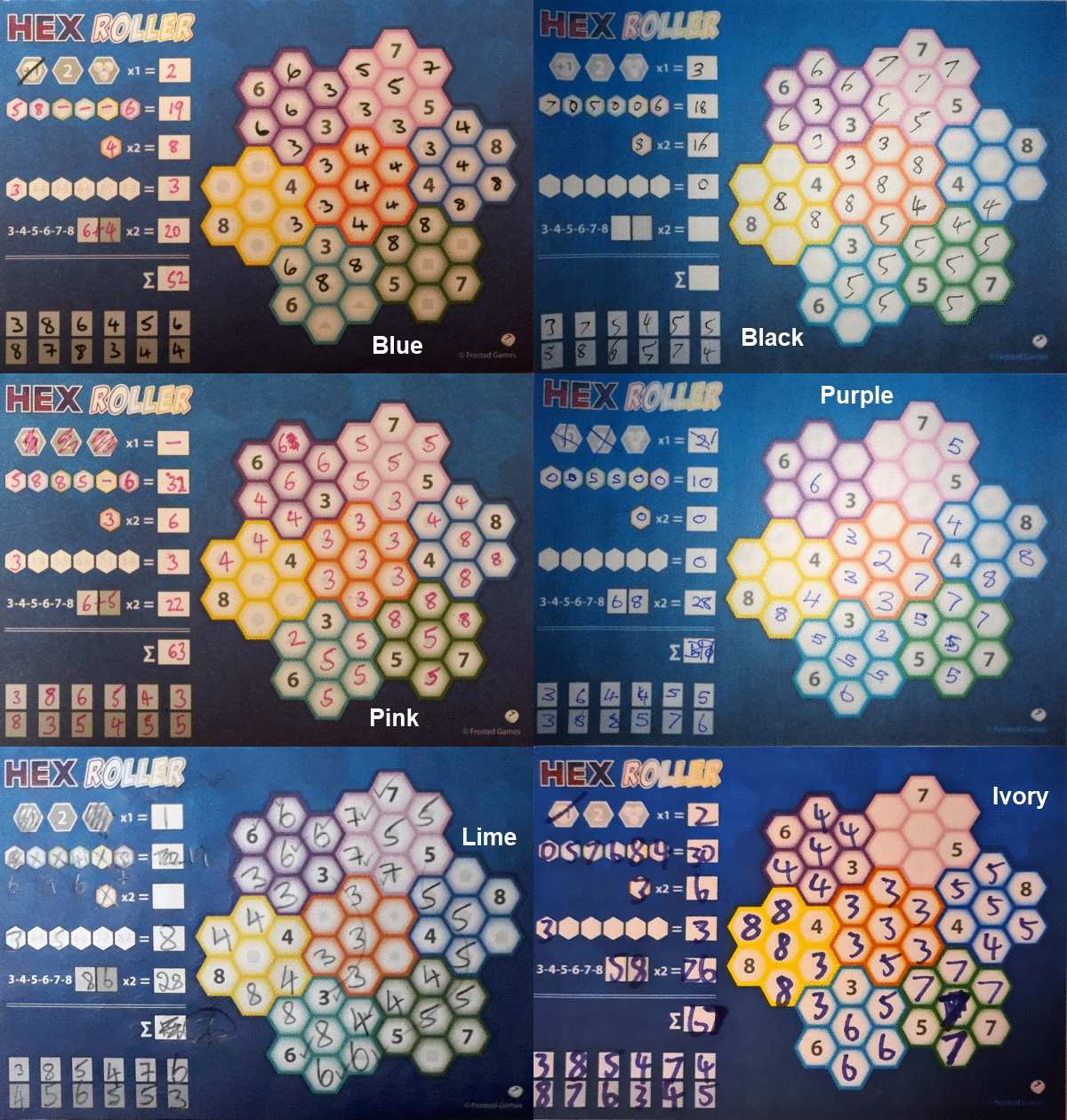
HexRoller
– Image by boardGOATS

With only seven rounds, the game rocked along quite quickly and was over in about twenty-five minutes.  Some people did better than others, but it was tight at the top with Green and Ivory tied for first place with sixty-seven and Burgundy just two points behind.  Everyone had really enjoyed it though, and we were all very keen to play the second, “Eight Dice” layout.  This layout is nominally the easier of the two, though we didn’t realise that before we started otherwise we’d have played it first.

HexRoller
– Image by boardGOATS

It has a larger central area, though, and is played over one extra round.  Some of the scoring is also very slightly different, which some people didn’t notice until the end when they came to calculating their score which led to quite a lot of recalculations.  Burgundy was third again, and Blue took second with fifty-seven.  Although Pink was insistent that because he was unable use a single die in the final round, he had a “moral score” of seventy-three his total of fifty stands.  That left Ivory the winner for the second time with a score of sixty-one.

HexRoller
– Image by boardGOATS

HexRoller is a really quick little game, and even playing it twice, there was still time for something else.  As we had struggled a little with Tiny Towns last time, we had planned to give it another go, this time with a new set of buildings.  The idea of the game is clever but quite simple:  players place resources on the spaces on their four-by-four town grid, and then, when the have the right resources in the the correct arrangement, they can replace them with a building.
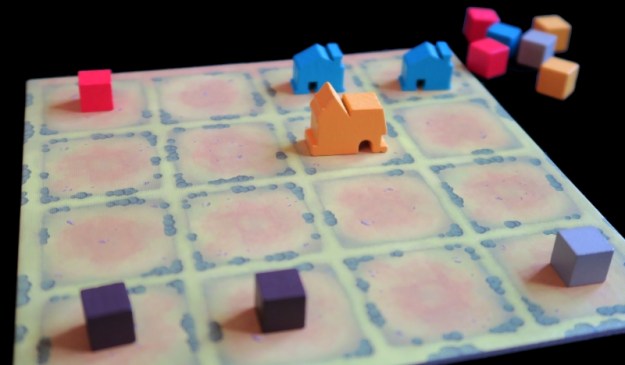
Tiny Towns
– Image by boardGOATS

Different buildings are built from different combinations of resources in different arrangements and, ultimately give different numbers of points.  We play using the Town Hall Variant where two resources are drawn at random, and then players choose their own for every third.  So, the key to the game is careful planning, but also  keeping options open in case the required resources don’t come up.  And luck also helps of course.

Tiny Towns
– Image by boardGOATS

This time we drew buildings from the alternative cards adding the Granary, Millstone, Bakery, Trading Post, Cloister and Almshouse to the Cottage.  These change the game considerably.  For example, the Granary feeds eight cottages (rather than the four of the Farm we used last time), but they must be in the eight surrounding spaces.  Similarly, the Millstone is worth two points if next to a red or yellow building (in this case a Granary and the Bakery), rather than a single point for each adjacent cottage.  The resources always take up more space than the buildings though and if players aren’t careful they can easily end up building on a space that makes it impossible to work with what’s left.

Tiny Towns
– Image by boardGOATS

Several players including Green, Blue and Pink picked up on the fact that the Cloister had the potential to be highly lucrative, scoring one point for each cloister in a corner.  Blue explained (several times) that this meant that two Cloisters both in corners would score two points each, whereas if one were in a corner and the other were not they would score one point each.  Pink decided that they were too difficult to build to get the most from them as they required four different resources, but Purple, Blue, Green and Lime were braver and decided to give it a go.

Tiny Towns
– Image by boardGOATS

Meanwhile, Pink and Burgundy went heavily for Almshouses.  The larger the number of these, the more points they score, but while an odd number of these scores positively, an even number scores negatively.  So this strategy was not without risk, although as players are not obliged to build buildings, they could always wait, and only build when they know they have a second ready to go.

Tiny Towns
– Image by boardGOATS

Lime was the first to be unable to do anything.  One of the down sides of playing games like this remotely is that players can’t watch what other players are doing, so as players dropped out, nobody else knew how they had done until the scores started to come in.  This time there was quite a spread with scores covering a range of nearly fifty points from minus fifteen upwards.  Burgundy had managed to avoid the pitfalls of the Almshouse and finished with twenty-eight points.
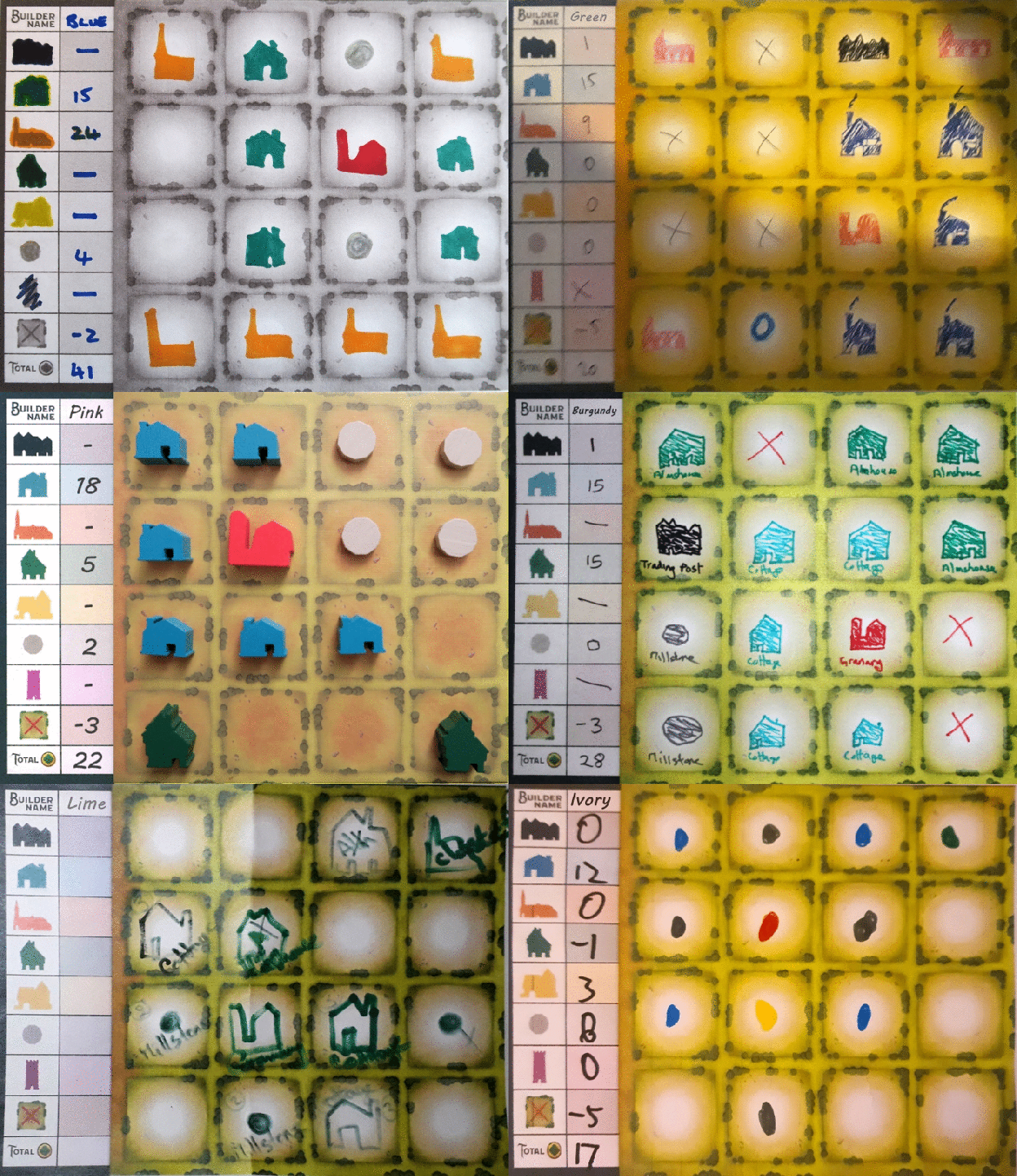
Tiny Towns
– Image by boardGOATS

Blue, however, had made the Cloister strategy work building a total of six, including one in each corner.  It was at this point that Green realised he could have built another two Cloisters, but had thought they wouldn’t score.  Worse, he hadn’t realised the empty spaces would score negatively, leaving him some eight points worse off.  He insisted that he wouldn’t concede, that there should be a recount as the rules hadn’t been clear, and that a lawsuit would clear it up…

Tiny Towns
– Image by boardGOATS

As in Pennsylvania, however, nobody listened to the litigant.  It was getting late though, so Lime, Lilac and Ivory left everyone else to play For Sale.  This is a great game for six players and the rendering of Board Game Arena is really good, making it really quick and fun to play.  The game itself comes in two parts:  buying properties and then selling them—the player who finishes with the most money wins.
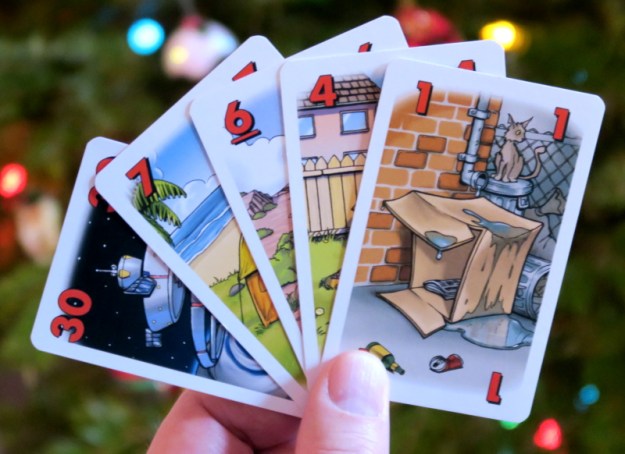
For Sale
– Image by boardGOATS

Everyone starts with $14,000 dollars and the bid must increase by at least $1,000 each time with players who pass taking the lowest numbered property available and getting half their stake returned.  There are two ways to play this, with the money returned rounded up or down – this time we chose to give every player the maximum amount of money with their returns rounded up.
For Sale
– Image by boardGOATS

This time, all the high cards came out in the final round.  This meant Burgundy paid just $1,000 for his castle (number twenty-eight) and Purple paid just $2,000 for the sky-scraper (number twenty-nine), although Green still paid $7,000 for the most valuable property (the space station).  As a result, most people had acquired some nice properties for a very good price.
For Sale on Board Game Arena
– Image by boardGOATS from boardgamearena.com

It was a three-way tie between Black, Burgundy and Green for the player who managed to sell their properties for the most money, with all three taking $48,000.  However, it is the total, including any money left from the starting funds.  In this, Pink and Blue had only spent $3,000 so had $11,000 left.  This enabled Blue to just beat Burgundy into second place and take victory with $53,000.  At this point, Pine, who had been unable to join in earlier as he was staying with his poorly mother.  Inevitably, the game of choice with seven, was 6 Nimmt!

6 Nimmt!
– Image by boardGOATS

6 Nimmt! is one of the group’s favourite games, and we really enjoy the additional madness that the “Professional Variant” gives.  In the original game, players simultaneously choose a card from their hand and then, starting with the lowest value card, cards are added in order to one of the four rows of cards on the table.  Each card is added to the row that finishes with the highest number that is lower than the number on the card.  Placing the sixth card instead causes the player to take the five cards into their scoring pile.
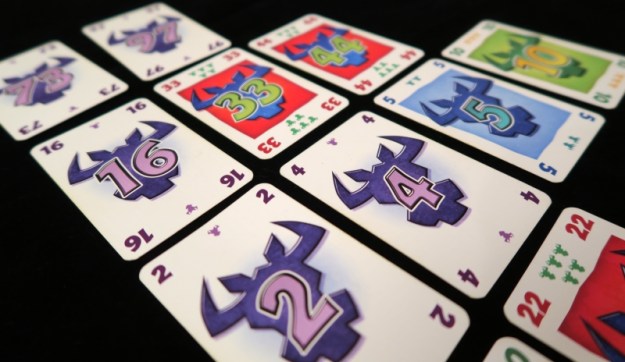
6 Nimmt!
– Image by boardGOATS

The “Professional Variant” allows players to add cards to the other end of the rows, as long as the difference is smaller.  This has the effect of making otherwise be “safe” plays, decidedly “unsafe”, and makes low value cards much more interesting to play.  It can have far more catastrophic effects on the game though, and this time was one of those games.

6 Nimmt! on Board Game Arena
– Image by boardGOATS from boardgamearena.com

Purple was the first to pick up cards, immediately followed by Green.  It wasn’t long before others joined in the race to the bottom.  Purple was leading the pack, though when Burgundy picked up seventeen nimmts, shortly followed by another fifteen and several other smaller totals, he overtook her, finishing with a magnificent minus forty-two!  The winner was largely incidental, but was Blue, who had only picked up fifteen in the whole game some twenty less than Pine, who always does well in this game, in second place.

6 Nimmt! on Board Game Arena
– Image by boardGOATS from boardgamearena.com

With that over, Green and Pink signed off, leaving five to continue, and the game of choice was Coloretto.  This is a very simple set collecting game, that we played from time to time when we were at the Jockey, but has become one of our staples this year.  The game is so simple and plays very quickly: players take a card from the deck and add it to a truck, or they take a truck and sit out until the end of the round.

Coloretto
– Image by boardGOATS

Players score points for their sets, with the three most lucrative sets scoring positively and any others scoring negatively.  Last time we played, we used the “Difficult” scoring, but that hadn’t been as interesting as, say, the “Professional Variant” for 6 Nimmt!, so this time  we used the standard scoring, according to the Triangular Number Series.
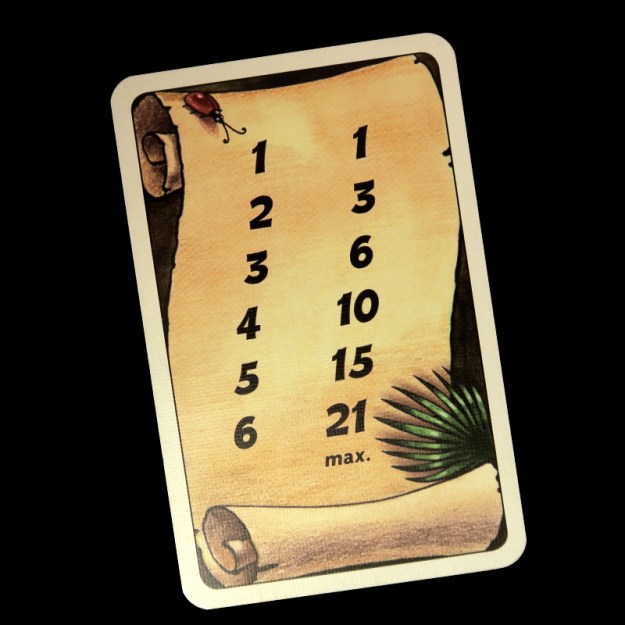
Coloretto
– Image by boardGOATS

With everyone very familiar with the game, it is often quite close and this was one of those games.  Indeed Pine and Black tied for second place with twenty-five points, but were beaten by Burgundy who finished just two points clear.  There was just time for one more game, and Sushi Go! has become one of our recent favourites in such circumstances, as it plays very quickly and the rendering on Board Game Arena is really good, though it would be really nice if they could add some of the extra options available in Sushi Go Party!.

Sushi Go!
– Image by boardGOATS

As it is, we played with the Soy Sauce mini expansion.  The game is very simple and we find that a little bit of Soy does add a little extra flavour.  The game is one of card drafting and set collecting, with players choosing one card from their hand to keep, passing the rest on.  Some cards score for sets of two or three (Tempura and Sashimi), while the Nigiri score more if played after Wasabi for example.  Soy goes well with everything, so scores if the player also has the most variety on their plate at the end of the round.

Sushi Go! on Board Game Arena
– Image by boardGOATS from boardgamearena.com

The game changers Maki Rolls and the Puddings which give points for the player with the most at the end of the round and game respectively.  The Puddings can be the real game-changers though as the player with the most gets six points and the player with the fewest loses six points.  In a close game that can make all the difference.

Sushi Go! on Board Game Arena
– Image by boardGOATS from
boardgamearena.com

This time, Blue and Pine took an early lead at the end of the first round while the others built up their Pudding supply for the end of the game.  Black took the lead after the second round though.  Burgundy put in a storming final round taking the six points for the most desserts, but with a three-way tie for the fewest, the negative points were split between Blue, Pine and Black.  Burgundy didn’t quite catch the leaders though, and he finished two points behind Pine and Black, who tied for first place.  And, well fed, it was time for bed.

Sushi Go! on Board Game Arena
– Image by boardGOATS from
boardgamearena.com

Learning Outcome:  Listening to the rules explanation usually gets you more points.

Deutscher Spiele Preis 2020 – Time to Vote

Although the convention season has been severely disrupted this year, the awards are carrying on as usual.  The best known of these is probably the Spiel des Jahres: this year’s nominations were announced earlier this week.  The Deutscher Spiele Preis, or German Game Prize, is slightly less well known, but arguably better reflects the slightly more advanced, “Gamers Games”, with the results usually more in line with Kennerspiel des Jahres category rather than the family Spiel des Jahres award, or “Red Pöppel”.  Recent winners of the Deutscher Spiele Preis include Wingspan, Azul, Terraforming Mars, Mombasa, and The Voyages of Marco Polo.

Wingspan
– Image by boardGOATS

The Deutscher Spiele Preis (which is awarded at the Internationale Spieltage, in Essen), is selected by a general vote which is open to anyone, players, journalists and dealers alike.  The incoming votes are evaluated by an independent institute and only votes with details of the full name and address are valid (any duplicates are removed).   All votes are treated the same with games placed first receiving five points, those placed second receiving four, and so on.

Azul: Summer Pavilion
– Image by boardGOATS

Only new games from the previous year are included in the ranking, so this year that’s games released since May 2019.  Thus anything new at Essen last year or the Spielwarenmesse (Nürnberg) this year, is eligible.  This includes:  Alubari, Maracaibo, Point Salad, Tiny Towns, Isle of Cats, Wavelength, Jaws, In the Hall of the Mountain King, Azul: Summer Pavilion, Fast Sloths, or any of the games nominees or recommended for the Spiel/Kennerspiel des Jahres awards.

Deutscher Spiele Pries 2020
– Image from spiel-messe.com

Voting is open until 31st July; it’s not necessary to submit a full list, so why not take the opportunity to vote for your favourite release of the year?