Category Archives: Games Night

23rd January 2018

Once the inevitable pizzas were dealt with, we settled down to the “Feature Game”.  This was Cities of Splendor, the expansion to Splendor, a splendid little game that we’ve played quite a lot since its release in 2014. The base game is really quite simple, but although a lot of groups apparently find it very dull, our group seem to find quite a lot of mileage in its subtlety and trying to get the better of Burgundy who mostly seems pretty unbeatable.  According to the rulebook, players are Renaissance merchants trying to buy gem mines, transportation methods and artisans in order to acquire the most prestige points. The most wealthy merchants might even receive a visit from a noble, which will further increase their prestige.  Despite all this, the game itself is, in truth, really quite abstract.  Players have essentially have three options on their turn: they can pick up gem tokens; buy a development card, or reserve a development card (and take a Gold token).

Splendor
– Image used with permission of boardgamephotos

When picking up tokens, the active player can either take three different gems, or, as long as there are four or more available, two the same, with a hand-limit of ten.  These are then used to buy development cards which provide the player with a permanent supply of gems of a given colour and sometimes, some prestige points. The development cards come in three decks, and the Level Three cards as significantly more difficult to obtain, often requiring many gems.  Sometimes it can be a good idea to reserve a particular card, preventing another player from taking it and getting a Gold token in return, which can be used in place of any gemstone when buying a development card.  At the start of the game there is a small number of noble tiles each with with a requirement (e.g. four opals and four rubies); the first player to fulfil this requirement gets the noble and the associated number of prestige points.  The first player to fifteen prestige points is the winner.

Cities of Splendor
– Image used with permission of BGG contributor punkin312

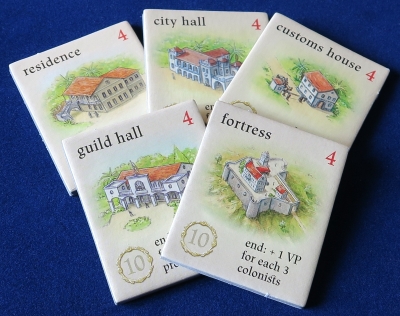
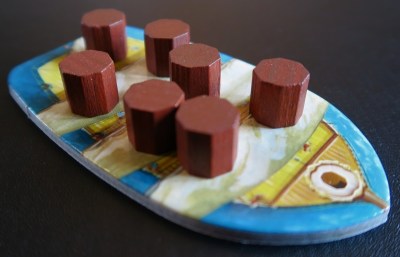
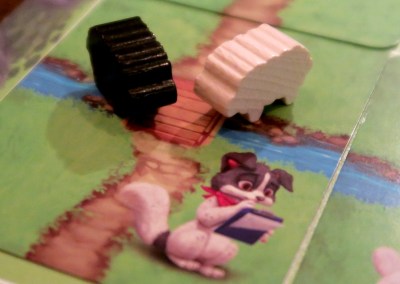
The expansion, Cities of Splendor, consists of four small modules:  Trading Posts; Strongholds; The Orient, and the eponymous Cities.  We were a little concerned that these expansions were going to take a game we enjoyed largely because it is so very simple, and make it unnecessarily complex (a phenomenon we had experienced previously with some parts of the Between Two Cities expansion, Capitals).  However, unusually, these modules must be used independently of each other, each providing a really very small tweak to the game, but potentially changing the dynamics quite dramatically.  For example, Strongholds provides three little plastic towers for each player, which can be moved by the active player whenever they take a development card.  The active player can either place or move one of their own strongholds, or remove someone else’s, thus providing another way to reserve a development card.  Alternatively, this effectively provides a way for everyone to “gang up” on one player, so this module has been renamed the “Get Burgundy” module…

Cities of Splendor
– Image used with permission of BGG contributor punkin312

We only had one copy of the expansion, but with several copies of the base game we decided to split into two groups, each playing different modules.  The groups were split along the lines of who wanted to get beaten by Burgundy and who didn’t.  The first group to get going contained Black and Blue, who were optimistic that the changes introduced by the expansion might upset Burgundy just enough to give someone else a chance to win.  As they don’t normally get the chance to play with them, they started with nobles drawn at random from the 2016 and 2017 Brettspiel Advent calendars and the promotional set and then had to decide which expansion module to use.   Rather than opting for the “Get Burgundy” module, they decided it would be fairer to choose something else and opted for the Trading Posts module.  This provides an additional small board with five “Posts” with specific requirements, which if fulfilled give players extra options.  For example, a player with one diamond and three ruby development cards is allowed to collect a single token every time they buy a development card.

Splendor
– Image used with permission of BGG contributor punkin312

Although Splendor is normally quite a thoughtful game, it usually moves along quite quickly. However, the addition of the expansion, slowed the normal fast pace quite noticeably as everyone spent more time working through the options for each turn, especially at the start.  It wasn’t unpleasantly slow though, particularly as everyone had plenty to think about during the down time. Burgundy grabbed lots of diamonds and quickly began to claim some of the special powers available from the Trading Posts, making particularly good use of the first one which allowed him to collect a token every time he picked up a development card.  Black tried to go for the last two Trading posts, one of which gave him two a point for each other Trading Post he had claimed and another which gave him a straight five points.  Blue had started well, but was finding that all the diamond cards had evaporated which brought her game to an abrupt halt.

Splendor
– Image used with permission of boardgamephotos

It wasn’t long before Burgundy was picking up his second noble, and with Black two turns away from finishing the game himself, the game came to an end as Burgundy claimed his fifteenth point, six more than anyone else.  Meanwhile, on the neighbouring table, they were playing with The Orient Module.  This provides ten extra development cards at each of the three levels, a total of six of which are placed face up (two from each level).  These red-backed, “Orient” cards have interesting and unusual powers.  For example, there is a level one card which acts as a single use, pair of gold tokens which can be used at any time during the game.  The other card available from the level one deck is an “Association” card which is immediately associated with one other card and increases the yield of that card by one.  There are also some double gem cards and one that enables players to reserve a noble.  Everyone made good use of the double gold cards and the “money bag” Association cards (aka “onion” cards) in the first row of Orient cards.

Splendor
– Image used with permission of BGG contributor punkin312

The second row expansion cards remained in place for quite some time. Purple took a lot of development cards using gold tokens, Green plodded away with opal and sapphire development cards, while Red was trying to hold on to her double gold cards to use on those difficult to get top row cards.  Eventually Green claimed a level two Orient card, a double red gem, which got him to within a whisker of getting the first noble, but Red had other plans.  An Orient card swiftly enabled her to reserve the noble, take from under Green’s nose and thus preventing him from taking a commanding lead.  Before long, Green was back, however, having built up his opals and diamonds which enabled him to claim Isabelle of Castile (with four opals and four diamonds). Then it was only a matter of time, Red claimed her noble, but couldn’t stop Green taking a top row card to finish the game with sixteen points leaving Purple, who had started, very frustrated—she was just one turn from claiming her reserved card which would have given her the last noble and fifteen points.

Splendor
– Image used with permission of boardgamephotos

Red had really enjoyed the extra challenge and had felt that the higher level expansion cards hadn’t really come into play and fancied giving it another go.  So, unusually for the group, rather than packing up, it got a second game.  There was a brief debate whether going first in Splendor is an advantage or not and the discussion spread to the next table.  It seems to be perceived wisdom, but there was a debate about whether the fact that players at the end of the round can get an extra turn (and so play for more points) might offset that.  Ultimately, no-one felt it made much of a difference and since Purple had started last time, it was between Green and Red, so they played Rock-Paper-Scissors to decide. With the excitement building, the count began, 1, 2, 3!  Round One was a draw: both had paper.  With the tension so tight you could cut it with blunt knife they started across the table at each other and prepared for the second round; a switch from paper was likely, but which way: Green went Scissors, but Red took the game with a well timed Rock and started the second game of Splendor.

Splendor
– Image used with permission of BGG contributor punkin312

Playing for a second time did not change the amount of thought that went into each turn; it always felt like a conundrum, one where several moves looked like good ones.  Perhaps the Orient cards hadn’t been shuffled very well, but all the level one “Onion” Association cards came out first and the double gold cards seemed to be stuck at the bottom of the pile. Red claimed to not know what she was doing, but made efficient use of her “Onions” nonetheless.  Purple continued her gold token strategy making sure she took whatever looked useful to Green while Green ironically, just couldn’t get any green emerald cards.  In fact the emerald development card handicap became quite a problem, especially since the other two were holding on to their green tokens and while an “Onion” card might have helped, he still needed one emerald card to start with! Eventually, Green was forced to change his strategy and picked up a level two expansion card to reserve the noble he was after before someone else had the chance to pinch it—all the more critical since it was the only one he could get under the circumstances.

Splendor
– Image used with permission of boardgamephotos

Red took the lead when she gained her first noble, but she said it wouldn’t last long, and she was right. Purple was next and was able to reserve a noble for herself, then Green claimed his reserved noble. The game continued to be quite tight and even though Green managed to claim a second noble, it wasn’t enough to end the game. That privilege fell to Red who finished with seventeen points. Purple was left with nothing she could do to increase her score, but that led to a debate as to what Green might be able to do. With twelve points, green needed five to draw level with Red and there was a five point card he could claim on the table. However, if Purple took that he would then only be able to claim a three point card, unless the card purple took was replaced with another five point development he could claim.  Purple decided to play king-maker and took the card leaving an unhelpful replacement card leaving him two points behind Red, the winner.

Splendor
– Image used with permission of BGG contributor punkin312

Since Red, Green and Purple had gone onto a second game, Blue and Black decided to do likewise and have another pop at Burgundy.  This time, Blue went on the offensive and decided that black opals were essential to her game plan and a couple of rounds in, suddenly realised that she had almost all the black tokens and there were no attainable opal development cards available.  With the others in dire straights, Blue was able to completely strangle the game.  The problem with this strategy is that holding all the tokens of one colour is a very powerful position to be in, but that power is useless unless those tokens are spent and then the power is gone.  Additionally, the other players will inevitably build up their cards in other colours and eventually this will lead to accessible cards for the rare gem turning up.  So, timing is critical and there is a lot of luck involved as well.  Perhaps the key part is to ensure that the amount of effort put in to controlling the game doesn’t exceed the value obtained.  Inevitably, Blue didn’t have the perfect timing required and eventually Burgundy broke free, finishing the game with a massive twenty points, leaving the others standing.

Splendor
– Image used with permission of BGG contributor dotkeller

The fact that both tables wanted to give their module another go says a lot about what we thought of them.  Clearly, the changes to the rules were not enormous but added a nice little bit of variation to a game we’ve played and enjoyed a lot.  Inevitably, we felt some of the Trading Posts some seemed much more powerful than others.  For example, the second Post enabled a player to take an extra gem of a different colour when taking two gems of the same colour.  The problem with this is that taking two tokens of the same colour is only possible if there are at least four tokens available in that colour.  In the two and three player games this is relatively unusual until later on when players have a lot of cards and no-longer need tokens, by which time it is too late.  In the four player game, we felt this would become much more valuable though.  On the other table, the players still felt they had been unable to use the high value Orient cards, even after a second attempt.  This led to a lot of discussion, in particular whether raising end-game trigger from fifteen to twenty, might encourage their use.  Certainly it could be an interesting variant to try on another occasion, either way, Cities of Splendor is certainly going see the table again for lots of reasons: it has breathed new life into the old game, we have two the other two modules to try, and Burgundy went straight out and bought a copy as well!

Kingdomino
– Image used with permission of boardgamephotos

While Burgundy was finishing beating Black and Blue black and blue, the other group were looking for something to play.  Red had started the evening relating her failed attempts to acquire Kingdomino for less than a fiver.  She had been keen to get hold of it even though she had not played it, so this seemed an opportune moment for Red to be properly introduced to the game.  It’s such a simple game that the rules explanation was quickly done:  Players take a domino which they add to their kingdom and then place their meeple on one of the dominoes on display for the next round.  There are a couple of really clever bits to this game though.  Firstly, since the dominos have a numerical value and are set out and taken, from low to high, players going for the more valuable tiles are trading this value against their position in the turn order.  Secondly, the two ends of the dominos depict terrain and when placed one end must connect to terrain of the same type already in the kingdom (or connect directly to the start tile).  Since all dominoes must fit in a five-by-five space (or be discarded) keeping options open is an essential part of the game.

Kingdomino
– Image used with permission of boardgamephotos

Finally, some tiles also depict one or more crowns, which are the key to scoring as each player multiplies the number of tiles in each contiguous region of terrain with the number of crowns on the tiles in that region.  This means that no matter how big an area is, it is worthless without any crowns.  Although it is a simple little game, it is easy to make a fatal mistake, and that’s exactly what happened this time.  Somehow, Purple messed up her grid patterns, but worse was to come.  She had been targetting mountains and pastures, while both Red and Green were looking to forests and lakes to fill their kingdoms. With only three playing a dozen dominoes were removed and it was not until the end of the game (face down).  It was only at the end of the game that it became apparent why Red and Green had found it so much easier to fulfil their plans—the high scoring mines and lots of pasture (including three of the crown tiles) had been removed. The odds had been heavily stacked against Purple this time.  With the others both getting a full set of bonus points, it was very close between first and second despite the fact that Green had played the game several times.  In the end there was only two points  in it, with Green the narrow victor.

Kingdomino
– Image used with permission of boardgamephotos

On the other table, Cities of Splendor had finished and the group were looking for something to play.  Inspired by the nearby game of Kingdomino, Black spotted Queendomino which he had not yet played.  Blue commented that she was happy to play it and be proven wrong, but that she felt it took all the good things in a great little game and broke it.  In her mind, the comparison was similar to that of Tsuro and Tsuro of the Seas.  The former is a short, light game that plays lots of people and despite player elimination is still great fun with minimal downtime.  On the other hand, playing Tsuro of the Seas at the Didcot Games Club had, on one notable occasion, ended up with Burgundy getting knocked out a couple of turns in and spending the next hour and a half as a spectator.   In Blue’s eyes, Queendomino’s first offence was the fact that instead of the tidy little box that Kingdomino came in, it had a huge, Ticket to Ride sized box, mostly because there was a tile-tower included.  This offended her sense of efficiency, but wouldn’t have been so bad, if it had worked properly.  Although the magnetic closing mechanism was cool, Blue in particular had repeated difficulties getting the tiles out of the bottom, a problem that was exacerbated as the stack got smaller and the reduced mass pressed less on the tile being drawn out, making it increasingly difficult.

Queendomino
– Image used with permission of BGG contributor Toynan

As for the game, the basic mechanism is the same as Kingdomino, however, there is an extra tile type: red building plots.  These act exactly the same as the other terrain types, except that there are a number of building tiles on display that payers can buy and add to their kingdom.  This building display is only refilled at the end of the round which can make being late in the turn order more of a problem.  This can be compounded if someone chooses to bribe the dragon to burn down one of the buildings.  Amongst other things, these buildings provide knights and turrets that players can use to collect taxes and score more points.  While this has the potential to make the game deeper, the downside is that it can make the already slightly mathsy scoring even worse.  Despite all this and Blue’s really rather appalling rules explanation, everyone was surprisingly keen to give it a go.  Burgundy inevitably, tried to profit from the new components and eagerly started collecting wooden turrets.  Blue and Black were a little more circumspect, though both of them picked up a few knights and used them to good effect to collect enough in taxes to ensure they were able to build a couple of nice buildings.

Queendomino
– Image used with permission of BGG contributor Toynan

In the end, it surprisingly close, and after several re-counts, Black was deemed the winner, six points ahead of Burgundy in second place.  Looking at the scores, it turned out that both Black and Blue had made most of their points on the original terrain, and it was arguable how much the new buildings had really helped.  Burgundy’s entire game plan had revolved around the new buildings, but somehow, although it looked like he was running away with it, the game hadn’t quite panned out like that.  Blue asked what the others thought of it and Burgundy commented that he’d be happy to give it another go, but that was in complete contrast to Black, who’s one word answer, summed up Blue’s feelings, “Terrible”.  At some point point during the game, Red had asked whether Blue would feel better about the game if it didn’t have the tower, to which Blue replied that it wasn’t the tower per se, it was more that the tower was a metaphor for all all the stuff they had added to the original Kingdomino game:  it was nice to look at, but fiddly, totally un-necessary and overall made the whole experience much less enjoyable.  With that, she had removed the tiles from the tower and immediately felt better about the whole thing, but not enough to save the game from being sold at the earliest opportunity.  So, Burgundy might not get his second chance to play it after all.

Queendomino
– Image used with permission of
boardgamephotos

Meanwhile on the next table, everyone was feeling a little tired, but as the hugely complex game of Queendomino, was still going on, Red and Green decided not to leave Purple relegated to observer, and chose to play one more short game.  The game in question was Battle Kittens, primarily because it’s got kittens in it, but also because it’s quite quick.  This was a game Blue picked up on a trip to Reading with Green, and, as he had enjoyed it more than she had, he’d received it as a little gift at the GOATS New Year Party.  At it’s core, it is a card drafting game where players draft their hand of kitten cards and then send them off to battle.  Each of the three arenas will contest three of the four kittenny attributes: agility, strength, wisdom and cuteness.  Players decide which kittens they want to put into each arena and then resolve any special cards with the highest total running out the winner.  At various times, both Purple and Red had a victory cruelly snatched away from them to the benefit of Green. The first time this happened was to Red who had a high score with three kittens and had it ended there she would have won that battle.  Unfortunately, she was forced to take a King card first, and lost all her other kittens and ended up losing the battle. Similarly, in the second round, Purple managed to get some really good Crown cards and won a couple of battles quite convincingly, but they either gave more fish for coming second or gave an equal number for first and second place and thus did nothing to dent Green’s growing pile of fish as his kittens gambolled their way to victory.
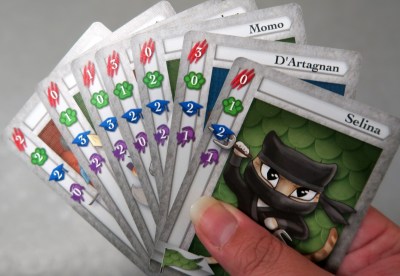
Battle Kittens
– Image by boardGOATS

Learning Outcome: Some expansions really add to the game, others can take a great game and make it “terrible”.
9th January 2018

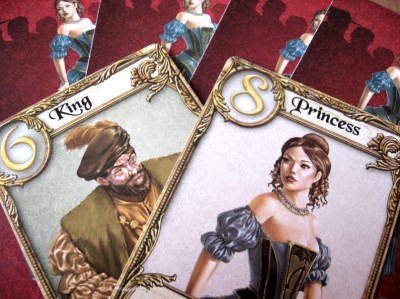
The evening started with a quick pre-pizza game of Love Letter.  We’ve played this micro game quite a bit over the years and it still comes out thanks to its amazing ability to fill tiny slivers of time.  It’s simplicity is the key though: from a deck with only sixteen cards, each player starts with only one card in hand.  On their turn, the active player draws a second card, and then chooses one to play, trying to eliminate other players from the game.  The winner is the last player remaining, or the player with the highest value card (on the rare occasion that the deck is exhausted first).  The very first card played set the tone for the whole evening, when Magenta played a Guard and correctly identified Blue as the Princess taking her out of the round without even playing a card.  Just to add insult to injury, Magenta pulled the same stunt in the third round too.  Blue got her revenge eventually, but it took several tries and in reality wasn’t all that satisfying even though she managed to prevent Magenta from winning a single hand and ensured Red took victory.

Love Letter
– Image by boardGOATS

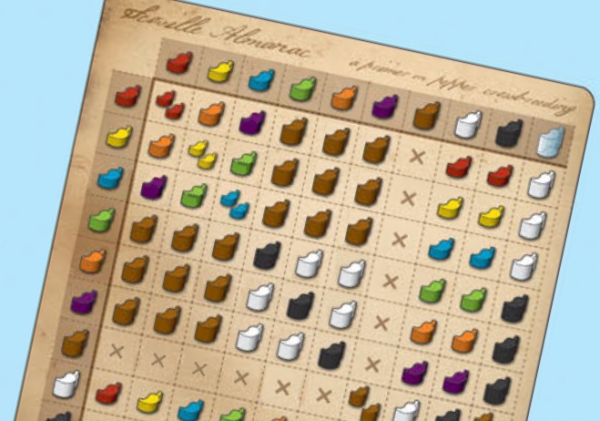
With a full compliment of gamers and pizza consumed, it was time to start gaming in earnest. The first game on the table was the “Feature Game”, Scoville.  This is an unusual game with auction, set collecting and “travelling salesman” elements, as well as a cool colour combination mechanic.  The individual elements of the game are not terribly complex, but because the rounds are quite long it is easy to lose track of things making the game a bit susceptible to analysis paralysis.  Each round starts with a blind bidding phase for turn order with the winner choosing his position on the player order track.  This is key because while the next phase, Planting takes place in turn order, the following stage, Harvest, takes place in reverse player.

Scoville
– Image used with permission of BGG contributor punkin312

During the Planting phase, each player first chooses a card from the market and gets the chili or chilis depicted on it.  Then they must plant a chili, either one they have just received, or one they already had behind their player screen.  Chilis are planted in a plot in massive communal player field on the central game board.  The position chilis are planted in is crucial, not only to the player doing the planting, but also to everyone else, as once a chili has been planted everyone can use it and nobody can remove it from the field.  Once everyone has planted a chili, then, in reverse player order, everyone takes it in turn to harvest.  Players move their Farmer meeple three steps around the field taking chilis as they go.  This is the clever part: the chili players get depend on the the cross-breed of the two chilis in the fields on either side.

Scoville
– Image by boardGOATS

Thus, if a player’s Farmer passes or stops between a red chili and a blue chili, they get a purple chili.  Similarly a combination of a yellow and a blue chili will give a green chili.  Once everyone has harvested, people get a chance to do something with their chilis:  take sell them for cash; get points for using them in a recipe, or exchange them for more chilis, points and/or cash at the farmers market.  The game is split into two halves, “morning” and “afternoon”, with the afternoon consisting of more exciting chilis available at the start of the round before planting.  When there are fewer recipe cards than there are players, the game is over and the winner is the player with the most points.

Scoville
– Image used with permission of BGG contributor punkin312

There was the usual debate as to who was going to play what, but as there were nine of us five ended up playing Scoville.  Blue got the “luck” of the draw and went first.  During setup, we’d had a discussion about the fact that going last is often a good thing as it means harvesting first, but in the early stages everyone went for planting as early as possible, leaving Burgundy to plant last and harvest first.  And harvesting first turned out to be a good thing for Burgundy because it meant he was the first to get an award for harvesting a second generation chili (i.e. a purple, orange or green one).  These awards are worth points at the end, and the earlier ones are worth the most.  It was a trick Burgundy pulled off a couple of times, netting him what felt like an unbeatable amount of points, however, the game had hardly started.

Scoville
– Image by BGG contributor chizcw

Everyone seemed to be struggling with something.  The first problem was distinguishing between the red, brown and purple chilis; there are a lot of little wooden pieces and many of them have similar colours, a problem exacerbated by the fact that a critical light-bulb had failed.  Beyond that, the game is fairly straightforward, however, it was the first time we had played it and people spent rather a long time staring blankly at the board, trying to decide where to plant their chilis.  Worse, since farmers cannot pass through or stop on a space occupied by another farmer, the amount of planning players could do in advance was severely limited.  This meant that players had a bit of a habit of getting in each others’ way and it wasn’t long before Burgundy and Magenta had managed to separate themselves from Blue, Pine and Red who had managed to wonder off in the other direction.

Scoville
– Image used with permission of BGG contributor punkin312

The problem with this was that Magenta and Burgundy had managed to acquire white, black and better yet, the clear sparkly chilis and planting these generated was more productive giving Burgundy even more awards.  At least, that was the way it started, but Magenta had other idea and cleverly managed to manipulate the turn order to ensure that she obstructed Burgundy in such a way as to beat him to the most lucrative of the high value awards.  Red, Pine and Blue could do little more than watch, feeling there was no way they could compete, but then, gradually, they began to build up collections of chilis and spend them on recipes which the found could also yield lots of points.  Unfortunately, by this time Burgundy and Magenta had run out of awards to compete for and were also turning their greedy eyes towards the points available for recipes…

Scoville
– Image used with permission of BGG contributor punkin312

With their better area of the field and only two players working it, perhaps it was inevitable that Burgundy and Magenta would be in a better position to grow the chilis needed for the most valuable recipes.  In the process, they managed to trample Pine into the ground and rub chili in his eyes by ensuring that he couldn’t take any recipe cards in the last couple of rounds because he couldn’t get the chilis he needed.  The last couple of rounds were a bit of an anti-climax, as everyone could see what was going to happen and we somehow managed to drag it out for longer than really necessary too.  No-one was in any doubt that the first and second places were going to Burgundy and Magenta, but the others hadn’t been paying enough attention to know which way round it was going to be.  In the end, Magenta finished with a massive one-hundred and eleven points, over twenty more than Burgundy in second, a difference that was almost as large as the range that covered everyone else.  It had been a much longer game than expected and everyone agreed that with fewer players it would have dragged less towards the end.

Scoville
– Image used with permission of BGG contributor punkin312

Meanwhile, on the next table, the other group were playing First Class, a modular, train-themed card drafting game, where two of five option modules are added to the basic card set, giving the game a lot of variety.  Although Black and Ivory had played it before, Green and Purple were new to the game so they needed a run-through of the rules and only the first two modules were used.  In First Class, players are competing rail line managers, working to upgrade their trains and improve their routes from Venice to Constantinople along path of the Orient Express.  Over three two-stage rounds, players select and activate action cards from a central area, each of which has their own deck of action cards.

First Class
– Image used with permission of boardgamephotos

At the start of the round players draw cards from the phase deck until there are three rows of six cards in the middle of the table.  During their turn the active player does two things: choose a card from the offer and then use it.  When the number of cards removed from one row is equal to the number of players, the row is removed from the game entirely.  The action cards allow players to extend their route; move their trains; improve their carriages; move their conductors, or expand their train.  There are also contract cards that may be drafted which have a specific condition that must be met during the game; meeting that condition may receive give bonus actions, points, or both.

First Class
– Image used with permission of boardgamephotos

After the first couple of rounds, Black and Ivory gave away what seemed to be the best tactic for this game, going for track cards and moving their Locomotive Meeple. This worked as not only did it give bonuses each time the train landed on a city space, it also gave bonuses at the end of each round (depending how far the train had got). Green had been building up his carriages and trying to get his Conductor to the end of his train as quickly as possible, since the largest bonuses seemed to be for the first person to get him to the end of their train.  However, when he looked across at Black and Ivory’s approach he felt that he had read the game completely wrongly as he had not realised that the mini-train track bonuses came up every round.

First Class
– Image used with permission of
BGG contributor ckirkman

Green continued regardless and quickly filled his train with zero point carriages, relentlessly pushing his Conductor to the end as fast as possible. He was of course rewarded for getting his Conductor there first, and so he spent the rest of the game trying to build up the value of his carriages to pick up as many points as possible. In contrast, Purple’s game plan was a little more measured and she did a little of everything, but that did mean that her Locomotive Meeple wasn’t travelling very far and neither were her guards as her long train wasn’t very long.  Black and Ivory were less interested in developing a long train and kept building up the value of their carriages, including some very useful double multiplier cards which meant that it seemed that Black and Ivory were chuffing away to victory while Green and Purple were running off the rails.

First Class
– Image by BGG contributor Wizzy Parkerir

Purple’s game was rescued in the second half by a masterful placement of a Locomotive Meeple bonus multiplier. She had applied it to the second bonus space; one which gave her two more forward movements of her Locomotive Meeple. In one go she leapt forward a total of six spaces, giving her three bonuses which would then score again for her at the end of each round.  With her Locomotive Meeple making it to the end of her track she then followed Green’s example of getting the Conductor to the end of the train taking the second place bonus on that. By the end of the game, Black and Ivory’s trains had also mostly reached their desired length and Green’s carriage values had increased.  In the final scoring, however, it was Black and Ivory that steamed home at the front with Ivory taking first place with one hundred and ninety-four.  Green had not gone into a siding as he had feared, and was only seven points behind Black, showing that this game probably does have more than one route to victory.

First Class
– Image used with permission of
BGG contributor ckirkman

Learning Outcome: Just because a game has enough pieces for five players, doesn’t mean it is a good idea for five people to play it.

31st December 2017

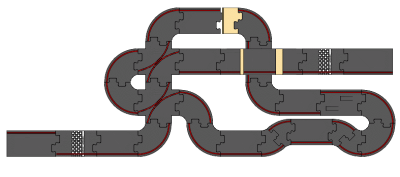
Green and Burgundy were the first to arrive, and were stood on the doorstep at 7pm on the dot.  This was possibly just because they were punctual, but may have been because they knew the first people to arrive would get the chance to set up the track for the evening’s “Feature Game”, the gorgeous, dexterity car-racing game, PitchCar.  Everyone had played it before except Azure, so he had a quick run of the track while Blue put out snacks and Pink sorted everyone out with drinks.  Like last year, Green and Burgundy designed a single, long, winding path with the idea being that it was a simple sprint to the finish rather than several circuits.

PitchCar Track 31/12/14
– Image by boardGOATS

Building the track is always a challenge, but Green and Burgundy had decided to maximise the difficulty by trying to use every piece of expansion in the box, including both crosses and the new double jump.  This made the track really quite complex, featuring a wide bridge/tunnel and a couple of jumps (for those brave enough to give them a go).  Rather than the usual “flying lap” to see who starts, each player had a single flick with the longest going first.  Blue took pole, but didn’t make it as far on her second attempt and within a few turns was in the lower half of the placings.  Similarly, Purple who had started second on the grid quickly began to move backwards too.  In contrast, Pink and Green who had started at the back of the grid, began a rapid rise through the field.  There were some really spectacular flicks, some that were successful, others that were almost successful, and a few that were horrific failures and received suitable opprobrium.

PitchCar
– Image used with permission of
BGG contributor kilroy_locke

The final bridge proved to be one of the greatest sticking points though as it was built from pieces that weren’t really intended to be used in that way, making joins quite difficult to traverse.  Blue, who had gone from the front to the back and back to the front, was the first to get stuck, but was forced to watch as Pine cruised past her showing her how to do it.  She proved a slow learner, however, as Green and Pink followed a couple of rounds later, while she struggled to make it over the step.  With the bridge so close to the finishing line, it turned out to be the discriminating factor in the race, and Pine finished the clear winner, with Green finishing a short nose ahead of Pink.  Meanwhile, the rest of the field passed Blue who by now had finally made it onto the bridge, but who seemed to have run out of fuel and limped home in last place, a couple of flicks behind Burgundy, who had been convinced no-one would be challenging him for the wooden spoon.

PitchCar
– Image used with permission of BGG contributor garyjames

While everyone else participated in the game of cooperative Tetris that is packing the track back into its case, Blue put the finishing touches to the supper of Cheesy Pasta Bake with fresh vegetables and a side order of Christmas trimmings.  These included “Pigs in Blankets” (or rather “Boars in Duvets”), “Devils on Horseback” and home made crackers that went off spectacularly and sent a shower of tiny pieces all over the room. With food finished, there was a quick game of “Musical Chairs” before everyone settled into two groups for the next round of games.  The first group, Green, Pine, Purple and Burgundy, fancied a bit of piratin’ and went for Black Fleet, a fairly simple, but thematic game.  The idea is that each player has a fleet consisting of a Merchant ship and a Pirate ship; there are also two Naval ships which players also control.  So, on their turn, players choose one action card which enables them to move their two ships round the archipelago depicted on the large and sumptuous board.

Black Fleet
– Image used with permission of boardgamephotos

Before, during or after moving, ships can carry out an action.  Merchant ships can can load or sell goods at an appropriate port, while Pirate ships may attack an opposing Merchant vessel in a neighbouring space and steal one cube of cargo (earning two Doubloons for its trouble) or bury some cargo they’ve stolen.  Ships can only carryout one action on their turn, so Pirates can only steal or bury on their turn, not both.  And they must avoid the Navy frigates as they do it because they can sink Pirate ships (also earning two Doubloons).  In addition to the Action cards, players can also play as many fortune cards as they like; these break the other rules of the game and and make play a little more unpredictable.  Finally, there are the Development cards, which both give players extra powers and act as the game timer, with the game finishing when one player has paid to activate all their Development cards.

Black Fleet
– Image used with permission of BGG contributor punkin312

There was much piratin’, tradin’ and policin’ of the ocean waves. Purple was an unfortunate early target simply for being in the wrong place at the wrong time. Green tried to target Burgundy, but a wily Merchant, he maintained his distance. Initially a lot of action took place on the western side of the board, and while Green began to bring in the money, Pine and Purple struggled to gain traction. Green was the first to activate a Development card, but he was followed by Burgundy on the next turn. By now Purple and Pine were complaining loudly that they were being picked upon, but that’s the trouble with this game, it tends to reward the leaders. Green and Burgundy activated their second cards in the same turn, but Green’s was of a higher value, meaning that he then activated his third card (the one with the lowest value) the following turn.

Black Fleet
– Image by BGG contributor spielemitkinder

By now the action had shifted to the east, Purple and Pine had finally managed to earn enough to activate a card, but by this time they were so far behind their chances of winning were almost zero and so their tactics changed to “get Green and Burgundy”. Unfortunately for Burgundy his ships were closer to Purple and Pine than Green’s were so he bore the brunt of their attack. His merchant ship was attacked and raided by both their pirates in the same turn and his path was blocked. Burgundy abandoned his plans to move it and opted to becalm his ship instead taking compensation for his lack of movement.  Green and Burgundy activated their fourth cards in the same turn, but Green had eight Doubloons left while Burgundy only had two. The next turn played out as expected with Green landing a load, activating his final card with four Doubloons left. Burgundy could gain nothing on his final turn, so couldn’t activate his final Development card. Unfortunately, the reward mechanism of gives bonuses to those who activate their Development cards first, which often leads to a runaway winner that the others are unable to catch.  That said, it is a fun game and doesn’t last overlong, so is a good game when players are in the mood.

Black Fleet
– Image used with permission of BGG
contributor The_Blue_Meeple

Meanwhile on the nearby table Black, Pink, Blue and Azure we trying out a new game, Sagrada.  This is a relatively new game, that we’ve only played once in the group before, as part of a “Monster Games” session some months ago.  A bit like Terraforming Mars, it is a game that has proved very popular, but was produced by a very small company who did not have the infrastructure or commercial clout to satisfy the demand which vastly exceeded expectation.  In the case of Sagrada, however, the game is one of those games with simple rules, but lots of complexity.  Players build a stained glass window by building up a grid of dice on their player board. Each board has some restrictions on which colour or shade (value) of die can be placed there and players take it in turns to take dice from a pool and add them to their window.  Depending on the difficulty of the starting grid, players start with a small number of favour tokens which act as “get out of jail free” options and allow them to use special tools to rearrange some of the dice, either during “drafting”, or sometimes those already in their window.

Sagrada
– Image used with permission of BGG contributor punkin312

Points are awarded for fulfilling certain criteria, depicted on cards drawn at random at the start of the game.  Although completing the window can be challenging in its own right if the dice don’t roll well, it is the objective cards that are the key to the game.  Each player has their own private objective which scores for the number of pips displayed on dice of a given colour in that player’s window.  The public objectives are much more complex though.  In this case, the three objectives were:  six points for every row with all five colours; two points for every pair of dice showing one and two; four points for every set of five different colours in the final window.  Black quickly spotted the synergy between two of the objectives, noting that each row that contained all five different colours would score a massive ten points.  Meanwhile,  Blue had drawn starting grid cards that were very challenging and was forced to make the best of it, and Pink and Azure, struggled to get to grips what they could and couldn’t do.

Sagrada
– Image used with permission of BGG contributor punkin312

Each round, players draw two dice from the pool in “Settlers starting order” (i.e. 1, 2, 3, 4, 4, 3, 2, 1).  This was something we really struggled with for no very good reason, and things weren’t helped by Blue who got herself into a mess, aggravated by the fact that she kept knocking the dice in her window with her sleeve.  Through it all, Black sailed serenely, finishing with a perfect set of five rows, each with five different coloured dice giving him a massive starting score of fifty which he went on to top up to a final total of sixty three.  Nobody was going to catch him, but Azure finished in second place with a highly creditable fifty-six, some way clear of Blue and Pink.  Both games finished almost simultaneously, and just in time to toast the New Year in and admire the spectacular fireworks in the general direction of our erstwhile gaming home, The Jockey pub.

Ca$h 'n Guns
– Image used with permission of BGG contributor punkin312

With the festivities over, it was time to choose our first game of 2018, and we picked Ca$h ‘n Guns.  This is a great party game, that we’ve played at the last couple of New Year parties.  This game combines gambling with a little chance and a dash of strategy, based round the theme of gangsters divvying up their ill-gotten gains by playing a sort of multi-player Russian Roulette.  Although we used some of the standees from the Expansion, this time we didn’t use the special powers and stuck to the game play of the base game.  This is very simple:  on the count of three, each player points their foam gun at one other player; the Godfather can then ask one player to change their choice before there is a second count of three giving players a chance to withdraw from the confrontation.

Ca$h 'n Guns
– Image used with permission of BGG contributor punkin312

At this point, everyone still in the round who has a target who has not backed out, reveals whether they chose to load their gun with a blank or a bullet.  The game is played over eight rounds and each player starts with three bullets and five blanks, all of which cannot be reused.  Anyone who gets shot is out of the round and anyone who receives three wounds is eliminated from the game.  We were all quite cagey at the start, so the loot was shared out among the whole group.  This didn’t last of course, and it was amid much hilarity that Azure decided to brave the three guns pointed at him only to take three bullets and retire from the game.  It was a few more rounds before the next casualty expired, when Black took his third shot and gracefully slid down the curtain to join the choir invisible.  Meanwhile, Green and Blue were somewhat hampered by being repeatedly targeted, leaving Pink to collect a large pile of artwork and Purple a huge pile of diamonds.  The only real question which of the two was worth the most.

Ca$h 'n Guns
– Image used with permission of
BGG contributor punkin312

Despite picking up the bonus for the most jewels, giving her a total of $122,000, Purple had to settle for second place behind Pink who finished with a fortune of $175,000.  Pink, highly satisfied with his success decided to do some washing up, and Green who had to prepare a roast for the next day decided it was time for him to go to leave.  Nobody else wanted to go though, so it was only a question of what we would play.  It was gone 1am, and nobody was in the mood for anything deep, so we decided it was a good time to introduce Azure to 6 Nimmt!, one of our favourite light, filller games.  A very simple “Cards with Numbers” game, 6 Nimmt! gives players the illusion of control while everything is going well, and shatters that illusion when it all goes wrong.  We usually play the game over two rounds and it is remarkable how differently they can go.  In this case, Azure and Blue came off worst in the first round, however, Purple and Black did particularly badly in the second round, so Azure finished joint second with Burgundy, just two points behind the winner, Pine.  By this time, the rain was pouring down, but it was definitely “late”; it had been a great way to say goodbye to 2017 and welcome in 2018.

– Image by boardGOATS

Learning Outcome:  It is a great way to start the year, with a foam gun in hand and a group of friends to point it at.

28th December 2017 – boardGOATS do the Quiz

As we meet at The Jockey every week, last year at Christmas we decided to enter a team for their Quiz night between Christmas and New Year.  We didn’t have a large team, but Blue, Pink, Pine, Violet and Violet’s mum were in attendance and had managed to win for the GOATS at the first attempt.  Flushed with that success, we decided to give it a go this year too. This time there were seven of us with Pine bringing along his mate, Azure.  As before, we booked a table for 8pm and, as usual, pizza was largely the order of the day with a burger, tagliatelle and scampi for those who decided not to follow the tradition.  While we were waiting for food to arrive, Green asked whether Red was going to be about over Christmas as he had some Gruyère for her. Unfortunately Azure misheard and asked who Trevor was.  Much hilarity ensued as Pine got himself in a terrible mess explaining who Red was and why he thought she wouldn’t be interested in someone called Trevor, but would love a block of cave-aged cheese!  To spare his further blushes, someone quickly suggested we played a game, which seemed like a good idea.  With so many people and so little time, the choice was limited, so we went with Tsuro.

Tsuro
– Image used with permission of BGG contributor aleacarv

Tsuro is a very simple game to teach and play, and, although it has nasties such as player elimination, it is so quick to play that these things don’t really matter.  The idea is that each player has a “Stone” which starts on a marker at the edge of the board and a hand of three tiles.  On their turn, the active player then places a tile on the next square in such a way as to create a path in front of the stone.  They then move their stone (and any others affected) along the path to the new end.  The game continues with players taking turns to place tiles and move stones trying to keep their stone on the board and avoid colliding with any other stone; the last stone left is the winner.  This time, it was a cagey start as everyone was very careful.  It wasn’t until the draw deck had been depleted, that the first players were eliminated, with Pine  forced to play a tile that caused him to collide with Blue removing both from the game.  Purple and Azure were next leaving three players until Black was forced to take himself off the board and Green with him, leaving Pink the sole survivor.

Tsuro
– Image used with permission of BGG contributor kilroy_locke

While we were eating Green asked about the “Monster Games” session the night before.  The evening had started with Kingdomino, and included NMBR 9, Azul and 6 Nimmt!.  The highlight had been El Grande, however, a game that we enjoyed on a previous “Monster Games” session.  This time, however, we decided to add the Grand Inquisitor & the Colonies expansion.  This adds an extra couple of elements to the game (but still no Portugal, much to Pink’s disgust).  Both Blue and Black quite liked the Grand Inquisitor component and would happily play with it again, but neither were very keen on the Colonies aspect, despite the fact that Blue had been able to use it to great effect towards the end of the game.  Pine had the last word on the subject though when he commented that he’d found it amusing that everyone had known before the start that Black and Blue were competing for first place, while everyone else was trying to avoid coming last.  It was perhaps just as well that the landlord chose that moment to hand out the paperwork for the picture round…

El Grande
– Image used with permission of BGG contributor kilroy_locke

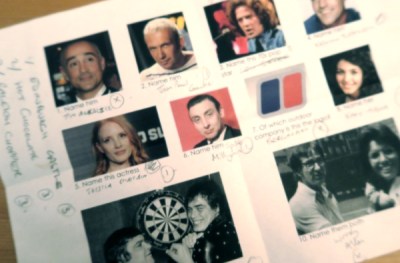
We started off badly, but quickly improved with a perfect score in the second round.  We maintained steady progress, but the team that beat the “Eggheads” would take some catching.  As the Quiz progressed it was clear that we would need a really good score in the “Who Am I?”, anagram and picture rounds to be in with a chance.  We got all three anagrams, but the “Who Am I?” was a bit of a disaster as we worked out who it was (“the big bloke from The Chase“), but couldn’t remember his name.  It turned out that that was actually enough information, but we only found that at the very end, so only got one point (his name is Mark Labbett).  Although we put in a reasonable picture round, it wasn’t good enough to make up the difference and we finished in a respectable second place.

Quiz December 2017
– Image by boardGOATS

With the Quiz over, we reverted to what we do best and went back to playing board games, or in this case, a dice game, as we finished the evening with Las Vegas.  The game itself is a very simple betting game.  Players begin their turn by rolling their dice and then assign some of them to one of six casinos (one for each dice face) each of which has a jackpot drawn at random from a deck of money.  Players must place all the dice displaying one number to bet on the casino of that number, and when done, play passes to the next player.  Once everyone has placed all their dice the player who placed the most dice on a casino takes the highest value currency card, with the person in second place taking the next and so on. The really clever bit is that before any money is handed out, any “draws” are removed.  This leads to a lot of barracking when dice are played as opponents try to encourage the active player to choose their favoured option.

Las Vegas
– Image used with permission of BGG contributor ckirkman

As usual, we included the Big Dice from the Boulevard expansion and the Slot Machine mini-expansion from the 2015 Brettspiel Advent Calendar.  The large dice are double weight and count as two in the final  reckoning.  The Slot Machine acts like a seventh casino, except that it can hold dice of any number, but dice of each number can only be added once (though a player must add all the dice they have of that number).  Since we play the game unusually slowly, we generally stop after just three rounds rather than the four recommended in the rules, and today was no exception.  Reducing the number of rounds meant that everyone had to make each round count to stay in the running, especially in such a close game.  Three players took over $300,000, with Green just $10,000 ahead of Black.  It was Blue who finished first, however, thanks largely to her judicious use of the slot machine which ensured a healthy return in the first two rounds.  And with that, it was home time for everyone, including Trevor the Cheese.

Las Vegas
– Image by boardGOATS

Learning Outcome:  Shy bairns get nowt.

12th December 2017

With this being the last GOATS Tuesday before Christmas (and the Jockey shutting on Boxing Day which would be the next one), we decided to have an early “Christmas Party” with everyone arriving for supper at the same time and home-made crackers.  Out of habit, most of us ordered pizza from their Tuesday “Pizza Special” menu, though there was also the odd portion of scampi too.  Even though it was still nearly two weeks until Christmas, we were a bit short on numbers thanks to the combination of people leaving early for the holidays and work commitments.  That didn’t stop Pine and Ivory bringing out their favourite topical Christmas Cracker jokes though:  “Why doesn’t Trump ever finish decorating his Christmas tree?  Because people keep shouting “Moron”!”  “Why didn’t Teresa May visit the baby Jesus? Because she couldn’t form a stable government…!”

Pizza at the Horse and Jockey
– Image from horseandjockey.org

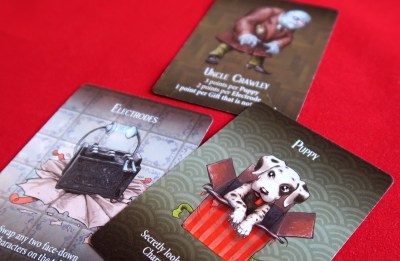
Once crackers, jokes and food had been dealt with, Magenta’s little one (who had come a long for the ride and a bit of pizza crust), found himself a friend to play with which gave everyone else the chance to get on with the “Feature Game”, Giftmas at Dungeon Abbey.  This is a short game designed by a local gamer and member of the Didcot Games Club, Rob Harper.  Blue and Pink picked up a pre-release copy at Essen in October and had saved it for a special, festive occasion, and this seemed appropriate.  The game is a fun, micro card game based in a world that is a sort of cross between Downton Abbey and the Adams Family.  The artwork is suitably gruesome, though it was very clear from the start who the Countess D’Ungeon was a caricature of!  Played over several short rounds, each player takes the role of one of the various eccentric and unpleasant family members grasping for whatever feels like the best present.  To this end, players begin with a character card and a couple of gift cards, all face down on the table in front of them.

Giftmas at Dungeon Abbey
– Image by boardGOATS

On their turn, the active player may either swap one of their face-down cards with one elsewhere on the table, or turn a card face-up, possibly activating a special action on the gift cards. The round ends when all a player’s cards are face up at the start of their turn or a bomb is revealed, at which point everyone scores points if they have collected the gifts wanted by their characters.  A lot of fun was had with everyone amused by the idea the sick combination of a set of electrodes and a puppy…  Before long, Magenta, Blue, Pine and Green had won one round a piece and Magenta’s son’s and his playmate was starting to look bored with the game they were playing, so although the we were just warming up nicely, we reluctantly decided to bring it to an early close when one player had won two rounds.  It was tight, but Green prevented Ivory and Burgundy getting in on the act and took his second round, and with it, the game.  Søn-Magenta had clearly had enough, so Mor-Magenta took him home leaving everyone else with a selection of wintery themed games to choose from.

Giftmas at Dungeon Abbey
– Image by boardGOATS

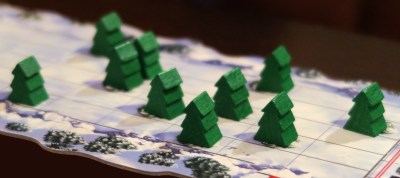
With five players left, the choice was actually rather limited and we quickly settled on an old favourite, the sled racing game, Snow Tails.  We played with the original edition, where players start by building the track which can either be from one of the suggested examples given in the rulebook, or, a home-designed one which we opted for.  On reflection, designing our own track might not have been all that clever, as we inevitably made it way more complicated than it needed to be.  The parcour began with a Chasm immediately after the start which caused an almighty bottle neck before everyone even got going.  Then there was a sweeping left hander and a short straight section followed by a right hander.  This wouldn’t have been so bad except they were immediately followed by a combination of a Crevasse (that had to be jumped at speed) and a field of saplings (adding a slalom element) just before the finish line.  As a result players had to control their speed very carefully throughout.

Snow Tails
– Image by boardGOATS

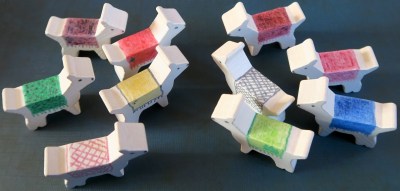
And that is what Snow Tails is all about really: controlling speed.  Players have a deck of number cards from which they draw a hand of five cards.  On their turn, cards are played on one to three of the active piles: the left husky, the right husky or the brake.  The catch is that if multiple cards are played, they must all be the same number, and once a card has been used, it can’t be used again until the player’s individual draw deck has been depleted.  The idea is that the sled’s speed is the sum of the dog cards in play, minus the current value of the brake; the speed dictates the number of spaces the sled moves forward in each turn.  Steering is carried out by adjusting the difference between the speeds of the two dogs which gives rise to “drift”, i.e. sliding movement to the left or right.  Drift occurs as a sled moves forward, with a maximum of one lane drift per forward movement.  An evenly matched pair of dogs goes faster leading to a balanced sled bonus, but for some reason we forgot about this.  It probably didn’t matter anyhow though, because the nature of the course meant that a balanced sled was a real rarity rarity and the close proximity of the obstacles meant it was unlikely that anyone would have been able to make use of the bonus as well.

Snow Tails
– Image by boardGOATS

Ivory and Blue were first out of the blocks and managed to steal a bit of march on everyone else, getting through the Chasm first and causing chaos behind as everyone else got stuck.  With nobody in his way, Ivory took an early lead and Blue gave chase, but bit by bit he continued to edge away.  It wasn’t long before Pine led the charge from the rear and those who had got jammed in the Chasm began to catch up.  This was partly because they had been able to store up a few good cards and plan their attack while they were waiting to get past the obstacle at the beginning, but also because first Blue, and then Ivory, paid the penalty for their quick start and were forced into the barriers.  Coming round the final corner, it was really tight, but Green, Burgundy and Pine were heading for home through the Saplings.  It was then that we realised the importance of positioning:  for those with no dents in their sled, it was possible just to mow through the saplings taking damage as necessary and career across the line.  There is a limit though as players got in his way, Pine stalled, allowing both Blue and Green through the gap, pipping him on the line.  Burgundy crossed the line first however, with Green finishing a close second in what had been a quite chaotic race.

Snow Tails
– Image by boardGOATS

With a shortage of five-player winter-themed games, we decide to go for one of our most popular games6 Nimmt!.  This is probably our most played game, which is strange as, even when we have a break, it always comes back into fashion again.  In the group we’ve discussed the phenomenon many times, and it is definitely a special game.  There are a combination of factors that add to it’s appeal including the time it takes to play, the number of players, the lack of down time, the simplicity etc..  Perhaps the biggest factor though is the illusion of control the game gives, until it all goes horribly wrong of course.  And of course it did this time too.  The first round was quite close with three players picking up almost exactly the same number of “Nimmts”.  It was the second round that was most amusing though as Pine and Ivory seemed to be competing to collect as many as they could, taking it in turns to pick up rows.  Unusually, as he usually has one catastrophic round, Burgundy managed to win both rounds with a clean sheet in the first and just five in the second.  This gave him a clear victory with Blue some way behind, just pipping Green to second place.  The excitement had all been far too much for Ivory and he decided it was home time, having won the unofficial “hat on the longest” competition that only he had been playing.

– Image by boardGOATS

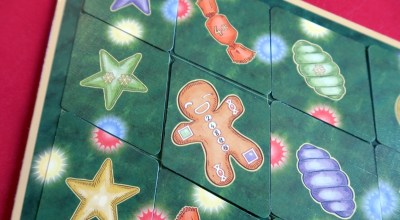
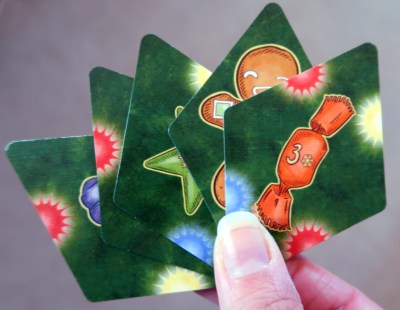
This left everyone else with time for one last festive game, Christmas Tree.  This is an apparently simple card drafting game, which turns out to be surprisingly challenging in practice (not least because shuffling diamond-shaped cards is remarkably difficult!  Each player begins with an empty Christmas tree shaped board and a hand of eight cards.  Simultaneously, everyone chooses one card to keep and passes the rest on.  They then add the card to their tree, decorating it.  Each card features a bauble of some kind, a wrapped sweet or a gingerbread cookie and some additionally have half a light on the edges.  Points are scored at the end of the game for satisfying the gingerbread men’s neighbourhood preferences, matching the half lights to make whole ones, for sweets and baubles.  The largest number of points come from the “objective cards”, however, which give points for ornaments in a particular arrangement.  At the start of the game, each player is given four objective cards and players choose one at the start of each round, which is scored at the end of that round.  As only Blue and Green had played it before (and then without the objectives) it was felt that it was fairest to draw the objective cards at random this time.

Christmas Tree
– Image by boardGOATS

It took a while for everyone to get the hang of the game, and it quickly became apparent that Green’s experience was invaluable as he took an early lead.  Blue, on the other hand, was demonstrating how not benefit from the advantage she had been given and was grubbing about at the back of the pack.  It turned out that everyone had a different strategy and was targetting different objectives, as evidenced by the changing of places in the final scoring.  Green, who was a long way out in front, remained there unchallenged, but all of a sudden, Blue made a march from the back, thanks to her large number of completed festive lights and a couple of well-timed linzer cookies (which allow players to swap decorations positions on their tree).  It was very tight for second, in fact, there were just two points in it, which given that scores ranged from one hundred and forty to over one hundred and eighty was very close and merited a recount of the final round.  The scores stood, however, and Blue just managed to edge in front of Burgundy to take second.

Christmas Tree
– Image by boardGOATS

Learning Outcome:  There are very few festive themed games that play five!

28th November 2017

The “Feature Game” was to be Lords of Waterdeep, and with a nearly full turn-out, it was simply a question of who wanted to play it.  Some were a little put off by the Dungeons & Dragons theme, but Burgundy, Green, Ivory, and Purple were keen to give it a go, with Ivory and Purple new to the game.  Each player is a secret Lord of Waterdeep, who uses their agents to recruit adventurers to collect gold so that they can complete Quests to advance their cause.  Each player in turn places one of their “agents” on a building space on the board and immediately resolves the effects of that building. A player may not place his agent on a building space if it has already been taken; the round ends when all agents have been placed, and a game is exactly eight rounds long.  Most of the buildings on the board give money or adventurers. The adventurers are represented by coloured wooden cubes: orange for Fighters, black for Rogues, white for Clerics and purple for Wizards.

Lords of Waterdeep
– Image used with permission of BGG contributor mikehulsebus

The adventurers players collect are exchanged for completing Quest cards. These cards can range from only a few points (four to six), but an extra advantage or some adventurer returned (a bit like a cash-back scheme), to some that give a massive amount of points (over twenty).  This is not the only source of points as there is also a substantial reward given to each player for completing the requirements on their secret Lord of Waterdeep card.  Despite the Fighting Fantasy theme, Lords of Waterdeep is really just run of the mill worker placement game, with adventurers instead of resources.  Unlike many games of this genre, “resources” flow in quite readily, but unfortunately they also flow out just as easily too…

Lords of Waterdeep
– Image used with permission of BGG contributor mikehulsebus

When Green completed a twenty point Quest early on, he looked a long way in the lead, but although it took a couple of rounds for his advantage to be quashed, quashed it duly was. It didn’t take long for everyone to work out which Quest card types everyone had for their secret goals, with Green and Ivory both wanting Commerce, and Green and Burgundy both chasing Piety. Only Purple remained more elusive to work out which was not surprising since she was actually scoring for every building she built and not scoring for Quests completed at all. No-one guessed, even though she managed to build six out of the maximum ten built. To be fair to Green and Ivory, Green had only played the game once before and that was four years ago, and Ivory had never played at all. Burgundy was at least aware that there was such a task, but after the game commented that he never does well at this game (unusually for him), though he enjoys the challenge.

Lords of Waterdeep
– Image used with permission of BGG contributor mikehulsebus

Throughout the game, Purple employed an interesting strategy in that she built up a number of Intrigue cards without using them. She turned that round in the last two or three rounds as her pile of Intrigues got whittled down, gaining her bonuses at everyone else’s expense ( and occasionally to their benefit as well), until she ended the game with none.  Ivory put a lot of effort into trying to get the big scoring quests and at one point was holding out for one on display to use with the building that would gain him an extra four points if he could complete at the same time as picking it up. In the end he bottled it and took it a turn earlier in case it was lost. It turned out he was right to do so, as shortly after he had taken it, all the quest cards were replaced. Ivory also managed to gain a number of bonus points as he too was a prolific builder.

Lords of Waterdeep
– Image used with permission of BGG contributor kilroy_locke

Green was trying to get as many Commerce cards as he could figuring the low scores would add up (Peity cards, his other bonus challenge, were in rather short supply in this game). About half way through, he built the extra worker building that when used allows the player to choose an action before anyone else. Green then used this to great effect taking this piece regularly and combining it with the first player marker to get the first two turns.  In a game where white Clerics were in such short supply (and many of the Quests that appeared later required lots of clerics), this really scuppered the plans of Ivory and Burgundy in particular.  Peity cards need more Clerics than most, Burgundy’s game was often frustrated by the lack of white cubes, and although he kept the first player token in the early part of the game and made good use of it, he just couldn’t quite get his engine going.

Lords of Waterdeep
– Image used with permission of BGG contributor mikehulsebus

The intrigue cards added an extra layer and interaction into the game. Many of them gave a benefit, but also gave a lesser advantage to another player of choice. And some were downright mean to a player of choice, and so alliances were made and broken throughout the game. Reasoning and pleading were a regular feature—an enjoyable interaction which is not so direct in other games.  In the end, it was a close game, but Ivory came out on top, just three points ahead of Green.  Everyone enjoyed it though and would be happy to play it again, but there was general agreement that with five players it would get crowded and might begin to drag.

Lords of Waterdeep
– Image used with permission of BGG contributor mikehulsebus

Meanwhile, on the next table, they had a bit of a problem:  almost all the games they had were four player games and there were five of them!  That afternoon, Magenta had expressed an interest in playing The Climbers again and, as it plays five, it was an easy choice.  This is a great three dimensional strategy game that we first played about a year ago.  It looks like it is designed round a set of children’s building blocks, but it’s appearance belies its true nature however, and, although it looks like a kiddie’s dexterity game, it is really a strategy game with almost no dexterity component at all.  The game is played in turn order with each turn comprising three steps. Firstly, the active player can move a block, any block so long as there isn’t anything on it, and they can place it anywhere, in any orientation as long as there is sufficient space. Next the active player can move their Climber as far as they like within the rules.

– Image by boardGOATS

Climbers can climb up any step below their head height unaided as long as the face they are climbing onto is grey or their own colour. They can also use their long and/or short ladders to climb larger distances, but they are fragile and therefore single use. Before the end of their turn, the active player may place their blocking stone, which prevents a brick being moved or used until that player’s next turn.  These are also single use though, so timing is everything, in fact that is true for almost everything about this game which was amply demonstrated by Blue. Nominated to go first by random draw, she made the most of it using her long ladder and getting as high up as she could as quickly as possible, much to everyone else’s disgust.  Black got himself somewhat stuck on a ledge, but Red, Pine and Magenta quickly caught up.  Then it became a real game of chess with everyone trying to outmaneuver everyone else.   Red accused Blue of using “Dubious Tactics”, but they proved to be winning tactics as she finished just higher than Red in second.

The Climbers
– Image by boardGOATS

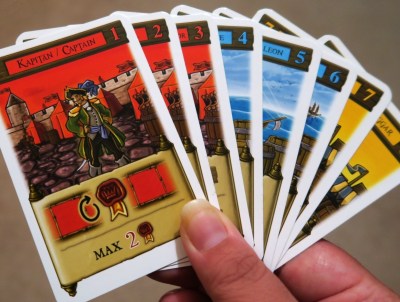
With the Matterhorn conquered, and Lords of Waterdeep still going, it was back to the search for a five-player game, and Santo Domingo fitted the bill.  This is a light card game of tactics and bluffing with a pirate theme set in the world of one of our more popular games, Port Royal.  The idea is that in each round player one character card from their hand which are activated in character order and then are placed on a personal discard pile.  The characters are designed to maximise player interaction, with their result dependent on cards that other players have chosen, similar to games like Citadels and Witch’s Brew.  For example, the first card is the Captain who can take a victory point (from a track on a central game board) up to a maximum of twice. The second character is the Admiral who also takes one victory point, but this time up to a maximum of five times, but this is only possible if there are enough points available. This means players have to play “chicken” and try to time playing their second card when other players play something other than the the Captain or the Admiral.

Santo Domingo
– Image by boardGOATS

Players have to be careful though because the third card is the Governor which gives players goods (rather than points) for every player who played either a Captain or an Admiral card. This means players are trying to maximise their return by reading everybody’s minds and saving their Governor for the round when everyone else is playing the Captain and the Admiral.  Cards four, five and six are the Frigate, Galleon and Customs are roughly analogous to the first three characters, except the Frigate and Galleon yield goods (instead of points) and the Customs card gives points (instead of goods).  Goods are very useful as they can be turned into victory points using the Trader (the seventh character card). Timing is key here too though as the potential return increases for every round that nobody uses the Trader; the return also depends on the number of people to play the card though, so even if everyone waits and then plays the Trader at the same time, players may get less than if they had played a round earlier.

Santo Domingo
– Image by boardGOATS

The final card is the Beggar which allows players to pick up their discard pile so that they can re-use them in the following rounds. At the end of each round, players check to see if anyone has passed thirty points and if so, that triggers the end of the game where any residual goods are converted to points at the minimum rate and the player left with the most points is the winner.  It was about half way through the game that Blue realised that there was something missing.  When the Trader is played, the return is dependent on the yellow track and how many players play the same card.  The problem was that once someone plays the Trader, that triggers a reset of the yellow, trader’s track.  Unfortunately, we forgot the reset bit which meant that players who were prioritising goods were finding it easy to get a good return whenever they wanted.  As a result, the game was very close and finished very quickly.

Santo Domingo
– Image by boardGOATS

Magenta took the first place with thirty-one points, just two ahead of Black in second.  As we had time, we decided to give the game another go, playing correctly this time.  Second time round was still close, though there was a better spread and the Beggar (who also gives goods for every Trader card played in the same round) suddenly became a bit more interesting.  After doing well in the fist game, Black got his timing wrong and failed to trade his goods.  Magenta was extremely efficient the second time round as well, but this time was beaten into second place by Blue.  With the game finished, Red and Magenta headed home and Blue, Black and Pine began a game of Azul.

Azul
– Image by BGG contributor JackyTheRipper

This is a new release that Pink and Blue picked up at Essen this year and so far has been popular with the group as well as receiving a lot of buzz further afield.  The idea of the game is that players are tile laying artists decorating a wall in the Palace of Evora with “azulejos”.  On their turn, the active player can either take all the tiles of one colour from one of the factory display (putting the rest in the central market) or take all the tiles of one colour from the market in the centre of the table.  They then place the tiles in one of the five rows on their player board.  The catch is that each player only has five rows, each with a set number of spaces, one to five. Players can add tiles to a row later in the round, but once a row is full, any left-overs go into the negative scoring row. Once all the tiles have been picked up, players evaluate their board, and, starting with the shortest row, one of the tiles from each full row is added to the player’s mosaic and scored.

Azul
– Image by BGG contributor JackyTheRipper

Players score one point for a tile that is not placed adjacent to any other tile, whereas tiles added to rows or columns score the same number of points as there are tiles in the completed row (or column). The game continues with players choosing tiles from the factory displays and then adding them to rows, the catch is that as the mosaic fills up, it is harder to fill the rows as each row can only take each colour once. The game is actually much more complex to explain than to actually play, and as such is just the sort of game we really appreciate.  Blue and Black had both played before, but Pine was new to the game.  Last time he played, Black had commented that this was “just the sort of game that he really liked, but wasn’t any good at”, so it was left to Blue to lead the way.  Pine didn’t need much showing however, and soon had a very fine wall of his own.  So much so in fact, that when Blue was forced to pick up five black “azulejos” she didn’t have space for he was in prime position to take a well deserved win.

Azul
– Image used with permission of boardgamephotos

While Azul was still underway, Lords of Waterdeep had come to an end, so Green, Ivory, Burgundy and Purple decided there was time for quick game of Lanterns: The Harvest Festival.  This is a straight-forward, light tile laying game, where players are decorating the palace lake with floating lanterns and competing to become the most honored artisan when the festival begins. Each tile is divided into four quarters, each of which has a colour, red, orange, blue, green, purple, black and white. On their turn, players choose a tile from their hand of three and add it to the central palace lake. Every player then receives a lantern card corresponding to the color on the side of the tile facing them, with the active player receiving bonus cards for any edges where the colours of the new tile match those of the lake. At the start of their next turn, players can gain honour tiles by dedicating sets of lantern cards, three pairs, four of a kind or seven different colours. Each tile is worth honour points and the player with the most points at the end of the game wins.

Lanterns: The Harvest Festival
– Image used with permission of boardgamephotos

Purple, Burgundy and Ivory went for trying to collect for the full colour set, while Green was content to begin targeting the “two-pairs” or four of a kind. Purple was a late starter to exchange her cards, forcing Burgundy to go for a couple of two-pairs, and Green got stuck with three orange lantern cards with none left to collect. Part way through the game, they suddenly realised that the six point scoring taken was actually a nine point scoring token and everyone had to work out who should have earned what. There weren’t too many already taken, so the correction was worked out quite easily. Purple seemed to not only hoard the cards, but was also building a large collection of bonus discs, such that the others thought that she wasn’t going to be able to use them all.  As usual there was the normal mutterings of the tiles being the wrong way round. Later on with shortages of some colours, tiles were placed in such a way to prevent some players collecting anything at all.  As the game wore on Purple started to exchange her cards and use her discs. By the end of the game she had actually used them all, and it turned out that she’d used them to perfection, proving that hoarding can sometimes be a winning strategy.

Lanterns: The Harvest Festival
– Image used with permission of BGG contributor punkin312

Just as they started, Azul finished so Blue suggested Black might like to give NMBR 9 a try since he had been quite intrigued last time when Pine, Blue and Purple had played it. Black was Keen and Pine had enjoyed it, so Blue explained the rules.  The idea is that players will play a total of twenty tiles, numbered zero to nine, with each one appearing twice.  One player turns over a card and calls the number and players each take one tile of that number and add it to their tableau.  Tiles must be placed such that at least one edge touches a previous tile.  Tiles can be placed on top of other tiles as long as there are no overhanging parts, and the tile sits squarely on more than one other tile.  At the end of the game the number tiles are multiplied by the level they sit on minus one.  So, a five on the third level scores ten points (5 x (3-1)).

NMBR 9
– Image used with permission of BGG contributor punkin312

The game followed the usual course, but it wasn’t long before the the bingo calls started.  Pine began, but Ivory on the next table soon joined in: “Number eight,  garden gate”; “On it’s own, number one”.  Pine finished with, “This number’s smaller, Ivory’s the caller!”  And finished the evening just about was, with only the maths left to be sorted out.  Both Blue and Black had managed to sneak a nine and a one onto the third story.  Pine had more than Black on the first story, but Blue had more than either of them and finished with a grand total of fifty three, some five points more than either of the others.

NMBR 9
– Image used with permission of BGG contributor punkin312

Learning Outcome: Don’t be misled by an unpromising theme.

14th November 2017

While Blue and Burgundy finished their supper, everyone else played a quick game of The Game, played with cards from The Game: Extreme.  The game is a very simple cooperative game: played with a deck of ninety-eight cards the group have to play all of them to win.  Each player starts with a hand of cards and must play at least two of their cards on one of the four piles. The first rule is that cards added to two of the piles must be higher face value than those previously played, while cards on the other two must be lower.  The second rule is “the backwards rule”, which says that if the interval is exactly ten the first rule is reversed.  The third and final rule is that players  can say anything they like so long as they don’t share specific number information about the contents of their hand.  The Extreme version has blue cards instead of red ones, but also has additional symbols on the cards which add further restrictions and make playing cards more difficult.

– Image by boardgoats

By ignoring the extra symbols the original version of The Game can be played with cards from The Extreme version.  As is often the case, the game started badly with almost everyone starting with cards between thirty and seventy.  There are two problems with this, firstly it forces players to progress the decks faster then they wanted.  Secondly, the very high and very low cards are still waiting to be revealed which causes the same problem a second time later in the game.  And this is exactly what happened.  Pine for example started with nothing below forty and only one card above sixty, and ended the game with a lots of cards in the nineties.  With such an awful hand before everyone else was ready, he ended up just playing everything and was the first to check-out.  By this time Burgundy and Blue were finished with pizza and had discovered that watching the others struggle was strangely compelling.  It wasn’t long before Purple was unable to play though, which brought the game to a close with a combined to total of seven cards unplayed.

The Game: Extreme
– Image by boardGOATS

With food finished and The Game over, the group split into two with the first group playing the “Feature Game”, Flamme Rouge.  This is a bicycle game that Blue and Pink played at Essen in 2016, but actually picked up at the fair this year.  The game is quite simple, bit even then we managed to get it slightly wrong.  The idea is that each player has two riders, a Sprinteur and a Rouleur, each of which has a deck of cards. Simultaneously, players draw four cards from one of their the rider’s deck and choosing one to play, before doing the same for their second rider.  Once everyone has chosen two cards, the riders move, starting with the rider at the front of the pack, discarding the used cards.  Once all the riders have moved, then the effect of slip-streaming and exhaustion are applied.  Exhaustion is simple enough – players simply add an exhaustion card to the deck for any rider without cyclists in the square in front of them at the end of the round.  The slip-streaming is slightly more complex, but the idea is that every pack of cyclists that has exactly one space between them and the pack in front, benefits from slip-streaming and is able to catch up that one space.

Flamme Rouge
– Image by BGG contributor mattridding

Slip-steaming is applied from the back, which means riders may be able to benefit multiple times.  The problem was, Blue had played incorrectly at Essen: they had played that a pack had to comprise at least two riders and would move forward regardless of how many spaces there were in front of them.  Ironically, the person to suffer most from this rules mishap was Blue as her Sprinteur was dropped from the pack early in the race and, although he got on to the back of the pack again, the exhaustion caused by all the early effort meant he struggled for the rest of the race and was soon dropped completely.  All the other riders managed to stay in the Peloton and, as the race drew to a close, there was some jockeying for position.  Black’s Sprinteur made a dash for the line, but got his timing very slightly wrong and didn’t quite make it.  Pine’s Sprinter on the other hand, timed his dash to perfection and pipped Black to first place.  In fact, Pine rode such a canny race, his Rouleur came in third.

Flamme Rouge
– Image used with permission of BGG contributor zombiegod

Meanwhile, on the next table, Burgundy, Purple and Green were giving Azul a go.  This is a brand new release that Pink and Blue picked up at Essen this year and played back at their hotel while they were in Germany.  It has such nice pieces and is such a clever, yet simple game, that Blue tipped it for the Spiel des Jahres award next year (or at least a nomination if something even better comes out).  The idea of the game is that players are tile laying artists decorating a wall in the Palace of Evora with “azulejos”.  On their turn, the active player can either take all the tiles of one colour from one of the factory display (putting the rest in the central market) or take all the tiles of one colour from the market in the centre of the table.  They then place the tiles in one of the five rows on their player board.

Azul
– Image by BGG contributor JackyTheRipper

Each row can only contain one colour, but players may have more than one row with any given colour.  The catch is that each player only has five rows, each with a set number of spaces, one to five.  Players can add tiles to a row later in the round, but once a row is full, any left-overs go into the negative scoring row.  Once all the tiles have been picked up, players evaluate their board, and, starting with the shortest row, one of the tiles from each full row is added to the player’s mosaic and scored. Players score one point for a tile that is not placed adjacent to any other tile, whereas tiles added to rows or columns score the same number of points as there are tiles in the completed row (or column).  The game continues with players choosing tiles from the factory displays and then adding them to rows, the catch is that as the mosaic fills up, it is harder to fill the rows as each row can only take each colour once.

Azul
– Image by BGG contributor JackyTheRipper

The game is much more complex to explain than to actually play, and as such is just the sort of game we really appreciate.  There are also end game bonuses which keep everyone guessing right up to the end.  So, although fairly simple to play, it is very clever and gives players a lot to think about.  Blue had played it with Burgundy, Black and Purple at the Didcot Games Club and everyone had enjoyed it, so Burgundy and Purple were keen to share it with Green.  The previous game had been very tight between first and second, with a tie for third, but this time, the game seemed quite tight throughout the game.  In the end, Burgundy finished the clear winner with seventy-eight points.  It remained tight for second place though, but Purple’s extra experience showed and she pipped Green by four points.  Both games finished at about the same time, so with Black, Ivory and Green keen to play 7 Wonders, and Purple and Blue not so keen, it was musical chairs while everyone else decided which group to join.

Azul
– Image used with permission of boardgamephotos

7 Wonders is a card drafting game similar to games like Sushi Go! or Between Two Cities.  Each player starts with a hand of cards and, simultaneously, each player chooses a card to play, a card to keep and then a passes the rest to the next player. The cards are played with various different aims:  players might try to build up their city and erect an architectural wonder, or attempt to have a superior military presence to neighbouring players. The game consists of three rounds, the first and third passing cards to the left, with the middle round passing cards to the right.  Black and Green went down the military route taking points from both Ivory and Burgundy and picked up additional victory points from blue cards.  Ivory and Burgundy, on the other hand, went for science points, but Ivory managed to take the most squeezing out both Burgundy and Black.  It was a close game with just five points between first place and third place, but it was Green who just finished in front.

7 Wonders
– Image by BGG contributor damnpixel

On the next table, Blue, Purple and Pine played a game of another Essen acquisition, Animals on Board.  This actually belonged to Pink, but Blue still had it in the bag from Didcot Games Club a few days before.  It is a very simple game of set collecting, with elements from Coloretto and 3 Sind Eine Zu Viel!.  Totally over produced, the game comes with fantastic cardboard arcs and thick card animal tiles.  There are five of each animal, and each set includes animals numbered from one to five and a selection are drawn at random and placed face up in the centre of the table.  On their turn the active player either divides one of the groups into two parts (and takes a box of fruit for their pains) or takes the animals from one of the groups, paying for them with boxes of fruit at a rate of one per animal.  At the end of the game (triggered when one player picks up their tenth animal) Noah claims any pairs of animals.  The remaining animals either score their face value if they are singletons, or score five if there are three or more.

Animals on Board
– Image used with permission of BGG contributor chriswray84

Blue began collecting pandas and zebras, while Purple and Pine fought over the tigers, foxes and crocodiles.  It was Blue who triggered the end of the game and everyone counted up their totals in whst turned out to be a very close game.  Everyone had at least one set of three and Purple had managed to take four foxes.  Blue had managed to pick up a total of eleven animals and that extra critter made the difference giving, her the win.  Since it had been so close and 7 Wonders was still going, they decided there was just enough time to play something else and see if revenge could be had.  Since NMBR 9, another game that came back from Essen, needs no setting up, they decided to give it a go.

NMBR 9
– Image used with permission of BGG contributor punkin312

NMBR 9 is a Bingo-type game like Take it Easy! or Karuba, where  one player calls a number and everyone plays their tile that corresponds to that number.  NMBR 9 takes the number theme one step further, since all the tiles are roughly number-shaped.  The idea is that players will play a total of twenty tiles, numbered zero to nine, with each one appearing twice.  One player turns over a card and calls the number and players each take one tile of that number and add it to their tableau.  Tiles must be placed such that at least one edge touches a previous tile.  Tiles can be placed on top of other tiles as long as there are no overhanging parts, and the tile sits squarely on more than one other tile.  At the end of the game the number tiles are multiplied by the level they sit on minus one.  So, a five on the third level scores ten points (5 x (3-1)).

NMBR 9
– Image used with permission of boardgamephotos

Blue started off well, which was unsurprising as she had played it before with Pink.  She quickly got herself into a bit of a tangle though, with the plaintive cry, “I’ve got a hole in the wrong place!”  Pine was steadily making up ground, but concurred, muttering, “There are too many sticky out bits on a four…”  With 7 Wonders finally coming to an end, Black and Burgundy found their curiosity piqued by the strange shaped tiles and tried to work out what was going on.  It wasn’t long before the last cards were turned over though and everyone had to take their shoes and socks off to work out the scores.  Pine’s smart second level placement had yielded success and he finished with score of sixty-one, a comfortable lead of five over blue in second place.

NMBR 9
– Image used with permission of BGG contributor punkin312

Learning Outcome:  Some games, make surprisingly good spectator sports.

31st October 2017

The evening began with Blue handing out Essen orders to Red (Sole Mio!, a relative of Mamma Mia!), Green (Thunderbirds and all the expansions), and Burgundy (lots of Concordia and Orléans bits).   Just to make sure Ivory and Pine didn’t feel left out, she had also brought a whole flock of boardGOATS to pass round – all suitably decorated.  There was a lot of discussion of the games at Essen, but Spiel has grown so much over the last few years that it was impossible to see everything as was evident when Green trotted out the fruits of his research and what was “hot”.  Altiplano, Clans of Caledonia, Photosynthesis, Gaia Project, Charterstone, and Noria were all completely missed for various reasons, but Pink and Blue had managed to look at Agra, Meeple Circus, and Kepler-3042 and had picked up copies of Keyper, Queendomino, Mini Park, Montana, Captain Sonar and Azul (Blue’s tip for Spiel des Jahres next year) among other things, all of which will no doubt appear over the coming weeks.

A Flock of boardGOATS
– Image by boardGOATS

With the chit-chat and pizzas over, it was definitely time to play something.  With six of us, it was almost certainly two games which was fortunate as Green wasn’t keen on anything Halloween themed, which ruled out the “Feature Game”, Dead of Winter: A Crossroads Game. That wasn’t a problem though, as Pine was keen to play and everyone else was happy to be a third.  In the end, it was Blue that joined them as she hadn’t played it before.  With two novices, that meant a full explanation of the rules.  Dead of Winter is a semi-cooperative game.  There are a number of things that make it different from other, older cooperative games like Pandemic.  For example, there is a group objective, but each player also has a secret, personal objective:  players must achieve both to win.  There is also the addition of a traitor, who’s objectives are counter to everyone else.  Both Pandemic and Shadows Over Camelot have this mechanism integrated as part of an expansion, and in Dead of Winter, this is also optional, or (like another of our favourites, Saboteur) can be played in such a way that there may, or may not be a traitor present.

Dead of Winter: A Crossroads Game
– Image used with permission of BGG contributor mikehulsebus

Perhaps more significantly than these though, is the nature of the ticking clock.  In Pandemic there is a deck of cards that which dictate what happens and, ultimately, how long the game is going to go on for as the game ends if they run out.  The situation is similar in the other Matt Leacock games like Forbidden Island and its sequel, Forbidden Desert.  In contrast, Dead of Winter, is played over a set number of rounds.  There is still a deck, the “Crisis deck”, but this sets the tone of the round and provides the “team” with a task that must be completed before the end of the round otherwise nasty things happen.  In general, the Crisis sets a tithe of cards that must be forfeit by the “team” during the round.   Of course, as in real life, the “team” consists of people who have different agendas, and one who may be out to sabotage the colony…

Dead of Winter: A Crossroads Game
– Image used with permission of BGG contributor adamfeldner

So, at the start of the round, a card is drawn from the Crisis deck and then everyone rolls their dice and the first player takes their turn.  This begins with another player drawing a card from the Crossroads deck.  This player is supposed to read only the first line, unless the condition is fulfilled in which case they read the rest of the card.  These are quite clever, as they end with two options—the eponymous “Crossroads”. The text on these cards adds a lot of atmosphere as well as adding to the sense of impending doom as sometimes the card might be activated by something the active player does.  Each player starts with two Survivors and the active player has one die per character and an extra one.  The Survivors have special abilities and the dice are “spent” by them carrying out actions.  For example, a player could attack a zombie which costs one die, but the value of the die needed will depend on the character:  James Meyers who is a bit of a wuss, is rubbish at fighting and needs a six, on the other hand Thomas Heart is a violent sort who loves a good brawl and anything at all will do.

Dead of Winter: A Crossroads Game
– Image used with permission of BGG contributor mikehulsebus

As well as attack a zombie, there are a number of other actions that require a die, including search a location, clean the waste, and build a barricade.  Searching is the only way players can get Item cards.  Around the central game board, there are a number of special locations and each one of these has a pile of Item cards.  The distribution of the different types vary and depend on the location, for example, weapons are unlikely to be found a the hospital, but medicine is quite prevalent.  Like attacking zombies, ability to search depends on the different characters and some Survivors have a special ability which means they are good at searching in a particular location.  In contrast, anyone can build a barricade or take out the bins, so these actions can be carried out by anyone with any dice, as long as they are in the right place.  In addition to actions that require a die, players can also play a card, help deal with the crisis, move a Survivor, turn food cards into food tokens, request cards from other players, hand cards to other players or initiate a vote to exile someone.

Dead of Winter: A Crossroads Game
– Image used with permission of BGG contributor mikehulsebus

While there are lots of things players can do, there are also hazards along the way.  For example, moving from one location to another is risky, so the Survivor must roll to see what damage the exposure did.  It may be that they were well wrapped up and nothing happened, but it is also possible that they were wounded in the attempt, or caught frostbite which is nasty because the effect progresses in later rounds.  Worst, of course, is getting bitten because the Survivor dies straight away and the effect spreads to other Survivors at the same location (who also have to roll the exposure dice).  Once every player has taken their turn, the zombies swarm, arriving at each location that where there are Survivors, with extras attracted by noise.  If a location gets overrun by zombies, they start killing Survivors.  Every time a Survivor dies, they Colony’s moral drops.  The game ends moral gets to zero, the requisite number of rounds have been played or if the main objective has been completed.  Our main objective was simply to survive the five rounds we were to play.  Blue began with a serious lack of practical ability in David Garcia (accountant) and James Meyer (psychologist).  Fortunately that was made up for by Ivory and Pine who began with Thomas Heart (soldier), Andrew Evans (farmer), Janet Taylor (Nurse) and Edward White (chemist).

Dead of Winter: A Crossroads Game
– Image by BGG contributor The Innocent

Andrew Evans, Janet Taylor, Edward White and David Garcia all had special abilities when searching and Thomas Heart was excellent fighting off zombies, while James Meyer just had an especially uncool anorak.  We started well and for the first couple of rounds, the zombies were only faintly annoying and the biggest issue was fulfilling the requirements of the Crisis Cards.  Early on, Ivory armed Andrew Evans with a rifle which enabled him to take out any one of the undead, something that proved very handy and made up for the enormous amount of noise Andrew Evans had been making during searching.  During the second round, Blue gained an extra couple of characters (Buddy Davis and Harman Brooks), which gave her extra dice and more special abilities she could use, but the downside was they came with a load of extra helpless survivors (folk that are a bit of a dead-weight and just need a lot of feeding).  It seemed like a gamble, but in the third round, Ivory “found” Sophie Robinson (a pilot) as well.   By the end of the third round, it was clear the message had got out to the zombie hoards and they were coming to get us (possibly due to the racket that Ivory had been making with Andrew).

Dead of Winter: A Crossroads Game
– Image used with permission of BGG contributor kilroy_locke

The fourth round was tight especially as everyone’s attention began to turn to their secondary goals.  The otherwise fairly useless James Meyer suddenly found himself some courage and a baseball bat and set about the un-dead with great gusto.  Pine decided that he really, really wanted that extra character that he’d been persuaded out of earlier in the game and acquired Alexis Grey, a librarian with an ability to search the library efficiently.  Going into the final round, we had to be a little careful in a couple of areas and moral was low, but it was clear that unless one of us turned out to be a traitor, the game was won.  And so it turned out: there was no traitor and it was just a question of who had succeeded in their secondary goal.  At the start of the game, Pine had been highly conflicted, needing medicine for Edward White’s special power, but also having a goal of needing to finish with two at the end of the game.  Since he started his final turn with no medicine, he thought the boat had sailed, but with his very last action, he happened to draw two medicine cards to satisfy his second objective.  Ivory also needed two medicine cards for his goal and had managed to hoard these throughout the game.  Blue’s challenge was more difficult as she needed the colony to have lost three members to the hoards.  Despite her best efforts to kill off some of her own Survivors, Pine and Ivory had generously helped keep them alive, so she failed dismally, the only one not to complete both victory requirements.

Dead of Winter: A Crossroads Game
– Image used with permission of BGG contributor kilroy_locke

Although we had all enjoyed the game, it was unfortunate that there wasn’t a traitor as the lack of an enemy within meant it felt a bit like communal puzzle solving.  It was also unfortunate, that so very few of the Crossroads Cards actually had an effect as they mainly affected characters we weren’t playing with.  This wasn’t helped by our habit of forgetting to draw them and/or reading too much of the card.  We felt the Crossroads Cards would have been more interesting with extra players, but it was already a long game and we felt the down-time would really drag with more.  Certainly, some turns, especially as Blue and Ivory acquired additional Survivors, seemed to take an unbelievably long time already.  Certainly four would probably be the maximum we would want to play with, though we would also increase the likely-hood of a traitor as we felt we’d missed out on half the fun.  In conclusion, Red and Burgundy’s comment at the start now made sense, “It’s a good game, but if there’s something else more interesting about…”

Dead of Winter: A Crossroads Game
– Image used with permission of BGG contributor zombiegod

Meanwhile, on the next table, Green and Burgundy were teaching Red how to play Puerto Rico.  This is a much older game which was the highest rated game for many years and is still well regarded.  Red had never played it and it was a very long time since Burgundy or Green had played it as well, so they were keen to see how it held up against some of the more modern games.  In Puerto Rico, players are plantation owners in seventeenth century Puerto Rico growing up to five different kind of crops: corn, indigo, sugar, tobacco, and coffee. Each plantation owner must try to run their business more efficiently than their competitors. First they must grow their crops then they must store them efficiently. Finally, players must sell their crops at the right time or ship their goods back to Europe for maximum benefit. In order to do this most effectively, the plantation owners must make optimal use of the arriving colonists and develop the capital city, San Juan, building useful amenities.

Puerto Rico
– Image by boardGOATS

The flow of the game is quite straight-forward in that on their turn, the active player chooses a “role” then everyone takes it in turns to carry out the action associated with that role. Each role has a “privilege” which the active player gets which gives them a little bonus (as well as the opportunity to take the action first. Once everyone has chosen a role, the remaining role cards are “improved” by the addition of money, the used role cards are returned to the pool and the start player (The Governor) moves one player to the left before the new Governor starts the next round. The aim of the game is to get victory points which are awarded for buildings and for shipping goods. However, to build, players need money, and before they can ship goods, players need to be able to produce the goods with a plantation (and where necessary process them in the appropriate building).

Puerto Rico
– Image by boardGOATS

Each building/plantation has a special bonus, but for a player to receive this, the building needs to be occupied by a “colonist”. All these activities are carried out through the role cards. For example, the Builder enables players to construct a building, but the player who chooses the role gets the privilege of paying one doubloon less than they would have done otherwise. Similarly, the Craftsman is used to produce, but the privilege allows the player who chose the role to produce one extra item (of those they had already been able to produce). Other roles include the Captain (enables players to ship goods); the Trader (allows players to sell goods for money); the Settler (players can take a plantation tile and add it to their island); the Mayor (the ship of “Colonists” arrives and they are divided among the players), and the Prospector (everyone does nothing except the person with the privilege who takes a doubloon from the bank).  The game ends when either, one player has built their twelfth building or the supply of victory points or colonists has been exhausted.

Puerto Rico
– Image by boardGOATS

The first few rounds were a little tentative. Green started with the Governor (through random selection) and chose the build action first. Burgundy chose Mayor using his extra citizen to occupy both indigo plantation and production building. Red needed a little help to suggest that she place her citizen on her Corn rather than her small market since this would enable her to produce something, whereas in the market she would have nothing to sell. So inevitably Red then chose craftsman. This gave Red a two corn, Burgundy an Indigo and Green nothing as he only had indigo and one citizen.  From there, the game progressed as you might expect, with each player following a different strategy.

Puerto Rico
– Image by boardGOATS

Green relied on his indigo resources and built a Small Market and an Office (so he could sell multiples of the same type of goods), dug a couple of quarries, and clearly went for a money and buildings strategy. When he started losing out in the Captain (shipping) phase he was able to very quickly buy a Wharf and always managed to ship something and thus stay in the running on victory points. He was the first to buy a big building of course and chose the one which gave him extra points for production buildings believing he could fairly easily add to his already reasonable tally. Burgundy went for a diversified portfolio of goods and as able to add a factory building which started to really rake in the money with four different types of goods. He was only missing corn, which he easily added to make an extra five doubloons every time craftsman came up. As a result he was not far behind Green at buying a large building.

Puerto Rico
– Image by boardGOATS

Since he had been shipping regularly and gathering victory points Burgundy took the building that would give him an extra point for every four points he had, however about half way through the game he began to struggle with his shipping. Red had begun to regularly take Captain, which meant that he was last to load and would often miss out being able to load all his goods—without any kind of warehouse was regularly losing all his stock of two or three goods each time.  Eventually, he had enough of this and decided to do something about it.  The choice was between a Wharf and a Harbour:  increasing his victory point income every time he shipped, or gain an extra ship he could always ship to.  It was a tough choice, but in the end he chose Wharf only to then discover he did not have quite as much money as he thought and so had to settle for Harbour after all.  This nearly proved his undoing in the end, as with two or three more captain actions happening he still found himself unable to ship everything, losing several goods in the process—Red and Green made quite sure of that!!

Puerto Rico
– Image by boardGOATS

Red’s game was a little more tentative, as she found her feet, trying to figure out how the game all hung together. She struggled a bit with getting the buildings and plantations all occupied in the right way to produce what she needed. She ended up with a lot of Sugar, but her small warehouse meant that early on she did not have to discard it and was able to make a large shipment later on, locking out Burgundy, the other Sugar producer in the game.  In the end she ended up with more citizens that she had spaces and so for a while had an occupied Indigo Production building but no Indigo Plantation. It seemed it didn’t really matter though, as she had a good thing going on with the Captaincy, shipping large amounts of Sugar regularly giving her a regular supply of points. With everything else that was going on, Red didn’t get round to buying a large building.

Puerto Rico
– Image by boardGOATS

As the game neared conclusion, we thought we would run out of Citizens first, but selection of the Mayor slowed and Captains became a more regular feature so the victory points dwindled fast. Green was worried that he might not get his large building occupied before the victory points ran out, so when he became Governor for the last time, he chose the Mayor in an effort to extend the game, much to Red’s chagrin.  She claimed that it was allowing Burgundy to get his large building occupied and thus gain more points, which is true, but it helped Green too.  In the end it was Red’s Captaincy that ended what proved to be an incredibly close game; Puerto Rico is not a game we usually think of as being so well balanced that the scores are always close. The hidden victory points and various other ways to gain points tend to keep players guessing right til to the end and it is usually possible for one player to quickly build an efficient engine which wipes the floor with everyone else.

Puerto Rico
– Image by boardGOATS

That wasn’t the case this time.  Although the actual game play is quite simple, Puerto Rico can be a challenging the first time as it is hard to really work out the best way to play, and things only become clear after two or three rounds.  So Red did really well, not only to keep pace with two experienced players, but especially to take second place against two players, scoring fifty points.  Green’s lack of resources to ship, even with his wharf, let him down and it was Burgundy, who scraped a win with fifty-three points.  While packing up, there was a lot of discussion about the game:  did Green really hand Burgundy victory by choosing that Mayor? We concluded probably not, as if Burgundy would have chosen it if Green hadn’t.

Puerto Rico
– Image by boardGOATS

Puerto Rico used to be the gamers’ game of games for quite a few years, until Agricola elbowed its way to the top. Since then that top spot has been fiercely fought for and, as in Formula 1, (where everyone now talks about Schumacher, Vettel and Hamilton), everyone seems to have forgotten poor old Juan Manuel Fangio, the unsurpassed master for decades. Once in a while it’s good to bring out the old tapes and watch the old master at work though, and so it is with Puerto Rico.  After so many years it was interesting to see how it stacked up against the newest masters of the gaming world.  We concluded that it still competes very well: it has variety and simplicity at its heart, great interaction and just enough complexity to make it a challenge without needing a PhD just to understand the rules.

Puerto Rico
– Image by boardGOATS

Dead of Winter was still going and it sounded like there was another half an hour play, which meant there time for another, shorter game, and the group settled on Coloretto. Everyone knew it quite well it was a quick start.  On their turn the active player either draws a coloured chameleon card and places it on a “truck” or, they take a truck and its chameleons (which means they’re out for the rest of the round). The idea is that players are collecting sets of cards, but only three will yield positive points, with the rest scoring negatively.  There are some “special” cards as well, including multicoloured joker chameleons and “+2” cards which give an extra two points at the end of the game.  So, everyone was shocked when  a “+3” came out of the pile came.  Clearly there were some expansion cards in the deck and nobody had noticed despite having played with it several times before.

Coloretto
– Image used with permission of BGG contributor punkin312

The first round was also remarkable in that first a yellow card was pulled, then a purple (placed on a different pile), then another yellow, which was placed on the purple pile, then a purple, which was placed on the yellow pile, to make two identical piles. So, what were the colours of the next two cards? Yes, yellow and purple! Burgundy and Red bailed at this point but Green decided to see where if he could get a second yellow or purple and ended up with a red instead giving him three singletons.  From there, the game progressed in the usual way. Green collected more new colours each with only one card, but that meant he had a wide choice to specialise in. Eventually he chose green as his primary colour, which the others found difficult to prevent him from getting. Burgundy was trying to keep his number of colours down, concentrating on just brown and yellow, but Red and Green kept ganging up on him to make sure he had to take something else very time.  To get round this, he ended up taking single cards several times, but that meant he didn’t get as many cards as he might otherwise have collected.  Red was the lucky one who took the rainbow joker and otherwise went for blues and purples.  She was forced to collect too many other colours though.  In the end, it was again Burgundy who managed to eek out the best score, despite Red and Green’s combined best efforts.

Coloretto
– Image used with permission of BGG contributor SergioMR

Learning Outcome:  Sometimes winning is impossible, even with teamwork.

17th October 2017

Inevitably, the evening started with Blue and Burgundy eating pizza while discussing Essen and what goodies might be available.  For lots of reasons, it was a very quiet night, but the “Feature Game”, Squirrel Rush, had enough pieces that everyone could join in, so we started off with that.  It was a new game to the group, but not terribly complex, even with the “Smart Squirrel” variant that we used.  That said, there was still a little bit of an “analysis paralysis” problem and at times we were in danger of getting into a “Chariot Racesituation again

Squirrel Rush
– Image by boardGOATS

The game takes place over six rounds with each round consisting of players moving their wooden squirrel around the board turning over tiles as they pass them and collecting nuts as they go.  Each tile has a different number of nuts on each side, but the catch is that squirrels can only move orthogonally and as players move their squirrel, each tile must have fewer nuts on it than the last.  Thus, a squirrel could move over a  tile with five nuts on it, then a three nutter and stop on a double nut tile (perhaps because there were no singletons available).  From round two, players can also play a card from their hand that allows them to break the rules slightly, for example by moving diagonally once or jumping a tile, or even leaving the “board and returning somewhere else.

Squirrel Rush
– Image by boardGOATS

It sounds quite simple, but in practice, we were all a little bit prone to over-thinking the problem and trying to spot that perfect move.  With five players there was also a lot of unproductive down-time.  This was because the board was constantly changing as tiles were turned over so meaningful decisions could not be made until the previous player’s turn at the earliest.  There were the inevitable nutty jokes to keep people amused between turns though, and Ivory enjoyed winding up Pine about how enormous his nuts were and how he was sure Pine would be happy to share them with Blue who didn’t have any…  Pine retaliated with a nutty factoid, asking which bird buries more nuts than a squirrel.  Only Burgundy knew the answer is the Jay, funny, yet beautiful birds.

Squirrel Rush
– Image by boardGOATS

Meanwhile the game continued, though everyone was finding it a bit of a struggled thanks to the tile layout which had lots of “fours” along one side.  The nutty comments continued as well with, Pine commenting that he’d found a nice bit of glade to sit in, nibbling his nuts…  In the end, it was a surprisingly close game, despite the fact that everyone knew Ivory was miles in front and had an insurmountable lead.  Insurmountable until the last round in fact, when Burgundy picked up a massive eighteen points thanks to an well placed nut, finishing on seventy-one, beating Ivory by just one point.  Pine nearly managed the same feat, finishing just one behind on sixty-nine.  In fact, it was a tight finish all round as Blue and Black finished in joint fourth with sixty-six.    All in all, it was a beautifully presented, enjoyable little game that would be play differently with a different tile layout; as Pine pointed out, “It’s Nuts!”

Squirrel Rush
– Image by boardGOATS

With so few of us, we needed something that played five.  Although lots of options were put on the table, it was almost inevitable what were going to end up play.  Ivory had been very envious of the fact he’d missed out when he’d been away last time due to a work team-building event, and his eyes lit up when he realised Roll for the Galaxy was a real option.  Problem was, Burgundy was not keen as he (like a lot of people), struggles with the icons and the procedure.  It is not actually as bad as the slightly older card game, Race for the Galaxy, but it’s still quite unlike anything else we play and the iconography adds to the challenge.  Black and Blue were firmly of the opinion that the reason we all struggle with this game is because we don’t play it enough and were therefore quite keen play it in order to become more familiar.  So Burgundy bravely agreed to give it a another go.

Roll for the Galaxy
– Image by BGG contributor haslo

On the face of it, the game is quite straight-forward:  players roll the dice in their cup in secret, behind their screen then separate the dice according to their symbols (Explore, Develop, Settle, Produce and Ship). Players then, still in secret, re-position one of their dice to use it to choose one action they would like to activate.  Players can also put a die to one side for a turn to “Dictate” the symbol on another die, i.e. reassign it to a different phase. When all the dice have been assigned, Once everyone has positioned their dice, they are revealed and players simultaneously carry out the phases that have been chosen in the appropriate order.  The catch is what happens to the dice when they are “spent”.  For example, dice used to Explore are simply placed straight into the “Citizenry” where they wait to be recycled on a later turn when they can be returned to the cup at a cost of $1.

Roll for the Galaxy
– Image used with permission of BGG contributor punkin312

Dice used in the other phases have a slightly more complicated route, so those assigned to Development or Settling are placed on to the appropriate pile of tiles until there are enough to build them, and then they are placed in the Citizenry to await recycling.  Dice used for Producing are themselves turned into produce and placed on the Production World tile, where they stay until someone activated a Shipping phase.  When the goods are Shipped, they are removed from the Production tile and placed in the Citizenry where they can be similarly recycled.  This is complex enough, but it is only really the back-drop to the game, the guts of which are centred on choosing tile combinations to build according to a particular strategy.  The problem is, if players are struggling to get the nuts and bolts of the game to work, then strategy inevitably will suffer.

Roll for the Galaxy
– Image used with permission of BGG contributor punkin312

Unsurprisingly given his enthusiasm for playing it, Ivory made all the early running, settling early and making good use of his Terraforming Robots Development which meant he had pots of cash and was referred to as “Money Bags” for most of the game.  Meanwhile, Burgundy and Pine were struggling to get their heads round the different “Dice Cycles”.  Pine had played it for the first time only a couple of weeks ago, but it is such a unique game in many ways that it is hard to remember what to do.  In fact, although both Black and Blue have played it several times now, they were both quite slow off the mark as they had to remind themselves of what they had to do.

Roll for the Galaxy
– Image used with permission of BGG contributor punkin312

It was about halfway through the game that the Christmas music started; Ivory was thrilled while Pine was disgusted in equal measure.  The bar staff were all feeling very festive and were not impressed when we pointed out that there was still Halloween and Bonfire Night to go before we could even begin to consider Christmas!  When Ivory built his twelfth world and  triggered the end of the game, his mood was improved even further, making him a very happy squirrel indeed.  With nobody else close to twelve worlds, it looked like Ivory was home and dry with some to spare, however, although she only had nine Worlds she had a lot of higher value, Genes Worlds.  This, together with the large pile of Victory Point chips she had acquired towards the end of the game, much to everyone’s surprise, drew her level with Ivory on forty-eight.  This led to a tie-break, which, despite the fact that we’d already started packing up clearly went Ivory’s way as he had many more dice and loads more money than Blue.  Magnanimously though, Ivory offered to share the victory.

Roll for the Galaxy
– Image used with permission of BGG contributor punkin312

Learning Outcome: It’s probably best not to comment on the size of a squirrel’s nuts…

3rd October 2017

The evening started with a quick hand of Love Letter between Blue and Burgundy while they waited for their “Fave” pizzas to arrive.  The game only lasted a handful of turns and Blue took it with the Princess when she played a Baron to force a comparison.  As Burgundy said, with that combination of cards lined up against him, his poor Baron didn’t stand a chance.  There wasn’t time for him to get his revenge, however, as food arrived, along with a Happy Birthday text from Pink (who wasn’t able to come).  With the arrival of Red and Magenta, Blue and Red talked about work for a few minutes before Ivory and Pine joined the party and everyone settled down to a quick game of 6 Nimmt!—a quick game that could be played while eating pizza.

Happy 5th Birthday!
– Image by boardGOATS

Bizarrely, Ivory had somehow managed to avoid playing 6 Nimmt! despite it being one of our most frequently played games.  So, there was a quick run-down of the rules before we could start.  The game starts with four cards face up on the table, the beginning of four rows.  Each player starts with a hand of cards and players simultaneously choose one and place it face-down before a simultaneous reveal.  Cards are then played in ascending order, with players placing their card on the highest card that is lower than the card being played.  When the sixth card is added to a row, the first five are taken by the active player and the number of heads contribute to that player’s score; lowest score wins.  We tend to play two rounds, each using half of the deck of one-hundred and four cards.  The thing that makes the game so compelling is that players begin to feel they have control over their destiny, but any grip they may have is incredibly tenuous and once things start to go wrong the problems tend to escalate horribly.

– Image by boardGOATS

This time, things started to go wrong early for Red and Blue, but Pine outstripped them by miles and finished the first round with twenty three “nimmts”—as he commented, enough for a whole dairy heard.  Burgundy and Magenta were doing much better with one nimmt and none respectively.  Given his excellent performance in the first round, everyone expected Burgundy to start collecting cards with enthusiasm in the second round, and so it proved.  His efforts paled into insignificance compared with some of the others though, in particular Ivory and especially Blue, who finished with a massive top score of forty-four.  The winner was unambiguously Magenta, however, who added a second clear round to her first and managed to end the game without picking up a single bull’s head, a real achievement.

Happy 5th Birthday!
– Image by boardGOATS

With everyone now arrived and pizzas all consumed it was time for the party to really start, with the “Feature Game”, Crappy Birthday accompanied by a marvellous blue Meeple Cake supplied by Georgie from The Jockey.  Everyone sang Happy Birthday and Blue and Green as the originators of the group blew out the candles then Red took the knife and started to carve while Magenta began dealing cards for the game.  With everyone eating cake (including the people at the pub who couldn’t believe we’d been going for five years), attention turned to Crappy Birthday.  This is funny little party game which we played for the first time last year to celebrate our fourth anniversary.  The premise of the game is that it is one player’s birthday and every one gives them a “present” chosen from the cards in their hand.  The birthday boy or girl then has to choose the best present and worst present and then returns these cards to the person who gave them.  At the end of the game players count up the number of pressies they have had returned and the one with the most (i.e. the one who gave the fewest mediocre presents) is the winner.  The game has a lot in common with Dixit, but is a lot simpler.  In the same way though, the production quality of the cards is really key to making the game work, though the emotions are very different:  in Dixit everyone marvels at the beauty of the art, in Crappy Birthday everyone laughs at the stupidity or brilliance of the gifts.

Crappy Birthday
– Image by boardGOATS

This time we discovered that Black wanted a Viking helmet for his birthday, Red wanted to go on the first trip to Mars, Burgunday fancied a course in Sumo wrestling and a drive across the Sahara was on Ivory’s “Bucket List”.  There were many amusing gifts that didn’t actually score points including the Gnome ABBA Tribute Band (singing, “Gnoming me, Gnoming you” perhaps?) and a dead rat to hang on the front door at New Year.  We also discovered that Pine hates heights and horses (especially those that are trying to throw you off), so the session of rodeo riding was thrown straight back in disgust.  Red returned a Porta-Potty (she’s seen plenty in the last year apparently); Blue threw back comedy lessons (she hates being on stage); Black sent back a chair because it was boring and Red decided she couldn’t cope with a 150lb burger and claimed it would make her sick.  Everyone clearly thought that physical exertion was not Burgundy’s thing, but it was the tight rope walking that he was least keen on while Ivory had a fit of shyness and turned down the kind offer of a session skinny-dipping.  Purple rejected the idea of her very own personal roller-coaster, though it was close between that and snake charming lessons.  Pine commented that he would have combined the snake charming with the five chihuahua puppies as the latter would have provided an excellent food supply for the snakes.  This did not go down well with Purple who had chosen the chihuahua’s as her favourite gift and didn’t want them eaten…

Crappy Birthday
– Image by boardGOATS

It didn’t really matter who was the winner because everyone had fun and everyone got their moment in the spotlight as they had to explain their decisions.  And while they listened everyone else got sticky eating the meeple cake which was soon nibbled away to leave just a bit of head and a foot.  After one round we counted up who had the most returned cards and Ivory who had five cards was the winner by miles with Green and Burgundy in a distant, joint second place.  Party games aren’t really the Group’s “thing”, but everyone enjoyed this one (particularly accompanied by cake) and the consensus seemed to be that once a year was about probably right, especially as it gave everyone time to forget the silly things on the cards.  With the birthday cards collected in and the cake mostly gone it was time to decide what to play.  Nobody was quick to decide and things were complicated by those planning to leave early.  In the end we decided to stick together as a group (it was a party after all) and play a round of Saboteur.

Saboteur
– Image used with permission of BGG contributor mothertruckin

The idea of Saboteur is that each player is either a Dwarf or a Saboteur and players take it in turns to play a card from their hand.  The Dwarves aim is to extend the tunnel to the treasure, while the Saboteurs try to stop them.  There are two types of cards that can be played:  tunnels and special cards.  The cards with tunnel fragments shown must be played in the correct orientation, though the tunnel depicted can include junctions, bends, and even dead-ends. While the Dwarves try to push the path towards the gold, Saboteurs try to play disruptive cards while trying not to look like it.  Meanwhile, special cards include “rockfall” cards which can be played to remove a tunnel card already played, and maps which can be used to see where the gold is hidden.  Most importantly, however are “broken tool” cards which can be played on another player to prevent them building tunnel cards until they (or another kind-hearted soul) plays a matching “fixed tool” card to remove it.  The game is supposed to be played over several round with the winning team sharing out a pile of gold cards, but we tend to play it as a team game and stick to one round at a time.

Saboteur
– Image used with permission of BGG contributor mikehulsebus

The game began quite carefully with everyone doing their best to look like dwarves, that didn’t stop the accusations though and it wasn’t long before someone decided that Black and Green were looking shifty.  Green had almost all the map cards and unsportingly decided to stick to the rules and refused to share them.  Then Pine roused suspicions when his use of a map card led to a disagreement with Green clearly identifying one of them as a Saboteur.  Before long Ivory had joined the fray and nobody knew what was going on, except that the tunnels kept moving forward.  Eventually, Blue left nobody in any doubt when she gleefully diverted the tunnel away from the only possible remaining gold.  With the last card in the draw deck gone, it went down to the wire, but all the sabotage from Blue, Pine and Ivory was to no avail.  Cards continued to be played and it took a whole extra round, but the Dwarves just managed to make it to the treasure.

Saboteur
– Image used with permission of BGG contributor mikehulsebus

With time ticking on, Red and Magenta left for an early night and the residue of the group split into two parts, the first of which played Sheep & Thief.  This game has had a couple of outings recently, in particular on a Tuesday two weeks ago.  Sheep & Thief is a curious little tile/card drafting and laying game with elements of pick up and deliver mechanisms added for good measure.  Each player has a board divided into a four by four grid, and starts with their home card and two sheep in the top left hand corner.  Each round is played in two halves: first players draft cards then they play them, taking it turns to place one card per turn.  Players are trying to connect their home card to the other three corners while trying to keep their sheep safe and trying to catch other players sheep with their fox, meanwhile, they are also attempting to navigate their black sheep to the bottom left right corner of their board.  With points for all sorts of things including sheep captured, sheep retained, long rivers, connecting the home card to the other corners of the board as well as for moving their black sheep as far from home as possible, it is a veritable “point salad”, but one where it is actually very difficult to do well.

Sheep & Thief
– Image by boardGOATS

Pine, with his love of sheep was always going to do do well, despite this being his first try at the game.  Everyone else had played it several times before and therefore knew what they were letting themselves in for.  The strategies were very varied though, for example, Purple prioritised getting her road from her home card to the opposite corner of her board and picked up fifteen points for doing so.  Green prioritised getting his black sheep as far as he could in the hope that he might get points for his road in the process.  Unfortunately, although Green’s sheep netted him fifteen points, he was not able to connect his home card to any other corner and therefore failed to get any extra points as a result.  In contrast, Black tried to do a bit of everything which really isn’t a strategy that works for this game.  As a result he really struggled.  It was a very close game, and on the re-count finished in a tie between Green and Pine who both scored thirty-one points with Purple just behind.  Since the tie-breaker is the number of sheep and and both Green and Pine finished with the same number of sheep the victory was shared.

Sheep & Thief
– Image by boardGOATS

On the next table, Ivory, Burgundy and Blue were being indecisive.  In the end after looking longingly at the “Deluxified” Yokohama, they reluctantly decided that it would probably take too long and decided to give Dice Forge a go instead.  This game was new to everyone except Ivory who gave his assurance that it would not be a long and complicated game.  And he was right – the whole thing took less than an hour and a half including teaching.  The game is a dice building game, with a lot in common with the deck building games like Dominion and bag building games like Orléans, or cup building games like Roll for the Galaxy, where the aim is to try to mitigate the effects of luck by stacking the deck, bag, cup or in this case dice, to improve the odds.  In the case of Dice Forge, it is the dice themselves that players are modifying.  Each player starts with two dice, similar to those in some of the Lego games, where the faces can be removed and changed.

Dice Forge
– Image by boardGOATS

Beyond this, the game is actually quite simple.  On the active player’s turn, everyone rolls both their dice and adds the result to their accounting tracks.  On their turn, the active player can then also spend some of their gains to either upgrade dice, or to move their pawn from their central “Starting Portals” to one of the “Islands” on the board and take a “Heroic Feat” card.  Each upgrade has a cost, with the best upgrades having the highest costs.  The cards also have costs and the most powerful cards are the most expensive.  When upgrading, players can choose which faces to replace and what to replace them with.  In contrast, most of the cards have a single use special action or bonus, but some also have a perpetual action.  With the game restricted to only ten rounds, however, these have to be bought early if they are to prove game winners.  Once everyone had had the full ten rounds, each player adds up their points and the player with the most is the winner.

Dice Forge
– Image by boardGOATS

There are several sources of points:  firstly, some dice faces give points, but this is not a particularly efficient way of scoring unless there are some cards that can be used to increase the acquisition speed. Cards can be more effective, but only if the means to buy them can be accumulated quickly and efficiently.  Blue started off trying to get some nice dice faces to improve the probability of a good roll.  She quickly realised the really clever part of the game:  what is the best way to upgrade the dice and how should the faces be distributed?  For example, is it better to put all the good faces on one die and guarantee one good roll, or is it better to spread them across both and hope to roll more good rolls than bad ones?  She opted for the latter, but wasn’t sure whether that was the right choice or not.

Dice Forge
– Image by boardGOATS

While Blue was faffing about with where to put her dice, Burgundy had a much bigger problem as he was struggling to roll what he wanted in order to upgrade his.  This had the knock-on consequence that by the time he got what he wanted, invariably, Blue or Ivory had pinched what he wanted.  Ivory, having played the game before clearly had a much better idea of what he was trying to do, but although he managed some exceptional rolls, he struggled from time to time too.  In the end, Burgundy more or less gave up on dice and started to collect cards.  Somehow he managed to accrue a seventy-two cards—a massive number compared with compared with the forty-two/forty-six that Ivory and Blue had gathered together.  It almost worked as well, since he netted a fantastic ninety-eight points, remarkable considering his very slow start.  In the end Burgundy finished just two points behind Blue who top-scored with a nice round hundred.  Everyone had enjoyed it though, despite the frustrations, and everyone was quite keen to give it another go, though not straight away as it was definitely home time.

Dice Forge
– Image by boardGOATS

Learning Outcome:  Time flies when you are playing boardgames!