Tag Archives: Roll for the Galaxy

21st January 2025

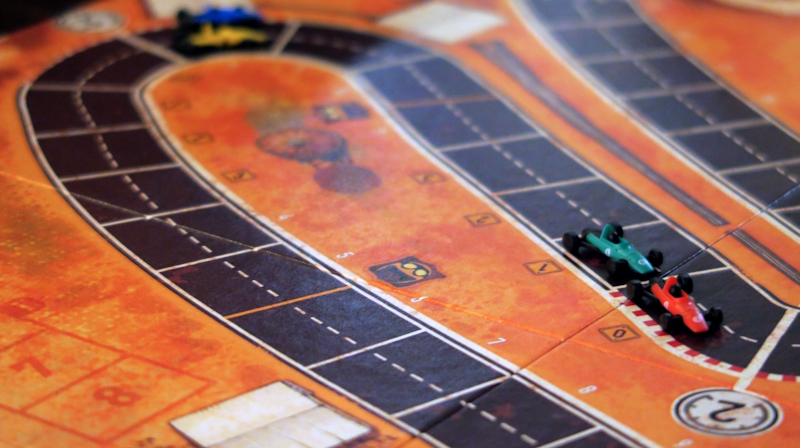
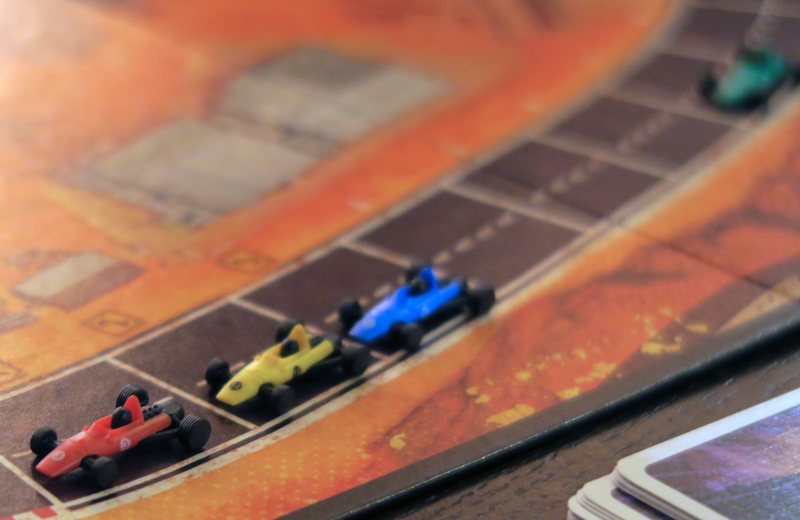
Blue and Pink were still eating as everyone else rolled up.  But as they did, like last time, there was an unusual amount of interest in the “Feature Game“, which, in a change to previous plans, was to be Heat: Pedal to the Metal.  This is a car racing game, in a similar vein to other games popular within the group like Flamme Rouge, Snow Tails, and Downforce.  Like Flamme Rouge and Snow Tails, as well as a racing game, Heat is also a hand management game.  The idea is that players simultaneously choose cards to play and then these are activated from the front of the pack (much like PitchCar).

Heat: Pedal to the Metal
– Image by boardGOATS

Players have a hand of seven cards drawn from their personal deck.  During the game, certain actions that are bad for their engine cause it to heat up meaning they pick up cards that block their hand.  Initially, Heat cards go into players discard pile, simulating the delayed effect engine damage can have, blocking their hand later in the game as the deck is recycled.  There are ways to cool the engine down, but these Heat cards cannot be discarded or played in the normal way.  What makes Heat slightly different to some of the other hand-management-racing games is that there is formally simultaneous play to choose cards and then players take it in turns to activate their cards and take a series of optional mini-actions.

Heat: Pedal to the Metal
– Image by boardGOATS

Players start by simultaneously adjusting their gear, staying put or shifting up or down one without penalty, or shifting two and picking up a Heat card.  The gear dictates how many cards a player must play – second gear means they have to play two cards for example.  Players then take it in turns to reveal their cards and move their car.  There are then five “situational” options: Adrenaline, React, Slipstream, Corner Check, and Discard, before the player replenishes their hand back to seven cards.  Adrenaline is a catch-up mechanism, where the player at the back can move one extra Space while adding one to their Speed value and/or gain one extra “Cool down”.

Heat: Pedal to the Metal
– Image by boardGOATS

“Cool down” is an important aspect of the game because it allows players to remove a Heat card from their hand and return it to their engine deck.  In React, players activate any additional symbols on the cards they have played or from the gear they are currently in or from the Adrenaline.  These include picking up cards because of Stress—players start the game with three Stress cards in the deck which represent lapses of concentration.  When a player plays these, they then have to draw cards from their deck to add an essentially random amount to their speed.  Of course it is not random, and a player who has an idea of what cards are still in their deck will be able to mitigate this.

Heat: Pedal to the Metal
– Image by boardGOATS

Further, Stress cards can also be used to postpone the effects of Heat, as any non-movement cards go straight into the discard pile.  Players can also control their engine heat by spending a period of time in a low gear by “Cooling down” their and removing Heat cards from their hand (three for first gear, two for second).  In contrast, players that have Heat cards available, may add an extra one to their discard pile to boost their speed by drawing an extra card as for Stress cards.  Once all these have been activated, players who end their movement along-side or immediately behind another car can Slipstream, that is move two spaces forward (this does not add to speed, it simply means the car moves further because it is moving more efficiently).

– Image by boardGOATS

If the player has crossed a Speed restriction line typically at a corner, they have to evaluate their Speed by summing the value of their cards and adding one for any Adrenaline bonus if they used it.  If this is more than the limit, players add the difference to their discard pile in Heat Cards.  Players that do not have enough Heat to pay for their excess Speed, pay all the Heat they have and then immediately spin out—move their car back to the last available space before the Speed limit line, take one or two extra Stress cards and change down to first gear.  Once all this is done, players can discard any cards they want that are not Stress or Heat cards before replenishing their hand, shuffling their discard pile if necessary.  The first player to cross the finish line triggers the end of the game and the player that travels the furthest is the winner.

Heat: Pedal to the Metal
– Image by boardGOATS

Although Blue and Ivory were keen to play, numbers meant they missed out and instead, Jade, led Teal, Pink and Lime.  A slight rules malfunction where the group were trying to play all the steps simultaneously meant the safety car did a lap before a restart, then they were off in earnest.  The group were playing on the USA track, which is generally recommended for a first play and is raced over two laps.  One thing that seems to be true for all race games is that once someone has got in front, it is very hard to haul them back, making it critical to get a good fast start.  This time, the good fast start was had by Jade and before long he had built that up and had gone one corner ahead, everyone else felt they were playing for placings and trying to work out how best to approach the corners.

Heat: Pedal to the Metal
– Image by boardGOATS

Instead of playing the end-game as written, the group decided to play it until everyone had crossed the line, so the game continued for some time after Jade had claimed victory.  Lime crossed the line second with Pink in hot pursuit, so much so that although Pink crossed the line in third, he finished his turn ahead of Lime and therefore was awarded runner-up (or first loser) status.  Teal just crossed the line, claiming a sympathy vote ensuring that everyone finished the race.  It had been a bit of a trial and Blue was still keen to give it a go, so Jade, who had been looking to pass it on, sold it to Blue on the spot, which means it will likely get a few more tries over the coming year.

Heat: Pedal to the Metal
– Image by boardGOATS

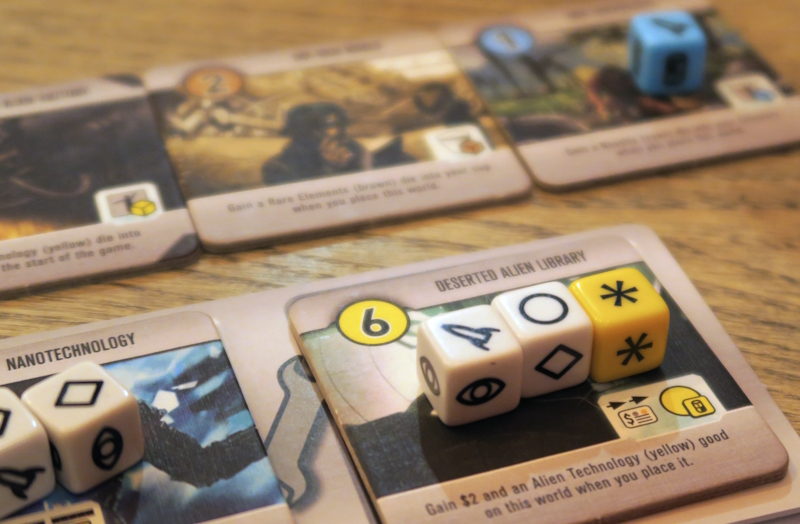
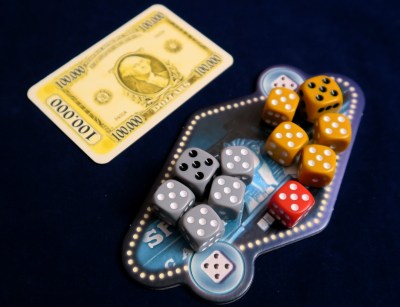
Blue and Ivory meanwhile, although keen to play Heat, had also been tempted by Roll for the Galaxy.  So, when Byzantium had commented that he hadn’t understood his first and only play, but had enjoyed it, the decision was made.  Roll for the galaxy is a dice game based on the card game Race for the Galaxy, which is itself a sort of space themed, card game version of Puerto Rico.  The thing all these games have in common is “Role (or Action) Selection”—the games have five or six phases or Roles and each player chooses one which will happen in the round.  Thus some things happen, and others do not.  A large part of these games is correctly gambling on others picking certain Roles or Actions and making them happen, so they can be piggy-backed.

Roll for the Galaxy
– Image by boardGOATS

The smaller the number of players, the more critical this can be.  So with just three players in Roll for the Galaxy, at least two will not be happening, possibly more.  The Actions are Explore (acquire world tiles); Develop (progress on building Development worlds); Settle (progress on building Production worlds); Produce (use Production Worlds to produce Goods), and Ship (sell Goods for money, or consume them for victory points).  In this game, the actions are all carried out using dice which are rolled in secret and placed behind the players screen to choose where those dice will get used.  This placement depends on the face shown, though any one die can be used to choose which Action will happen.

Roll for the Galaxy
– Image by boardGOATS

The dice are then moved to the Development or Settlement piles of tiles in their respective phases to progress building those worlds, or placed on Production worlds as goods.  Alternatively, they can be spent to pay for Exploring or Shipping in which case, they (along with any dice from any completed building projects or shipped goods) are placed back in their Citizenry.  Dice can be purchased into the player’s cup at a rate of one dollar each, so it is important for players to ensure their finances are healthy or their game will rapidly stagnate.  The game ends when, either someone has built their twelfth World, or the the pool of victory point chips has been exhausted.

Roll for the Galaxy
– Image by boardGOATS

The game was slow to get going at the start, but then Ivory raced to an early lead getting a nice array of Worlds in his tableau leaving Blue and Byzantium trailing in his wake.  But then, instead of finishing the game by building his final World, he appeared to pull up.  This gave Blue and Byzantium the illusion of a chance, but was of course because he had a plan.  Ivory had the Galactic Reserves Development World which gave an extra victory point for every Goods item on a World at the end of the game while also allowing each Production World to hold an extra Goods item.

Roll for the Galaxy
– Image by boardGOATS

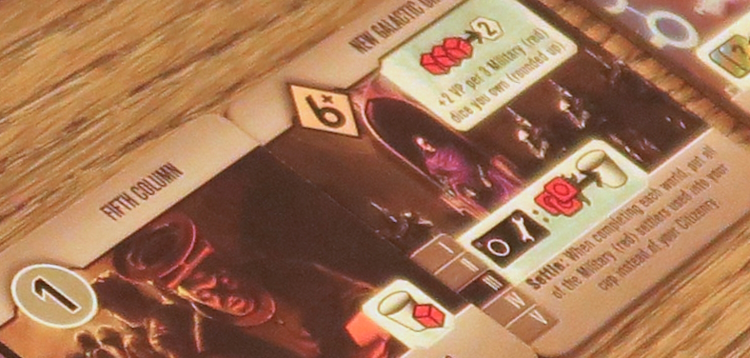
So, the couple of extra rounds was to enable him to fill his Production Worlds and in the end, the game was brought to a close by Byzantium building his twelfth planet, although the victory point chips were also depleted by the end of that round.  Blue had taken a sizeable twenty-four of those victory points through trading goods, but hadn’t been able to build enough.  As a result, her planets were worth only eighteen points, barely twice those of Ivory’s and Byzantium’s thirty.  Byzantium had five victory point chips and a couple of points from his New Galactic Order, but Ivory was some distance in front, thanks to his thirteen points for his Galactic Reserves and Galactic Bankers Developments together with his eight victory point chips.

Roll for the Galaxy
– Image by boardGOATS

There was time to play something else, but rather than go through rules, as Roll for the Galaxy was already out, the trio decided to give it another go.  This time, with an element of time pressure, it was arguable that some of the decisions made weren’t as sharp and the scores were all lower the second time, though that might have been partly because there were notably fewer rounds.  Blue kept dipping into the bag to try to get Rare Element (brown) Worlds to go with her Mining League, but failed repeatedly and eventually gave up.  Ivory triggered the end game with his twelfth World and this time it was Byzantium who struggled to build enough.

Roll for the Galaxy
– Image by boardGOATS

The scores were a bit closer on the second attempt, though the end result was still much the same, with Ivory again taking victory, though with half the winning margin.  By this time, the other games had also finished.  The first of these was Forests of Pangaia, in which Mint was joined by Pine and Plum.  This is a truly beautiful, tactile game, where players are trying to meet objectives to score Life Points; the player with the most Life Points at the end of the game is the winner.  The game has elements of set collection and area control and is played on a central map made of terrain hexagons.  Players take turns to perform three phases: Grow Seeds, take a Spirit Action, and finally add Treetops.  Once Seeds have grown and been turned into Trees, players carry out one of three possible Spirit actions.

Forests of Pangaia
– Image by boardGOATS

These are: Plant (moving their Spirit Pawn to a Lake space and planting seeds in adjacent spaces); Gather (moving their Spirit Pawn back to their player board and receiving a resource), and Prey (moving their Spirit Pawn back to their player board and playing their Ritual Card).  There are fourteen Rituals the Spirits can perform to collect Gaia’s Life Energy.  Once the Ritual card has been scored all the player’s Trees that were involved in the Ritual then partially or fully Decay (depending on the Ritual), either losing a level or rotting back to nothing and leaving a Seed.  The player then discards their Ritual card and draws a new one.  The game ends when the last Ritual card is taken by any player.

Forests of Pangaia
– Image by boardGOATS

Plum went first and spent most of the game collecting Sun tokens.  In contrast, Pine collected lots of Wind tokens inspiring lots of jokes about using wind to spread his seed.  The winner, however, was Mint with a nine point Trail Ritual due to excessive seed spreading giving her a total of twenty-eight points.  Pine just pipped Plum for second place by a single point.  It had been a really enjoyable game, however, made all the better by the gorgeous pieces. Meanwhile, on the other end of the same, albeit long table, Black, Purple and Sapphire played a game of last year’s winner of the Golden GOAT Award, Stamp Swap.

Stamp Swap
– Image by boardGOATS

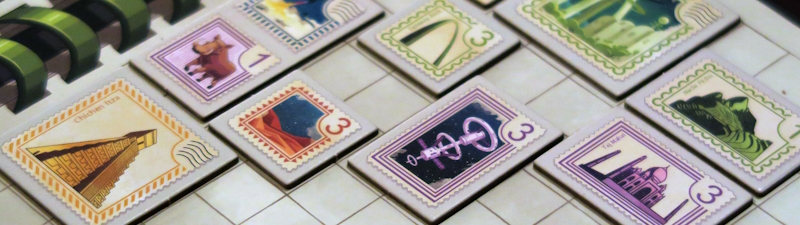
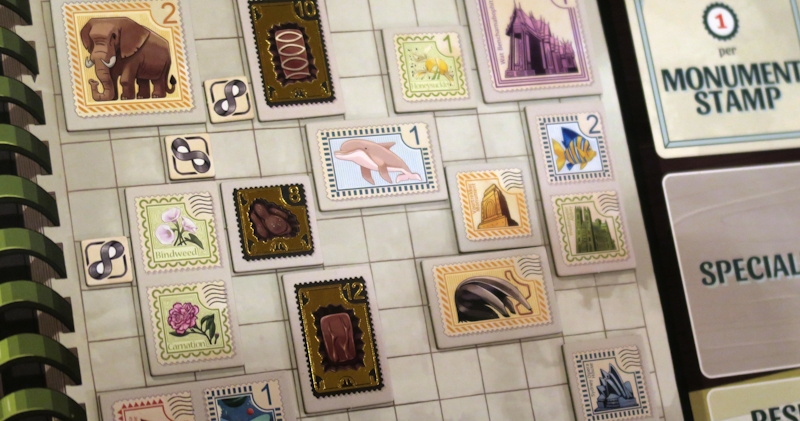
This is a really smooth tile placement centred around stamp collecting.  There is a lot of simultaneous play, which is nice because it minimises down time.  First, players take it in turns to choose items from the central Pool, then simultaneously divide them into two piles of offerings.  The player with the first player token, chooses and takes one of the piles offered by their opponents.  The opponent keeps their other pile and then chooses a pile from one of their opponents and so on.  Once everyone has two piles, players arrange the Stamps in their Album and then choose which of the four available end of round cards to score this time.

Stamp Swap
– Image by boardGOATS

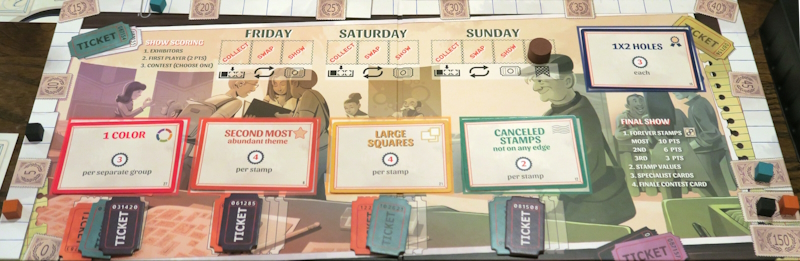
After three rounds, players score the end of game objective card and the player with the most points is the winner.  One of the clever parts about this game is how much difference the objective cards make to the way players arrange their Stamps.  The end-game scoring gave three points for each enclosed gap two spaces in size (i.e. a one-by-two hole).  More points were available during the game for cancelled stamps not on the edge of the page; for large square stamps; for each stamp in a player’s second most abundant theme, and for groups of a chosen colour.

Stamp Swap
– Image by boardGOATS

This time the game was very close.  Purple (specialising in Flowers) struggled to get the stamps she needed and Sapphire (specialising Space stamps) kept getting confused which way the turn went.  It didn’t seem to inconvenience him too much however as he and Black (Monuments) fought it out for first and second place.  Black picked up a lot of his points for Special Stamps—just three accounted for a quarter of his points, which contributed to his total of one hundred and seven points, just four more than Sapphire.

Stamp Swap
– Image by boardGOATS

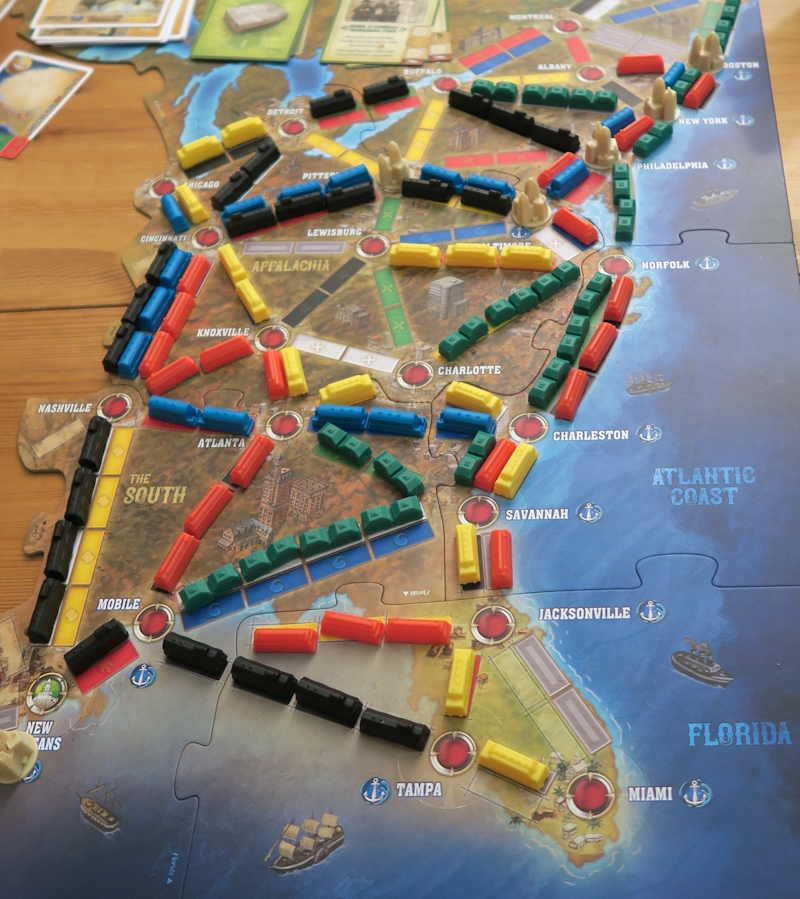
While everyone else was finishing up, there was some discussion about the continuation of the Ticket to Ride Legacy campaign that Blue, Pink, Black, Purple and Pine embarked on at New Year.  The campaign is played over twelve rounds and the group had managed the first two games on the first outing with the next two more recently on Saturday evening.  Spoiler alert—hover HERE to see details. The winner of the third round was Black, very closely chased by Pink with Blue taking third.  After a break for tea (lamb and vegetable tagines with millet), the group began their fourth game. Spoiler alert—hover HERE to see details.

Ticket to Ride Legacy: Legends of the West
– Image by boardGOATS

This was much less close than the third game. The winner was Pine, with Black six dollars behind and Pink a further fourteen points behind him, in third. Spoiler alert—hover HERE to see details. While chatting with the others, out of curiosity, Pine went through The Book and totaled up the scores for the first four rounds, which gave Black a lead of some twenty dollars. Something the rest of the group need to give some thought to next time, before he gets an unassailable advantage although there is a suspicion that as the campaign progresses, the games get longer and more points will be available in each round giving players a chance to catch up.  We shall see.

Ticket to Ride Legacy: Legends of the West
– Image by boardGOATS

Learning Outcome:  However you roll, when you race you need a fast start.

12th December 2023

Blue and Pink were just finishing their supper when Plum and Byzantium arrived, soon followed by Pine, Black and Purple, Teal, Ivory, and finally Lime.  With ten then, the first question was whether to play two games with five each, or three games with fewer.  And then it was who would play the “Feature Game“, Namiji, and who would play something else.  The decision was pretty much made when Ivory said he’d brought Roll for the Galaxy and lots of people looked interested.  Roll for the Galaxy is somehow a game a lot of people struggle with, so who played what almost sorted itself out, with the outstanding question being whether there would be a third game.

Namiji
– Image by boardGOATS

In the end, it was easier to play two games than try to come up with a third, so Ivory took Plum, Teal, and Byzantium to the other side of the room to recap the rules for Roll for the Galaxy, while Blue taught the others Namiji.  Although this was new to everyone, it is extremely to the group favourite, Tokaido.  Both games are based on a time-track, that is to say, players are traveling along a path playing a kind of “leap-frog” where the player at the back jumps forward into an empty space and then carries out the action associated with it.  The player can move forward as far as they like, but the desire to jump into a chosen space is tensioned against the fact that the further forward a player moves, the longer it will likely be until their next turn.

Namiji
– Image by boardGOATS

Both Namiji and Tokaido have with elements of set collecting, indeed the different actions are very, very similar between the two games, and although players are Japanese fishermen, sailing south of the Japanese archipelago in Namiji, the rubric says they are just “a few miles away from the famous Tokaido road” and that games are barely that far apart.  The “Stations” in Namiji are: Angling, Net Casting, the Crustacean Trap, the Whirlpool, the Sacred Rock, the three Panoramas and the Dock.  The last four are roughly analogous to the Temple, the Hot Springs, the Panoramas and the Inn in Tokaido.  The Angling, Net Casting and Crustacean Trap stations are a little bit different.

Namiji
– Image by boardGOATS

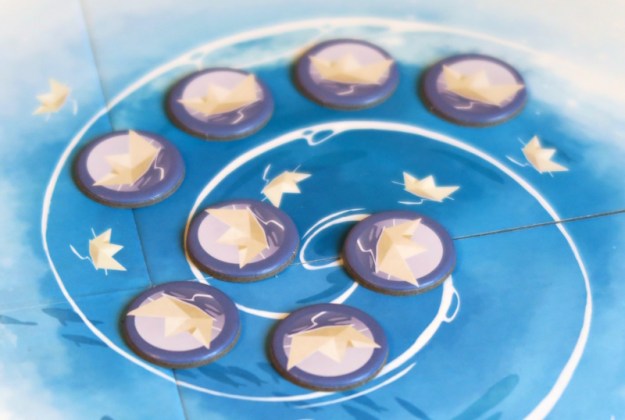
Like the Village and the Encounters, these have set-collecting elements, but fish caught when Angling or Casting are laid out in the player’s boat with points scored for rows where the colours or types are the same.  The Crustacean Trap is a push-your-luck draw from a bag where players score a point for each Crustacean drawn (up to a maximum of five), but if two crabs are drawn in the same haul, the whole lot are lost.  The biggest difference between the two games is that there is no money, which has the effect of knocking some of the slightly rougher corners off.  For example, the Inn is much harsher in Tokaido than the Dock in Namiji.

Namiji
– Image by boardGOATS

Because Food cards have to bought at the Inn and these have different costs and duplicates cannot be bought, sometimes players have to go without which costs them six points.  This is enough to effectively put a player out of the running.  In contrast, in Namiji, they are a bit of a non-event.  There are two types of card drawn at the Dock:  Food and Upgrades.  As in Tokaido, Food gives points—fewer than in Tokaido, and variable without the cost or the limit of one type per player.  Upgrades grant players permanent abilities for the rest of the game (triggered when landing on their corresponding Station.  The game ends when everyone returns to port—as in Tokaido, there are bonus points for lots of things, and that includes being early back at port (with decreasing numbers of points as players arrive later).

Namiji
– Image by boardGOATS

Although the rules were simple and the game was mostly known, the debate started when Blue had barely left the table.  The discussion centred on whether the player chosen to be first should go at the front of the track (and thus actually “go” last) or whether they should take the first turn (and therefore actually start at the back).  Black opined that the that the turn order (randomly picked) was the order players should be placed on the track, while Pine felt the person picked should be the one start.  In the end, after studying the rules (which failed to answer the question), the group went with Pine’s view, and finally started sailing.

Namiji
– Image by boardGOATS

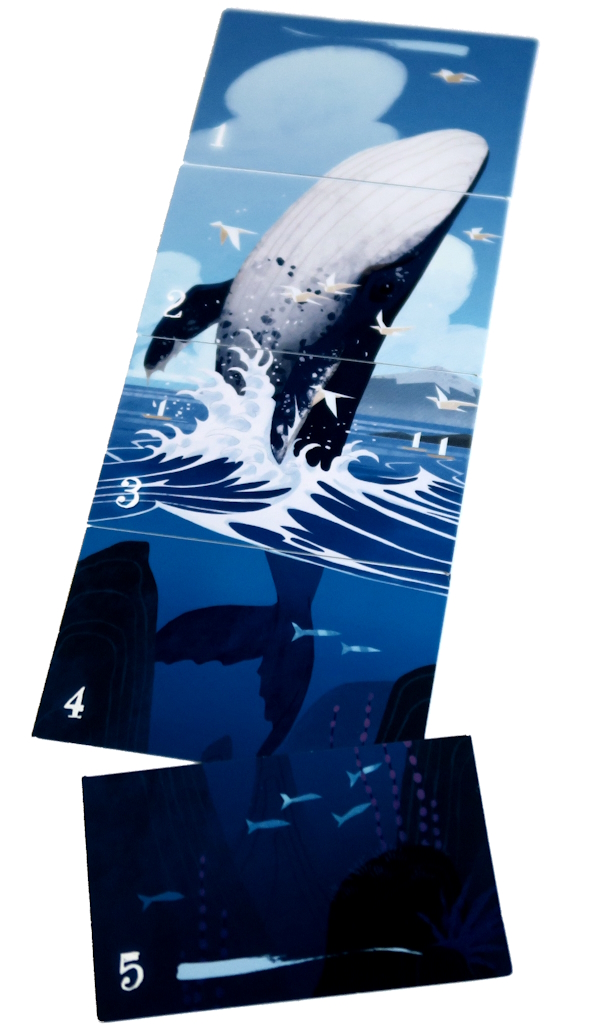
Pink was the first to complete the first Panorama (the Squid), soon followed by Lime who out-competed Purple and Pine to complete the lucrative Whale Panorama taking the bonus points for it too.  Black concentrated on setting his paper hats sailing into the Whirlpool to jettison negative points and top-scored for his catch (though there aren’t any bonus points for that).  Pine concentrated on collecting Cards and then was the first to get back to port.  Ultimately, Namiji is a game that rewards players for concentrating on one thing, and in this case that was Lime, who’s twenty-five points for his Panoramas made all the difference giving him clear victory ahead of Pine in second and Black and Pink jointly in third.

Namiji
– Image by boardGOATS

Meanwhile, on the other side of the room, Ivory had just about finished explaining the rules for Roll for the Galaxy when Blue arrived. In principle, the rules are quite simple, but playing the game well is much more difficult.  The game is based on the card game, Race for the Galaxy.  In both games, there are five phases, and players choose one each to activate.  This is important, because with more players more phases are likely to happen.  That is to say, while it is possible that everyone chooses the same phase which is the only one to happen, it is much more likely that two, three or four will be picked giving people more things to do in each round.

Roll for the Galaxy
– Image by boardGOATS

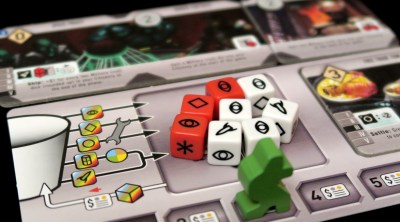
In Roll for the Galaxy, at the start of the round, players simultaneously “shaky-shaky” their dice in their Cup and roll in secret.  Then, behind their screen they secretly assign them to the different phases.  Most are assigned according to the face that was rolled, but any one can be used to decide which phase the player wants to happen.  Additionally, any one die can be used to “Dictate” the behaviour of one other die.  Once everyone has assigned their dice, everyone reveals their choices and the phases for the round are finalised.  Each player then gets to carry-out the actions indicated by their dice, returning unused dice to their Cup.

Roll for the Galaxy
– Image by boardGOATS

There are five phases in each round: Explore, Develop, Settle, Produce and Consume.  Explore allows players to choose tiles that they build in either the Develop or Settle phases, while Produce places goods on Production Worlds that can be turned into points or Credits in the Consume phase.  Used dice (those consumed or used to build) are then placed in a player’s Citizenry and only return to their Cup on payment of one Credit per die.  Thus, the game is very smooth with dice being assigned simultaneously, then moving to either of the player’s stacks of tiles to be used to pay for building, or onto one of their Production Worlds where it stay until it is Consumed.

Roll for the Galaxy
– Image by boardGOATS

Since what players can do depends on the roll of the dice, at first glance, it seems like the decisions are made by chance.  However, that just makes the decisions more key, if nuanced.  Which Worlds to build, which phase to choose, whether to Dictate to reassign a die, whether to consume to give points or cash, and overall, which strategy to choose.  And although the roll of the dice plays a big part, there are lots of dice and plenty of rolls, so the luck averages out, though players have to surf their luck.  The game ends at the end of the round when a player builds their twelfth World, or when the pile of Victory points runs dry, and in this sense, although the game is about rolling dice, it is still a race, a race to build an engine, score points and finish the game.

Roll for the Galaxy
– Image by boardGOATS

The game began with the rattle of the simultaneous “shaky-shaky” as dice rattled in everyone’s Cups.  At the start of the game everyone wanted to Explore and build, but what depended on strategy.  Blue started with a military strategy dictated by her first Development which gave points for red dice at the end.  Ivory also planned his game around his Developments and their bonus points, but built his engine based on reduced costs to build and to Dictate.  Teal and Sapphire chose to follow a conventional “Produce-Consume” victory point strategy, while Plum tried a bit of everything.

Roll for the Galaxy
– Image by boardGOATS

Roll for the Galaxy is a little bit “multi-player solitaire”, with everyone concentrating on their own engine and deciding what they want to do.  However, the winner has to take advantage of the fine margins and that means watching what other players are doing and anticipating and then taking advantage of their choice of phase when they can.   This time, the end was triggered by Ivory, who accelerated quickly out of the traps thanks to his early choice of Development Worlds, and ultimately finished with thirty-six points for his buildings and ten bonus points giving him a runaway victory.  A very creditable second place went to Byzantium, the only player who had never played either Roll or Race for the Galaxy before, with Blue completing the podium.

Roll for the Galaxy
– Image by boardGOATS

Learning Outcome:  Sometimes when you win you have a Whale of a time!

Boardgames in the News: Twenty-Five Years on the Rio Grande

When Rio Grande Games published their first games twenty-five years ago this month, the gaming world in the USA was a very different place.  At the time, games in the USA were almost all either simple “kids” roll and write games or very long, heavy strategic games for “geeks” not the family games had been around for some time in Europe, especially Germany.  Even in the UK, European games were specially imported from Germany and unofficial translations made and circulated through magazines like SUMO.  As the envious eyes of Jay Tummelson looked across the pond, he he parted company with Mayfair Games and started translating and importing German games for the US family market.  The rest, as they say, is history.

Mississippi Queen
– Image by boardGOATS

The first games imported by the newly created Rio Grande Games (named after the view from Jay’s office window), were Löwenherz and the 1997 Spiel des Jahres winner, Mississippi Queen.  These were both co-published with Goldsieber Spiele, but later games involved other publishers and in due course, Rio Grande Games started producing their own new games.  The best known of these are probably Dominion and Race/Roll for the Galaxy, but their biggest legacy is probably the changes they brought to gaming in the English-speaking world, who now have widespread access to Euro-games.

Rio Grande Games Logo
– Image from riograndegames.com


10th January 2023

One of the first to arrive was Yellow, and it was delightful to see him after such a long time.  He was especially welcome as he was bringing a copy of Paris that he’d been looking after since UK Games Expo in August 2021.  Before long though, there were eight all ready and lined up to play the “Feature Game“, Long Shot: The Dice Game, when two more arrived and a debate began to work out who would play what and where.  As Long Shot was supposed to be quite short, eventually, Plum, Pine, Purple and Lime took themselves off to play Ticket to Ride: London, with Blue, Green, Yellow, Black, Ivory and Teal sticking around to play Long Shot:  The Dice Game.

Long Shot: The Dice Game
– Image by boardGOATS

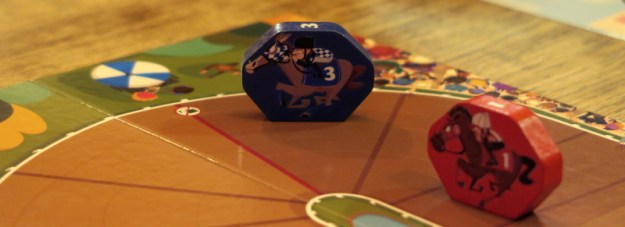
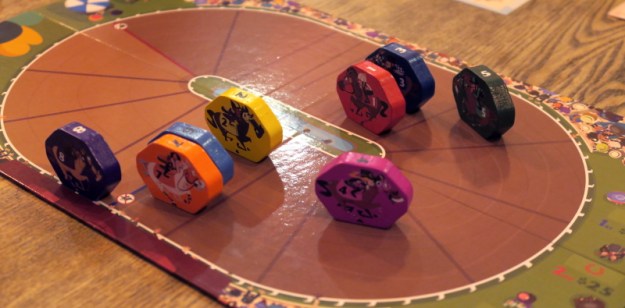
Based on the party game Long Shot, Long Shot: The Dice Game is a light horse racing and betting game in a similar mould to that of Turf Horse Racing, that featured on several people’s lists of top games from 2022.  As it is relatively quick to play, the idea was that it would leave plenty of time to play some of our other old favourites and Ticket to Ride: London was thought to be a good match in terms of length.  Inevitably, that was not quite how things turned out, however.  Long Shot (Dice) is quite simple, and Blue, assisted by Green, was explaining the necessary to the runners and riders.  Ticket to Ride is well known within the group though and was therefore quicker to get started.

Long Shot: The Dice Game
– Image by boardGOATS

The idea of Long Shot (Dice) is that the active player rolls two dice which dictate which horse moves and how far (one to three spaces).  Everyone (including the active player) then chooses an action from their card, carries it out and crosses it off.  The actions include:  placing bets, buying a horse, buying a riding cap, buying a riding jersey, crossing a horse off the concession chart to get a bonus action once a row or column has been completed.  In general, the action depends on the horse that has been rolled, i.e. if horse number two is rolled, players can bet on that horse, buy that horse, get a cap or jersey for that horse’s rider or cross that horse off the concession grid.  However, each player has three “wilds” which are opportunities to choose any horse.

Long Shot: The Dice Game
– Image by boardGOATS

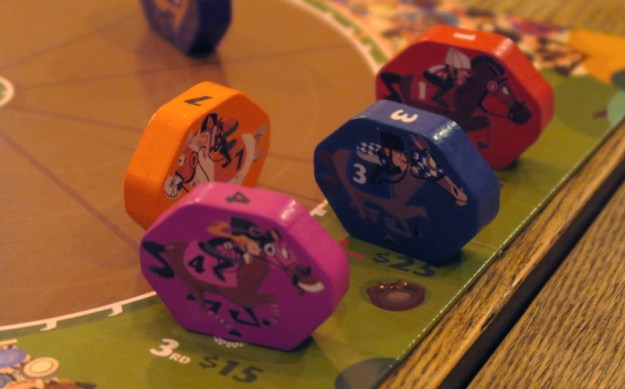
At the end of the game, players score if they own or bet on a horse that is placed and for any cap/jersey combo for the same horse.  This time, Green started and rolled the blue horse number three which moved three spaces.  As did Teal.  By the time it had moved on three out of four opportunities (and a total of nine spaces), it was starting to look like the dice were loaded and this did not appeal to everyone’s sense of fair play.  The group more or less divided into those that wanted the blue horse wearing number three to win (because they had invested in it) and those who didn’t and preferred the red number one horse.

Long Shot: The Dice Game
– Image by boardGOATS

As Ticket to Ride progressed, the route planners asked how the race was going, and the gamblers, felt it would not be long, given the progress the blue number three horse had made and the lead it had built up.  After its early spurt, a few other horses managed to start to make a bit of ground and, with players starting fill out their bonus grid, players began to take bonus actions which leveled the course somewhat.  The bonuses included taking a free $7 (quite a lot of money in this game); a free $3 bet; free riding cap/jersey, but by far the most interesting were the options to move horses.

Long Shot: The Dice Game
– Image by boardGOATS

Each player has the following four bonuses:  they can move one horse three spaces (once forwards and once back) and they can move two horses two spaces (also both forwards once and both backwards once).  It was as the blue number three horse approached the three-quarters mark (after which players could no longer bet on it) that players showed their allegiance, moving it forwards, or backwards.  And with six players, everyone had potentially several bites of the cherry.  Just as it seemed that one horse had an unassailable lead, one or two players would upset the apple cart and push the leader back and something else forward.  Even the the three-legged purple number eight horse looked like it might be in with a chance of placing at one point (albeit not for long).

Long Shot: The Dice Game
– Image by boardGOATS

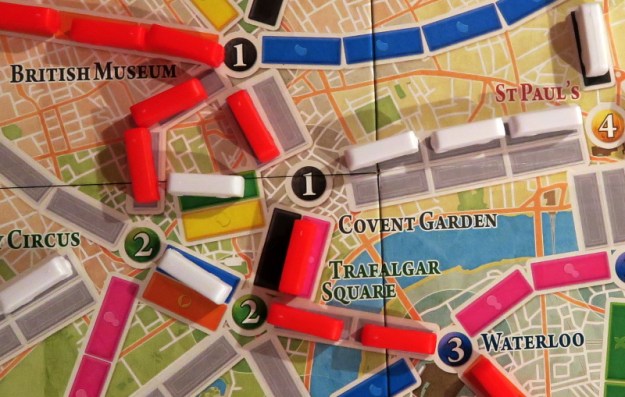
Ticket to Ride made more rapid progress.  Although Purple succeeded in completing one of her tickets (for three points), she failed to finish her other two.  That cost her ten points (effectively twenty, which is what she’d have got if she’d completed them), and she blamed Lime.  Lime had troubles of his own though as he was in a very tight battle with Pine.  Perhaps it was his comeuppance for the trouble he’d caused Purple (real or only perceived), but Pine pipped him to victory by a single point, gained when he completed one of the single carriage routes in the centre of the board in the dying moments of the game.

Ticket to Ride: London
– Image by boardGOATS

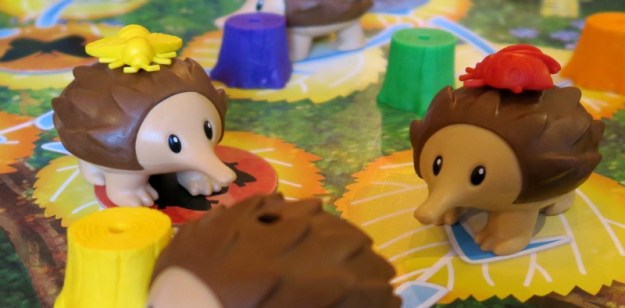
It became a bit of a running joke that the Purple/Plum/Pine/Lime group playing with their train-set asked how things were doing when they finished, and again as they packed away, and again after they’d been to the bar, and again after they’d consumed their drinks and been to the bar again, and each time were told that it was nearly done.  Eventually, Purple, Lime and Pine resorted to playing Love Letter to kill time, winning one round each.  Although Long Shot (Dice) was great fun and everyone was quite amused by the shuffling of horses backwards and forwards, Pine had a point when he commented that when gamers play a light silly game they can play it to destruction—a bit like Echidna Shuffle, which we all adored though it outstayed its welcome when one game lasted two hours!

Echidna Shuffle
– Image by boardGOATS

As players ran out of bonuses, the Long Shot horses ran out of track, and eventually, the red horse number one crossed the line, followed by the blue horse number three and finally, the pink horse number four.  Unlike in Downforce for example, however, although winning the race is useful, the betting has much, much more of an influence on the final result.  For example, the two horses Ivory had bet on, numbers five and six, didn’t come in making a severe dent in his score.  In spite of this, it was quite close—Green and Yellow tied for third  with $109 while Teal took second place with $114.  Blue claimed victory though, finishing with $122.

Long Shot: The Dice Game
– Image by boardGOATS

It was only when Green and Pine pointed out that Teal hadn’t scored his horse which gave him $2 per horse he had a bet on, and in his case, an extra $12.  Recalculating his final score, much to her chagrin, Teal just pipped Blue to victory.  From there it was simply a case of tidying up and working out what people wanted to play next.  Ivory had suggested Roll for the Galaxy at the start of the evening and there were lots of takers now, so he went off to set up with Teal, Green and Plum.  Although Teal had played Race for the Galaxy online, Roll for the Galaxy was new to him so the group started with a quick rundown of the rules.

Roll for the Galaxy
– Image by boardGOATS

The idea is that everyone starts with a couple of “Worlds” and some dice representing their population.  Players roll their dice with the faces dictating different actions.  In secret, players allocate their dice to the five different phases: Explore, Develop, Settle, Produce and Ship.  Players choose one phase that they want to happen then everyone simultaneously reveals their choices.  All the phases selected will happen, with dice that players have allocated to other phases returned to their cup and recycled.  The game is a combination of “engine builder” and “population builder” (similar to games like Orléans), with players needing the right combination of Worlds to provide their engine, and then building the right combination of dice to make them work effectively.

Roll for the Galaxy
– Image by boardGOATS

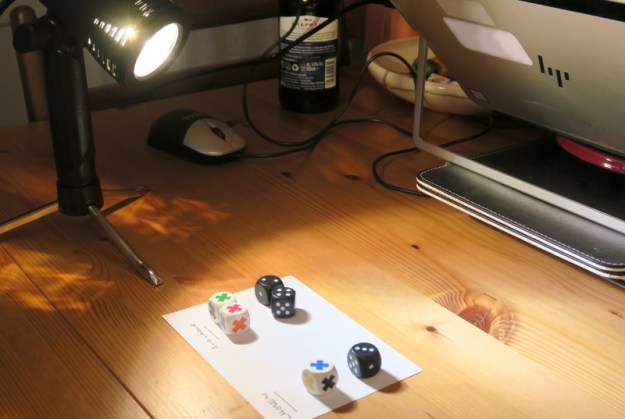
With the lighting being less than perfect, some of the dice colours were a little difficult to distinguish, particularly purple and brown.  Plum came to the rescue though, with her new Christmas present:  a portable folding lamp.  The magic of the LED gave a good strong light, enough for everyone without taking up too much room on the table.  Everyone was very impressed and many rapidly came round to the idea that it was a must have gamers’ accessory!  After a faltering start for a couple of turns, Teal soon got the hang of how to select actions and where the dice should go.

Roll for the Galaxy
– Image by boardGOATS

The first clarification needed was that players can only choose one action (though everyone’s choice will be activated), and the second was that the die used to select that action does not need to show a face that matches it. The rest of Teal’s game was one of learning:  with his mining industry, he was able to ship goods for victory points while still gaining some credits, and gained a couple of useful purple die. Unfortunately being new to the game meant he was unable to mount a serious challenge for victory points.  Plum, on the other hand, started out with a couple of red military dice and managed to obtain one more during the game along with the New Galactic Order tile which gave her a couple of extra points for those red dice.

Roll for the Galaxy
– Image by boardGOATS

Plum also made good use of her Terraforming Robots which gave her an extra credit for each World she built and two extra if it was a brown world. She managed to get three brown Worlds.  Ivory also managed to obtain the useful purple die, but his real bonus was from the Alien research ship which gave him a white and a yellow explore action whenever it was chosen.  This meant he was able to keep his credits topped up and have plenty of new tiles on the go without the expenditure of a die. As a result he was able to concentrate on building worlds and shipping/trading.

Roll for the Galaxy
– Image by boardGOATS

Green, meanwhile, quietly built his tableaux concentrating on blue worlds due to his Consumer Market which gave him an extra credit if at the end of the produce round he had  goods on a blue world. He also obtained a green and a yellow world. His Galactic Recycler meant he gained a credit every time he managed to complete a tile. He was the first and only player to build all twelve tiles which gave him the largest score for Worlds. Combined with his Free Trade Association he scored extra points for his three blue worlds and with the victory points he’d collected along the way he finished with forty-four points and a healthy lead, ahead of Ivory’s thirty-eight, just ahead of Plum thanks to his two yellow and two green worlds.

Roll for the Galaxy
– Image by boardGOATS

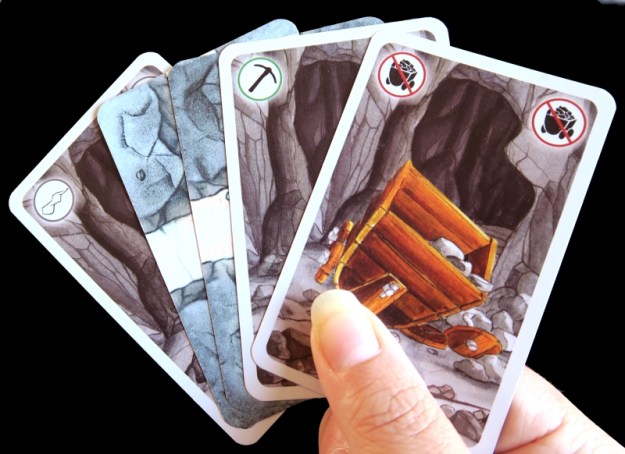
Meanwhile, at Purple’s request, everyone else was playing Saboteur.  This is a hidden traitor game where players take it in turns to either place tunnel cards or to play action cards.  The Good Dwarves are trying to find gold, while the Evil Saboteurs are trying to obstruct them.  In the rules as written, the game is played over several rounds with gold handed out at the end of each round.  The way the gold is distributed doesn’t really necessarily reflect the player who made the biggest contribution, so we play with the “House Rule” that each round is treated as an individual game, then we can play as many “games” as we like and/or time allows.

Saboteur
– Image by boardGOATS

This time, the group played three games.  The first one began with lots of people suspiciously checking and double-checking where the treasure was buried by playing map cards.  Purple was accused of being an Evil Saboteur, quickly followed by Black, Lime and Blue, all of which made no sense as there could only be a maximum of two.  In the end apologies were required when Pine found the gold and Blue and Purple were revealed as the Actual Saboteurs.  The second round followed a similar pattern, only this time pretty much everyone was accused of “Saboteury behaviour”.

Saboteur
– Image by boardGOATS

This time there was a Solitary Saboteur, which meant poor black had a really uphill battle and had really lost before he’d begun.  Once again, Pine was the Dwarf that found the gold, with Lime setting him up.  In the final round, things went a little differently though, particularly when Pine’s dubious behaviour signaled that he might not be trying to find the gold this time.  When Blue distracted the Dwarves by causing a massive rock-fall, it was up to Lime to try and patch the tunnel.  Things had just settled when Blue played another rock-fall and Lime patched that too.  When Blue brought down a third and fourth tunnel collapse, Lime was able to patch them too.

Saboteur
– Image by boardGOATS

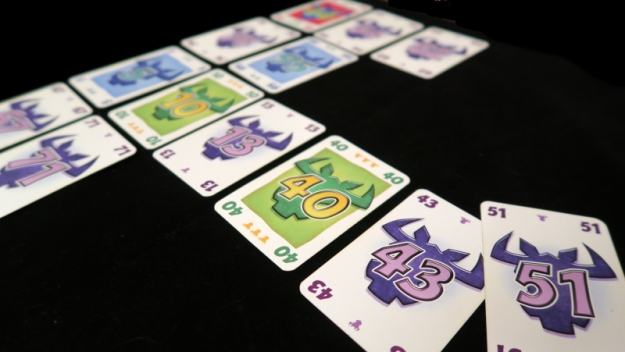
It took so much effort though, that when Pine pushed the tunnel past the gold card, although it only needed a couple of extra tunnel segments, the Dwarves couldn’t make it giving a rare victory for the Saboteurs.  As Roll for the Galaxy was still going and there was a little time left till last orders, there was just time for a quick game of 6 Nimmt!, an old favourite. Blue commented that the name was one of the infamous German joke game titles, and Yellow added that “Nimmt” was the imperative of the German verb, nehmen, to take, thus when the sixth card is played on a row, that player takes the other cards.  The player with the fewest bulls heads wins.  We’ve played it quite a bit recently with the professional variant where cards can be added to the low or high end of the rows.

6 Nimmt!
– Image by boardGOATS

This time, however, as time was pressing the group decided to stick with the simple maths.  We play over two rounds with half the deck in each.  Lime had a complete nightmare in the first round, with twenty-seven “nimmts” in the first round; Pine in contrast managed a clean sheet and Black only picked up two points, so it was all to play for, for some at least.  Lime did much better in his second round giving him a total of thirty-three, only slightly more than Yellow, while Blue managed nearly that in the second round alone, top-scoring with a nice round fifty.  Black picked up just five, but there wasn’t much anyone could do to compete with Pine, who picked up just one solitary point in the second round, his only one in the whole game.

6 Nimmt!
– Image by boardGOATS

Learning Outcome:  Betting can be a mugs game.

3rd May 2022

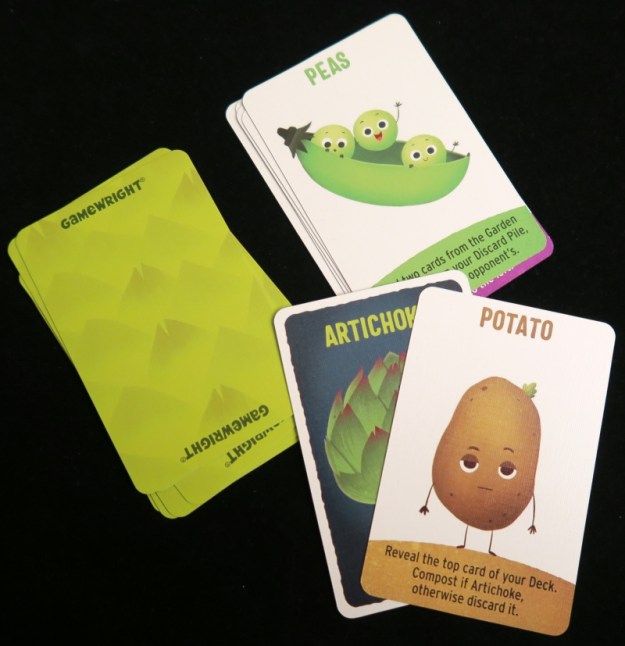
Like the last few games nights, this one started with Pink and Blue playing the deck-shedding game, Abandon All Artichokes.  This is a very simple game where players start with a deck of ten artichoke cards from which they draw a hand of five, then, on their turn, they take one card from the face up market, play as many cards as they can, before discarding their hand to their personal discard pile.  If, on drawing their new hand of five cards they have no artichokes, the game ends and they win.  In the first couple of games a few weeks back, Pink struggled somehow, and Blue won.

Abandon All Artichokes
– Image by boardGOATS

Then Pink got the hang of it, and won several games on the trot, but this time it was Blue’s turn to finally get back on terms, just before supper arrived.  They were just finishing when Black and Purple, and then Teal arrived.  Although it was still very early, it was a perfect opportunity to play the “Feature Game” as it was Moneybags, a quick little social deduction, filler game. The premise is similar to that of Ca$h ‘n Guns, where players are thieves dividing up the spoils from a robbery, stealing from each other and generally trying to deceive everyone so that they come out on top.

Moneybags
– Image by boardGOATS

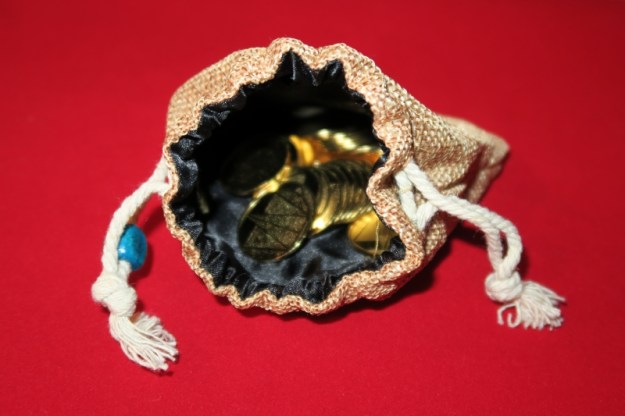
In Moneybags, one player takes the role of the Godfather, divides the loot “evenly” amongst the players’ small hessian sacks.  Holding only the top of their sack, each player takes it in turns to Pass, Stick, or Rob another player.  Pass and Stick are simple actions (pass and remain in the game, pass and stick with the total in their sack so they can neither Rob nor be Robbed), but Rob is the interesting one.  The active player can Rob any other player that is still “in”, taking some or none of the loot from their sack.  The thief mustn’t be too greedy, however, as the victim can challenge—the protagonists compare their loot and the one with the largest stack loses, the winner takes all the loot and the loser is eliminated.

Moneybags
– Image by boardGOATS

After two turns round the table, the game ends with the Godfather (or arguably Godmother), taking their second turn.  The winner is the player with the most loot.  Moneybags can be played over three rounds, though like Saboteur it is probably best when one round is considered “the game” rather than playing in campaign mode.  Pink started as the Godfather and divvied up the money.  In addition to coins, there is also a Diamond in the loot; this is worth roughly ten coins. When comparing spoils, the coins are stacked with the Diamond placed on top so that the tallest stack loses when Robbed or wins at the end of the game.  The Diamond is comparatively light, so it adds a little bit of additional ambiguity to the proceedings.

Moneybags
– Image by boardGOATS

Pink, made a point of taking note of where the Diamond went and then stole it back later in the game giving him the first round, slightly ahead of Teal in second.  Lime arrived during towards the end of the game, so the rules were explained to him.  Then Ivory joined the party so Blue swapped out and gave him a quick summary as well, while Purple, as Godmother, divided up the spoils.  With a slightly better idea of how the game played, the second round went even better with more players Robbing and challenging each other.  As a result, the Diamond went round the table several times.  There was much hilarity as players tried to guess how much cash people had, and Pink showed his age when he commented that someone’s stash “chinked like a bus conductor’s money bag”.

Moneybags
– Image by boardGOATS

Once again, the Godparent finished with the Diamond, but Purple had very little cash to go with it and therefore only made third place.  This time the winner was Ivory, in a very, very tight finish, just ahead of Black.  It had been a lot of fun and although we could easily have played another round or two, we also wanted to play some longer games.  Moneybags fills a similar role to 6 Nimmt! though, so it will get another outing soon.  In the meantime, Viticulture (Essential Edition), Roll for the Galaxy, and Brass: Birmingham were all suggested for the next game, but Pink always loves playing Viticulture and Teal has been keen for a while, so Ivory took them off to play that while the others decided what to play.

Viticulture
– Image by boardGOATS

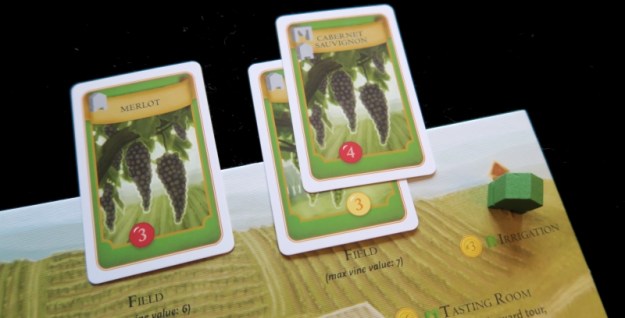
Viticulture is a worker placement game where players plant and harvest grapes, make them into wine and fulfill contracts to get points.  The first player to reach twenty points triggers the end of the game, and at the winner is the player with the most points at the end of that round.  Although Viticulture is not particularly novel or innovative, it is widely respected as one of the best worker placement games around, succeeding in being both smooth to play and relatively easy to learn, though it takes real skill to be good at it.  This time, everyone sold land to fund worker training; although we haven’t done this when we played previously, it would seem to be an accepted tactic in most games now.

Viticulture
– Image by boardGOATS

At the start of the game, players get choice of a couple of “Mama” and “Papa” cards (taking one of each)—these give people starting resources, workers, money, Visitor cards or a starting building.  Pink took a Trellis from his Mama card which meant he could just plant grapes that needed a Trellis and not worry about building any cultivation infrastructure.  The others prioritised money. Playing two worker cards at the same time (using the on-board bonus) was a popular.  Though it required care not to overrate the feature and wind up playing some slightly naff workers, when perhaps it might have been better to wait until the next round.

Viticulture
– Image by boardGOATS

The grey, extra-worker meeple was also popular, with players seemingly happy to be last in the turn order if that meant they got an extra “turn”.  Although everyone had played the game before (though Teal only online), there were some rules that needed “ironing out” as years of playing with the Tuscany expansion meant that Pink had forgotten many of the differences between that and the base game (Tuscany will get an outing as the “Feature Game” in a few weeks). The game was brought to an unexpected (and obviously skillful) conclusion by Teal, who finished the game just before Ivory and Pink had the chance to deploy their big scores.

Viticulture
– Image by boardGOATS

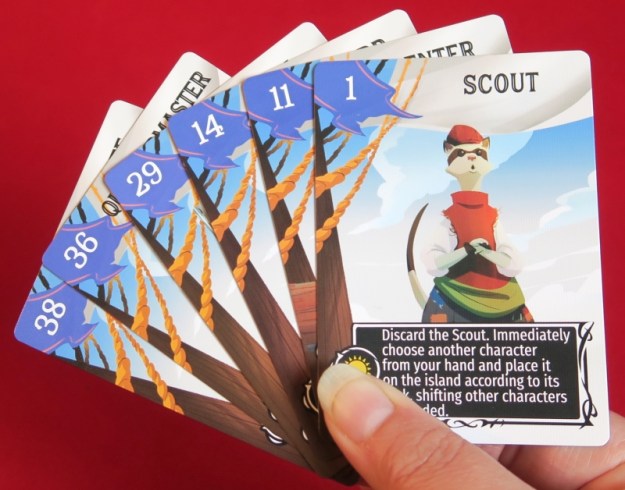
On the next table, Libertalia: Winds of Galecrest got a second outing, largely as Black and Lime had missed out last time, but also as Purple and Blue had enjoyed it.  This is also a fairly simple game to play, with a lot of depth.  Players start with the same hand of Character cards chosen from a larger deck.  This provides a lot of variability, while also ensuring that nobody has an advantage caused by random card draw.  The cards are numbered from one to forty, each with different actions—some daytime, some dusk, and some nighttime.  The idea is that everyone simultaneously chooses a card to play, then the cards are activated in ascending order during the day, descending order at dusk and simultaneously at night.

Libertalia: Winds of Galecrest
– Image by boardGOATS

Some of the cards can have a huge impact on other players’ games.  For example, the Brute causes the highest value card in play to be discarded, which means the player that played that card doesn’t get actions on that round.  In addition to night time actions, any players whose characters survive the day, also get to take some loot, if there is enough available of course.  Some of the loot is extremely valuable, some of it can be used to assassinate other Characters and and some can be more of a curse than an advantage.  As a result, rounds can go well or badly.

Libertalia: Winds of Galecrest
– Image by boardGOATS

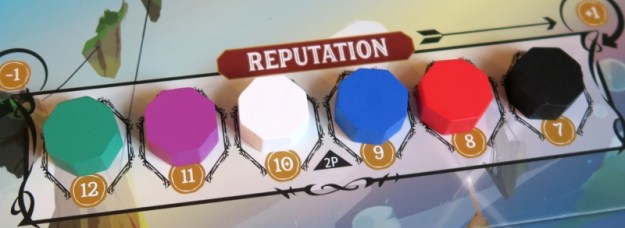
The game is played over three voyages, lasting four, five and six days respectively.  At the end of each voyage, players bank their takings and are paid a small amount based on their reputation at the start of the next round, which then acts as their kitty.  This time, Blue had an appalling first round.  This meant she was some twenty to thirty doubloons behind the others from the start, but also meant that when when others threatened, she was able to point to her lack of funds and how she was “not the threat”.  In contrast, Lime took an early lead and therefore attracted a lot of hostility, missing a lot of turns as a result.

Libertalia: Winds of Galecrest
– Image by boardGOATS

By the start of the final voyage, Blue was still some way behind, but hadn’t given up, Purple was fighting to get to the front, Lime was getting a bit fed up of being picked on and Black knew he was likely to be next in line.  It was all to play for, especially as the final voyage is the longest so players have time to plan and work card combinations.  Blue managed an amazing final round and nearly made it in what was a very tight finish—she ended just two doubloons behind Lime and Black who tied with eighty-six.  Lime could have won outright if he had played his Captain in the final round, but as it was, Black’s Aristocrat left him third on the Reputation track, one place ahead of Lime, giving him victory on the tie-breaker.

Libertalia: Winds of Galecrest
– Image by boardGOATS

Remarkably, Viticulture had finished first, so after discussing and admiring Roll for the Galaxy and comparing it with Race for the Galaxy (which Teal was more familiar with), the trio squeezed in a quick game of Love Letter.  This is a super-quick micro card game played with just sixteen cards that celebrates its tenth anniversary this year.  When it was first released it was very innovative, but since has inspired a lot of similar games, it is still great in its own right, as a simple, quick filler though.  The idea is players are trying to finish with the highest ranking card, so on their turn, they take a card from the deck adding it to their hand, then play one of their two cards.

Love Letter
– Image by boardGOATS

Each card has a rank, but also an action that takes effect when played.  For example, these allow players to look at others’ cards, force others to discard their card, or make them compare cards with the lowest being eliminated.  The last player standing wins the round, the first to three is the winner of the game.  This time, Pink and Ivory got their revenge on Teal for ending Viticulture too soon.  Between them, they shared the five rounds, with Pink just taking the balance and with it, victory as Libertalia and the evening as a whole, came to an end.

Love Letter
– Image by boardGOATS

Learning Outcome:  There’s no such thing as honour amongst thieving gamers.

20th July 2021 (Online)

Since last time, there had been quite a bit of debate about returning to the Horse and Jockey, but there was a little hesitancy and with the extremely hot weather, staying at home this week turned out to be the right choice all round.  As the decision had been just a little bit last-minute, we chose to keep the “Feature Game” simple and opted for the Skills Mini Expansion for Cartographers.  We have played Cartographers several times and everyone has really enjoyed it.  With the Spiel des Jahres winners announced this week, this was also the nearest we could get to playing a game to mark the occasion (it received a nomination for the Kennerspiel award last year).

Cartographers: A Roll Player Tale
– Image by boardGOATS

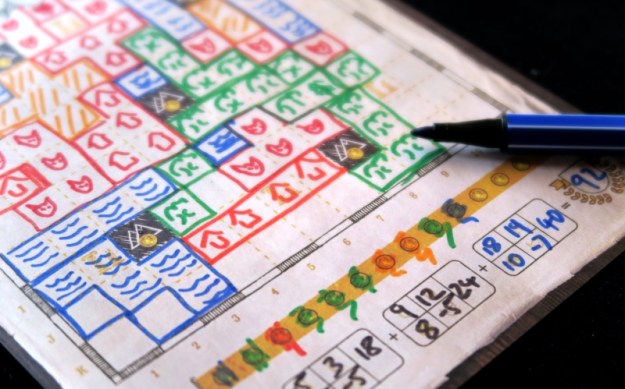
Cartographers is a “Roll and Write” type of game, but one with more of a “gamery” feel than most.  It is based on Tetris, with shapes revealed on the flip of a card in a similar way to other games we’ve played this year like Second Chance and Patchwork Doodle.  However, the thing that makes Cartographers more “gamery” than these is the addition of terrain and players usually have to make a choice, either of the shape or the terrain.  The terrains are tied in with goal cards, four of which are revealed at the start of the game.  Two goals are then scored at the end of each of the four seasons, in a similar way to another game we like, Isle of Skye.

Cartographers: A Roll Player Tale
– Image by boardGOATS

There are lots of other little aspects of the game that make it interesting—the presence of Ruins and Ambush Cards in the deck, for example, deliver a curved ball, just when players feel they are in control.  Players can also build their income by surrounding mountain ranges and choosing to play certain shapes; this gives more points at the end of each round.  The Skills expansion gives players a way to offset this income for special actions which potentially give players other ways of achieving their goals, further adding to the decision space.

Cartographers: A Roll Player Tale
– Image by boardGOATS

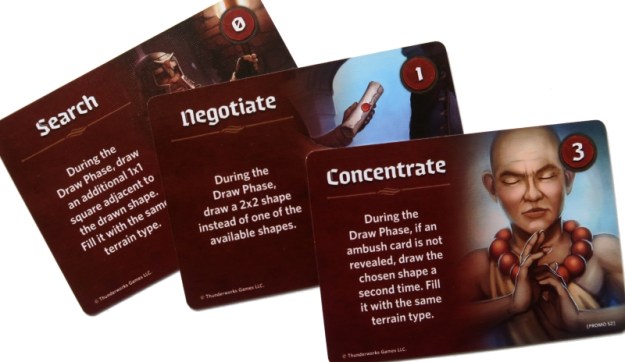
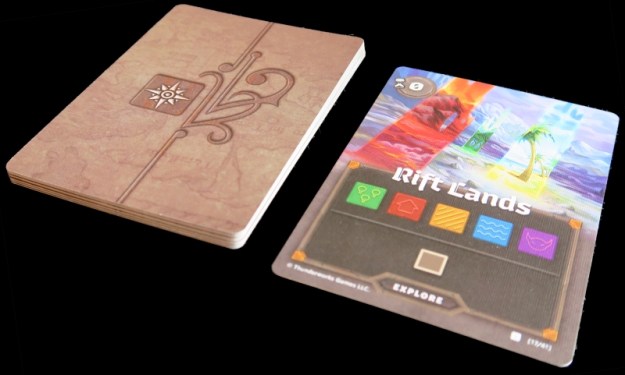
One of the most impressive things about Cartographers is the amount of variety that is built into the game, which means every play feels different and the game stays remarkably fresh.  So, there are two different player maps and four of each type of goal card.  This variety is carried through to the Skills expansion; there are eight cards of which three are chosen at random.  This time we chose the B side of the map (with empty “wasteland” spaces marked) and drew the Greenbough, Mages Valley, Wildholds and Borderlands goal cards together with the Search, Negotiate and Concentrate skills cards.  These skills cost anything from free (like Search) to three (like Concentrate), and each can be played multiple times per game although only one can be played each Season.

Cartographers: Skills Mini Expansion
– Image by boardGOATS

We quickly realised that the expensive skills like Concentrate are only likely to be played in the final round, as the cost is in “income” and that income is generated at the end of every round.  So, playing Concentrate at the start of the game will ultimately cost a player twelve points, while playing it in the final round will cost three just three points.  For this reason, the free Search skill was always likely to be used by almost everyone in almost every season (and so it proved).  Of course, the higher tariff reflects the increased power though:  Search allows players to increase the size of the shape they are drawing by a single square; Negotiate (which costs one) allows players to draw a two-by-two shape, and Concentrate allows players to draw the shape a second time.

Cartographers: A Roll Player Tale
– Image by boardGOATS

As well as the skills which we had not played with before, several of the goal cards were new to us as well, including Greenbough (which rewards gives players one point per row and column with at least one Forest square in it) and Mages Valley (which gave points for each space next to a Mountain—two points for each Lake and one point for each Arable).  We’d played with the Wildholds goal before though (which gives six points for each Village of six or more spaces) and, although Borderlands was new to us (which give points for each completed row or column), we’d played The Broken Road goal which is similar (giving points for completed diagonals).

Cartographers: A Roll Player Tale
– Image by boardGOATS

The game began much as usual, and Pink, who was watering the tomatoes in the “mini-market-garden”, commented that he could hear Burgundy muttering, sighing and generally sounding stressed from outside.  Although we had played with “Wastelands” before, we had all focussed on how the fact some of the spaces were already full would help.  We had all forgotten how much the Wastelands obstruct plans and generally make life considerably more difficult.  Blue made a bit of using the ruins spaces to give her more flexibility later, but had forgotten that it would reduce the number of spaces she would be able to fill later in the game.

Cartographers: Skills Mini Expansion
– Image by boardGOATS

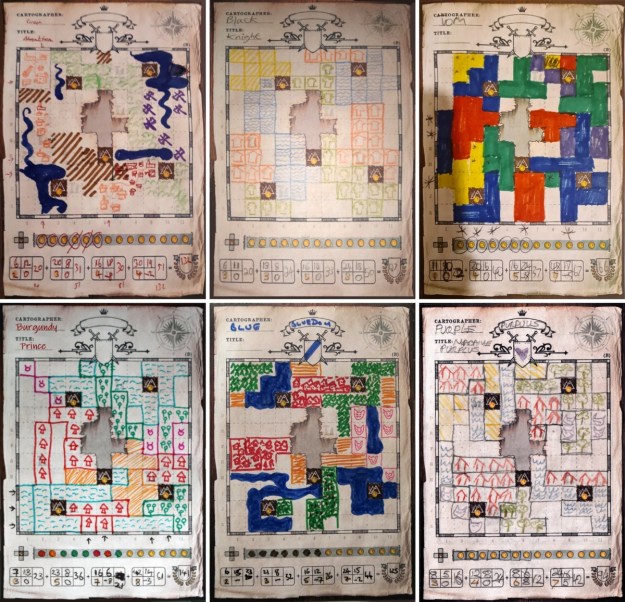
It was clear after the first round that Ivory was going to be tough to beat, a feeling that was cemented after the second round.  Unusually, Burgundy was the first to post a score, with a total of one hundred and forty-one.  Although this was high enough to earn him second though, when Ivory’s score came through he was a massive twenty-five points ahead.  Once again, it had been a very enjoyable game, and as we tidied up there was a little bit of chit-chat about the skills and what they added to the game.  Since they are not compulsory, the consensus  was that we should add them every time, though it was clear that they had been widely used because of the presence of the free Search skill, which everyone had used, and some in every round.

Cartographers: Skills Mini Expansion
– Image by boardGOATS

With Cartographers over, we had a bit of a discussion about moving back to our much loved and greatly missed, Horse and Jockey.  We’d conducted some anonymous surveys over the preceding week to try to gauge opinion trying to ensure that nobody felt under pressure to do anything they weren’t comfortable with.  Some of the group had been back on occasional Thursdays, playing old favourites like The Settlers of Catan, Wingspan, and Roll for the Galaxy and new games like Red Rising, Mercado de Lisboa, Ticket to Ride: Amsterdam, Tapestry (with the Plans and Ploys expansion), Ginkgopolis, Everdell, and Draftosaurus (aka “Sushi Go with Dinosaurs”).  Others, however, had not been to the pub for nearly eighteen months.  After some discussion, we decided that we’d schedule a trial visit in ten days time, so that those who had not been out could see how they felt without committing, and those that went could report back to those that were feeling a little more reticent.

The Horse and Jockey
– Image by boardGOATS

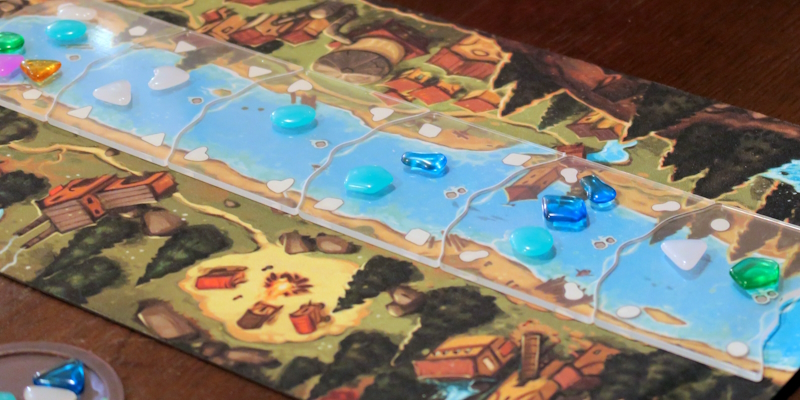
After that, we moved onto Board Game Arena.  It was a quiet night without both Pine and Lime, and once Green and Ivory had left as well, we were down to five which gave us a lot of options.  Coloretto was one, but in the end we chose Niagara, a game we’ve all played quite a bit, but never online, and we were keen to see the new Board Game Arena implementation and whether losing the tactile moving river would leave the game lacking.  A strong element of the game is the element of simultaneous play, however, and this was a large part of the appeal this time.  Players simultaneously choose a Paddle Tile which dictates how far their canoe will move in the round.  Then, in turn order, players move their canoe up or down the river, paying two movement points to pick up a gem from the bank (or drop one off).

Niagara
– Image by BGG contributor El_Comandante
adapted by boardGOATS

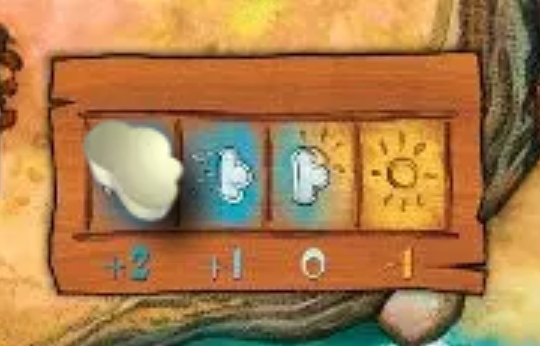
The winner is the player to get four gems of the same colour, five gems of different colours, or any seven gems safely home and into the shallows.  On the face of it, this is relatively simple, but the really clever part of the game is the movement of the river.  In general, the river moves at the speed of the slowest boat—if the lowest numbered Paddle Tile is a two, then the river moves two spaces and all the boats move with it.  However, one of the Paddle Tiles is a weather tile which enables players to increase or decrease the rate to make life harder or easier.  Since everyone has to play all their Paddle Tiles before they can recycle them, the timing of their weather tile is critical: players who leave it to the end run the risk of the river running fast and losing boats over the cascade because they can’t do anything about it.

Niagara on Board Game Arena
– Image by boardGOATS
from boardgamearena.com

And it wasn’t long before that’s exactly what happened, when both Blue and Black got their timing wrong and lost boats over the falls, so had to pay hard earned gems to get new ones.  Then, to add insult to injury, Pink sneakily crept up on Blue and stole another gem from her.  Players can only steal if they land on the same space as another boat while travelling upstream, and even then it is a choice.  There was much ill feeling especially from Blue, but she wasn’t the only one.  And with that, the gloves came off and everyone tried to redress the balance and ensure that such bad behaviour would not go unpunished.

Niagara on Board Game Arena
– Image by boardGOATS from boardgamearena.com

Pink was abreast of that though and had a plan.  Knowing his bad behaviour would make him a target he collected gems in one boat letting others take them while he stole the gems he wanted and got them to shore quickly.  Much to everyone’s disgust, he soon had five different gems and there was nothing anyone could do to stop him getting them home.  Burgundy actually had more gems giving him a nominally higher score, but his set of six did not include five different colours and Blue’s set of five included three nuggets of amber.  The victims of Pink’s grand larceny were unimpressed with his terrible behaviour, and as it was getting late, we decided to call it a night.

Niagara on Board Game Arena
– Image by boardGOATS
from boardgamearena.com

Learning Outcome:  Theft is totally unforgivable.

Boardgames in the News: What are “Roll and Write” Games?

In the last few years, “Roll and Write” games have been everywhere, but what defines them and what let to the rise in their popularity?  Well, their roots lie in simple dice games, which are as old as the hills, but arguably the first “Roll and Write” game is Yahtzee, a game that is now a childhood classic.  Although the commercial game dates from the 1950s, the game is based on the older family of traditional games, including Yacht, Generala, Poker Dice etc..

Noch Mal!
– Image by boardGOATS

The idea is that players roll five dice to try to get specific combinations, re-rolling some, all or none up to three times.  These fall into different categories each of which can only be scored once and are crossed off on a scoring sheet.  This roll and re-roll mechanism has been used as the basis of many more modern games like Pickomino (aka Heck Meck), To Court the King and even Roll for the Galaxy, but these are not “Roll and Write” games, they are dice games.  More dice games with a “Writing” element, followed as well though.  These include Reiner Knizia’s Decathalon, the Catan Dice Game, and Roll Through the Ages: The Bronze Age with its subsequent series of games.

Roll for the Galaxy
– Image by boardGOATS

Perhaps the most influential game of this type, however, is Qwixx.  In this game, each player has their own score-sheet with four rows, numbered two to twelve, each in a different colour.  On their turn, the active player rolls six dice: two white and one of each of the four colours. The active player can mark off the sum of one white die and one coloured die in the row of the same colour, while everyone else can mark off the sum of the two white dice on any one of their four rows.  The catch is that the numbers must be crossed out in order: descending for the blue and green rows, ascending for the red and yellow rows.

Qwixx
– Image by boardGOATS

And that is the core that really makes a “Roll and Write” game:  the decision making.  While there is no industry recognised definition, it is widely understood that games that fall into the “Roll and Write” category have the following key characteristics:

  • A randomiser: traditionally dice, but some games use cards etc.;
  • A key element of decision making;
  • Individual work sheets, which are more than just a score pad.

Qwixx was published seven years ago, and was popular in its own right receiving a nomination for the Spiel des Jahres award in 2013.  Its legacy, however, is the way it helped to open the door for other games in the genre.  Noch Mal! (aka Encore!) followed in 2016 and in 2018, “Roll and Write” games really took off.  Yahtzee, Quixx and Roll Through the Ages have now been followed many other very popular and successful games including, Welcome to…, Ganz Schön Clever! (aka That’s Very Clever!), Railroad Ink, and Cartographers: A Roll Player Tale.  Between them, these games have received two Kennerspiel and two Spiel des Jahres nominations.

Ganz Schön Clever
– Image by boardGOATS

There are now, hundreds of “Roll and Write” games available and new games continue to arrive, each with their own twist: some based round rolling dice, some involving a deck of cards, and there are even games now that involve cutting out!  But what is the appeal, and why the sudden growth in this genre?  For the publisher they are obviously cheap and relatively easy to produce, often needing little in the way of complex or bespoke components.  In a squeezed market this is very important.  For designers they are easy to prototype and many of these games are relatively easy to play-test too.  This is because they can often be played solo, and the mathematics of probability are well understood (by mathematicians at least).

Cartographers: A Roll Player Tale
– Image by boardGOATS

For gamers, the low price of these games means financial investment is typically small.  They are usually quick to learn and don’t over-stay their welcome either, which means they are low risk and if they “click” they also can see a lot of table time.  They are easy to play remotely too, because players just need pens and a work-sheet each, and access to a web camera.  And thus, the timing of the rise has been serendipitous: with so many people stuck at home this year, “Roll and Write” games are really coming into their own now.  It remains to be seen whether their popularity will continue into 2021 and beyond.

Noch Mal!
– Image by boardGOATS

1st October 2019

It was a bitty start with lots of chit-chat and eating, including Blue’s fantastic pizza with mushrooms growing out of it. A little bit of singing to celebrate the fact it was the eve of our seventh birthday was immediately followed by special meeple cakes. Eventually, when everyone had finally finished sucking the icing off their wooden meeples, we finally settled down to the now traditional birthday “Feature Game”, Crappy Birthday.

Pizza
– Image by boardGOATS

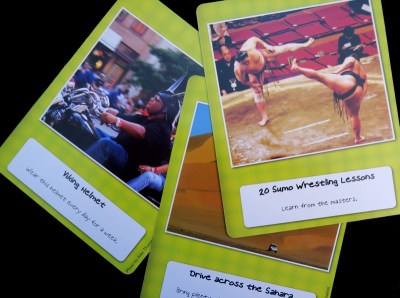
Crappy Birthday is a very silly party game that most of the group would normally turn their noses up at, but love to play once a year. The idea is that each person has a hand of cards featuring silly things and chooses one to give to the active player as a birthday present. The Birthday Boy/Girl then chooses the best and worst gifts which score the giver a point. Players take it in turns to receive gifts and after everyone has had one go, the player with the most points is the winner. It is very simple, but the best part is really when the recipient has to sit and sort through all their gifts and justify their choices. It seems a really silly game, and indeed it is, but it encourages people to get to know each other a little better and in a different way too.

Crappy Birthday
– Image by boardGOATS

This year, we discovered that Black would like a trip to the North Pole, Pine fancied two weeks in a swamp and Purple fancied a course on Mime Art.  In contrast, Burgundy was not keen on getting his earlobes stretched, Blue wasn’t keen on a GPS (with or without an annoying voice) and Lime eschewed some “garden manikins”.  Perhaps the most surprising thing we discovered was just how great Ivory would be as a day-time quiz host.  Amongst the fun, the scores were largely incidental, but everyone picked up just one or two points except for Purple who scored three points and Black who just pipped her to the post, with four points.

Crappy Birthday
– Image by boardGOATS

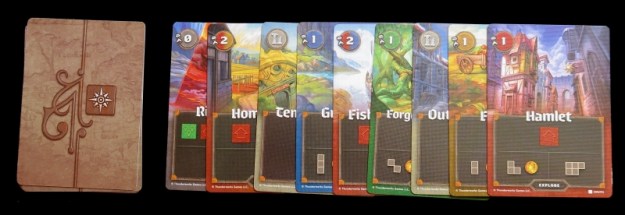
Since Blue and Ivory had both brought Roll for the Galaxy, it was clear that they were keen to give it a go and when Green said he’d play it, the only real question was which copy would get played. Since it can be quite a long game, Blue and Ivory got going quickly and left the others to sort themselves out. Although Ivory was keen to give the new Rivalry expansion a go, as it has been a while since we last played (and Green wasn’t totally familiar with it either), the trio decided to leave that for another day.  Although a lot of the group seem to get in a bit of a mess with Roll for the Galaxy, it is not actually a complicated game. It is a “pool building” game, similar to deck builders like Dominion or bag builders like Orléans or Altiplano, except with dice.

Roll for the Galaxy
– Image by boardGOATS

The idea is that at the start of the round, everyone simultaneously rolls all their dice in their cup and, depending on what faces are shown, secretly allocate the dice to the five possible phases of the game: Explore, Develop, Settle, Produce & Ship. One of the dice can be used to select which phase that player wants to “nominate”, i.e. guarantee will happen. Any die can be used for this, it does not have to match the chosen phase. Once everyone has assigned all their dice and chosen their phase to nominate, all dice are revealed and the active phases are revealed. The clever part is the element of double think that players have to use: a player can only nominate a single phase, so if they want to Produce and Ship they have to rely on someone else to nominate the other one. Guess right and both phases will happen, guess wrong and they will only get one of them, and if that relies on something else happening, they may find they end up doing neither.

Roll for the Galaxy
– Image by boardGOATS

Thus, while there are a lot of other moving parts, fundamentally, a successful player must piggy-back on other players because it will give them more actions.  Dice that are used then go into the players’ Citizenries, and unused dice go back into the players’ cups. Dice are extracted from the Citizenries and returned to the cups on payment of $1 per die, once all the actions have been carried out. Thus, the player with the most appropriate dice can turn the handle on their engine most efficiently. The aim of the game is to finish with the most points, which are obtained from settling and developing worlds and shipping goods to give points.

Roll for the Galaxy
– Image by boardGOATS

So, the first action is Explore, which is taking world tiles from a bag. These are double-sided with a development on one side and a production or settlement world on the other. They go into either the Development or Settlement piles so that dice are placed on top of these during the Develop and Settle phases: when the cost has been matched by the number of dice, the world is added to the player’s tableau and they can use whatever special power it provides. Some of the worlds are production worlds which typically provide more, exciting dice to add to the system.  In addition to extra, coloured dice, Production worlds also house dice played during the Produce phase. These can then be consumed for victory points or traded for cash, enabling more dice to be transferred from the player’s citizenry to their cup.

Roll for the Galaxy
– Image by boardGOATS

The game ends at the end of the round when either, a player Settles/Develops their twelfth world or when the stock of victory point chips run out. The winner is the player with the highest score from their combined victory points and worlds. There are a couple of other minor rules (for example players can pay one die to effectively change the face of one other die), but essentially, that is all there is to it.  Players start with a double tile comprising a complimentary pair of settlement and development worlds and a start world, together with a couple of tiles to add to their Development/Settlement piles.  For the first game it is recommended that players choose the Development and World with the lowest cost to add to their piles, because that is easier to play.  For later games, however, players can choose, which gave Blue a really tough decision.

Roll for the Galaxy
– Image by boardGOATS

In the end she decided to go for it, and chose to start with the “Galactic Federation”, “6+” development world in her building pile.  This would give her an extra one third of her development points at the end of the game, but more importantly two of the dice used for every development would bypass her citizenry, going straight into her cup.  Green started with no fewer than three of the red, “Military” dice, which coupled with his “Space Piracy” starting development, gave him really a good source of finance. He looked very unimpressed with this combination, but Ivory and Blue felt it was a really nice combination of starting tiles. Ivory’s start tiles were also nice, but didn’t have quite the same degree of complimentarity, but he did get a nice  purple, “Consumption” die.  The starting tiles are only the beginning though; the game is all about building an engine made up of dice, Production Worlds, and Developments and then using it efficiently.

Roll for the Galaxy
– Image by boardGOATS

In the case of Blue, her starting tiles led her towards a Development strategy, so she spent a lot of the early part of the game Exploring to try to find nice Development tiles to enhance that approach.  Green and Ivory had a more conventional, “build the finances and the dice pool then Produce and Consume” strategy.  The problem with this was they both frequently wanted the same phases, but ended up with either both of them choosing to, say, Produce, or both choosing Ship, when what they both really wanted was to maximise their dice by Producing and then Shipping.  Blue, on the other hand, could mostly be fairly sure that neither Ivory or Green were going to what she wanted, so was able to focus on her own plan, and just piggy-back the actions of the others.  Although the game has a reputation of being slow (with our group at least), this time, the game got going quite quickly and it wasn’t long before Ivory started his Production engine, Shipping his produce for victory points.

Roll for the Galaxy
– Image by boardGOATS

Green soon followed, while Blue kept building her Developments and occasionally taking advantage of the “Produce/Consume” strategies of the others to provide enough finance to move her dice out of her Citizenry.  Blue felt her game was really boring since all she did was Develop, but in the end, it was probably the fact that Blue was doing something different that was key.  Blue triggered the end of the game placing her twelfth Development/World tile, which gave her the most points from building, slightly more than Green.  Ivory Consumed the most victory points, with Green not far behind, and Blue not really troubling the scorer in that department.  It therefore all came down to bonuses from the “6+” Developments, which is where Blue made up for other deficiencies taking fifteen points giving her a total of fifty-seven points, five more than Green who was just a couple ahead of Ivory.

Roll for the Galaxy
– Image by boardGOATS

It had been a lot of fun, and next time we’ll have to give one of the modules form the Rivalry expansion a try.  On the next table, their game was coming to an end too.  Having been abandoned to sort themselves out, someone mentioned Ticket to Ride, and with everyone having a good idea how to play, that turned out to be most popular. The game is very simple and everyone has played it, in most cases, quite a lot, so we often play with expansion maps.  This time, the Team Asia/Legendary Asia expansion was an option, but as we usually play with the Europe version of the game, the group decided to play with original USA map with the addition of the USA 1910 additional route cards.

Ticket to Ride: Europe
– Image by boardGOATS

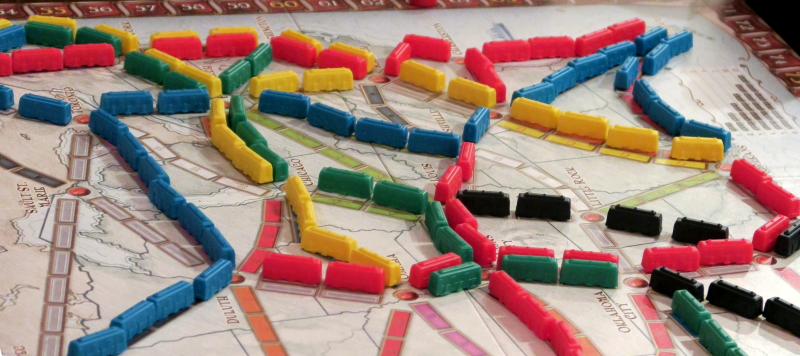
The basics of the game is that players start with a handful of train pieces and place them on the board to connect cities, paying with cards.  Thus, on their turn a player can take two coloured train cards from the market (either the face up cards or blind from the deck) or play sets of cards of a single colour that matches both the number and colour of one of the tracks on the board.  Players score points for the number of trains they place, but also for tickets.  Players choose from a handful of these at the start of the game and can take more tickets on their turn instead of placing trains or taking train cards.  These are risky though, because although they are a source of points, any tickets that are not completed at the end of the game give negative points.

Ticket to Ride (USA)
– Image by boardGOATS

The original version of Ticket to Ride (with the USA map) is much less forgiving than the Europe edition that we more usually play.  This is partly thanks to the layout of the tracks, but also due to the absence of Stations which can help alleviate some of the stress associated with failure to complete tickets.  With five, it was always going to be a really hard game and likely to end up with a bit of a train-wreck for someone, and so it turned out.  The eastern states were rough, really, really rough with Burgundy, Lime, Pine and Purple all fighting for routes in the same space.  As a result, Black benefited from mostly staying out of the scrap.

Ticket to Ride (USA)
– Image by boardGOATS

Pine, Lime and Purple managed to complete the most tickets, five each, but remarkable, all three were a long way behind Burgundy and Black who only completed three and four tickets respectively.  This was partly due to negative points, but was mostly caused by the fact that the longer tracks give disproportionately more points and Black for example was able to pick up two of the long tracks around Salt Lake City relatively unopposed as he was mostly alone working in the west.  Similarly, Burgundy did well in the north.  As a result, it all came down to the longest route bonus, ten points, but with Black and Burgundy both in the running it gave a twenty point swing to Burgundy giving him a total of one hundred and thirty-five points, nearly twenty more than Black in second place.

Ticket to Ride
– Image by boardGOATS

Ticket to Ride and Roll for the Galaxy finished simultaneously and only Green decided he needed an early night, leaving everyone else to play one of the group’s favourite game, Las Vegas.  This is a simple game of dice rolling and gambling, where players use their dice to bet in one of the six numbered casinos.  Each casino has one or more money cards and at the end of the round, the player with the most dice in that casino takes the highest value money card.  The player who comes second takes the next highest value card and so on.  When betting, players must place dice in one of the numbered casinos.  The first catch is that they must place all the dice they roll that depict that number in the matching casino.  The second catch is that any dice involved in a tie at the end of the round are removed, and it is this that makes it a great game.

Las Vegas
– Image by boardGOATS

We have the original version of the game rather than the new edition, Las Vegas Royale, though we added elements from the Las Vegas Boulevard expansion, including the double weight “Big” dice and the Slot Machine.  We also house-rule to only play three rounds instead of the four in the rules as written.  This time, Ivory stole a march in the first round, when he was forced to place his last die as a losing singleton in “Casino Five”, only for Purple to roll a five with her final roll and take out both herself and the hitherto winner, Pine.  As a result Ivory took the jackpot of $90,000 to go with his other winnings.

Las Vegas
– Image by boardGOATS

It is not a game to give up on though, as anything can happen.  The second round was relatively uneventful, but the deal for the final round left the last three casinos each with a single card of $100,000.  This is highly unusual, but we decided to play on and see what happened.  In the end, it had a bit of an “all or nothing” feel about it, with players going in early and in big.  It was probably no coincidence that the three big jackpots were taken by the three highest scoring players.  Pine thought he had come off worst, Black, who had done so well in the other two games took the wooden spoon.  It was Ivory’s flying start that was key though, and together with his strong finish, his total takings were a massive $430,000, $40,000 more than Blue in second.

Las Vegas
– Image by boardGOATS

Learning Outcome:  Party games can be great when everyone is in a party mood.

27th Movember 2018

With the Festive Season now apparently upon us, the pub was once again packed and food was later than usual.  For this reason, we started with a quick game of No Thanks!.  This used to be one of our “go-to” filler games, but has been somewhat neglected of late, so was surprisingly unfamiliar to some people.  It is very simple though and very easy to learn on the fly:  everyone starts with eleven red chips and the first player turns over the top card—they can take it, or pay a chip for the privilege of passing the problem on to the next player.  The player with the lowest summed card total when the deck expires is the winner.

No Thanks!
– Image used with permission of BGG contributor msaari

There are are two catches, firstly, where a player has a run of consecutive cards only the lowest is counted and secondly, a small number of cards are removed from the deck at random.  Top scorer looked to be a toss up between Blue, Red and Mulberry, but Red took the dubious honour in the end, with forty.  It was tight between Pine and Burgundy, however, both of whom had a large pile of chips and a substantial run of high cards (between them they had nearly forty of the fifty-five chips and the cards numbered twenty-eight to thirty-five).  There were only two points in it in the end and it was Pine who took the honours.

No Thanks!
– Image used with permission of
BGG contributor ronster0

The group had been just about to start playing when Black, Purple and Green had walked in.  Since No Thanks! only plays five, so pre-empting a discussion of options, Blue chucked over a copy of Dodekka which the group obligingly settled down to play.   This is another light set collecting game where the aim is to get the highest score possible from one of the five colour suits, while ideally scoring nothing in all the other suits.  Gameplay is very simple:  take the first card on display, or reveal a card from the deck and add it to the end of the row (thus “passing”).  If the sum of the cards on display now totals more than twelve, the active player must pick up all of the cards on display. When the deck runs out, the winner is the player with the highest score (the total face value of one suit minus one for each other card).  It was very close at the top, with only one point separating Black and Purple, and much to Purple’s chagrin, it was Black who came out on top.

Dodekka
– Image by boardGOATS

Just as No Thanks! was coming to an end, food arrived, along with Ivory.  Dodekka was still going, so while some munched, those remaining decided to give The Game an outing (played with a copy of The Game: Extreme, but ignoring the special symbols).  This is a surprisingly popular game within the group, which is remarkable because it is cooperative and we generally prefer competitive games.  Another simple game, the idea is that the team have a deck of cards from two to ninety-nine and they must play each card on one of four piles:  two where the card played must be higher than the top card, and two where it must be lower.  There are just three rules:  on their turn, the active player can play as many cards as they like (obeying the rules of the four piles), but must play at least two cards before replenishing their hand, and players can say anything they like but must not share “specific number information”.  Finally, there is the so-called “Backwards Rule” where players can reverse a deck as long as the card they play is exactly ten above or below the previous card played on that pile.

The Game: Extreme
– Image by boardGOATS

Red started and it quickly began to go wrong with with Pine holding a “nice mid-range hand”.  With the help of everyone else he battled through though, and it wasn’t long before he had a “nice extreme hand” while all the piles were offering “nice mid-range options”.  It perhaps wasn’t surprising with this that the group didn’t win (i.e. play all their cards onto the four decks), but given that they had such a poor run of luck, they did well to exhaust the draw deck and ultimately have only eight cards they were unable to play.  Inevitably, Dodekka finished just after The Game started, so Black, Purple and Green killed time with a quick game of Love Letter.  This is the original “micro game”, consisting of just sixteen cards.  The idea is that each player starts with a single card, draws a second card and chooses one of the pair to play.  The cards are numbered one to eight (with more of the lower numbers), and each number has an action associated with it.  The aim is to eliminate all opponents, as the last man standing is the winner.
Love Letter
– Image by boardGOATS

Rounds only take a minute or two, so elimination is not a problem.  This time, each player won a round.  So with honours even and with the other game and food coming to an end, it was sudden death.  This time it was Purple’s turn to come up trumps, taking the final hand and with it, the game.  This started a big debate as to who was going to play what.  As it was likely to be Ivory’s last chance for a meaty game for a few weeks (with Christmas and his impending arrival), the “Feature Game” was Ambition, the expansion to one of his favourite games, Roll for the Galaxy.  With Burgundy fed-up with the feeling of confusion that Roll for the Galaxy always gave him and Black feeling that he’d played it a couple of times recently, for a while it looked like it was only going to be Blue and Ivory.  Eventually Black saw sense, and Green joined in, despite the fact that he felt he’d not played the base game enough to appreciate the expansion.

Roll for the Galaxy
– Image used with permission of BGG contributor punkin312

Roll for the Galaxy is the dice game of the popular empire building card game, Race for the Galaxy.  Both suffer from the same “iconography confusion”, but that aside, neither are actually complicated games.  The idea builds on the Puerto Rico/San Juan idea of different phases or activities that only happen if or when players want them to.  Roll for the Galaxy is almost a “worker placement” game where dice are the workers and have a say in what sort of work they do with players “spending” these dice to make actions happen.  Each player starts with a dice in their cup which they roll and assign, in secret behind a screen.  When dice are used they are placed into the player’s Citizenry and it costs a dollar to move them from the citizenry to back into the cup.  Each face of the worker dice corresponds to one of the five different action phases:  Explore, Develop, Settle, Produce, Ship.  Each player uses one die, any die, to select a single phase that they want to “happen”.  All the other dice are assigned to the Phase that corresponds to the face rolled.  Any that do not correspond to the chosen phase can only be used if another player chooses those phases to happen.  Any that are used move into the player’s Citizenry, any that are not used go back into the cup.

Roll for the Galaxy
– Image used with permission of BGG contributor punkin312

As such everyone is reliant on other players to help them out and the player who best piggy-backs other players’ choices usually does well.  It is not only about second-guessing what other players are going to do though: success also requires a good strategy, a complementary tiles (Worlds), an understanding of probability, the ability to effectively manipulate the dice rolled, and a modicum of luck.  Luck is everywhere, but there are ways to mitigate its effect.  For example, in Phase I (“Explore”), players draw tiles out of a bag.  These are double-sided with one side being a Development World and the other a Production World.  These are “Built” in Phases II & III (“Develop” and “Settle”) and the cost is paid in dice, anything from one to six (with expensive Development Worlds generally partnered with cheap Production Worlds).  These tiles are drawn at random in Phase I and a side chosen and the Worlds added to the bottom of their personal Development or Settle pile as appropriate.  The top World tile is the one that will be built first and if there is not enough to complete a building, that means there will be fewer dice available for the following rounds, until it is finished.

Roll for the Galaxy
– Image used with permission of BGG contributor punkin312

This may seem very harsh, with players potentially getting stuck with a high value building and a shortage of dice so that they struggle to complete it in a timely fashion.  However, clever use of the Explore Phase can ensure that this is not a problem, despite the luck involved.  Players can discard as many tiles as they like, drawing one extra from the bag.  Thus, an early round committing lots of dice to the Explore phase can enable lots of tiles to be recycled as better ones are drawn.  Dice assigned to Phase IV (Produce) are moved to Production Worlds where they will stay until Phase V (ship) happens and that player has dice assigned to it.  In this way, dice can get “stuck” in a similar fashion to dice involved in Developing or Settling.  Thus dice management is one of the key skills to the game.  Points come from building (a building that requires five dice is generally worth five points at the end of the game); from bonus points Development buildings which give points for some particular feature (e.g. one extra point for a particular type of Production World), and from victory points generated during Phase V (Shipping) by using the “Consume” option.

Roll for the Galaxy: Ambition
– Image used with permission of BGG contributor dotKeller

The Ambition expansion doesn’t change the game very much, simply adding a very small number of Worlds, some extra Starting Worlds, some in game Objective tiles and replaces one of each player’s starting white dice with a black “Leader” die.  The first player (and only the first player) to achieve each of the objectives receives “Talent” counters; these can be treated as single-use workers or as victory points at the end of the game.  There are also orange “Entrepreneur” dice—these and the “Leader” dice have some faces with two symbols allowing players to choose which of these Phases to assign them to and giving them the magic power of automatically switching to the alternative Phase if the initial nomination does not happen.  There are a couple of other little twists, for example on some faces the second symbol is a dollar sign signifying that if the die is used for its intended Phase then the die goes back into the Cup (not into the Citizenry) after use, making it effectively free to use.

Roll for the Galaxy
– Image used with permission of BGG contributor punkin312

Ivory was fastest out of the blocks with a large amount of liquidity from his “Doomed World” that gave him $8 start up.  Furthermore, his “Alien Artefact Hunters” start-world gave him $2 each time he consumed Alien goods, and Victory points (from Consuming).  For everyone else it looked like it was going to be over before it had begun when Ivory  was the first to achieve an Objective, adding the associated Talents to his already growing pile of victory points.  Although they were a little less obvious , everyone else’s Start Worlds were quite useful too however.  Black for example received extra cash every time he developed, Green had the ability to reassign two of his white dice as Explorers or Settlers and Blue could reassign any two dice to explore.  These special abilities were slower to take effect, but gradually, these, together with the lack of production on the “Doomed World” meant the group began to haul back Ivory’s rapid head-start.

Roll for the Galaxy
– Image used with permission of BGG contributor punkin312

Blue, and to a lesser extent Green, spent a lot of time Exploring (using their special abilities), carefully choosing which Worlds to build and stacking the deck to control the order, a tactic that paid dividends later in the game.  In Blue’s case, she used the Objectives as a target and then used the Talents to finish off Worlds quickly enabling her to grab a couple from under Ivory’s nose.  Green more or less ignored the Objectives as he was too busy trying to remember how to play the base game while fiddling with his phone.  Black was less fortunate, and really struggled with the luck of the dice and found it difficult to make use of his special ability to get his engine going.  Then suddenly it looked like Ivory might end the game as the Victory Point reserve rapidly depleted.  He couldn’t make it on the first attempt though and there were a couple more things he wanted to do in any case.  In the end it was Blue who ended it—building not only her twelfth World, but also an extra one giving her a massive forty points for that alone.

Roll for the Galaxy
– Image used with permission of BGG contributor punkin312

Although Blue had a couple of Victory Point chips and a handful of Talents left over, it paled into insignificance compared with the massive pile of chips in front of Ivory—the question was whether it would be enough though.  It was very close, but Blue’s last round just tipped it in her favour and she won by five points.  With that, Ivory and Green took their leave, leaving Black and Blue to consider their options.  While they had been playing with their dice, the others had played a full four rounds of Saboteur and moved on to their next game.  Saboteur is a fun little hidden traitor game where players are either Dwarves trying to find the treasure or Saboteurs trying to stop them.  We’ve played it quite a bit and in truth it plays best with more than six players, as the number of Saboteurs varies and there is an element of doubt.  With five their can be either one or two Saboteurs, and the odds are heavily stacked against a lone Saboteur, but in favour of a pair.  Nevertheless, the group were keen to introduce Mulberry to it.

Saboteur
– Image used with permission of BGG contributor mothertruckin

It is another quite simple game:  On their turn, players can play a tunnel card onto the grid in the centre, play a special card (a broken or fixed tools card on another player or a map card to look at the destination cards), or discard a card face down and then draw a replacement.  If the Dwarves don’t get to the treasure before the cards run out, the Saboteurs win.  In the first round, Burgundy was isolated as the Saboteur and despite his best efforts, he failed to disrupt an organised team of Dwarves.  In the second round Burgundy was joined by Pine, and with two of them the odds were much better and the pair took the opportunity to prevent the Dwarf team from getting to the gold.  As a group, we normally only play a couple of rounds, but everyone wanted to see if luck would deal Burgundy a Dwarf card.  The immediate answer was no, and in the end it turned out that the third rounds was a direct replay of the second with Pine joining Burgundy on the Saboteur winning team.

Saboteur
– Image used with permission of BGG contributor mikehulsebus

By this time the group had decided they would keep playing until Burgundy wasn’t the Saboteur, and in the fourth round they finally got their way when Mulberry was a lone Saboteur.  Inevitably she failed to break the will of the “gang of four” who easily found the treasure.  Normally we don’t bother sharing out the “gold” scoring cards as it is very arbitrary who goes first and in a low number of rounds it is purely luck who wins overall which takes some of the fun out of the game.  This time though, the group played the rules as written.  With Burgundy and Pine winning two rounds and sharing the spoils two ways (instead of three) it was inevitable that they would score well.  In the end it was Pine who did lightly better, thanks to the fact he had been on the winning Dwarf team in the first round.  As Roll for the Galaxy was still going (and Red and Mulberry had gone home for an early night), the group looked round for something else to play and Purple’s beady eye lit on Steam Donkey.

Steam Donkey
– Image by boardGOATS

Steam Donkey is a card game that involves building a seaside resort consisting of a four by three grid of attraction cards. The three rows represent the different parts of the resort:  beach (yellow), town (pink) and park (green).  Similarly, the four columns correspond to the different types of building: amusements, lodgings, monuments and transport.  In order to place a feature, it must go in the correct location and must be paid for using cards of the same type, as such it has similarities with games like Race for the Galaxy and San Juan.  As players build their resort, visitors arrive at the station and come to see the attractions. Each attraction can take a certain number of visitors, which are actually a row of face down cards that are used to replenish the cards in players’ hands. Thus, on their turn players carry out one of the following actions:  choose a colour and build as many attractions in that colour as they can/want paying with other cards from their hand; choose a colour and start taking cards in that colour from the “station” (a row of face down cards), or if there are no visitors of the chosen colour (or there are no spaces for the visitors to go), they can add visitor cards to their hand and refill the station platform with four new visitors.

Steam Donkey
– Image by boardGOATS

The colour of the visitor side of cards does not reflect the colour of the attraction on the other side, however, the type of attraction is indicated.  There is a hand limit of twelve though and this can actually be quite a serious impediment for players collecting cards to build the more valuable attractions.  At the end of the game, points are scored for each unique attraction built as well as for fulfilling individual goals and bonuses depicted on players’ resort posters.  It was a long time since anyone in the group had played it, and Pine hadn’t played it at all, so it took a while to get going.  It was close at the top with Burgundy and Pine scoring pretty evenly for their buildings and taking almost exactly the same number of bonus points too.  Burgundy just had the edge however, and took the game by three points, with a grand total of seventy.

xSteam Donkey
– Image by boardGOATS

When Roll for the Galaxy finally finished and Green and Ivory left Blue and Black alone it was clear that they were going to be waiting for a while, so they looked round for something that wasn’t too long and played well with two.  In the end, they settled on Kingdomino, but decided to add the new Age of Giants expansion acquired at Essen.  Kingdomino is a tile-laying game with a couple of clever mechanics.  Players take it in turns to choose a “domino” and add it to their “Kingdom”.  The clever part of the game is that the tiles are numbered with players who choose the high numbered (and therefore more valuable) dominoes taking their turns later in the next round.  In the two player game, players get two turns per round, so their first turn can be used to try to set up the second turn.  In the two-player game, each player is building kingdoms consisting of 7×7 arrays of “squares” rather than 5×5 arrays, which makes the game much more strategic.

xKingdomino
– Image by boardGOATS

The game ends when there are no more tiles to place.  Scoring is by multiplying the number of tiles in each terrain by the number of crowns in that terrain.  Thus a moderate sized area with plenty of crowns is worth more than a large area with very few crowns.  The Age of Giants expansion doesn’t change things as much as Queendomino, which we found managed to take all the fun out of the game and add a whole load of unnecessary complexity instead.  This expansion adds a small number of tiles that feature either a Giant or a Giant’s footprints.  When a Giant Tile is drawn, a large wooden giant meeple is placed on it.  When this is taken, the Giant is taken too and is placed over one of the crowns anywhere on that player’s area.  When a footprints tile is taken, a Giant of their choice moves from their Kingdom to another player’s Kingdom.

xKingdomino: Age of Giants
– Image by BGG contributor kalchio

There are two problems with this little addition, firstly, there is a rules tweak that means five tiles are drawn in the two player game and one is discarded.  Blue and Black found that this meant they just chose not to take tiles with Giants on them except when forced to right at the end.  Secondly, even when forced to take a Giant, there was almost always somewhere it could be poked that caused minimal damage, so it wasn’t really a big issue.  This was a real shame as the Giants are lovely.  As well as adding a fifth player there is also a a small pile of bonus-point tiles; both Blue and Black really liked these as they thought that they added a nice twist.  This time, they ended up with bonus points for Sea tiles adjacent to the castle and Marsh land on the corners.  Both players tried to accommodate these, though Black did a much better job than Blue.

xKingdomino
– Image by boardGOATS

It may have been that Black was focussing too much on the bonuses however, as he ended up unable to place all his tiles.  And although he scored well on the bonuses and for Sea and Pasture, he scored very little for Woodland, Marshland and Mountains.  In contrast, while Blue completely failed to score for Pasture, she scored well in every other terrain and made a killing with her Wheat fields, giving her a total of two-hundred and thirty-three, some sixty more than Black.  With that done and the epic game of Steam Donkey finally over, there was just time to arrange some of the details for the Christmas Party nest time before everyone went home.

xKingdomino
– Image by boardGOATS

Learning Outcome:  We like simple games: they can be quick to learn, but take time to master.

16th October 2018

Blue was late after an unscheduled nap, so Burgundy consumed the first half of his supper alone.  Blue was quickly followed by Ivory and Pine and then a new visitor, Navy.  With Cobalt last week (who was busy moving house this week so couldn’t come) that makes two new people in two weeks.  Navy is a more experienced gamer and is into slightly more confrontational games than those we normally play, but that’s good as it might encourage us to leave our comfort-zone of cuddly Euros set in medieval Germany.  As we were all introducing ourselves, Green, and then Black and Purple turned up and the discussion moved on to how we choose the “Feature Game” (Blue suggests something to Green who mostly replies that he’s never heard of it, but it sounds quite interesting…).  Recent discussions have centred round the new Key Flow (aka “Keyflower the card Game”) for the next meeting and maybe Imaginarium (or, “The One With The Elephant on the Front” as Navy referred to it).  With that, Green started getting out this week’s “Feature Game“, which was Greed, a card drafting game where players are crime lords trying to earn more money than anyone else through clever use of their cards.

Imaginarium
– Image by BGG contributor W Eric Martin

At it’s heart, Greed is a quite simple, card-drafting game with a healthy dose of “take that” and a gangster theme.  Players start with a hand of twelve cards and “draft” three cards  (i.e. choose a cards and pass the rest on, three times).  Players then simultaneously choose one card then together reveal this card and action it before the it is replaced with another drafted card.  A total of ten cards are played in this way per person before the players tally their holdings and the player with the highest value is the winner.  Obviously, the game is all about the cards and there are three types, Thugs, Holdings and Actions, but it is the combination of these that is critical.  Actions have a unique effect associated with them while Thugs and Holdings typically also have a cost or a condition associated with them (e.g. cash paid to the bank or a collection of symbols on cards held).  Holdings are the key however.  When a Holding is played a token is placed on that card for each symbol on it and an additional token for each symbol of that type already possessed. These tokens are worth $10,000 each at the end of the game which is added to the value of cash collected through card plays.

Greed
– Image from kickstarter.com

Although it was Green’s game he had only played it once and that was over a year ago, while Burgundy had read up on it.  Pine and Navy had joined them to make the foursome.  The game takes a few rounds to understand how it really works.  After that, it’s quite easy to play, but working out which card to take and which to play is much harder, as they all seem to be really good. Unfortunately Navy struggled a bit at the beginning and made mistakes in his first couple of plays as he either found he couldn’t actually play his chosen card and had to just ditch it, or wasn’t able to get the indicated bonus. However, as he had not accumulated any wealth early on, it also meant he didn’t lose any when Green played a couple of cards which meant everyone else lost dollars, which leveled the scores a little.  Burgundy’s preparation really helped when he played a Holding card and proceeded to place six tokens on it, so by the half way mark it was looking like a two horse race between Burgundy and Green with both Navy and Pine looking short on cards.

Greed
– Image used with permission of BGG contributor punkin312

Through the second half of the game, Pine really got the hang of it and started raking in the dollars and had quite a pile of cash. Green then played a Holding card which enabled him to add chits equaling the same number as the maximum on another players cards, which meant he was able to gain from Burgundy’s excellent earlier play.  In the final rounds, Green played another card which removed one of his holdings only to be able to play it again the following round with even more tokens than it had previously. There was a brief discussion as to whether he should get the usual amount for it as well as the removed ones and two extras, a decision that went in Green’s favour, but the real question was whether it would be enough to beat Burgundy.  In the end, it was close, but the answer was no and Green finished with $30,000 behind Burgundy’s winning total of $235,000.

Roll for the Galaxy
– Image used with permission of BGG contributor punkin312

Meanwhile, on the next table everyone was being indecisive, but in the end the decision was made in favour of Roll for the Galaxy.  This is a game that really fascinated the group for a while because somehow it behaves differently to everything else we play and we really struggled to get to grips with it.  At the time, we concluded that our struggles were probably because we weren’t playing it enough so effectively had to learn it afresh every time we played.  For this reason we went through a phase of playing it quite a bit, but that was some months ago now and it was definitely time for another outing.  In principle, it is not a difficult game and the core mechanism is similar to the so-called “deck builders” (like Dominion) or “bag builders” (like Orléans or Altiplano), except instead of building a deck of cards or a bag of action tokens, players are building their supply of dice.  In Roll for the Galaxy, each different die colour reflects the different distributions of the dice, so for example, white “Home” dice feature each of the symbols for Develop, Settle, Produce and Ship once and Explore twice.  On the other hand, the yellow “Alien Technology” dice have three faces that depict the asterisk (“Wild”) and one each of Develop, Settle and Produce.  Thus, where probability affects which cards or tokens are drawn in the other games, in Roll for the Galaxy, players have more control over which dice they are using, but chance affects how those dice roll.

Roll for the Galaxy
– Image used with permission of BGG contributor punkin312

In principle, Roll for the Galaxy is not a difficult game and the basic mechanism is similar to that in Dominion or Orléans/Altiplano, except instead of building a deck or a bag of action tokens, players are building their supply of dice.  Each different die colour reflects the different distributions of the dice, so for example, white “Home” dice feature each of the symbols for Develop, Settle, Produce and Ship once and Explore twice.  On the other hand, the yellow “Alien Technology” dice have three faces that depict the asterisk (“Wild”) and one each of Develop, Settle and Produce.  Thus, where probability affects which cards or tokens are drawn in the other games, in Roll for the Galaxy, players have more control over which dice they are using, but chance affects how those dice roll.  Although the dice are important, like Greed, the game is really all about the special powers the players’ tableau, in this case made up of World tiles rather than cards.  Ultimately the game is really a race to trigger the end of the game is when the victory point chip pool runs out or a player builds their twelfth World.

Roll for the Galaxy
– Image used with permission of BGG contributor punkin312

Game play is mostly simultaneous:  players roll their dice and  allocate them to their phase strip.  Each player can choose one phase that they guarantee will happen, so in a four player game there is a maximum of four phases per round and where players choose the same phase there will be fewer, sometimes even only one.  The phases are:  Explore, Develop, Settle, Produce & Ship which correspond to draw Worlds from a bag; “spend” dice to build development Worlds;  “spend” dice to build production Worlds; place dice on production Worlds, and move dice from production Worlds in exchange for either victory points or money (which in turn can be used to speed up recycling of dice).  While we were setting up Ivory regaled us with the first few pages of Julia Donaldson’s “The Gruffalo”.  We will miss him and his stories when he takes his paternity leave in the new year.

Roll for the Galaxy
– Image by BGG contributor The Innocent

Blue began with the poor starting combination of a level six development World and a level one settlement, or a a level one development World and a level six settlement so began by rectifying the problem by exploring.  The game rocked along at a merry lick, with Black and Purple building and Ivory thrilled that he finally managed to build his first ever “Alien Technology World”, a feat he quickly followed with his second. Blue was slower building, but had a few high value developments and made good use of these before she began collecting some victory points.  This started a sudden cascade of Black and Ivory collecting points as well.  As a result, everyone focused on the number of victory point chips as the end game trigger, so much so that nobody, spotted that Purple had built her twelfth World.  As the group was just about to start the next round and everyone likes seeing their plans fulfilled, they played on anyhow.

Roll for the Galaxy
– Image by BGG contributor dodecalouise

Although it was a very tight game and everyone added to their scores, the extra round probably didn’t make any difference to the final placings.  Black and Ivory took over twenty victory points in chips alone, but they were offset by Blue’s high value Worlds and bonus points which gave her fifty-six points, just three more than Black in second place.  Everyone enjoyed the game, but there was one non-game highlight: Green’s sad little face when he looked across and broke off from setting up Greed with the sad comment, “Oh, They’re playing Roll for the Galaxy…”  Well, as everyone had a good time and with players getting quicker at it, it’s less of a labour than it used to be, so it surely won’t be long before he gets a chance to play it again.

Roll for the Galaxy
– Image by BGG contributor haslo

Greed finished first and as it was still early there time for another game, but nobody wanted to have a late night so the group picked something shorter and settled on this year’s Spiel des Jahres winner, Azul.  This was another game that was new to Navy, but it is very popular in the group and we’ve played it a lot.  Players are tiling a wall, taking tiles of one colour either from one of the factories (putting the rest in the central pool) or from the central pool.  Tiles are added to rows on the players’ boards and at the end of the round one tile from each full row is transferred to the players’ mosaics.  The aim is obviously to fill all the rows to transfer the maximum number of tiles, however, any excess tiles score negative points.

Azul
– Image used with permission of boardgamephotos

Navy quickly got the hang of this one and all the scores were close for a lot of the game, though it was noted how neat Green’s mosaic was looking as he managed to fill the first left hand vertical row and nearly completed the second as well before placing anywhere else.  Burgundy and Pine were both less tidy, but was still picking up extra points for connecting tiles when placing them. Although Navy’s board was a little more scattered, but that would help him to catch up later.  Everyone thought they were entering what would be the final final round with  three players with at least one row just one tile from completion, amazingly nobody completed them and everyone get one extra round.  This meant the group actually ran out of tiles to place on the central discs, triggering the end game in different way.  After this final round and final scoring, Pine finished on top of the podium, ahead of Burgundy in  second place with Navy in a very respectable third in a close game.
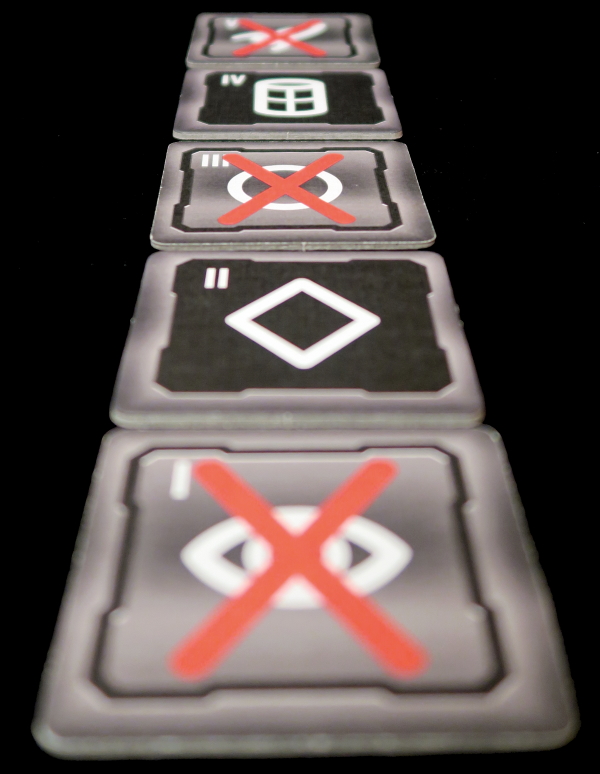
Azul
– Image by BGG Contributor styren

While Roll for the Galaxy was finished, there was a bit of chit-chat about strategy and it was clear that to do well at the game, you also need to keep a close eye on what everyone else is doing too. This can be tricky when you are struggling to work out what to do on your own board however.  Winning or losing though, Azul is a nice game that always delivers a challenge; it will be interesting to see how the new stand-alone version of the game, Stained Glass of Sintra compares and if it is as good or better than the original, or whether it “does a Queendomino or Tsuro of the Seas“.  No doubt we will find out in due course.  With that, those that wanted an early night headed for home, leaving Black, Purple, Burgundy and Blue with time for one last, shortish game.  Black suggested San Juan which had been played at the last Didcot Games Club meeting, and everyone else concurred.

San Juan
– Image used with permission of BGG contributor EndersGame

Essentially, San Juan is sometimes referred to as “Puerto Rico the Card Game”, but in truth they are very different games although the artwork and roll selection is similar.  In practice, it is actually a simpler version of the card version of Roll for the Galaxy, Race for the Galaxy.  The game uses the same multi-purpose card mechanism seen in games like Bohnanza, though in this case, cards can be buildings, goods, or money.  The idea is that players take it in turns to choose a “role” and then everyone carries out the action associated with that role, though person who chose it carries out with the “privilege”, a slight advantage.  The roles are Councillor; Prospector; Builder, Producer and Trader.  Players have a hand of cards and can use the Builder to build these cards to paying for them with other cards from their hand.  Hands are replenished directly using the Councillor or Prospector.  However, it is much more efficient to build an engine using production buildings.  These take cards from the deck and turns them into goods when a player chooses the Producer role; when the Trader role is chosen, these goods can be traded for cards according to the current value depicted on the tally stick.  The game end is triggered when someone builds their twelfth building.

San Juan
– Image by BGG contributor Aldaron

Black and Burgundy were quick out of the traps building their efficient production engine, with high value coffee and silver producers.  Purple started with “purple buildings” before also moving into sugar production and then Monuments.  Blue on the other hand started with a hand full of nice looking purple civic buildings that she didn’t want to part with and after three rounds hadn’t seen a production building, so decided to try something different and built a Tower (to increase her hand limit from seven to twelve) and started building.  Elsewhere on the table Burgundy was stealing a march on everyone else, adding a Well, Smithy, Aqueduct and Market Hall to his high value buildings.  When he added a Library which enabled him to use his privilege twice, he began turning over cards at a phenomenal rate and it looked like the writing was on the wall.  Everyone was keeping a careful eye on everyone else, trying to make sure they didn’t fall behind in the number of buildings they had, and before long, the game end was triggered and it was the final round then the scores were added up.

San Juan
– Image used with permission of BGG contributor EndersGame

After the scores had been added up, Black bemoaned the lack of the endgame scoring bonus cards that rewarded the production buildings and monuments that he had been collecting (Guild Hall and Triumphal Arch).  It was then that Blue explained that she had been stashing them under her Chapel as she had no use for them and didn’t want the others to have them.  It was possible that this tactic made the difference, as despite having only two production buildings, her City Hall and Chapel delivered a massive thirteen bonus points, just enough to offset the cheaper buildings she had been forced to build.  Remarkably, Blue finished with thirty-one points, four ahead of the “Production King” Burgundy.

San Juan
– Image used with permission of BGG contributor thatmadgirl

Learning Outcome:  Though difficult, it is important to keep a close eye on what everyone else is doing.