Tag Archives: El Grande

Spiel des Jahres Nominations 2025

The nominations for the 2025 Spiel des Jahres Awards have just been announced.  Although there are now other lots of other awards (including the recently announced Golden Geek Awards), this is still the most prestigious award in board gaming and certainly the one that carries the most weight when it comes to casual gamers.  There are three categories, the Kinderspiel (children’s game) , the Kennerspiel (“expert’s” game) and the most desirable of all, the family award, the Spiel des Jahres or “Red Poppel”.  The nominees for this year’s awards have been announced as:

  • Kennerspiel des Jahres
    Kennerspiel des Jahres 2025 - Nominees
    Endeavor: Die Tiefsee (aka Endeavor: Deep Sea) by Carl de Vissser
    & Laurent Escoffier
    Faraway by Johannes Goupy & Corentin Lebrat
    Neuland (aka Looot) by Charles Chevalier & Laurent Escoffier


In recent years, there has been a shift in both the family and expert awards, away from traditional Euro-style board to lighter, more innovative games.  Gone are the days of El Grande, Tikal and The Settlers of Catan (all winners from the 1990s) with recent winners including MicroMacro: Crime City (from 2021) Pictures (from 2020), Challengers! (from 2023).  It may be that there has been a concerted effort to “freshen” the brand and subvert the conventional idea of what a board game is.  Last year’s winners, were Sky Team and Daybreak which were unusual in that both are cooperative games with Sky Team also being a two-player game (unusual for a “family game”).

– Image by BGG Contributor JuiceNeutron

In addition to the nominees, there are always a number of recommendations, which in this year include Castle Combo and Cities.  The Spiel des Jahres Awards are still the industry’s headline award and therefore are of great significance; it will be interesting to see which direction the awards go in this year when they are announced on Sunday 13th July in Berlin.

The Spiel des Jahres Awards
– Image from spiel-des-jahres.de

Spiel des Jahres Nominations 2024

The 2024 nominations for the three Spiel des Jahres categories have just been announced.  Although there are now other awards, this is arguably still the most prestigious award in board gaming and, certainly the one that carries the most weight when it comes to casual gamers.  There are three categories, the Kinderspiel (children’s game) , the Kennerspiel (“expert’s” game) and the most desirable of all, the family award, the Spiel des Jahres.  The nominees for this year’s awards have been announced as:

In recent years, there has been a shift to light or innovative games.  Although the complexity of this year’s offering is not in the same league as some of the 1990s winners (e.g. El Grande, Tikal and The Settlers of Catan, all of which won the “Red Pöppel” as they preceded the inception of the Kennerspiel award), there is a marked shift away from the novel, internet or app based games of MicroMacro: Crime City (from 2021) and Detective: A Modern Crime Board Game (from 2019) and the party games like Just One (from 2019), Pictures (from 2020), Top Ten (from 2022) and Challengers! and Fun Facts (both from 2023).

Forest Shuffle
– Image by boardGOATS

In addition to the nominees, there are a number of recommended, including Harmonies and Forest Shuffle (aka Mischwald) both of which have peaked interest in the group, with the latter having been enjoyed on a Tuesday evening shortly after its release at Essen.  As always, the Deutscher Spielepreis is likely to be a better fit for more dedicated gamers, but we will no-doubt play many more of the nominations and recommendations over the coming weeks.  The Spiel des Jahres Awards are still the industry’s headline award and therefore are of great significance; it will be interesting to see what the winners are when they are announced on Sunday 21st July in Berlin.

The Spiel des Jahres Awards
– Image from spiel-des-jahres.de

Spiel des Jahres Winners – 2023

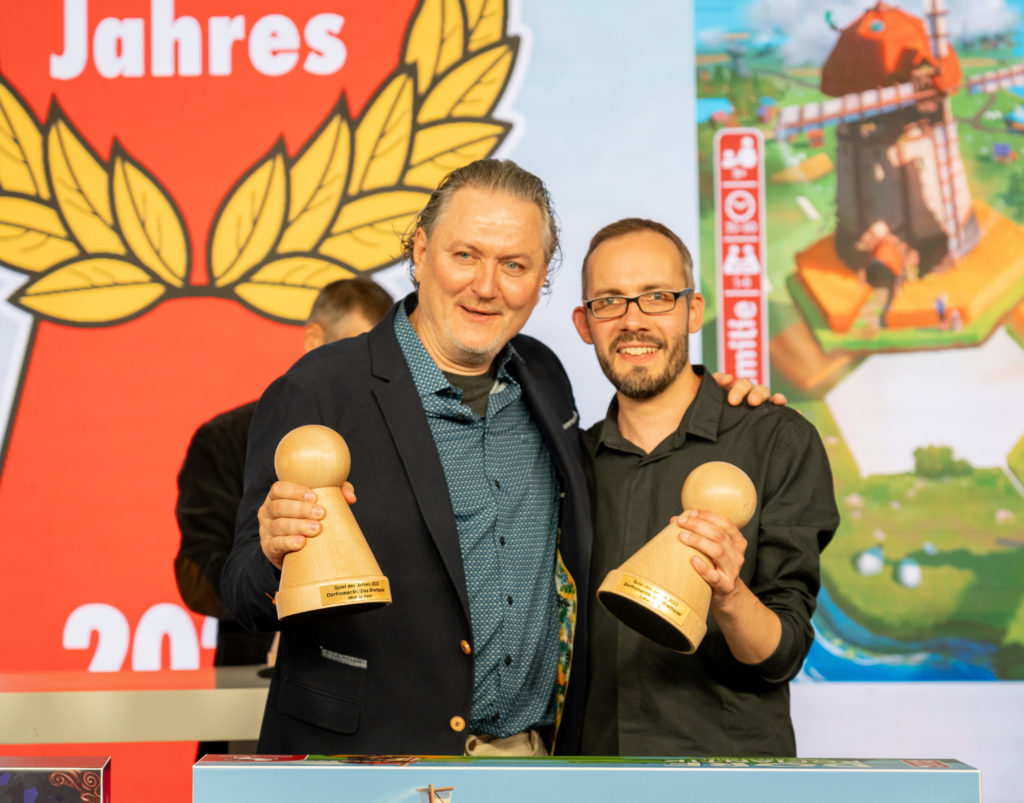
The 2023 Spiel des Jahres (German Game of the Year) winner has been been announced as the cooperative campaign game, Dorfromantik: The Board Game which is based on the video game of the same name.  Players work together to together to lay hexagonal tiles to create a beautiful landscape trying to make the train track and river as long as possible while also fulfilling the orders of the population.  There is a legacy element where points earned can be used to access new tiles that are hidden in locked boxes, which give new, additional tasks and make higher and higher scores possible.  The game is very simple (as draw a tile, place a tile, fulfill tasks), but the hook is the changing strategy that comes with the expanding pool of tiles.

Dorfromantik: The Board Game
– Adapted by boardGOATS from image
by BGG contributor Rugerfred

The winner of the Kennerspiel des Jahres, the “Expert” or “Connoisseur’s” game was announced at the same time and was Challengers!.  This is a sort of “capture the flag” tournament game where players first draw cards and build a deck, then shuffle and duel against another player.  The winner of the match takes the trophy and points, and at the end, the players with the most points duel in the final to decide the overall winner.  Although this is supposed to be a more advanced, it is not in the same league as previous winners of the Kennerspiel award like Village or Wingspan, or even previous Spiel des Jahres winners like El Grande and Settlers of Catan.

Challengers!
– Image by boardGOATS

The thing to remember though is that these games are intended to be family games and the awards are intended to cater for three different ages of families, those with very small children (Kinderspiel—this year won by Mysterium Kids); those with young children (Spiel des Jahres, or “Red Pöppel”), and those with slightly older children (Kennerspiel des Jahres, sometimes known as the “Grey Pöppel”).  This doesn’t mean these games are not suitable for more dedicated gamers, just that they not the target audience, so they should not be surprised if they are not a great fit.  This situation is not going to change in the near future, as the ultimate purpose of these awards is to sell games and advertise them to the general (German) public.

Dorfromantik: The Board Game
– Image from spiel-des-jahres.de

That said, with the right mindset, anyone can enjoy all these games, and they are some of the best of their type available.  So, as usual, congratulations to all the winners and nominees.

Spiel des Jahres Nominations 2023

This year’s nominations for the three Spiel des Jahres categories were announced last Monday.  This is arguably the most prestigious award in board gaming and, as such, is the one everyone wants to win.  There are three categories, the Kinderspiel (children’s game) , the Kennerspiel (“expert’s” game) and the most desirable of all, the family award, the Spiel des Jahres.  The nominees for this year’s awards have been announced as:

  • Kennerspiel des Jahres
    Kennerspiel des Jahres 2023 - nomineesChallengers! by Johannes Krenner and Markus Slawitscheck
    Iki by Koota Yamada
    Planet Unknown by Ryan Lambert and Adam Rehberg

In recent years, there has been a marked change the complexity of the games—compared with previous winners like El Grande, Tikal and The Settlers of Catan (all of which won the “Red Pöppel” as they preceded the inception of the Kennerspiel award), for example, even this year’s nominations for Kennerspiel are extremely light games that have been called party games by some.  This is at least partly because the criteria or rules for the Spiel des Jahres Awards are very clearly and strictly laid out.

Heat: Pedal to the Metal
– Image used with permission of Henk Rolleman
(@namellor on Instagram)

For example, one of the most popular games of the year, Heat: Pedal to the Metal, was not eligible, allegedly due to lack of ready availability in the German market.  Similarly, the German release for another popular game, Earth, marginally failed to make the entry date, but may therefore be eligible for next year.  Another favourite amongst the GOATS is Die Wandelnden Türme (Wandering Towers), which also failed to get a mention either this year or last, presumably because it too fell foul of one of the rules. Iki, on the other hand was first released in 2015, but did not get a “full German release” at the time and therefore the recent re-release with new artwork is eligible, so there is still hope for all those that have missed the boat.

Die Wandelnden Türme
– Image by boardGOATS

It is also worth remembering that the “Red Pöppel” Spiel des Jahres Award is specifically aimed at German families, not necessarily families that play lots of games.  Even the “expert” Kennerspiel des Jahres Award, is aimed at families that are “just ready to move on to the next step”—neither award are aimed at people who regularly play games.  For this, the Deutscher Spielepreis is a much better fit, but the Spiel des Jahres Awards are still the industry’s headline award, and therefore are of great significance.

The Spiel des Jahres Awards
– Image from spiel-des-jahres.de

The winners will be announced on Sunday 16th July in Berlin.

Spiel des Jahres Winners – 2022

The 2022 Spiel des Jahres (German Game of the Year) winner has just been been announced as Cascadia.   Cascadia is a token-drafting and tile laying game featuring the habitats and wildlife of the Pacific Northwest.  Players take turns expanding their terrain area and populating it with wildlife by taking a terrain and wildlife pair of tiles and adding them to their territory.  Players are trying to create large areas of matching terrain to create wildlife corridors, while also placing wildlife tokens to achieve the goal associated with that animal type (e.g. separating hawks from other hawks, surrounding foxes with different animals and keeping bears in pairs).

– Image by BGG contributor singlemeeple

In recent years, there has been a marked change in the sort of games winning the award with a noticeable shift to lighter games with a general drift away from “traditional board games” like past winners, El Grande, Tikal, The Settlers of Catan, Carcassonne, Ticket to Ride: Europe.  This was epitomised by last year’s winner MicroMacro: Crime City, which is arguably more of an activity than a game.  Although this may make games more relevant to a wider cross-section of the public, it also means the Spiel des Jahres awards are increasingly less applicable to more traditional gamers.  This year’s winner, Cascadia is something of a throwback in this regard, being a more conventional modern board game and not as light as some of the recent winners.

– Image by Ludonaute

That said, the introduction of the Kennerspiel des Jahres or “connoisseur” award eleven years ago, was aimed at filling the gap left by the drift of the Spiel des Jahres Award, with a move towards lighter games.  As such, it is usually a better fit for the experienced gamer, though not necessarily those who enjoy classic Euro board games.  This year, all three nominees were more traditional Euro-type games, guaranteeing that the winner would be too.  The Kennerspiel des Jahres winner is announced at the same time as the winner of the “Red Poppel”, and this year it was another nature game, Living Forest, a game where players are a nature spirit trying to save the forest and its sacred tree from the flames of Onibi.

Cascadia
– Image adapted by boardGOATS from the
live stream video on spiel-des-jahres.de

The Kinderspiel des Jahres award winner was announced last month and went to Zauberberg (aka Magic Mountain), a game where players move sorcerers’ apprentices down a mountain, and ride the influence of the will-o’-the-wisp.  As usual, congratulations to all the winners and nominees.

Spiel des Jahres Nominations 2021

The nominations for the Spiel des Jahres have been announced.  There are three categories, the Kinderspiel (children’s game) , the Kennerspiel (“expert’s” game) and the most desirable of all, the family award, the Spiel des Jahres.  The nominees for this year’s awards have been announced as:

  • Kinderspiel des Jahres
    Kinderspiel des Jahres 2019Dragomino by Bruno Cathala, Marie Fort and Wilfried Fort
    Fabelwelten (aka Storytailors) by Wilfried Fort and Marie Fort
    Mia London by Antoine Bauza and Corentin Lebrat

Last year, the winner of the Spiel des Jahres was Pictures, a game where players model the picture on their card using the available components, e.g. shoelaces, coloured cubes, etc.; players get points for correctly guessing other players images and for other players guessing their image.  This is considerably lighter than some of the earlier winners, notably, Tikal and El Grande, or even some of the best known winners like The Settlers of Catan, Carcassonne or Ticket to Ride.  As the main award winners have become lighter over the years, we have found the Kennerpiel des Jahres better fits to our tastes.  The Kennerspiel nominees are not especially complex games, but are typically a step up from the light, family-friendly games of the main prize, the Spiel des Jahres.

– Image by from spiel-des-jahres.de

Last year the Kennerspiel award went to The Crew: The Quest for Planet Nine a game we have still been unable to play thanks to the global pandemic.  The Crew beat our preferred choice, Cartographers.  In contrast to The Crew, as a “Roll and Write” game, we have played Cartographers a lot.  So far, we are unfamiliar with the nominees this year and likely won’t get the chance to play any of them until some time after the winners have been announced (19th July in Berlin for the Kennerpiel and Spiel des Jahres Awards; 14th June for the Kinderspiel des Jahres).

Cartographers: A Roll Player Tale
– Image by boardGOATS


Boardgames in the News: Radio 2 and Online

Over the last few years there has been a lot of anecdotal evidence that modern boardgames are becoming less of a niche activity, with a large number of reports in local and national media.  Last month alone, there was a prime-time article on BBC Radio 2‘s flagship Breakfast Show, where Chris Evans interviewed Dicky Duerden, Head of Games at the Chance & Counters Games Cafe in Bristol.  The interview took place shortly before 9am (2hrs 13 mins into the show) and discussed classic games like Connect Four and Kerplunk as well as their most popular games, Scrabble and Jenga.

Chris Evans
– Image from bbc.co.uk

The interview included a couple of nice little anecdotes, for example, Dicky Duerden explained that Battleship began life as a French game called “L’Attack” and was renamed twice, changing to “Salvo”, then “Broadside” before finally becoming “Battleship”.  He was also asked whether they have problems with players having temper tantrums and whether people lose pieces or walk off with them.  Apparently, Chance & Counters has heavy unflippable tables with shelves to store the games and cup-holders to help prevent spillage.  So, the most damage they’ve had to a game was when someone stole all the marbles from Hungry Hungy Hippos—presumably the thief couldn’t stand the noise!

Hungry Hungry Hippos
– Image from medium.com

Modern boardgames have also featured in print and other media channels.  For example, the literary and cultural commentary magazine, The Atlantic, recently reported how U.S. sales of boardgames grew by twenty-eight percent between spring 2016 and spring 2017.  They put this increase down to the rise in popularity of card games like Cards Against Humanity, Secret Hitler, and Exploding Kittens as well as what they initially refer to as “hobby” boardgames.  Although the article is written from a US perspective, it includes a nice commentary from Phil Eklund, head of Sierra Madre Games and designer of Pax Porfiriana, Greenland and Bios: Megafauna amongst others.  The interview with Phil Eklund is excellent and well worth a read; it includes discussion of Essen and Spiel des Jahres as well as discussion of a wide range of games including Power Grid, Biblios and El Grande rather than just the usual Settlers of Catan and Ticket to Ride.

Biblios
– Image by BGG contributor Schaulustiger

Every report about the growth of modern boardgames hides something less cheerful:  the number of stores that have closed in recent time.  As demand for modern games increases, so does their availability at places like Amazon, and that increases the pressure on an already squeezed niche.  In the last year or so, several excellent and well established stores have closed including Shire Games and Northumbria Games.  With prices continuing to rise—a new big-box game is rarely below £50 these days—and the growth of crowd-funding, more and more gamers are looking for discounts where they can.  The boardGOATS are lucky to have three excellent outlets locally, Eclectic Games (in Reading), Thirsty Meeples and The Gameskeeper (both in Oxford).  Perhaps the Chris Evans interview will encourage more people to pay them a visit.

Money
– Adapted from Image by Petras Gagilas (flickr.com)

28th December 2017 – boardGOATS do the Quiz

As we meet at The Jockey every week, last year at Christmas we decided to enter a team for their Quiz night between Christmas and New Year.  We didn’t have a large team, but Blue, Pink, Pine, Violet and Violet’s mum were in attendance and had managed to win for the GOATS at the first attempt.  Flushed with that success, we decided to give it a go this year too. This time there were seven of us with Pine bringing along his mate, Azure.  As before, we booked a table for 8pm and, as usual, pizza was largely the order of the day with a burger, tagliatelle and scampi for those who decided not to follow the tradition.  While we were waiting for food to arrive, Green asked whether Red was going to be about over Christmas as he had some Gruyère for her. Unfortunately Azure misheard and asked who Trevor was.  Much hilarity ensued as Pine got himself in a terrible mess explaining who Red was and why he thought she wouldn’t be interested in someone called Trevor, but would love a block of cave-aged cheese!  To spare his further blushes, someone quickly suggested we played a game, which seemed like a good idea.  With so many people and so little time, the choice was limited, so we went with Tsuro.

Tsuro
– Image used with permission of BGG contributor aleacarv

Tsuro is a very simple game to teach and play, and, although it has nasties such as player elimination, it is so quick to play that these things don’t really matter.  The idea is that each player has a “Stone” which starts on a marker at the edge of the board and a hand of three tiles.  On their turn, the active player then places a tile on the next square in such a way as to create a path in front of the stone.  They then move their stone (and any others affected) along the path to the new end.  The game continues with players taking turns to place tiles and move stones trying to keep their stone on the board and avoid colliding with any other stone; the last stone left is the winner.  This time, it was a cagey start as everyone was very careful.  It wasn’t until the draw deck had been depleted, that the first players were eliminated, with Pine  forced to play a tile that caused him to collide with Blue removing both from the game.  Purple and Azure were next leaving three players until Black was forced to take himself off the board and Green with him, leaving Pink the sole survivor.

Tsuro
– Image used with permission of BGG contributor kilroy_locke

While we were eating Green asked about the “Monster Games” session the night before.  The evening had started with Kingdomino, and included NMBR 9, Azul and 6 Nimmt!.  The highlight had been El Grande, however, a game that we enjoyed on a previous “Monster Games” session.  This time, however, we decided to add the Grand Inquisitor & the Colonies expansion.  This adds an extra couple of elements to the game (but still no Portugal, much to Pink’s disgust).  Both Blue and Black quite liked the Grand Inquisitor component and would happily play with it again, but neither were very keen on the Colonies aspect, despite the fact that Blue had been able to use it to great effect towards the end of the game.  Pine had the last word on the subject though when he commented that he’d found it amusing that everyone had known before the start that Black and Blue were competing for first place, while everyone else was trying to avoid coming last.  It was perhaps just as well that the landlord chose that moment to hand out the paperwork for the picture round…

El Grande
– Image used with permission of BGG contributor kilroy_locke

We started off badly, but quickly improved with a perfect score in the second round.  We maintained steady progress, but the team that beat the “Eggheads” would take some catching.  As the Quiz progressed it was clear that we would need a really good score in the “Who Am I?”, anagram and picture rounds to be in with a chance.  We got all three anagrams, but the “Who Am I?” was a bit of a disaster as we worked out who it was (“the big bloke from The Chase“), but couldn’t remember his name.  It turned out that that was actually enough information, but we only found that at the very end, so only got one point (his name is Mark Labbett).  Although we put in a reasonable picture round, it wasn’t good enough to make up the difference and we finished in a respectable second place.
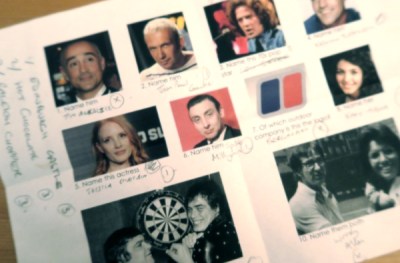
Quiz December 2017
– Image by boardGOATS

With the Quiz over, we reverted to what we do best and went back to playing board games, or in this case, a dice game, as we finished the evening with Las Vegas.  The game itself is a very simple betting game.  Players begin their turn by rolling their dice and then assign some of them to one of six casinos (one for each dice face) each of which has a jackpot drawn at random from a deck of money.  Players must place all the dice displaying one number to bet on the casino of that number, and when done, play passes to the next player.  Once everyone has placed all their dice the player who placed the most dice on a casino takes the highest value currency card, with the person in second place taking the next and so on. The really clever bit is that before any money is handed out, any “draws” are removed.  This leads to a lot of barracking when dice are played as opponents try to encourage the active player to choose their favoured option.

Las Vegas
– Image used with permission of BGG contributor ckirkman

As usual, we included the Big Dice from the Boulevard expansion and the Slot Machine mini-expansion from the 2015 Brettspiel Advent Calendar.  The large dice are double weight and count as two in the final  reckoning.  The Slot Machine acts like a seventh casino, except that it can hold dice of any number, but dice of each number can only be added once (though a player must add all the dice they have of that number).  Since we play the game unusually slowly, we generally stop after just three rounds rather than the four recommended in the rules, and today was no exception.  Reducing the number of rounds meant that everyone had to make each round count to stay in the running, especially in such a close game.  Three players took over $300,000, with Green just $10,000 ahead of Black.  It was Blue who finished first, however, thanks largely to her judicious use of the slot machine which ensured a healthy return in the first two rounds.  And with that, it was home time for everyone, including Trevor the Cheese.

Las Vegas
– Image by boardGOATS

Learning Outcome:  Shy bairns get nowt.

Spiel des Jahres Winners – 2017

The 2017 winner of the coveted German Game of the Year or Spiel des Jahres award is Kingdomino.  Kingdomino is a simple little tile laying game with elements borrowed from other games, in particular, Carcassonne and Dominoes.  These are combined to make a well presented family game where players taking it in turns to add to their kingdom by placing dominoes that depict different terrains types.  We have played Kingdomino several times on a Tuesday evening and everyone who has played it has enjoyed it.  Discussing it among the group, everyone has felt that it is a fun, light filler that is very accessible and is a worthy winner.  The Kennerspiel des Jahres was awarded at the same time.  This honours more challenging games and was first introduced in 2011 to make up for the fact that the main, Spiel des Jahres award had moved away from the slightly more involved fare (like El Grande and TIkal) towards lighter, more family friendly games (like Dixit and Qwirkle).

Kingdomino
– Image by boardGOATS

Unusually, this year the Kennerspiel des Jahres award went to a series of games:  EXIT: Das Spiel.  These are cooperative games that reproduce the experience of an escape room by providing a series of puzzles inside a game box.  There are currently five of these games, though the award is for the first three, The Abandoned Cabin, The Pharaoh’s Tomb, and The Secret Lab.  Unfortunately, as a group we rarely play cooperative games and are not huge fans of the modern trend for social deduction type games, which  means we are unlikely to play this soon on a Tuesday evening.  The Kinderspiel des Jahres award was announced last month and went to Ice Cool which is a beautiful dexterity race game with cool little “weeble” penguins and wooden fish pegs.

Ice Cool
– Image used with permission of punkin312

Boardgames in the News: The Best Games Featuring Maps

The “Brilliant Maps” Blog recently listed what it considered “The 28 Best Map Based Strategy Board Games You’ve Probably Never Played“.  Leaving aside the fact that most dedicated gamers will have played many of them, how valid is this list?  On closer inspection it turns out that the list is really just the top twenty-eight games listed on BoardGameGeek.com (BGG) that happen to have a map for the board.  As such, it makes no subjective judgement on the quality of the map and is simply a list of the best games according to BoardGameGeek that feature a map.

Twilight Struggle
– Image used with permission of BGG contributor killy9999

For example, the game with the highest rating on BoardGameGeek.com is Twilight Struggle which is a Euro/war game hybrid and is therefore played on a map.  The map is not particularly picturesque, however, though for those old enough to remember, its spartan nature is strongly evocative of the Cold War setting.  Is it a great map though?  It certainly captures the theme of the game and perhaps, as such, it is indeed a great map.

Terra Mystica
– Image by BGG contributor Verkisto

Unsurprisingly, many of the games mentioned are war games.  There are a fair number of Euro games too though:  high on the list are Terra Mystica at number two, Brass at four and Power Grid at six.  Number ten on the list is Concordia and eleven is El Grande – a game that is celebrating its twentieth anniversary this year.  Further down are Tigris and Euphrates, Steam, Pandemic, Ticket to Ride: Europe, Carcassonne and finally, just sneaking onto the list, The Settlers of Catan (or Catan as we are now supposed to call it).  All these games indeed include maps of some description, but overwhelmingly, they are also all well-established “classic” games.  Are they the best maps though?

Amerigo
– Image used with permission of BGG contributor Oceluna

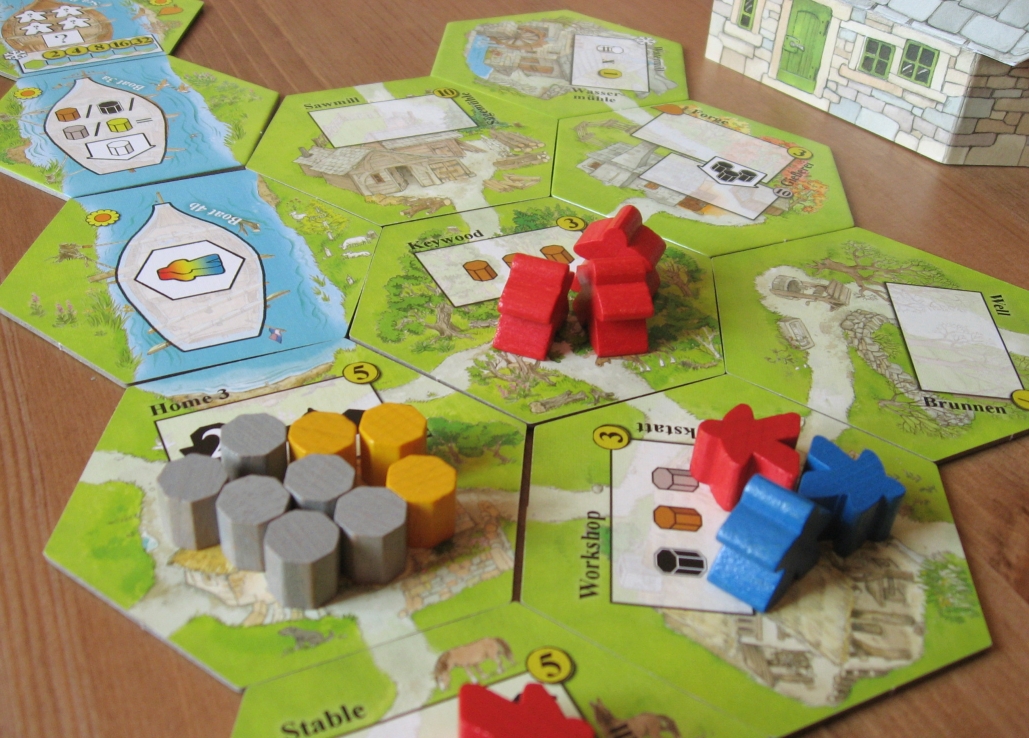
There are some stunningly beautiful games that haven’t made the list, for example, Amerigo is played on a beautiful seascape and Lancaster includes a lovely map of the England.  How do we define “map-based game” however?  Clearly, a map is is a two-dimensional play space so that excludes games where the play-area is predominantly linear i.e. “a track”.  But what about games where the map is produced as the game is played?  If Carcassonne is considered a map game, other games where the board is built during the play should also be included, like Saboteur and Takenoko.  What about one of our favourite games at boardGOATS, Keyflower?  In this game, players buy tiles and then use them to build their own personal little village map.  Should this be included too?

Keyflower
– Image by boardGOATS

Ultimately, none of this really matters of course:  a game is a game and it all comes down to how much people enjoy playing it.  One thing is clear though, while a game can be good in spite of the rendering, playing with beautiful components can only enhance the boardgame experience.

Carcassonne
– Image used with permission of BGG contributor Topdecker