Tag Archives: Ticket to Ride

BoardGOATS @ “The Mix” II – Saturday 21st November 2015

Following the success of our first drop-in session in April, The Mix in Wantage town centre is again hosting a gaming session on Saturday from 10.30 am until 2 pm.  Once again, members of the club will be providing games and teaching people how to play them.

The Mix
– Image from thewantagemix.wordpress.com

There isn’t very much space so we won’t be playing long games, in any case, the idea is to show people what modern boardgames are all about by demonstrating shorter games.  We will bring a few eye-catching games like PitchCar, Riff Raff, Bamboleo, Boom Boom Balloon, Toc Toc Woodman, and Saturn, but most of the gaming will be smaller filler games like Dobble, Turf Horse Racing, No Thanks!, Walk the Plank!, Love Letter, The Great Balloon Race and some of our other light favourites.  We will also be bringing some of the classic gateway games like Carcassonne, Ticket to Ride, The Settlers of Catan and Jamaica as well as a small number of deeper games, just to show people what else is out there.

Boom Boom Balloon
– Image used with permission of henk.rolleman

20th October 2015

While Burgundy, Magenta and Blue waited for their supper to arrive, they began a quick game of Bellz!, the “Feature Game”.  This is a very simple manual dexterity game, albeit one that is very well presented.  The pouch opens out to form a soft bowl containing bells in four different colours.  Each colour includes bells in three different sizes; the aim of the game is to be the first person to have picked up all the bells of just one colour using the stick which has a magnet in each end.  On a player’s turn they can pick up multiple bells or chicken out and stop at one, but if they pick up any bells that don’t match the colour of those they have already collected then that turn is forfeit.

Bellz!
– Image used with permission of BGG contributor joeincolorado

It is certainly more difficult than it looks and there is a little bit in the way of tactics as the magnetism gets weaker further away so with skill it is possible to daisy chain bells and only pick up certain bells.  There is also a strong magnet one one end of the “wand” and a weaker one on the other.  Th rules are not completely clear (and are completely in German in any case!), and gamers inevitably ask whether the bowl can be moved and how much shaking is allowed, which were things we house-ruled.  We had had about two turns each when Green arrived and joined in.  Food arrived and we were still struggling so we carried on as we ate.  Burgundy ran out the eventual winner with Blue following close behind leaving Magenta and Green to fight it out for the last bell.  Grey and Cerise promptly turned up and, as it is an eye-catching game, also had a go with Cerise taking the honours.

Bellz!
– Image used with permission of BGG contributor punkin312

This was followed by a discussion of the Essen game fair including some of the games seen and purchased by Blue and Pink.  By far the majority of the toys they picked up were expansions for games we’ve played before including:

Colt Express: Horses & Stagecoach
– Image used with permission of BGG contributor sdetavern

There were several new games too though, in particular:

There were also older games, some of which we’ve been interested in for a long time.  For example Rockwell was a big game at Essen two years ago, and Green and Blue have expressed an interest in both at the time and since.  Somehow either the price wasn’t right or it wasn’t available at the right time, until now when a good deal beckoned. Blue and Pink picked up a number of small games as well.  These are often hard to get hold of except at places like Essen and are sometimes a hit, and sometimes not so popular, but as they are relatively inexpensive and take up little space in the luggage, they are what makes the fair special.  Finally, there were the promotional items, extra copies of which Blue handed round.

Rockwell!
– Image by BGG contributor Rayreviewsgames

Eventually we decided it was time for a game, and with six the decision is always whether to split into two groups or not.  Green suggested Eketorp for six, but Blue really wasn’t keen, so eventually we opted for Codenames, a new social deduction team game based on the meanings of words which had received a lot of good reports before Essen.  Green pulled a face at the idea of “a word game” and Burgundy commented that social games were not really his thing, even Blue who bought it wasn’t terribly keen because it had sounded un-promising when she read the rules.  Cerise was almost enthusiastic though and Magenta pointed out that it shouldn’t take long, so we gave it a go.

Codenames
– Image used with permission of BGG contributor punkin312

The idea is that there is a grid of twelve cards and the players split into two teams, with even numbers of male and female, we did the childish thing and played boys vs. girls.  The leader of each team is the Spymaster, and as Grey had popped out for a second, we volunteered him to be one so it was natural that Cerise should be the other.  The Spymasters’ job is to get their team to reveal the cards/words that correspond to their team of “agents”, by giving clues.  The clue must be a single word followed by a number which reflects how many words are indicated by that clue.  For example, the clue, “trees: three” could be used to indicate the words “oak”, “ash” and “elm”.  Members of the team then touch cards that they think are their agents; they must indicate at least one, but may try up to one more than the number in the clue.

Codenames
– Image used with permission of
BGG contributor aleacarv

The Girls started off badly finding a neutral and the Boys started off well quickly getting a three card lead.  Before long, the Boys started to get a bit stuck with movie clues and the Girls began to catch up.  As Magenta pointed out afterwards, it was important to listen to both the clues and the discussion of the other team as you can get extra clues.  And so it proved in the end.  With the teams tied, the clue was “Regents; two”.  Blue and Magenta misheard and thought Cerise had said “Regions”.  The Boys struggled on their turn too though, and suddenly the Girls had another chance.  When Green had repeated Cerise’s clue during the Boys’ discussion, Blue had suddenly realised the Girls’ mistake and they were able to find “Park” and close out the game.  Although it is not really our sort of game, everyone was very complimentary about it and as a group we enjoyed it much more than we thought we would.  We could all think of people who would like playing it and now that we know how it works, it would be much quicker to play next time too, making it a surprisingly fun filler with the right group.

Codenames
– Image used with permission of BGG contributor punkin312

With that done, we had to decide what to to play next and, with too many for Cosmic Encounter, inevitably Eketorp was raised again.  Grey was very enthusiastic, but Blue really wasn’t keen, especially as it can drag with six players.  Much to Blue’s delight and eternal gratitude, Magenta tactfully suggested that, despite being a Viking, she could play something else with Blue and Burgundy.  With that, Green happily started explaining the rules.

Eketorp
– Image used with permission of BGG contributor Ceryon

Eketorp is a game where players attempt to gather resources to build their Viking stronghold on the Swedish island of Öland.  In this game players try to second guess which resources the others don’t choose, with a battle and a potential extended stay in the hospital as the reward for failure.  The game itself is played in several rounds.  First material is distributed across the board according to the card revealed at the start of the round.  The players then decide, in secret (behind their player screens), which areas to send their Vikings to.  Vikings can either go to one of the seven resource or brick areas, reinforce the defence of their own village, or attack one of the other players’ villages.   Players then reveal their choices  and place their Vikings on the central board.

Eketorp
– Image used with permission of BGG contributor cuazzel

Depending on how the various Vikings meet, peace may be preserved or battles may ensue.  Vikings on a material field live in peace if there are sufficient building bricks, i.e. there is the same number of building bricks (or more) than there are Vikings wanting them.  If there are insufficient bricks available, then there will be a battle.  Battles also take place on a siege field in front of a player’s castle for the right to lay siege if several Vikings are positioned there.  Battles always take place in a particular order. Firstly, the starting player engages in a battle, then everyone else takes turns until all battles and sieges have been resolved.

Eketorp
– Image used with permission of BGG contributor helioa

Battles are fought using cards chosen from a starting hand of four.  Each player choses a card in secret and then they reveal them simultaneously with the highest card winning.  The difference in value between the two cards determines the battle difference which indicates which area of the hospital the loser ends up in.  In the case of a tie, both parties go to the hospital.  The clever bit is that once a battle has been fought, players swap cards and place the new card face down in front of them.  Once a player has played all their cards in battles, they take the cards in front of them to form a new hand.  In this way, the game is self-balancing so that a player who has a bad card draw at the start will have a better hand later in the game and vice versa.

Eketorp
– Image used with permission of BGG contributor cuazzel

If village siege is successful, then the attacker gets to pillage bricks from the village wall.  Bricks may only be taken from the walls that are two bricks high and the  total point value of the bricks taken may not exceed the battle difference.  Bricks can only be removed from top to bottom and the attacker can then take one of these bricks home (with the remainder going back into the reserve).  Once all battles have been resolved all the winning Vikings can take their bricks home and add them to their village wall.  Each wall comes in six parts and a maximum of three bricks can be stacked in each giving a maximum of eighteen in total.  Once a brick has been used, it cannot be moved at a later date.  The bricks are nominally made of different material and are worth different amounts at the end of the game (green, or grass is worth one whereas grey or stone is worth four for example).  The end of the game is triggered when one player reaches the maximum of eighteen bricks.

Eketorp
– Image used with permission of BGG contributor
Capitaine Grappin

At the start, with no village walls to attack or defend, and all Vikings fit and healthy, the central resource pools were particularly busy places.  After many attacks and counter attacks, eventually all were either victorious and claimed resources, or were licking their wounds in differing levels of the Viking hospital (talk about a beds crisis!).  Green took the early lead at this point. Round two was much quieter, with less than half the Vikings available to go brick hunting, so everyone was relatively successful with their choices.

Eketorp
– Image used with permission of BGG contributor DrGrayrock

Over the course of the next couple of rounds, the game board became more crowded and there was even the odd cheeky raid on a village.  By this time, Grey had managed to create a nice evenly built village wall, one or two bricks high made up of both grass and wooden bricks (worth one and two points respectively) – easy pickings in a fight, but less threatening too. Green was a bit lopsided, concentrating on building with a range of brick colours mostly on one side in order to limit the attack directions.  Cerise however had quietly managed to built quite a good wall round a large part of her village with a lot of clay and stone bricks (worth three and four points).  So, the next two rounds were characterised mostly by Grey and Green attacking for Cerise’s wall.  The first attack by Green was successful, but only enough to nab the top green brick, hardly a dent at all and netted only one point.  Grey’s attack was a stalemate.

Eketorp
– Image used with permission of BGG contributor Garry

In the final round, Cerise found herself surrounded on all sides with Green and Grey attacked from one side each.  Again only Grey was successful enough to break down part of the wall though.  Then for the final battle of the game, Grey and Green had to go head to head for the right to attack Cerise from the third side – it was a draw and Cerise was safe!  As Cerise was the only one who had managed to build a wall at least three high all the way round she picked up the five point bonus and proved herself the superior Viking with a score of forty-four leaving Green and Grey some way behind, fighting it out for the wooden spoon.  In the end, Grey decided he didn’t like the game after all, because had Cerise beat him!

Eketorp
– Image used with permission of BGG contributor
Capitaine Grappin

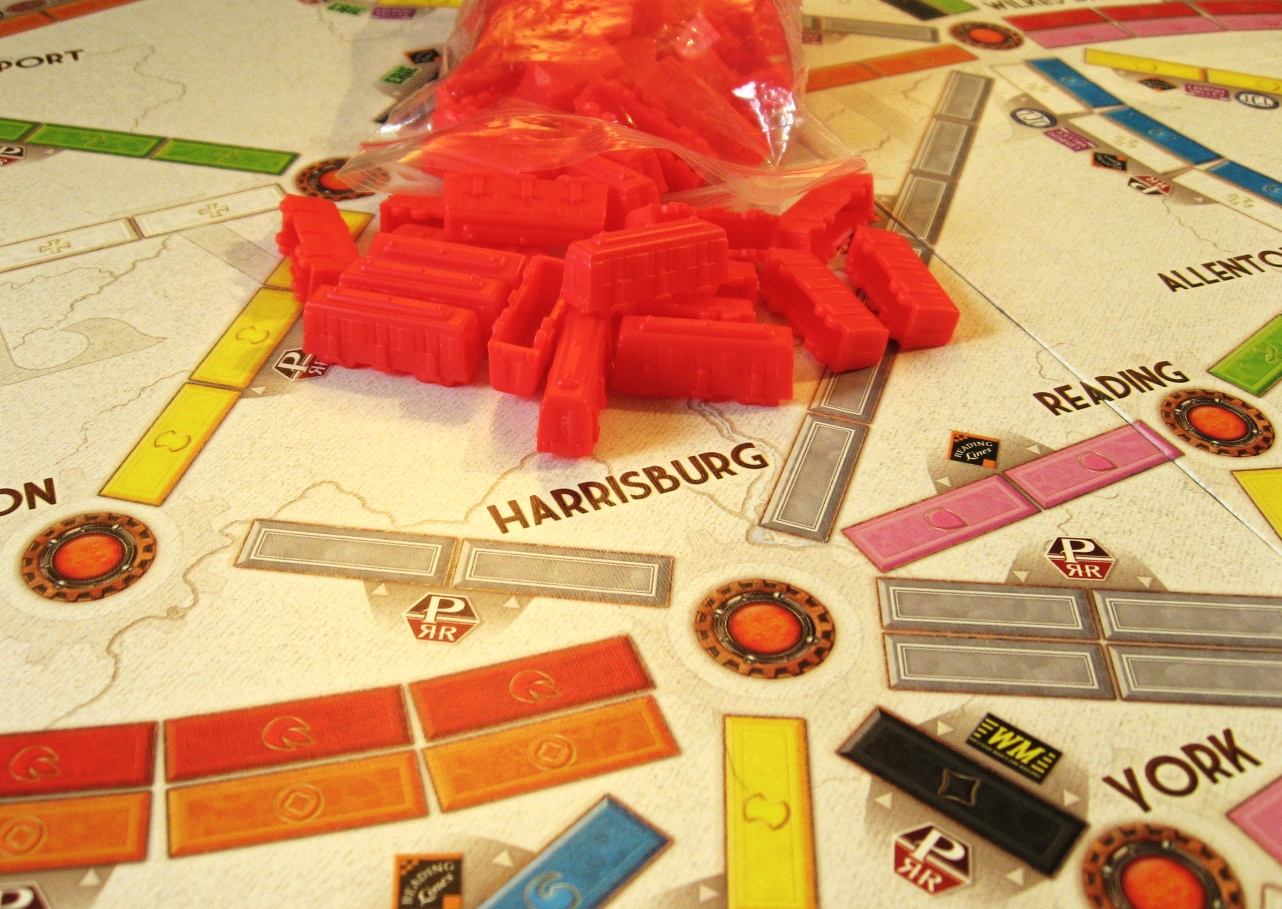
Meanwhile Blue, Burgundy and Magenta conducted a brief audit of the games available and Burgundy’s eyes lit up at the idea of trying out the new Ticket to Ride Map Collection as he had played a lot of Ticket to Ride and prided himself on being quite good at it.  Magenta is also no slouch either however, and was also keen as she had won her last three games of Ticket to Ride: Europe.  Similarly, Blue has slightly unjustly acquired a reputation for beating people at Ticket to Ride, and although she hadn’t played it much recently, she had won her demonstration game at Essen and had enjoyed it too, so was very happy to give it another try.  Although everyone was keen to try the UK map, to avoid giving Blue an unfair advantage, the Pennsylvania side was chosen.

Ticket to Ride
– Image by boardGOATS

The basic Ticket to Ride game is really very simple.  On their turn the active player can do one of three things:  pick up two coloured train cards from the face up display or the face down draw deck; place plastic trains on the map using cards to pay and scoring points; or draw ticket cards, which name two places and give points at the end of the game if the player has built a route between them, but score negatively if not completed.  From there, each different version makes small changes to the rules, for example, some editions include tunnels and/or ferries and sometimes there are extra cards or bonus points etc..  So, the first problem was trying to remember which of the specific rules are applicable to the base game and then integrate them with the new rules for the Pennsylvania map.  In particular, this was whether we should be using the double routes and how many points the different routes should be worth since there was no score table.  Eventually, we decided to use single tracks (ala three player Ticket to Ride: Europe) and scored routes as follows:

  • Single car:  One point
  • Two cars:  Two points
  • Three cars:  Four points
  • Four cars:  Seven points
  • Five cars:  Ten points
  • Six cars:  Fifteen points
  • Seven cars:  Twenty-one points

The seven car route from Cumberland to Baltimore engendered a lot of discussion, as there aren’t any routes of that length in Ticket to Ride: Europe.  Burgundy was fairly sure they were worth eighteen points in Märklin, but the increase in points from six to seven cars seemed very uneven compared with the change from five to six cars.  In the event, it didn’t make much difference, but checking the rules online later confirmed that Burgundy was right and it should have been eighteen.
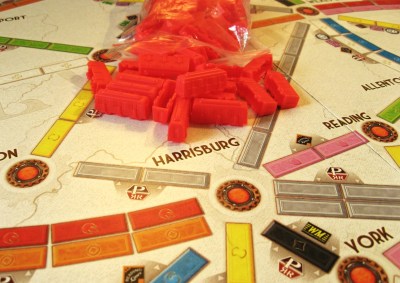
Ticket to Ride Map Collection: Volume 5 – United Kingdom & Pennsylvania
– Image by boardGOATS

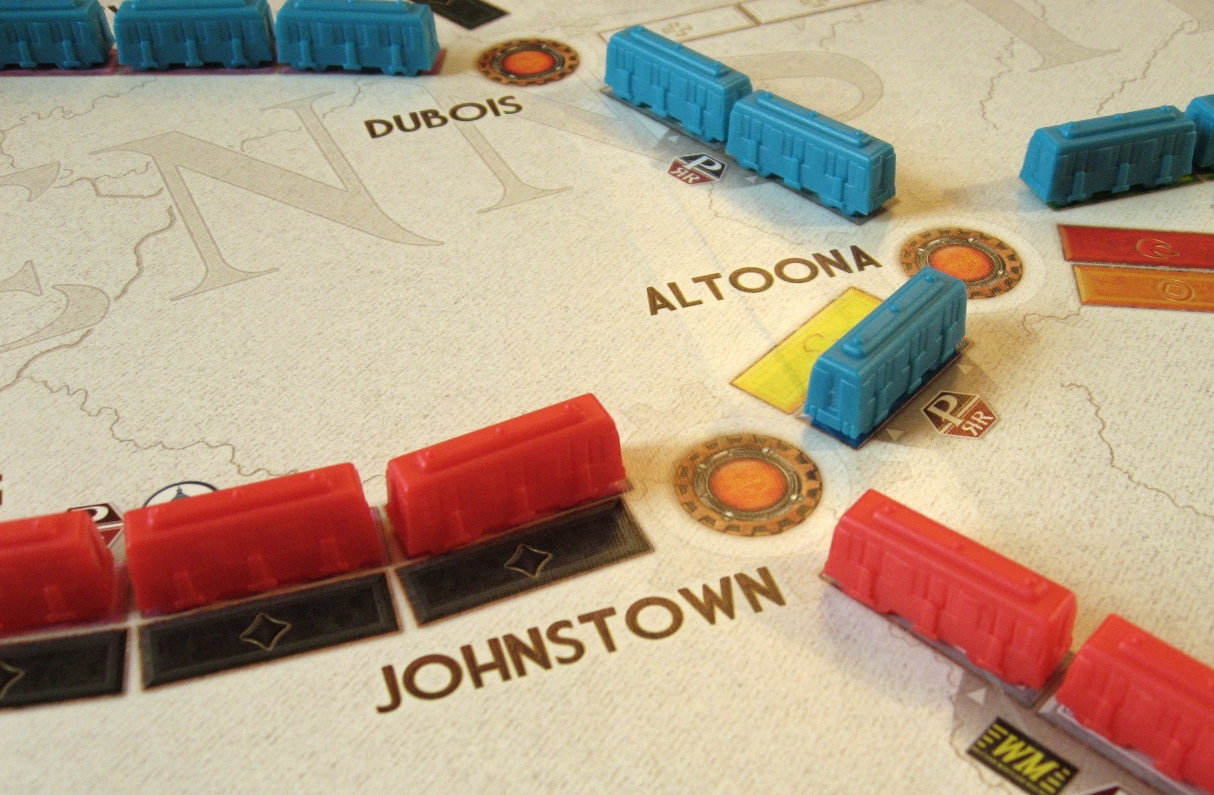
Burgundy was quite pleased with his starting tickets getting three east-west routes that he thought could largely be coincidental.  His delight faded to despair, when in the first turn, Blue took the route from Altoona to Johnstown and quickly followed it by adding the Altoona to Dubois, in quickly completely scuppering his plans.  Magenta was equally unimpressed that double routes were not in use when Burgundy and Blue quickly completed all the connections to Johnstown rendering one of her tickets impossible within the first few turns.  From there, the game quickly descended into a knife-fight in a phone box with everyone scrabbling to make their starting tickets and it looking very much like nobody was going to succeed.

Ticket to Ride Map Collection: Volume 5 – United Kingdom & Pennsylvania
– Image by boardGOATS

As Burgundy pointed out though, tickets were not going to be so important in this game as there were a lot of points available from the Shares.  This is a new feature specific to this map.  The idea of these is that most routes also have one or more company logos shown next to them on the map.  When these routes are completed, players choose which company they would like to take a share certificate for.  The companies are different sizes with some companies having a lot of certificates available while smaller company others have fewer.  At the end of the game, each player’s stock holdings are evaluated and points awarded.  The bigger companies are worth more points, however, it is harder to get the majority stake in these.  In the case of a tie, the share certificates are numbered and the points go to the person with the one taken first.

Ticket to Ride Map Collection: Volume 5 – United Kingdom & Pennsylvania
– Image by boardGOATS

The shares certainly did have a massive impact on game play.  Normally in Ticket to Ride, players achieve their first routes and then start picking up tickets, trying to maximise the number of longer routes as these give the best points return for the cards and trains, but, that wasn’t how this game went.  Although Blue bravely picked up some more tickets and was promptly followed by everyone else, this was the only time anyone did this as everyone got in everyone else’s way so much it was just too risky.  Since achieving tickets was proving so challenging, everyone started trying to pick up share certificates which meant building small routes as these were the cheapest and easiest way to get them.  Then suddenly, Burgundy declared he was out of trains and the game came to a quick end which only left the scoring.
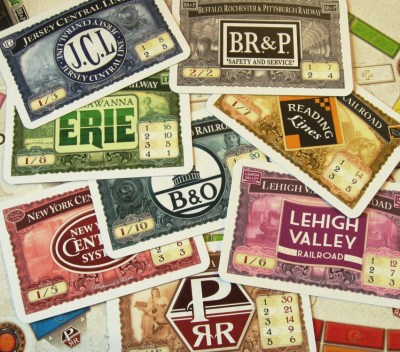
Ticket to Ride Map Collection: Volume 5 – United Kingdom & Pennsylvania
– Image by boardGOATS

Although Burgundy had moaned about how badly he had done, neither Magenta nor Blue realised just how badly until it came to scoring tickets.  It’s true that the first ticket scored him ten points, but all the others were incomplete losing him nearly all the points he had accrued from placing trains.  Magenta also had a ticket she had failed to achieve, but it hadn’t cost her nearly so dearly.  Blue on the other hand had somehow managed to make all her connections and therefore also picked up an extra fifteen points for the Globe Trotter Bonus.  Unfortunately for Burgundy, although he had done well on the shares, the horror-show that had been the tickets had put him right out of contention and he was nearly lapped (though not quite!).  Although Magenta had shares in more companies, the combination of the extra tickets and the fact that Blue had managed to hang on to the majority in a couple of the larger companies made the difference.  Blue finished on one hundred and ninety eight, just over thirty points ahead of Magenta in what was a very tough game.
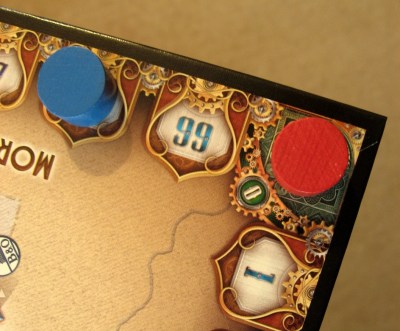
Ticket to Ride Map Collection: Volume 5 – United Kingdom & Pennsylvania
– Image by boardGOATS

With Grey and Cerise gone, that left us with time for a quick filler to finish.  11 Nimmt! and Deep Sea Adventure were both in the frame, but Green liked the sound of Qwixx, which had been nominated for the Spiel des Jahres in 2013, but was beaten by Hanabi.  The game sounded interesting though there was very little to it.  On their turn, the active player rolls six dice, four coloured and two white.  Each player has a score sheet with four tracks:  the red and yellow tracks go from two to twelve and the blue and green tracks go from twelve to two.  Once the dice have been rolled, all the players may cross off a number of any colour that corresponds to the sum of the white dice, if they choose.  The active player may additionally cross off one number corresponding to the sum of one of the coloured dice and one of the white dice.  They can choose which of the white dice they are going to use, but the die colour must match the colour of the track.

Qwixx
– Image used with permission of BGG contributor joeincolorado

The snag is that players must progressively cross off numbers to the right, i.e. once they have crossed out the red five for example, they cannot go back and cross out the red four.  Also, while all the other players can freely choose whether or not to use the white dice, the active player must cross out something on their turn or take a penalty (minus five at the end of the game).  Finally, if someone wants to cross out the last number on any track (twelve for red and yellow, two for green and blue), they must first have crossed out at least five other numbers on that track, at which point the die corresponding to that colour is locked and the colour is closed for all players.  The game ends when two dice have been removed from the game or when one player has accrued four penalties.  Scores are awarded for the number of crosses in each row according to the triangular number sequence also used in Coloretto (one, three, six, ten, fifteen, twenty-one, twenty-eight, etc.), so every additional cross is worth an ever increasing amount.

Qwixx
– Image used with permission of BGG contributor punkin312

The game started with everyone being very cagey and not taking the option of scoring the white dice as they were too high, but eventually, some people were braver than others and different patterns began to emerge.  Initially, the game looked very promising with the potential interplay between different effects, like the probability distribution for two dice, balancing the high scoring potential with not getting stuck and picking up penalty points.  Blue was even wondering whether it would be necessary to get another scoring pad.  However, being gamers, we all played to a very similar strategy and, before long, the inevitable happened, with everyone stuck waiting for the most unlikely dice rolls (two and twelve).  As a result, Burgundy who got there first started picking up penalties closely followed by Green.  The game ended when Burgundy picked up his fourth penalty point and we added up the scores.  Magenta, who had only taken the one penalty finished five points ahead of Blue with Burgundy and Green nearly twenty points behind thanks to all their penalties.  And then the inquisition began.
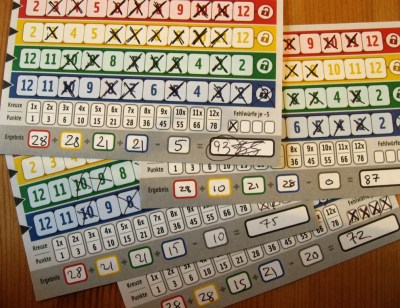
Qwixx
– Image by boardGOATS

We all really like the game at first because of the way the probability interacted with the constraints on number selection, however, we quickly found that it felt very random because the game was self-balancing.  As their game finished, each player was going to be hoping for lucky dice rolls.  Since twelve and two are relatively unlikely which would have a delaying effect, during which time, anyone who had not got quite as far was going to be able to grab a couple of extra crosses.  The random nature of rolling dice meant that ultimately, the effect of any strategy or tactics applied during the game were vastly outweighed by the randomness of the dice at the end.  Although we felt it was probably a good game for children to have fun with, as a game, it was very surprising it was nominated for the Spiel des Jahres.

Qwixx
– Image used with permission of BGG contributor punkin312

Learning Outcome:  Sometimes it is good to play games outside your comfort zone.

Boardgames in the News: The Best Games Featuring Maps

The “Brilliant Maps” Blog recently listed what it considered “The 28 Best Map Based Strategy Board Games You’ve Probably Never Played“.  Leaving aside the fact that most dedicated gamers will have played many of them, how valid is this list?  On closer inspection it turns out that the list is really just the top twenty-eight games listed on BoardGameGeek.com (BGG) that happen to have a map for the board.  As such, it makes no subjective judgement on the quality of the map and is simply a list of the best games according to BoardGameGeek that feature a map.

Twilight Struggle
– Image used with permission of BGG contributor killy9999

For example, the game with the highest rating on BoardGameGeek.com is Twilight Struggle which is a Euro/war game hybrid and is therefore played on a map.  The map is not particularly picturesque, however, though for those old enough to remember, its spartan nature is strongly evocative of the Cold War setting.  Is it a great map though?  It certainly captures the theme of the game and perhaps, as such, it is indeed a great map.

Terra Mystica
– Image by BGG contributor Verkisto

Unsurprisingly, many of the games mentioned are war games.  There are a fair number of Euro games too though:  high on the list are Terra Mystica at number two, Brass at four and Power Grid at six.  Number ten on the list is Concordia and eleven is El Grande – a game that is celebrating its twentieth anniversary this year.  Further down are Tigris and Euphrates, Steam, Pandemic, Ticket to Ride: Europe, Carcassonne and finally, just sneaking onto the list, The Settlers of Catan (or Catan as we are now supposed to call it).  All these games indeed include maps of some description, but overwhelmingly, they are also all well-established “classic” games.  Are they the best maps though?

Amerigo
– Image used with permission of BGG contributor Oceluna

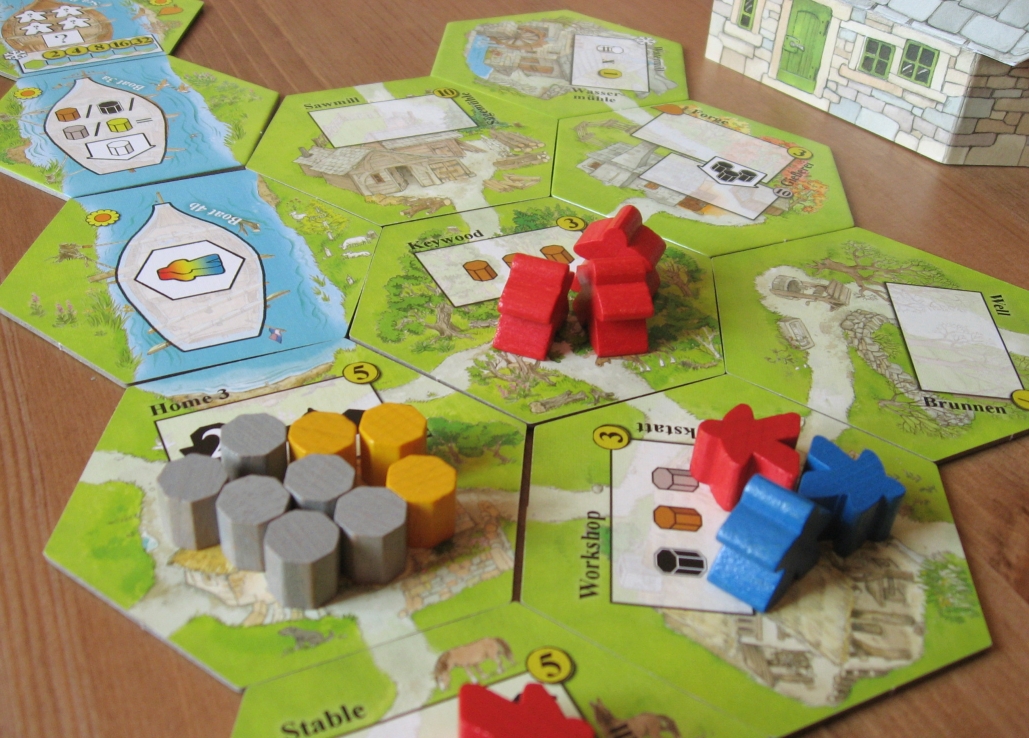
There are some stunningly beautiful games that haven’t made the list, for example, Amerigo is played on a beautiful seascape and Lancaster includes a lovely map of the England.  How do we define “map-based game” however?  Clearly, a map is is a two-dimensional play space so that excludes games where the play-area is predominantly linear i.e. “a track”.  But what about games where the map is produced as the game is played?  If Carcassonne is considered a map game, other games where the board is built during the play should also be included, like Saboteur and Takenoko.  What about one of our favourite games at boardGOATS, Keyflower?  In this game, players buy tiles and then use them to build their own personal little village map.  Should this be included too?

Keyflower
– Image by boardGOATS

Ultimately, none of this really matters of course:  a game is a game and it all comes down to how much people enjoy playing it.  One thing is clear though, while a game can be good in spite of the rendering, playing with beautiful components can only enhance the boardgame experience.

Carcassonne
– Image used with permission of BGG contributor Topdecker

Boardgames in the News: So, What Are Euro-Games?

A couple of months ago at our game night, one of the gamers commented that there were a lot of good games from Europe.  This prompted a discussion about “traditional games”, “Euro-games”, “American games” and their relative merits.  Most people know all about traditional games even if they don’t know what gamers mean when they use the term:  traditional games are the games we all used to play as a child including Scrabble, Cluedo and love it or loath it, the dreaded Monopoly.  Some people also include in this list games like Chess, Go and Backgammon as well as traditional card games like Whist, Hearts and Rummy.

Go
– Image used with permission of BGG contributor ManCorte

But the front page of the boardGOATS website says, “We generally prefer to play “Euro” style games,” so, what do gamers mean by “Euro-games” or “Euro style games”?  Well, most of the traditional games we used to play as children were produced by publishers in the United States of America, companies like Milton Bradley (who made Scrabble) and Parker Brothers (who made Cluedo and Monopoly).  Incidentally, both these companies are now part of Hasbro, but the aggregation of smaller companies to form a larger one is a topic that’s been covered elsewhere.  While the “English” market was dominated by big players that concentrated on producing a few top sellers, in Germany there was no such dominance.  The effect this had was that the market consisted of a large number of small manufacturers producing more varied products.

Scrabble
– Image used with permission of BGG contributor Susie_Cat

This coupled with the traditionally strong German toy industry encouraged the growth of a culture of families playing games together on a Sunday afternoon. It was in this environment that the annual German Game of the Year, or Spiel des Jahres Award, highlighted a range of games from Rummikub in 1980, Torres in 2000 and Camel Up last year.  Over the years, the red pawn of the Spiel des Jahres logo, has become a mark of boardgaming quality, and for many German families, buying the game of the year is something they do every Christmas.  Therefore, the qualities espoused by these awards heavily influence the concept of the “Euro-game”.

Rummykub
– Image by BGG contributor OldestManOnMySpace

But what are these qualities that make a game “European”?  Well, that fount of all knowledge, Wikipedia, describes them as characterised by “simple rules, short to medium playing times, indirect player interaction and abstract physical components”.   It goes on to say, “Such games emphasize strategy, downplay luck and conflict, lean towards economic rather than military themes, and usually keep all the players in the game until it ends.”  On the whole this is not a bad summary, except that it is not very specific:  how simple are “simple rules” and how long are “short to medium playing times”?  Clearly these features are more about contrast, and although there are lots of different types of games including party games and war games, this comparison is usually between European style ames and American-style Games, aka “Ameri-Trash”.

Last Night on Earth
– Image used with permission of BGG contributor Bilben04

Although common, use of the term Ameri-Trash (or Ameritrash) is controversial as some see it as unnecessarily negative, however, although other terms have been suggested none have proved as popular or as persistent.  The term itself is over fifteen years old and was probably originally used disparagingly and applied to genuinely bad American games as a comparison with the much higher professional standards of games in Germany at the time.  Since then, the scope has been expanded and many fans of those American games have adopted the term as a badge of honour.

Merchant of Venus
– Image used with permission of BGG contributor kilroy_locke

American-style games tend to be long, usually over two hours, and classically involve a lot of luck and often feature dice rolling.  They are often considered to be a lot less “cerebral” or “puzzle-like” and, as a result, are sometimes described as “more fun”.  The reference to “trash” may in part reflect the style of the pieces which tend to include a lot of plastic pieces to go with the dice.  There is also often a lot of direct conflict in American-style games, where European games tend to be much more family friendly with indirect player interaction.  Classic Ameri-Trash games include:  Arkham Horror, Merchant of Venus, Cosmic Encounter and Last Night on Earth: The Zombie Game.  Sometimes there is also a book or film tie-in leading to games like Battlestar Galactica and Dune.  Even just comparing the titles with those of classic Euro-games like Puerto Rico, El Grande, Tikal and Agricola, the difference can clearly be felt.

Arkham Horror
– Image by BGG contributor igorigorevich

The most essential part of American-style games is the theme, however, which is often integral to the game mechanisms.  This encourages people fantasize they are part of the action when playing the game.  The miniatures, the long playing times, the complex interwoven rule-set and the interaction (often culminating in players being eliminated) all combine to draw players into the drama of the game.  In contrast, for Euro-games, the mechanisms are the focus, and the games can often be re-themed without much effort.  The theme is therefore used more as an introduction to the more abstract European strategy games, making them more accessible, rather than being an essential part of the emotional investment.

Relic Runners
– Image by BGG contributor cnidius

But things are not as simple as that.  The nature of modern boardgaming encourages cross-fertilisation.  There are more highly-themed, strategy-games available now and more long, strategic games with miniatures – these are sometimes referred to as “hybrid games”.  For example, games produced by the Days of Wonder (based in the USA), like Ticket to Ride and Relic Runners have a lot of plastic pieces, though the games themselves are quite strategic and generally run for no more than an hour.  Similarly, games like Escape: The Curse of the Temple and Space Alert use real-time and a sound-track to draw the players in, yet they are both short (Escape takes just ten minutes to play) and have no player elimination.  Vlaada Chvátil’s Dungeon Lords series of games, also have a lot of theme, but are also playable in a manageable time-frame, have a lot of strategy and a reasonably streamlined set of rules.

Dungeon Lords
– Image used with permission of BGG
contributor PaulGrogan

Confusingly however, “hybrid” has more recently also come to mean games that include some sort of mobile device application (and thus require a smart phone, tablet or similar).  Now, lots of games have Apps that help them a long a little (e.g. One Night Ultimate Werewolf), but games like Alchemists and XCOM: The Board Game don’t really function properly without them.  The question is, are these still boardgames?  In truth, they are a sort of hybrid computer-boardgame, but the point is, however appropriate the name, it is all about the game and the other people playing:  the bottom line is, if you enjoy playing it, it doesn’t matter what it is called.

Alchemists
– Image used with permission of
BGG contributor Mouseketeer

5th May 2015

We weren’t sure whether Yellow and Orange (who recently moved to Swindon) were coming, so we started out with a quick game of 6 Nimmt!.  This is an older game, and though very simple it is one that everyone in our group somehow struggles to remember the rules for.  The game is played with a deck of cards numbered from two to one hundred and four and features a number of “Bulls Heads” (mostly just one, but some have as many as seven).  Four cards, chosen at random are turned face up on the table to make the start of four rows.  The idea is that everyone then simultaneously chooses and reveals a card from their hand.  Then, starting with the player who played the lowest card, players add their cards to the rows on the table.

6 Nimmt
– Image used with permission of BGG
contributor punkin312

Cards are added to the row that ends with the highest number that is below their card.  Thus, if the cards on the table are four, ten, fifty, and seventy-two, a player with fifteen would add it to the row containing ten.   If the card played is the sixth card in the row, then the player must take the cards and place their card in the empty space.  If the card played is lower than the last card in all the rows, the player must take all the cards in a row of their choosing.  The aim of the game is to be the player with the lowest number of Bulls’ Heads or “Nimmts”.  As play continues, the number of cards in the rows increase (making it harder to play safely) and the number of cards in hand decrease on each turn (players don’t pick up after each turn), so the decisions get increasingly agonising, especially when the rows contain cards with a lot of Bulls’ Heads.

6 Nimmt
– Image by BGG contributor Niko the Shadow

Burgundy started the first round badly and finished worse, ending with thirty-five Nimmts, compared with Black and Purple who both finished the first round with none.  The idea is that a game consists of two rounds, each played with a random half of the deck.  Unfortunately, we miss-counted and used to many in the first round, so the second round included some repeated cards.  Not that it helped Burgundy much as he finished the second round with twenty-one giving him a combined total of over fifty.  Black and Purple did better, but it was Green who had the best over-all, with just two Nimmts in the first round and none in the second, he was the clear winner.

6 Nimmt
– Image used with permission of BGG contributor punkin312

We then moved on to our Feature Game which was another older game, The Settlers of Catan, which is celebrating its 20th anniversary this year.  As it is an old classic, we had three different editions available and countless expansions.  Since everyone was keen to play it, we set up two parallel games.  Although we’ve only played it once before in the group, everyone knew the game, so we just had a quick reminder of the rules as we were setting up.  At its basic level, the game is one of resource management and civilisation building.  Players start with two roads and two settlements.  These are placed along the edges and on the corners of the hexagons of the modular board.  Each hexagon has a number on it, and on each player’s turn, first they roll both dice and resources are awarded to players with settlements on the corners of the hexagon that  corresponds to the total rolled.  Once the resources have been handed out, the active player can trade resources with other players and use them to build more roads and settlements, develop their settlements into cities or buy development cards.  Victory points are awarded for settlements, cities and the longest continuous road as well as via development cards (both as straight victory points and for the player with the most soldier cards, i.e. the largest army).

The Settlers of Catan
– Image by BGG server robot BoardGameGeek

Burgundy, Blue and Red played with a ten year old, third Mayfair edition, while Green, Black and Purple eschewed an older Mayfair edition and opted for the slightly easier setup provided by the fourth Mayfair edition.  Green, Black and Purple were nearly ready to go, while Burgundy, Blue and Red were still separating the base game from expansion tiles.  No sooner had this been noted by the first group when, calamity, quarter a pint of beer was spilled over their cards, narrowly missing their board!  A hasty drying session ensued and the third copy of Catan came in handy after all, as it was temporarily cannibalised for cards.

The Settlers of Catan
– Image used with permission of BGG contributor ronster0

Meanwhile, Blue, Burgundy and Red had finished setting out their randomised board and had started to critique it.  There was only one good source of brick and nothing for ore, in fact, the only abundant supply of anything seemed to be wood and sheep of which there were plenty.  This was exacerbated by the fact that nine was by far the most frequently rolled number in the first half of the game, which delivered both wood and sheep.  Blue had gone first and had grabbed the best brick space, however, although Red and Burgundy apparently had two better starting positions, it was a bit claustrophobic as they were both camped in close proximity on one side of the board.  Red really suffered as she ended up with two awkwardly placed positions and that made her game really tough.  Everywhere she went she was blocked by Burgundy and Blue and although she challenged for the longest road, she just couldn’t get out of the trap.  Although Blue had much more space to work with, good settlement positions were further apart which meant she had to build a lot of road before she could build.  Consequently, she quickly picked up the Longest Road card.  While Blue was road building, Burgundy got his nose in front and was first to build his third settlement.  With the extra resources this provided, Burgundy was able to keep his nose in front, settling more and building cities first.  He also had enough resources to buy a handful of Development Cards, which first of all netted him the Largest Army, and then enabled him to masterfully take the Longest Road card by building three sections in one turn.  This, together with a single victory point card brought him to ten points bringing the game to a close.

The Settlers of Catan
– Image by boardGOATS

Eventually after a lot of mopping, the second game of The Settlers of Catan had got underway.  As is often the case in this game, it was the statistically unlikely numbers which came up all the time and the more probable ones hardly ever!  This time, five appeared time and again, until Purple was awash with sheep  Wood, ore and wheat appeared often enough, but brick was not available at all, probably because they were both elevens and the twelve!  So, the sheep were exchanged for brick and everyone quickly built their third settlement.  Black obstinately refused to join up his two bits of road to claim the Longest Road card which left Green free to take it having extended his road slightly to try to get some ore into his production.

The Settlers of Catan
– Image by BGG contributor shannona

Everyone built a another settlement or two and Black started turning his into cities, but still didn’t join his roads.  Green struggled to get sufficient wheat and ore, so started buying development cards instead of building cities (as they only need one of each rather than a total of five). In the process, Green also ended up with a number of soldiers which resulted in the Largest Army card.  It was then that we discovered that Black had been inadvertently cheating. He had been using his port to swap two wood for his missing resources (he had two settlements on the wood hexagon that happened to be a six).  Of course there would have been nothing wrong with that, except that in this case his port was for the ore port not the wood port!  Green and Purple ribbed him mercilessly for the rest of the game (and indeed the rest of the evening, as he deserved.

The Settlers of Catan
– Image used with permission of BGG contributor thephantomhennes

Fairly quickly Green had taken a commanding lead with five points to the others two and three, which then became six and eventually eight when he took the Largest Army card.  Green kept plugging away at the development cards, trying to get victory points, but a clear lead meant he was also attracting the attention of the robber and his brick port was great considering he had three settlements giving brick, but the dice just weren’t playing the high numbers game.  Eventually Green found a victory point card and he needed just one more to win.  A settlement at the end of the road or a victory point development card (or perhaps a city) would do it, but by now Black had three cities and a settlement, plus that little gap in his roads.  With people finally rolling sixes and Black gaining four wood every time, the inevitable happened. He built another settlement and the missing piece of road meant his was now one longer than Green. So Black went to ten points, and Green tied with Purple two points behind.  Still, Black had cheated…!

The Settlers of Catan
– Image by BGG contributor olaha

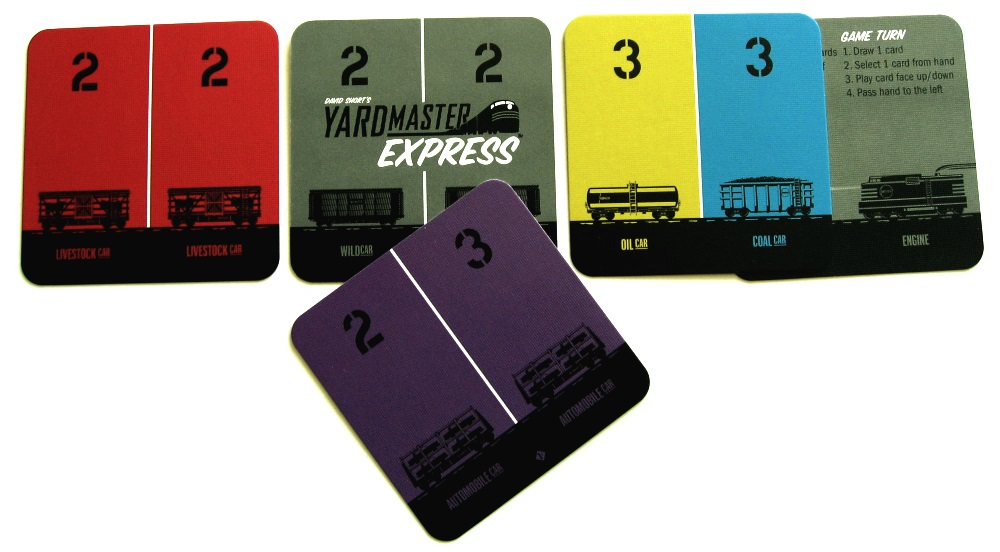
The second game was still in full flow when Blue, Burgundy and Red finished, and decided to give a quick game, Yardmaster an outing.  This is a cute little set collecting game with a train theme and some parallels with the Ticket to Ride games.  In Yardmaster, however, players are building a locomotive rather than routes.  On their turn players can do two actions.  The actions are: draw a cargo card (either blind or from the face up discard pile); buy a railcar card from the four face up cards in the middle, or swap their “Exchange Token” with any other one around the table.  To buy a railcar, players pay using sets of cargo cards, so a yellow number three railcar will cost three yellow “oil” cards.  However, the exchange tokens allow players to use other cargo cards at a rate of two-to-one, so in the above example, if the player only had two yellow oil cards but also had two blue “coal” cards and the blue exchange token, they would still be able to buy the yellow number three railcar.

Yardmaster
– Image used with permission of BGG contributor joeincolorado

When buying a railcar, if the number or colour match the previous car, then it must be added to the end of their locomotive.  If not, then players can park it in their personal sorting yard and add it later, when another railcar is being bought and added to the locomotive.  This is the clever part of the game as it allows players to “stack” points in their personal train yard enabling them both to take some risks and strategically remove railcars from the grasping hands of their opponents.  Players score is the total of the numbers of the on the railcars making up their locomotive (waggons in the sorting yard do not score).  Burgundy started with a succession of ones and gradually built a very long, if not very high scoring loco.  Meanwhile, Blue and Red grabbed a couple of higher scoring waggons each.

Yardmaster
– Image used with permission of BGG contributor moonblogger

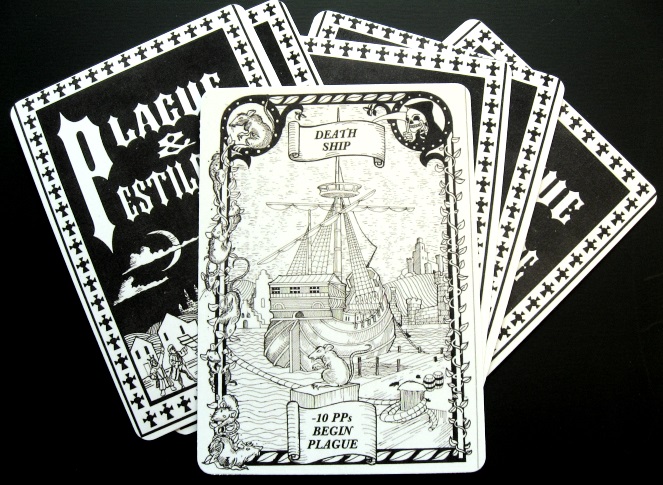
Although quick, Yardmaster was still going when the second game of Settlers finally finished and Green, Black and Purple were looking around something to play and opted for Plague & Pestilence.  This is another old game, dating back to the early 1990s and has been out of print for a long time, however, Green had brought along a self-printed version.  The game is played in two “phases”.  The first is the Prosperity Phase. During their turn, the active player rolls a pair of purple six-sided dice which indicates how much their population increases by.  Then the active player draws Prosperity cards to refill their hand and plays one.  A special Death Ship card is shuffled into the Prosperity deck and drawing it indicates the start of the second phase, the Plague Phase.  This is played exactly the same as the first phase, but the dice rolls now indicate how much the active player’s population decreases by.  As the game progresses, the plague ravages the populations and players are eliminated; the last player is the winner.

Plague & Pestilence
– Image by boardGOATS

Green, Purple and Black had played Plague & Pestilence recently (though not on a Tuesday) and Purple had won decisively with a whole handful of population cards, so was looking forward to a repeat performance.  With it being a game where being nasty was not just possible, but obligatory, Purple and Green quickly ganged up on Black to punish him for cheating in The Settlers of Catan.  Water off a ducks back, he responded with “Pied Piper” cards and “Mass Migrations”!  However his attempts at getting Green and Purple to fight came to naught thanks to Purple’s apparently endless supply of “Negotiated Settlement” cards.  Populations rose and fell, city improvements were built and destroyed. Some surreptitious changing of population cards from small denominations into large ones to reduce the size of the their pile and hide the true value of the hand went on.  Then the death ship arrived and the game was really afoot.

Plague & Pestilence
– Image by boardGOATS

Meanwhile, Red, Burgundy and Blue were bringing Yardmaster to a close, having ridden out a spell of poor railcar cards.  Burgundy was just a handful of points away from winning, and with a cards in his sorting yard needed to buy the red one in the middle, but it was Blue’s turn.  Red urged Blue to take the card or Burgundy would end the game on his next go, but Blue had other plans and using her Exchange Token bought a yellow three and took the opportunity to move all the cards from her sorting yard onto the end of her locomotive, giving her a score of twenty, seven more than Burgundy.

Yardmaster Express
– Image by boardGOATS

Plague & Pestilence was still ongoing, so, after a quick chat about Yardmaster, Blue, Red and Burgundy decided to give its little brother, Yardmaster Express a go.  This shares the locomotive building feature, but is even quicker and simpler than Yardmaster, though much more luck-driven.  The game is based on card drafting, so the start player begins with a hand of railcar cards, draws one from the draw deck and then chooses one to add to their loco.  As before, the waggons must match in colour or number, but this time, the cards are “split” so they contain two waggons and the front waggon may not be the same as the rear one.  Scores are the sum of the numbers on the waggons, as before, but bonus points are awarded to the player (or players) with the longest continuous set of waggons of the same colour.  This can be significant as the bonus is equal to the number of waggons.  If a player cannot match the colour or number they can play the card face down as wild, but these score less and break any otherwise continuous string of waggons.  Once a card has been chosen, the had is passed to the next player who draws a card and chooses one.   There is a little bit of opportunity to screw over the next player by taking the cards they want, but otherwise, the game is highly luck dependent, and this time, Blue was the lucky one.

Plague & Pestilence
– Image by boardGOATS

Over in Plague & Pestilence, survival was the order of the day.  Purple unfortunately had several very high roles and no improvement cards to reduce them, so quickly found her deck dwindling.  Green and Black, however, were getting better luck on the roles, and combining them with City Improvements, managed to hold on to more of their population.  Purple, with a population reduced to just ten, had one last go at Green with a “Pied Piper” card, but ultimately it wasn’t enough as she rolled 9s and 10s and within a couple more turns was dead. The gloves were now off between Green and Black.  Well not so much gloves off as desperately trying to shore-up our own populations against the relentless tide of plague and death.  Green eventually managed to win the war of attrition, thanks in no small part to four consecutive trade centre cards (which increased his population by ten each time)!

Plague & Pestilence
– Image by boardGOATS

With both games finally finishing more or less together, we had a quick chat and then decided to finish as we had started, with another game of 6 Nimmt!.  This time we started with the correct number of cards and, as before, Burgundy managed to start collecting Nimmts like they were going out of fashion.  Once again, Black managed to avoid picking up any Nimmts in the first round, but this time it was Blue that joined tied with zero at the halfway point.  Much to everyone’s surprise it was Burgundy however, who won the second round with just three Bulls’ Heads.  Unfortunately, with eighteen in the first round he was always going to find it hard to compete for the lead, which left Blue and Black with fourteen overall, having finished both rounds with exactly the same number and the evening finished with a draw.

6 Nimmt
– Image by boardGOATS

Learning Outcome:  New games can be good, but classics remain popular for a reason.

BoardGOATS @ “The Mix” – Saturday 18th April 2015

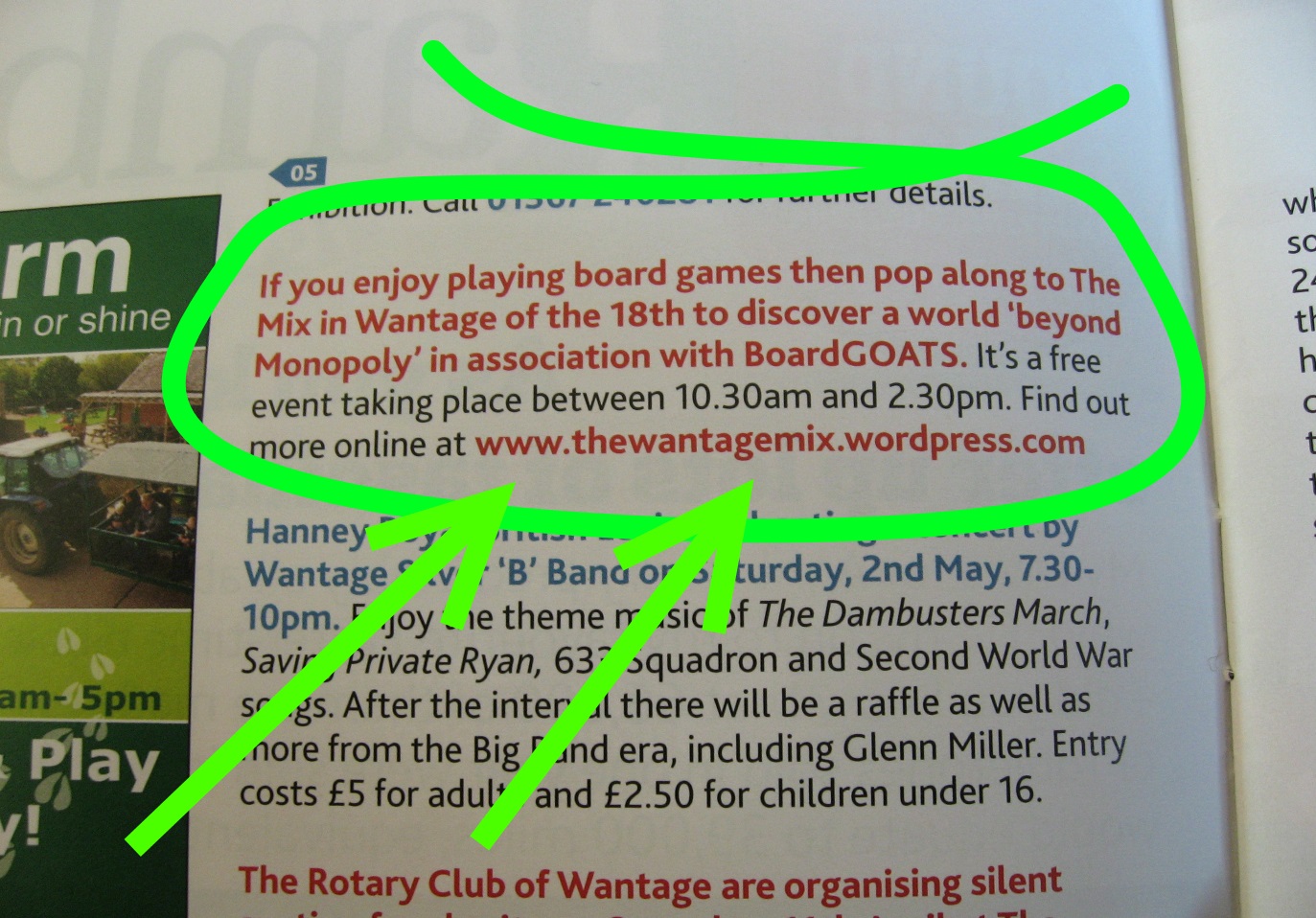
The Mix in Wantage town centre is holding a drop-in gaming session on Saturday from 10.30 am until 2.30 pm.  Members of the club are providing games and will be teaching people how to play them.

The Mix
– Image from thewantagemix.wordpress.com

There isn’t an awful lot of space so the idea is to encourage people to drop in and play a short game or two.  We are planning to bring a few eye-catching games like PitchCar, Riff Raff, Bamboleo, Toc Toc Woodman, and Saturn, but most of the gaming will be smaller filler games like Dobble, Turf Horse Racing, No Thanks!, Walk the Plank!, The Great Balloon Race and some of our other light favourites.  We will also be bringing some classic gateway games like Carcassonne, Ticket to Ride, The Settlers of Catan and Jamaica as well as a small number of deeper games, just to show people what else is out there.

Round and About - The Mix
– Image by boardGOATS

The event has been well advertised and was mentioned in the Ramblings section of the April edition of the local magazine, “Round and About”, so we are hoping for a decent turn-out.  Please pop in if you are in the area on Saturday.

Boardgames in the News: Are Asmodée Taking Over the World?

Asmodée is the French translation for Asmodeus, and according to Binsfeld’s classification of demons, Asmodeus is the demon of lust and is therefore responsible for twisting people’s sexual desires.  In the boardgame world though, Asmodée (originally known as Siroz) are a small French game publishing and distribution company, specialising in the family market. For example, they are well known for Dobble, Dixit, Time’s Up! and Ca$h ‘n Guns, but they also publish some more challenging games including Snow Tails, Mr. Jack, Formula D, Takenoko and 7 Wonders.

Jungle Speed
– Image used with permission of BGG contributor kilroy_locke

Asmodée was started in 1995 by Marc Nunès, a self-trained entrepreneur developing role-playing games, but quickly became France’s foremost games publisher and distributor.  One of the big early successes was Jungle Speed, launched in 1998, which has since gone on to be one of the top-selling titles in France, rivalling Monopoly, Trivial Pursuit and Pay Day.  The real turning point came in 2003, however, when Asmodée obtained the French licence to distribute Pokémon collector cards, which opened up the mass retail sector.  This development led to an 18% investment from Naxicap in 2005.  Naxicap’s stake was bought out two years later by Montefiore who acquired 60% of the company as part of a deal with management worth €40-50 million.  Montefiore invested €120 million to finance Asmodée’s international growth, funding the acquisition of the Belgian game distributor Hodin in 2008, the Spanish games developer Cromola and the German Proludo in 2009, followed by the purchase of a 60% stake in the UK-based distributor, Esdevium Games in 2010.  Asmodée also strengthened it’s portfolio with the acquisition of Abalone and partnership with Libellud (leading to the distribution rights for Dixit) in 2010.

Abalone
– Image used with permission of BGG contributor msaari

In 2012, Asmodée branched out further, setting up a subsidiary in Shanghai, China,  with the intention of expanding “into a new market taking advantage of Asmodee’s extensive line-up of games and the existing relationships with partners, thus promoting the brand in mainland China, Hong Kong and Taiwan”.  This ambition brought Asmodée to the attention of the Eurazeo, a European investment company and a deal was announced in November 2013 that valued Asmodée at €143 million.   In January, 2014, almost exactly a year ago now, Eurazeo bought 83.5% of Asmodée through an equity investment of €98 million while Asmodée’s management team and original founders reinvested €14 million of their own money.

Ticket to Ride
– Image used with permission of BGG contributor garyjames

With the backing Eurazeo provided, Asmodée then went big:  in August last year it was announced that Days of Wonder would be “merging into the Asmodée Group of game companies”.   Days of Wonder are one of the biggest names in modern boardgaming, and are often credited with the growth of the modern boardgame industry, thanks largely to their flagship Ticket to Ride games, which have sold well over two million copies to date.  This is not the only “big game” in their catalogue either, they are also responsible for Memoir ’44 and Small World, both of which are popular games, demonstrated by the number of expansions they support and which take Days of Wonder’s total number of games sold to over five million since their founding in 2002.

Small World
– Image used with permission of BGG contributor crosenkrantz

According to Forbes, Days of Wonder generates between $10 million and $20 million in revenue annually, not bad in such a niche market.  From Eurazeo/Asmodée’s point of view, such an acquisition makes sound financial sense, not just because of the commercial value, but because they already provided a lot of the distribution for Days of Wonder games.  This wasn’t enough for Asmodée however, and three months later, they acquired the U.S. publisher Fantasy Flight Games.

– Image used with permission of BGG contributor adamfeldner

This was a bit of a change of direction for Asmodée:  hitherto, all the acquisitions had been firmly in the family boardgame and distribution markets.  Fantasy Flight games are a very different animal and their headline games, Twilight Imperium and Arkham Horror are much less family friendly.   Even their X-Wing Miniatures Game which is very popular with fathers and sons, is a long way outside the normal scope of Asmodée, since it is essentially a two-player war game with a Star Wars theme.  However, there are considerable benefits for both parties, since the merger will enable Fantasy Flight to improve its distribution in Europe, while simultaneously giving the growing Asmodée Group access to Fantasy Flight’s North American sales and marketing teams.

Black Fleet
– Image used with permission BGG contributor Toynan

Asmodée weren’t stopping there, however, with Ystari Games, Asterion Press and Pearl Games also becoming “part of the Asmodée family” late last year.  The link with Ystari Games almost certainly comes from their mutual interest in Space Cowboys.  Space Cowboys is a game creation studio created in 2013 by Marc Nunès (who started Asmodée way back in 1995, remember?), Philippe Mouret and Croc (both of Asmodée), Cyril Demaegd (Ystari) and Sébastien Pauchon (GameWorks).  Space Cowboys is a very small outfit, but already has one Spiel des Jahres nomination under its belt in Splendor and looks to be trying for a second with Black Fleet, the gorgeous pirate game released at Essen last year.

Asmodee Publishing 2015
– Image from eurazeo.com

So, what are Asmodée up to?  The concern is that gamers generally like the current diversity in the market and fear that this succession of mergers and partnerships will mean a homogenisation of the games available.  The November 2014 Eurazeo “Investor Day” report spelled out the current state of Asmodée in detail and the good news is that this does not seem to be Eurazeo/Asmodée’s intention.  The report states, “Each studio has its own DNA,” and goes on to say, “Repeated success lies in the full independency granted to these studios, to keep innovating.”  So it seems the diversity is valued, however, by acquiring mid-sized publishers like Days of Wonder and Fantasy Flight, Asmodée is positioning itself to compete more effectively with multinational toy giants like Hasbro and Mattel, who publish top board game brands including Monopoly and Scrabble.

Asmodee Organisation 2015
– Image from eurazeo.com

So, is it a good thing that Asmodée are setting themselves up to rival the big boys?  Well, Asmodée is not the only company to engage in mergers:  in 2011 Filosofia purchased the U.S. publisher Z-Man Games, and U.S. publisher FRED Distribution (which releases games under the Eagle Games and Gryphon Games brands), acquired U.S. publisher Face2Face Games.  More recently, in late 2013, Mayfair Games (the U.S. partner for Catan) bought a controlling interest in Lookout Games (the company who first brought Agricola, Caverna, Le Havre and Ora et Labora to the market).

Asmodee Logo
– Image from escapistmagazine.com

Clearly a large stable company provides security for designers, as well as providing support for the individual studios who know that one poor decision is no-longer likely to bring about the end of the company, both of which have to be A Good Thing.  However, companies like Eurazeo invest for only one reason:  financial return.  With an effective monopoly, Asmodée are now in a position to squeeze the market, indeed we may already be seeing the evidence of this in the price rises announced at the start of the year.  With this in mind, it will become clear in due course whether Asmodée is good for boargaming in the UK or whether it is genuinely the demon of lust responsible for twisting our gaming desires…

Boardgames in the News: 20 Years of Catan and El Grande

It seems to be the year for anniversaries: arguably 2015 celebrates significant anniversaries for two of the greatest games in boardgaming history.  We are not talking about Monopoly here (though there has been a lot written about the 80th anniversary of the brand).  The games in question were both released in Germany in 1995:  The Settlers of Catan and El Grande.   The first of these, Klaus Teuber’s The Settlers of Catan, is widely known amongst gamers and many non-gamers, and is often cited as being responsible for the “gaming revolution”.  The base game of “Settlers” (or “Die Siedler”) and its expansions have appeared in thirty languages and sold more than twenty-two million copies worldwide.  At Spielwarenmesse, The International Toy Fair at, Nürnberg, Kosmos and Mayfair unveiled a new look for the entire line of Catan games.

The Settlers of Catan
– Image used with permission of BGG contributor kilroy_locke

The press release explains, “The new look will strengthen the Catan brand both domestically and internationally.  The new cover art utilized by all partners will provide a visual continuity throughout the world.  This new look is more vibrant and alluring with overall improved presentation and splendidly clean branding. The new packaging cries out… CATAN!”  It goes on to say, “As part of the growing expansion of the Catan® family of products, the base game will simply be called CATAN® in all countries and languages, along with a unification of the game’s graphic design in all territories and languages.”

The Settlers of Catan
– Image by BGG contributor herman_the_german

There are a couple of curious things about this, firstly, when Kosmos released the game twenty years ago, it was just going to be called “The Settlers” (or rather “Die Siedler” since it was released in German first).  That was until Blue Byte published a computer game by the same name, so Kosmos decided they wanted something more unique and identifiable and made up “Catan”.  Secondly, aside from the the editions released in English by Mayfair Games (who went its own way with original art and component design), the brand has already been “unified” in its look!

The Settlers of Catan
– Image by BGG contributor degamer

The second of the games mentioned above is El Grande, which was first published in Germany by Hans im Glück.   Like “Settlers” the year before (or “Catan” as we must now call it), in 1996, Wolfgang Kramer and Richard Ulrich’s El Grande was awarded both the Spiel des Jahres and the Deutscher Spiele Preis.  Although it is less widely known than its predecessor, El Grande is hugely respected by gamers often cited as “still the best area control game”.  It is so highly thought of that it continues to be higher on the BoardGameGeek ranking than The Settlers of Catan and many other well known and hugely popular games including Carcassonne, Ticket to Ride, Pandemic and Dominion.  These games are all continuously reprinted, but sadly, the nature of boardgames means that many good titles go out of print.  Unfortunately, El Grande is one such game; it had fallen out of favour with its publishers and has not been reprinted in English or German since the Decennial Edition, ten years ago.

El Grande
– Image used with permission of BGG contributor garyjames

There are a number of reasons why games like this go out of print.  Firstly, much as we hate to admit it, boardgaming is a niche market:  Hasbro recently proudly announced that Monopoly has sold 275 million copies over the eighty years, but compare this with the estimated 450 million Harry Potter books sold in a fraction of the time.  In turn, these make Catan’s 22 million copies look positively paltry by comparison and for games that fail to make the jump to the wider market, the first print run is often only a few thousand.  Whether or not one of these games gets a second print run depends on demand and sale-speed of the first impression, and ultimately, whether or not the publisher thinks it can secure a good return.  Factors that affect this, obviously include the mark-up and the Recommended Retail Price (or RRP, sometimes known as Manufacturer’s Recommended Sale Price or MRSP).  Games that have language dependent components usually suffer here.

El Grande
– Image used with permission of BGG contributor DrGrayrock

There are two main markets:  Germany and USA.  We in the UK benefit from the fact that the USA nominally speak the same language as us, but otherwise, the UK boardgame market is relatively small-fry.  Anyhow, for this reason, games are commonly released primarily in English and German, however, the margins are clearly much larger if the same game can be released to both markets with minimal reworking, and companies like Z-Man Games have made a name for themselves translating the best European games for the English market.  Other companies (e.g. Zoch, Queen and R&D Games) release games as “international” editions which include language independent components and rule booklets in multiple languages.

El Grande
– Image by BGG contributor Domostie

Obviously, it is much more difficult to release a multi-lingual edition if key components include significant text.  It is also much easier to translate a game if the only change needed is the box and the rules; El Grande clearly fell foul of this.  However, so did The Settlers of Catan, and that didn’t do so badly.  So there are obviously other factors, including game play, accessibility, approachability, appearance and marketing.  There is no question that the trading dynamic and controlled randomness in Catan are key parts of its success as they keep everyone involved between turns, but timeliness is probably the real key:  it was perhaps just the right time for a family game that felt a bit different.  So, by the time El Grande came along, well, everyone was playing Settlers, and as a result, El Grande didn’t make quite the same impact.

El Grande
– Image by BGG contributor Bernaar

That doesn’t mean it is less of a game though, so it is great news that Hans im Glück has recently announced the long-awaited return of El Grande, this time in the form of a Big Box with upgraded components.  The Big Box is a collection that, like the Decennial Edition ten years ago, will contain all the expansions that have been officially released over the years.  Z-Man Games has also confirmed that it will release a parallel Big Box in English; Dutch publisher 999 Games will be doing the same in Dutch and have also mentioned a “Jubileumuitbreiding”, or “anniversary extension”.  Clearly anniversaries are to be celebrated, especially if it means older, well-loved games become available once more.

Boardgames in the News: The Guardian

A lot of people familiar with the world of “Designer Boardgames” will tell you how it’s becoming more mainstream.  The opening of more and more and more boardgame cafés and features on the BBC are often cited as example of modern boardgames making it into the public conciousness.  The latest example is the “Board Games” section in the “Life & Style” magazine of The Guardian.

Wil Wheaton

So far they have published articles discussing Ticket to Ride and its effect on boardgaming; commenting on boardgames in society; debating the relationship between computer games and the growth of boardgames, and most recently, an interview with Wil Wheaton, actor, producer and presenter of TableTop, the online boardgame show, now in its third series.  Its not so much the content of the articles (though it is clear that these have been written by someone with an interest or who has done their research), it is the fact that that playing games is no longer something to be shy about:  being “a bit geeky” is no longer something to be ashamed of.

And that has to be a good thing.

Spiel des Jahres Nominations – 2014

Every year the a jury of German-speaking board game critics (from Germany, Austria, Switzerland), review games released in Germany in the preceding twelve months and award the best the German Game of the Year, or Spiel des Jahres.  The criteria used include:

  • game concept (originality, playability, game value),
  • design (functionality, workmanship),
  • layout (box, board, rules),
  • rule structure (composition, clearness, comprehensibility).

Last year, the winner was Hanabi, and previous winners include, favourites like Ticket to Ride: Europe, Niagara, Zooloretto, Alhambra, and Carcassonne.  The nominees for this year have just been announced and include (amongst others) Splendor, which we played last time we met.

Spiel des Jahres