Author Archives: nannyGOAT

Next Meeting – 1st Movember 2016

Our next meeting will be on Tuesday 1st Movember, at the Horse and Jockey pub in Stanford-in-the-Vale.  As usual, we will be playing shorter games from 7.30pm as people arrive, until 8pm when we will start something a little longer.

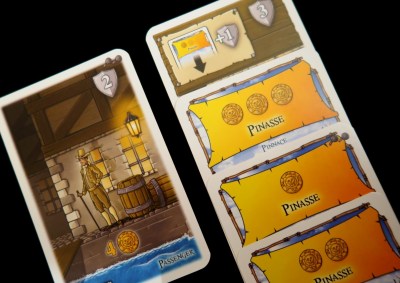
This week the “Feature Game” will be Batavia, which is a medium weight game about merchants visiting the trading posts of the five East India companies all over Asia.

Batavia
– Image used with permission of BGG reviewer EndersGame

And speaking of traders…

A successful trader parked his brand new Porsche in front of the office ready to show it off to his colleagues.  As he prepared to get out a juggernaut went past, too close and completely tore off the driver’s side.  The trader immediately grabbed his mobile and dialled 999.  It wasn’t more than five minutes before a policeman pulled up, but before the policeman had a chance to ask any questions, the trader started screaming how his car, which he just picked up that day, was completely ruined and would never be the same again. After the trader finally finished his rant, the policeman shook his head in disbelief.

“I can’t believe how materialistic you traders are,” he said.  “You’re so focused on your possessions you don’t notice anything else.”

“How can you say that?” asked the trader.

The policeman replied, “Didn’t you realise that your arm is missing from your elbow down? It was looks like it was torn off when the truck hit you.”

The trader looked down in absolute horror.  “$%#*@!” he screamed, “Where’s my Rolex?!?!?!”

18th October 2016

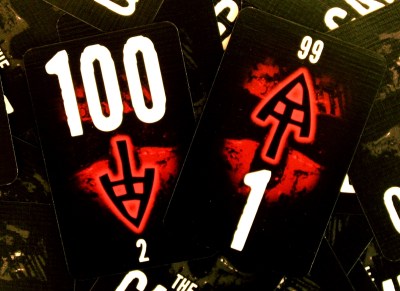
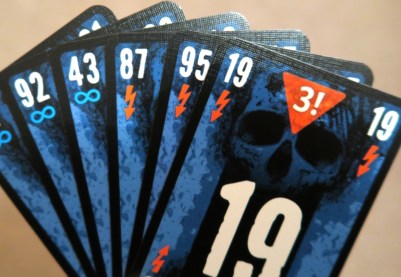
Magenta arrived first, and after a short delay while she fiddled with her phone she was joined by Blue (armed with lots of “Mammy Sheep” for Red and a pile of other bits from Essen for everyone else). Burgundy, Pine, Red and Cerise followed together with food.  We were nearly done when Black and purple turned up and ordered their food, so while we were waiting we started a pair of parallel games of the “Feature Game”, The Game: Extreme.  We’ve played the original version, The Game, quite a lot, so were keen to see what this added.  The Game is very simple:  as a group, players must try to to play every card from the deck (numbered two to ninety-nine) onto four piles.  On their turn, the active player must play two cards from their hand on any of the four piles:  for two of the card must be of higher value than the current top card, while for the other two it must must be of lower value.

The Game
– Image by boardGOATS

Players can discuss anything they like so long as nobody discloses any specific number information and they can play as many cards as they like on their turn so long as they play at least two (until the deck has been depleted, after which they must play one).  To help eveyone out, there is also the so called “Backwards Rule” which allows players to push a pile back so long as the difference between the card they are playing and the card they are covering is exactly ten.  Once the active player has played their cards, they replenish the missing cards.  The game ends when all cards have been played or the active player is unable to play a card.  The game is often compared with Hanabi, as it is a cooperative card game, but for Hanabi to work really well it needs to be played in total silence and with poker faces – anything less and clues are given away unintentionally and the level of “cheating” becomes arguable, but playing like this is very stressful.  In contrast, we find that The Game is much more relaxed and “fun”, which is why we like it.

The Game: Extreme
– Image by boardGOATS

The Game: Extreme differs from the original in that the cards have a different colour scheme and twenty-eight of them are marked with special “command”.  There are seven different commands, three that take effect immediately and only directly affect the active player, and four that continue to affect every player on their turn until they are covered by another card.  These commands are all nasty and vary from “play three cards” to “pick up only one card”, or “no talking”.  It was very quickly apparent that the commands make The Game: Extreme much more difficult than The Game.  What was less obvious was that it becomes much more stressful and, as a result, less fun.  After both groups had endured two terrible rounds getting barely half way through the deck, Magenta, Blue and Burgundy came to the conclusion that a large part of the problem was that it felt like the game was playing the players rather than the players playing the game.  Blue commented that it hadn’t felt like that with two players when , so maybe an extra card each would help?  So Magenta, Blue and Burgundy gave it another try with seven cards apiece.

The Game: Extreme
– Image by boardGOATS

This time, it was much better – everyone felt like they had meaningful choices instead of no choice, but it was still difficult.  Clearly with the extra cards The Game was much easier, but still not trivial and the group finished with a creditable three cards remaining.  Meanwhile, Pine, Red and Cerise had got bored with dispiriting losses and had moved onto Port Royal Unterwegs.  This is supposed to be the travel edition of Port Royal, though how it is the travel edition, Heaven only knows as the box is the same size as the full version, which itself is big enough to include the expansion as well!  Perhaps it is in reference to the number of cards, which is considerably less than half the number in the full game and, as a result it plays a maximum of four rather than the five in the original.  The cards are different and the rules slightly more succinct too, which make the game play a little more streamlined.

Port Royal Unterwegs
– Image by boardGOATS

Port Royal is a very simple game:  on their turn the active player turns over the top card of the deck and either takes the card if it is a Ship that they want; repels the Ship if they don’t want it and have sufficient cutlass cards to do so; buys the card if it is a Character card that they want and can afford, or places it face up in the display in front of the draw-deck and draws another card.  They continue to do this until they have bought/taken a card, or a Ship is drawn that is the same colour as a ship already in the display and cannot be repelled, in which case, they go bust.  The game uses the same dual use cards trick as Bohnanza where the cards have one meaning when face up and are coins when face down.  In general, each Character card has a special power, but is also worth victory points at the end of the game.  Port Royal Unterwegs is very similar except the characters are generally less complex and the game ends when someone gets to eight points instead of the usual twelve.

Port Royal Unterwegs
– Image by boardGOATS

These changes make Port Royal Unterwegs quite a bit quicker than its parent, but it helps a lot if players have an idea of what they are trying to do and what chances they need to take as there isn’t time for them to come round again.  It turned out that of the group of players only Pine had actually played it before and he had scant recollection of it.  Blue did her best to remind him from the next table, but as there were slight changes to the rules and she didn’t want to let the side down in The Game: Extreme, she couldn’t give them the help they really needed.  After the event, Blue asked Pine what happened and he replied, “Just record it as three people who didn’t know what they were doing…”  Red was similarly vague and aside from the fact that Cerise won and Pine came second, everyone seemed very keen to forget the whole experience.  Maybe one to try again sometime.

Best Treehouse Ever
– Image used with permission of
nonsensicalgamers.com

While all this was going on, Black and Purple on the next table were struggling with one of their Essen acquisitions, Best Treehouse Ever.  This is a card drafting game where players spend three weeks (rounds) building themselves a tree-house.  Similar to games like Between Two Cities, 7 Wonders and Sushi Go!, players start with a hand of cards (in this case six) and then everyone simultaneously chooses one room card and places it face down in front of them before passing the rest of the cards on to their neighbour.  Once everyone has passed their cards on, everyone simultaneously adds their room to their tree-house.  There are very few building restrictions, but it is these that make the game interesting.  For example, tree-houses must be no more than six levels high and each room must be supported by two branches from the room below (except on the outside).  The first room of any colour may be placed anywhere, but those that follow must touch a room of the same colour.  If at any point a room card cannot be placed, it must be discarded, reducing the final magnitude of the tree-house and ultimately the number of points it can score.

Best Treehouse Ever
– Image used with permission of nonsensicalgamers.com

The really clever bit is the “Balance Marker” – a wooden cube at the bottom of the tree.  Everyone knows that when building a tree-house it must be balanced if it is not to collapse.  So, rooms cannot be built on the same side of the tree as the balance marker, which shifts throughout the game based on the players room placement.  Thus, the building restrictions require constant awareness of the position of rooms in a players tree as well as those in the trees of the opposition.  While the ability to start a new set of coloured rooms gives flexibility, players must be cautious not to cut off existing colours too early.  Once all cards have been played or discarded, the round is concluded by a scoring session where players choose one of the four game changer cards, which either multiply the score of one room colour or completely prevent a room colour from scoring.  After three complete rounds there is a final scoring round where players with the majority of one or more room colours at the end of the game will score an additional point per room of that colour.

Best Treehouse Ever
– Image used with permission of nonsensicalgamers.com

With just two players, the scoring s simplified – the multipliers are removed and players have one “this room doesn’t score” card each instead.  As ties don’t score at all in the final round, these become quite critical in a head-to-head game.  This time, both players had level five treehouses, though this was probably largely because it was the first time Black and Purple had played the game and they played too many rounds.  In the final scoring, Purple dominated the red and brown rooms while Black had the majority in yellow and purple rooms.  It was very tight, but Purple took the game by a single point.  Best Treehouse Ever was a game that Black and Blue had discussed getting.  Sadly, it was clear that Black was disappointed that it wasn’t at its best played with two, however, it will doubtless get another outing in the near future with more of us involved.

Best Treehouse Ever
– Image used with permission of nonsensicalgamers.com

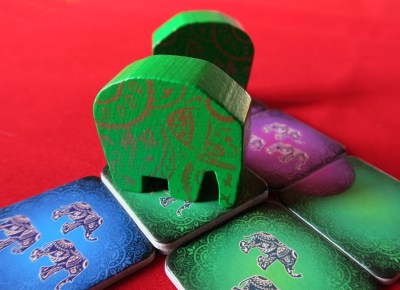
With Black and Blue suffering from “German lurgy” and Burgundy still recovering from his last bout, everyone was keen for an early night.  Once Red, Cerise & Magenta had headed off, everyone else settled down to go through the rules of Kerala, a simple little tile laying game with beautiful presentation, while Purple multi-tasked and wrote an essay about her favourite tree-house. In Kerala, each player starts with a single tile in their own colour with two wooden elephants perched precariously on it.  On their turn, the active player draws the same number of tiles from the bag as there are players and then chooses one before everyone else takes it in turns choosing one.  Players then simultaneously place their tiles next to a tile with an elephant on it and move the elephant onto the new tile.  The tile can be placed in an empty space, or on top of a tile previously laid.  Thus, over the course of the game players’ elephants ponderously move over their play-area with players messing with the player to their left by leaving them with tiles they don’t want.

Kerala
– Image by boardGOATS

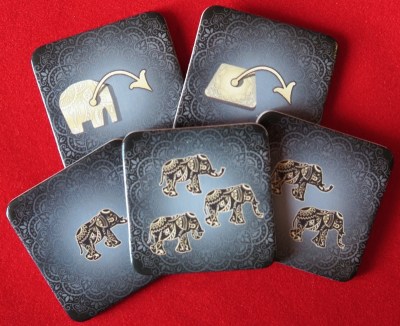
Tiles come in the five different player colours:  red, green, blue, black and purple.  At the end of the game players require precisely one contiguous region of each colour (with two allowed for their own colour); if they are missing a colour they lose five points and if any regions appear more than once, tiles must be removed with a penalty of two points per tile.  There are three types of tiles, Elephant tiles, Edge tiles and Action tiles.  Elephant tiles score points at the end of the game with players receiving one point for each elephant visible. “Edge” tiles have one side with a different colour; if these are adjacent to the correct colour the player scores an additional five points otherwise they can be ignored.  There are also two sorts of action tiles, which score no points but allows the player to move either a tile or an Elephant.

Kerala
– Image by boardGOATS

After a few slight rules queries, everyone got on with the gentle action of choosing tiles and moving elephants, but gradually everyone became aware of the game’s “Tusks” as Blue left Pine with something he really didn’t want for the second time and what had initially seemed like multiplayer solitaire suddenly wasn’t.  As their areas expanded, players gradually got themselves into difficulties and then struggled to get themselves out of them again.  Although nobody pulled their punches when choosing tiles to leave, everyone offered genuine assistance and friendly opinions, especially to those unfortunate players left with rubbish at the end of the round.  Predictably, having played it before, Blue finished some way ahead of the pack, though Black, with a veritable troop of Elephants in a very tidy array joint top-scored with forty-five, eight ahead of Pine in third.

Kerala
– Image by boardGOATS

Learning Outcome:  Essen is Awsome, and Blue needs cloning.

Boardgames in the News: Asmodee Take Over Canada

The Canadian company, F2Z Entertainment, own Filosofia Éditions (who bought Z-Man Games in 2011) and are also the parent of company of Pretzel Games and U.S. company Plaid Hat Games.  Given the rate that Asmodee have been gobbling up games companies, it seemed only a matter of time before they turned their attention to F2Z Entertainment.  It seems their enticing range of games, which include Pandemic, Dead of Winter and Carcassonne, was just too much and in July, Asmodee announced that it had entered into exclusive discussions to acquire F2Z Entertainment.  These discussions are now concluded and, as of today, F2Z Entertainment, will be known as Asmodée Canada.

Asmodee Canada
– Image from trictrac.net

So, who will be next? Rio Grande Games perhaps?  Or maybe Czech Games Edition or Pegasus Spiele will be their target following their recent successes in the Spiel des Jahres and Deutscher Spiele Preis?  Time will tell.

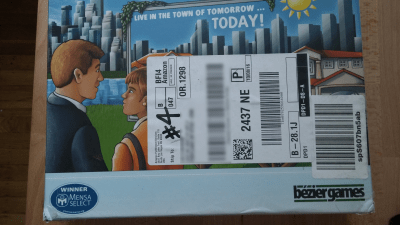
Boardgames in the News: When is Amazon Packaging not Packaging?

Answer:  When it’s a game box…

Amazon
– Image by reddit contributor Zepheus

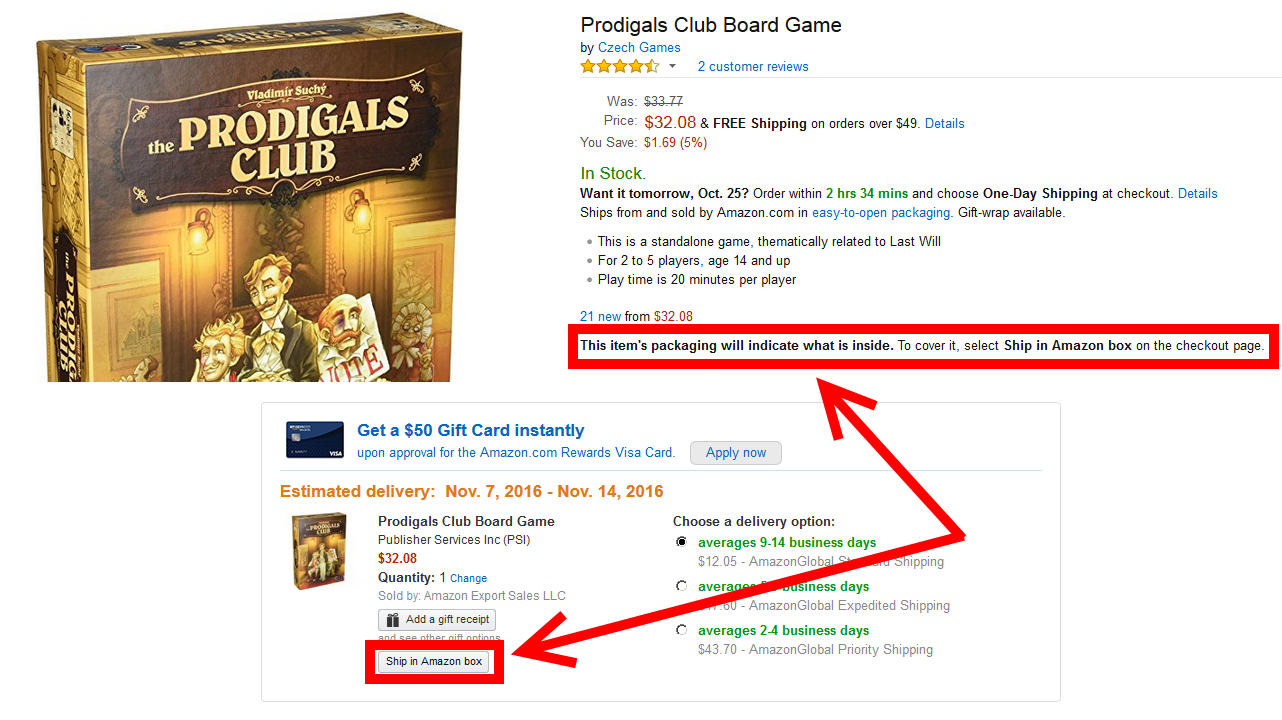
It is not unknown for games bought in online auctions to be shipped in a bin bag, or worse, with just a sticky label stuck to the box.  While ignorance is no defence, it is arguable that caveat emptor could apply in such cases.  Nobody would expect such treatment from a reputable seller and yet there has been a trend of such behaviour in the USA for some time from Amazon.com.  There are now reports of the same happening with parcels shipped by Amazon.co.uk and Amazon.de.  With Amazon.com/Amazon.de it seems that the thing to look out for is a comment on the item page that says, “This item’s packaging will indicate what is inside and cannot be hidden“.  Examples are very hard to find on Amazon.co.uk, but most games on Amazon.com and many on Amazon.de exhibit this text.  The Prodigals Club is one example and in such a case case, a box can be added for no extra charge when selecting delivery options.  It is possible that this trend is a result of the new “same day shipping” which has now made it to Europe, so in time it may affect more items.  With Christmas approaching and the inevitable last minute purchases, buyers beware – it may be that items other than games are affected too…

Amazon Packaging
– Image by boardGOATS

Goats in the News: What if Goats Voted for the US president?

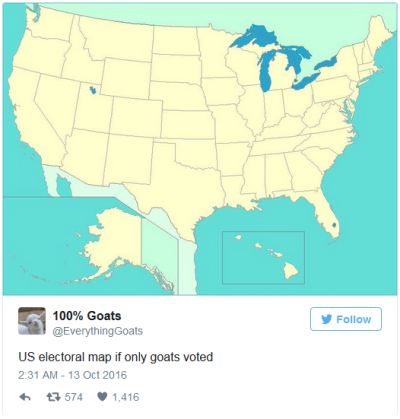
With the US election the subject of every other media article, the silly season is definitely here.  A recent email to Republican supporters sent by Eric Trump included the state division map which apparently showed an overwhelming majority for his father, Donald Trump.  The map was calculated from numbers published on FiveThirtyEight.com, a statistics-driven news website.  Unfortunately, the map he used showed who would win the US election if only men could vote (the report also included a similar map depicting the situation if only women voted). Inevitably, these were followed swiftly by other maps prepared by the Twitterati, including one calculating showing what would happen if goats voted…

US Election Map
– Image from twitter.com

Next Meeting – 18th October 2016

Our next meeting will be on Tuesday 18th October, at the Horse and Jockey pub in Stanford-in-the-Vale.  As usual, we will be playing shorter games from 7.30pm as people arrive, until 8pm when we will start something a little longer.

This week the “Feature Game” will be The Game: Extreme, which is a game picked up from the Game Fair last week in Essen.  We’ve played The Game quite a lot, but this new version adds extra instructions on some of the cards that make the game quite a bit more challenging.

The Game: Extreme
– Image by boardGOATS

And speaking of “the game”…

Jeff was working as assistant manager in a hotel.  They used to get all sorts of people staying, one day a group of chess enthusiasts checked in.  That evening, the gamers were all standing in the lobby discussing their recent tournament victories. After about an hour, Jeff came out of the office and asked them to disperse.

“But why?” one of them asked, as they started to move on.

“Because,” answered Jeff, “I can’t stand chess nuts boasting in an open foyer.”

4th October 2016

It was a quiet night, thanks to illness, work and other commitments.  There were still enough of us to split into two small groups, the first of which settled down to play Endeavor.  This is a game we’ve played a couple of times this year and still proves quite popular.  This time, only Green had played it before and Grey and Ivory were unfamiliar with it, so it was necessary to have a complete run-down of the rules.  The game is played over seven rounds, each of which consists of four phases:  Building, Population, Income and Action.  The idea is that players have four status tracks, one each for Industry, Culture, Finance and Politics, which roughly correspond to the four phases of the game and dictate what players are allowed to do at each stage.

Endeavor
– Image by boardGOATS

Players begin by choosing a building, some of which provide an increase in one (or more) of the four status tracks, some provide actions, while most others do a mixture of both.  Players then move population markers from their general supply to their harbour according to their current culture level.  A strong population is essential as it ultimately limits the number of actions players can take on their turn.  The income phase allows players to move some of their workers from buildings back into their harbour as dictated by their current level on the income track.  These add to the population players have available to do things with, while also making space on the buildings so that these actions are available for re-use.  The first three phases of each round are mostly just preparation and book-keeping; the guts of each round are in the final phase, where players take it in turns to carryout an action of their choice.  There are five basic actions: Taking Payment, Shipping, Occupying, Attacking, and Drawing Cards.
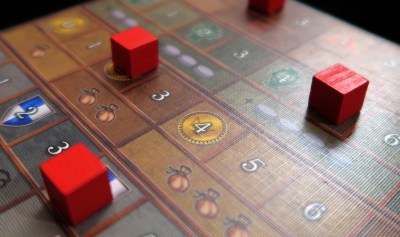
Endeavor
– Image by boardGOATS

In order to carryout an action, players must activate an appropriate building by moving a population marker from their harbour to the building.  In the case of shipping, occupying and attacking, the actions are carried out on the central, communal player board.  To ship, after activating an appropriate building, players can move one of the population markers to one of the six shipping tracks and take the token that was on the space.  These tokens are useful as they add to the status tracks, but some also give a free action.  Shipping is also important as it gives players a presence in a region which is necessary for occupying, attacking and drawing cards.  When a player places the last token on a shipping track, The Governor card from the top of the pile in the region is allocated and the region is considered “open”.  This means that players who already have a presence in the region can also occupy the cities within the region. This gives both tokens and victory points, but where a player occupies a city that is connected to another city they already occupy, they get an extra token, which can be very valuable, as well as providing extra points at the end of the game.  This makes position very important, but if someone occupies a city that another player wants, one option is attacking.

Endeavor
– Image by boardGOATS

This is carried out in the same way as occupying, but is a separate action and costs an additional population marker.  Occupying a region also adds to a players presence in the region: players can also draw the top card from a region’s stack and add it to their player-board, so long as their total presence in the region is higher than the card number.  Cards are important as they also add to the status tracks as well as provide victory points, however there is a card limit which is enforced when a player passes at the end of the round and any status track points gained with the card are lost when cards are discarded.  Once everyone has completed one action phase players continue taking it turns until everyone passes.  Thus, the final possible action is taking payment which is the simplest action and allows players to move one of their population markers back to the harbour so that they can re-use the building in the same round. In addition to the five basic actions, some of the more expensive buildings provide a choice or even a combination of two of the basic actions.  After seven rounds, points are awarded for cities, for connections between cities, for progress up status tracks, cards, some special buildings, and any left-over population markers.

Endeavor
– Image used with permission of BGG contributor henk.rolleman

It was an inauspicious start: Grey was unhappy with the name, it hurt his language sensibilities, and he was very concerned as to where the “u” had gone.  Green was definitely at an advantage as the only person to have played the game before, but he did his best to guide the others for their first few turns. In truth, there is very little choice to be made in the first round or so, however, what choice there is tends to turn out to be critical by the end of the game.  With so little decision to make, the first round is always over in a flash, though the later rounds take progressively longer as the game goes on.  Ivory and Green both started building Workshops for the extra brick, while Grey went for a Shipyard and started to ship. In the second round, Ivory and Green’s Workshop enabled them to build more valuable buildings and Ivory took a Guildhall to get in on the shipping act, while Green declined the extra brick and went for the Shipyard. This gave him a second green population token and popped him over into gaining three population markers.  As the fog of first game confusion began to clear for Grey, he saw the advantage of the Workshop, so took it at the second opportunity.
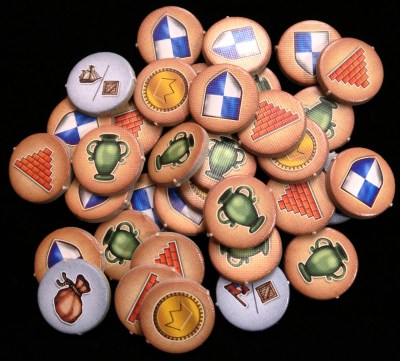
Endeavor
– Image by boardGOATS

The first few rounds raced past as everyone developed their own board, increased their  populations and took cities and shipping tracks, but some clear strategies were emerging.  Green had a large number of cities in central Europe and a smattering of shipping routes, but was pushing strongly for Africa (to make connections with his European cities and give some great bonus action chits). Ivory was also keeping a strong hold in Europe, but not so much on the shipping tracks, while Grey was concentrating on opening up India and the Far East. Ivory had built up a healthy row of cards, and although he was the only one to resort to slavery so far, it was only the one card.  In the fourth round Grey took the penultimate space on the India shipping track and gifted Green a super-turn, when he used his Dock to ship (thus opening up the region) and then occupied too. The newly occupied town linked to his European city and so he got that extra token too. Grey did get the bonus Governor card in consolation however.  And then, the regions tumbled, next were the Far East and then North America.
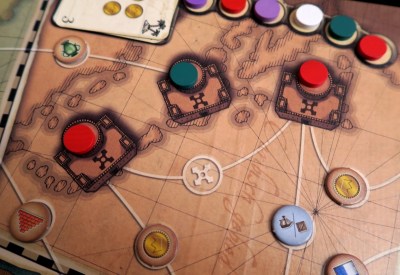
Endeavor
– Image by boardGOATS

By the fifth round, the first four cards in the central region had all been taken, and a quick count up showed Green had five cities. He waited until the sixth round and, since no-one had attacked him, he took the final card and abolished slavery. Luckily Ivory was not too badly affected by this and avoided the collapsing house of cards such an event can often trigger.  At the start of the final round, Grey spotted that Ivory had a cluster of four cities plus one in Africa: that gave him four connections.  He also noticed that there was one cornerstone city that connected them all. So he bravely marched in, took the losses involved in attack and swiped several points from Ivory in one go.  The final turns were used for mopping up as many points as possible and once everyone had passed, it was on to final scoring.
Endeavor
– Image by boardGOATS

Not unexpectedly given his extra experience with the game, Green scored the most, with victory points from most areas.  Ivory was close behind in what had been a very enjoyable game.  In fact Grey had not only got over the mis-spelled title, but had enjoyed it so much that he went on to try to find a copy for himself.  Alas Endeavor is very out of print so if it can be found, it’s going to cost a pretty penny, which is a shame, as it is a really good game with good replay-ability, thanks to its random token layout.  On the adjacent table, there was much debate as to what to play, but eventually, the group settled on Istanbul, winner of the Kennerspiel des Jahres two years ago.  We’ve played it a couple of times, but Pine was completely new to it, though both Blue and Red had played it before.  It is also a fairly simple game where players are trying to lead their Merchant and his four Assistants through the Turkish bazaar.  There are sixteen locations each with an associated action, but to carry out an action, the Merchant needs an Assistant to help out.

Istanbul
– Image used with permission of BGG contributor duchamp

The problem is, once an action has been completed, the Merchant must move on, however, an Assistant remains to complete the details of the transaction.  Thus, the Merchant can only carryout a transaction if he has the help of an Assistant.  When he runs out of Assistants, the Merchant cannot carryout a transaction and must either visit the Fountain and summon his Assistants or go back to stalls where the Assistants are to collect them.  The central play-area is made up of tiles representing each stall, so there are four possible layouts:  “Short”, where the distances between places that work well together are small making game-play easier; “Long”, where places that work well together are far apart, which forces players to plan ahead more; “Challenging”, where similar places are grouped together, and “Random”.  For this game, we chose “Long” routes to give us a slightly more interesting game.

Istanbul
– Image used with permission of BGG contributor punkin312

Blue began by collecting money and visiting the Wainwright to build up the size of her cart, while Red began collecting the special tiles from the Mosque’s while they were still cheap.  Although Pine felt he understood the rules and the aim of the game perfectly, it took him a few rounds to work out how to go about making things work together effectively.  So it was that Blue just managed to get to the Jewelers before Pine and use a double card to buy two gems.  As Pine had only had the exact money for his own double gem purchase, he was now two Lira short and had to go and acquire more cash.  To add insult to injury, he had just acquired his extra Lira when Red pulled a similar trick and Pine had to go and find yet more cash.  While Blue and Pine were building piles of currency, Red was quietly collecting tiles from the Mosques and a full set gave her two gems.

Istanbul
– Image used with permission of of boardgamephotos

Blue and Pine completed their carts and, with her gems from the Jeweler, Blue seemed to have got her nose in front.  That was before Pine, largely unintentionally, got his revenge for the problems Blue had caused him earlier in the game.  Everything Blue tried to do, Pine was there first and obstructed her plans.  In such a tight game, it was just enough to give Red the extra time she needed to get her fifth gem and trigger the end of the game.  Despite a massive forty-two Lira, Pine needed two turns to change them into gems leaving Blue just ahead in second place with four gems.  As Endeavor was still in the closing stages, Red, Blue and Pine investigated the “Feature Game”.  To celebrate our fourth birthday this week, this was to be Crappy Birthday a silly little filler/party game.  This game has a lot in common with games like Apples to Apples and in particular, Dixit.  The idea is that each player has a hand of cards featuring strange potential gifts.  On their turn, it is the active player’s birthday and everyone else passes them a card.  The active player then chooses what they think is the best and worst and returns them to the original owner who keeps them as points.

Crappy Birthday
– Image by boardGOATS

After a couple of turns, Endeavor came to an end and the group joined up for a proper game of Crappy Birthday.  The key to playing this sort of game is knowing the other players.  Although we meet regularly, we don’t all know each other all that well, so this was always going to be interesting.  By the end, we’d learned that Red would quite like to bungee-jump; Green thinks turning his car into a caravanette would be fun (well, perhaps not his car); Blue has a pathological hatred of having her photo taken and Pine likes fluffy penguins and had been to the Westmann Islands and played with warm lava…  In the absence of cake (partly due to a mix up) we completed two rounds and Ivory and Green finished in front with three points apiece.  Given how unsuccessful social games often are with our group (most recently Codenames, which was very divisive), this was not expected to be a great success.  However, the cards were such fun and so unusual, that we all really enjoyed it.  Sadly, that means the game has poor replayability as, once the surprise has gone, the game will be much less fun.

Splendor
– Image by boardGOATS

With that done, Red, Ivory and Grey headed off, leaving Pine, Blue and Green to play something quick.  After a little chit-chat Splendor was the chosen game, with both Pine and Blue having unfinished business after getting soundly beaten twice in quick succession.  In this game, players have just three options on their turn:  collect gem tokens, buy a gem card using gem tokens (and/or cards), or reserve a gem card and receive a gold (wild) token at the same time.  Players can have a maximum of ten tokens, though unlimited cards and the cards act as permanent tokens.  Thus, at its heart Splendor is an engine building game built on a set-collection mechanism.  Players score points when they buy some gem cards and for attracting Nobles which are awarded to the first player collect certain combinations of gem cards; the game end is triggered when one player reaches fifteen points and the player with the most at the end wins.

Splendor
– Image used with permission of BGG contributor henk.rolleman

The game started with both Pine and Blue going for it with all guns blazing.  The set up included three special Noble tiles:  one from the 2015 Brettspiel Adventskalender and two from the promotional tiles set, but all four Nobles included opals.  So, it was just as well that there were lots of opals out at the start of the game.  Blue and and Pine collected as many of them as they could.  Green picked up a few too, but found the competition was quite stiff and went for more rubies and sapphires.  It was Pine who picked up the first of the Nobles, but that galvanised Blue into action and she grabbed the remaining three in quick succession.  She was still a few points short of the finish line, and it was then that Green realised he had misread one of the cards.  Having had a similar lead and lost last time she had played, she wasn’t going to let this one get away, and ruthlessly gathered the remaining points she needed to quickly bring the game to a close.  Blue finished the game with sixteen four points ahead of Pine in second place.

Splendor
– Image used with permission of BGG contributor henk.rolleman

Learning outcome: Some of the best games can be very difficult to get hold of.

Essen 2016

It is that time of year when, the leaves fall from the trees and gamers visit Germany.  No, Oktoberfest isn’t the draw (that happens in September anyhow), this is an altogether different annual German “festival” – The Internationale Spieltage, which is held in Essen.  To Gamers worldwide, Essen is synonymous with the largest games fair in Europe and, arguably, the world.  The fair runs Thursday to Sunday in mid-October every year and is the one of the largest and most significant of all the boardgame conventions.   As such, many of the manufacturers plan their biggest releases for October with their debut at the Fair.

Essen
– Image from merz-verlag.com

Last year there was a bit of a paucity of new games and it seemed to be all about expansions.  This year, while there are still plenty of expansions for well-loved games like Istanbul, Colt Express, Orléans and Ca$h ‘n Guns etc., there are also a lot of new games based on old favourites.  For example, there is Key to the City – London (which has a lot of elements of one of our favourite games, Keyflower), Jórvík (an update and re-theme of Die Speicherstadt), X Nimmt! (a variant on the popular but chaotic 6 Nimmt!), and the latest incarnation of the Ticket to Ride series, Ticket to Ride: Rails & Sails.  There will be plenty of other interesting original games too though, including The Oracle of DelphiA Feast for Odin, Cottage Garden and The Colonists.  Several members of the group are going this year, and they’ll no doubt bring back lots of exciting new toys to share with everyone.

Essen
– Image used with permission of BGG contributor Gonzaga

Boardgames in the News: The V&A on TODAY

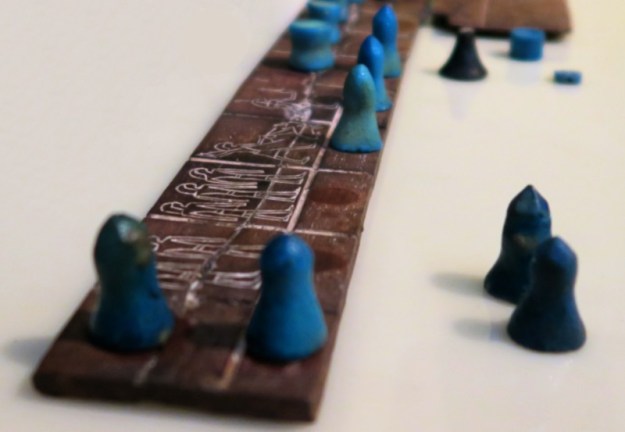
With the increasing interest in modern boardgames and boardgame cafés, it is inevitable that the established media will take more of an interest.  So far we’ve had the articles in the scientific journal Nature, BBC Radio Oxford, The Guardian, BBC Radio 2, and Channel 4’s “What Britain Buys”.  Today the BBC’s flagship radio news program, “TODAY” joined the fray together with a report on the new games exhibition at the Victoria and Albert Museum. The interview with Catherine Howell (of the V&A) and Leslie Scott (designer of Jenga) is available to listen to on iPlayer and starts at starts 2hrs 46 mins in.  It is an interesting article that covers changes in games from Senet to modern games as well as explaining the four different types of games as presented at the exhibition (race, chase, displace and space).  The “Game Plan” exhibition opens this weekend at the V&A Museum of Childhood in Bethnal Green and will include over a hundred objects as well as an “interactive game”.  The event is at least in part inspired by the boardgame café Draughts who are holding a “Gaming in the Galleries” event at the museum later this month.

Senet
– Image by boardGOATS

Aren’t all games interactive?

Boardgames in the News: The Monthly Game Guardian

In recent years it has become increasingly acceptable to play boardgames, so much so that there are now regular articles in the national press – in particular The Guardian who have had a dedicated boardgames area in their “Lifestyle” section for some time.  They now also have a regular monthly guide designed to help people “find the best games” and “steer clear of disappointing duds”.  This is written by Owen Duffy who writes for the Guardian on a range of subjects and until recently ran the tabletop gaming blog Cardboard SandwichThe first article showcases four games that even some dedicated gamers might not be aware of:  Ice Cool, Ticket to Ride: Rails & Sails, Mystic Vale and Sneaky Cards.  Owen has a real love of playing boardgames and is genuinely knowledgable about them, so the “Boarders Hoard” is definitely worth keeping an eye out for.

Ice Cool
– Image used with permission of BGG contributor punkin312