Category Archives: Games Night

24th February 2022

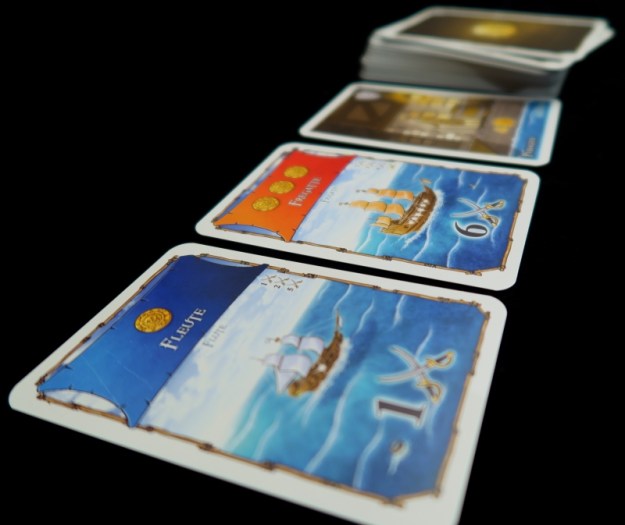
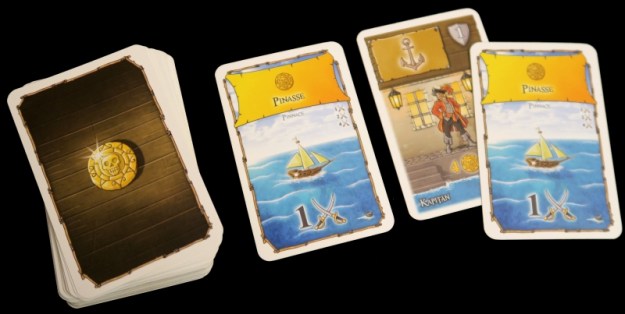
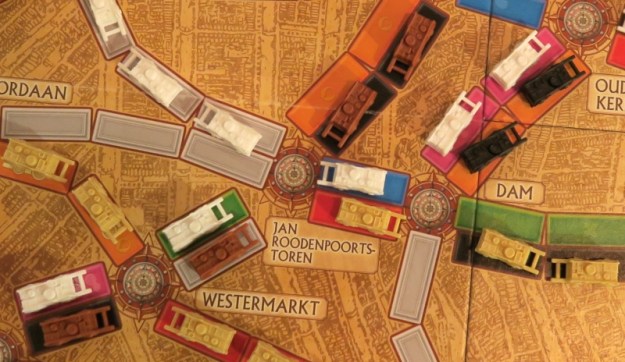
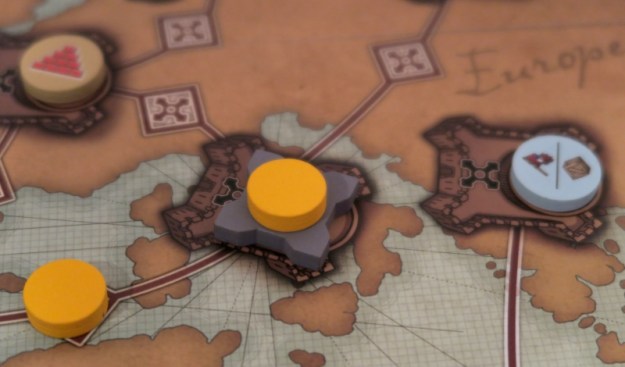
Blue, Pink and Pine arrived early and while they waited for dinner to arrive, they had a quick game of Ticket to Ride Demo.  This is one of the “cut down” Ticket to Ride games which play in the same way as the full-sized versions, but are a lot shorter and often tighter.  As in the parent, players take it in turns to collect cards, or spend them to place trains on the board.  The Demo game has a double-sided map, but with events in Europe so much in the news, the Europe map was chosen.

Ticket to Ride Demo
– Image by boardGOATS

Pink and Pine began competing for the train-lines through the Benelux countries down to Bucharest, while Blue joined Warsaw to Madrid in the south east via a roundabout route. It was a really tight game, so much so that once the points for the tickets had been added, it was a three-way tie.  With just the Longest Continuous Path bonus to add, it was between Blue and Pine, with Blue just nicking it, to give her thirty-four points and victory.  There wasn’t time to dwell on it as Pine’s enormous platter of cheese had arrived and in that, he was definitely the victor.

Ticket to Ride Demo
– Image by boardGOATS

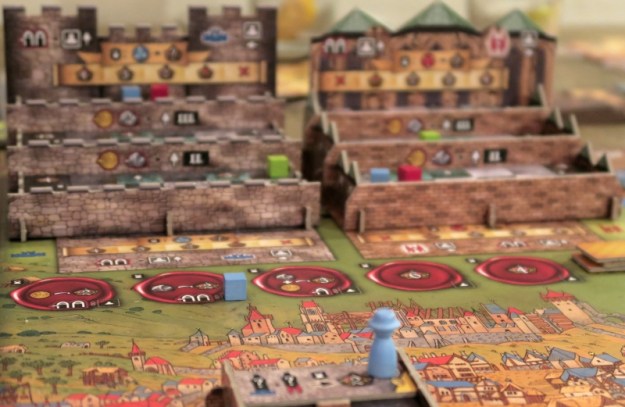
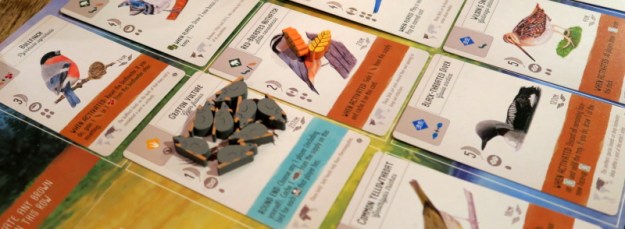
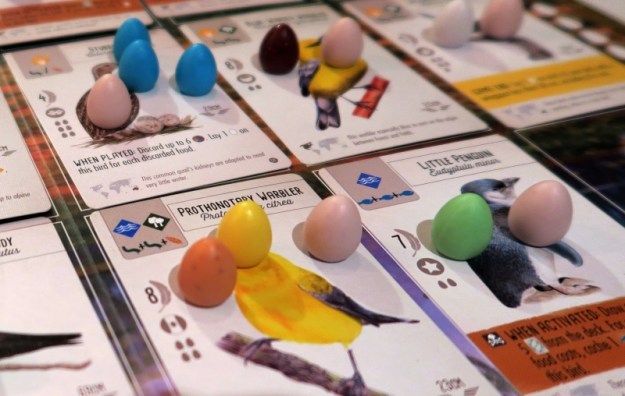
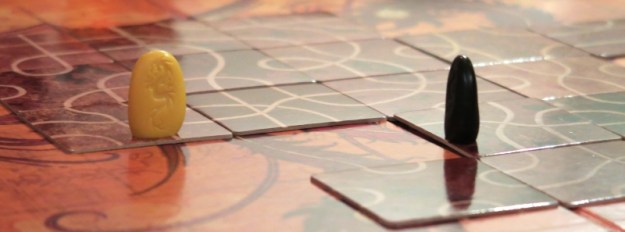
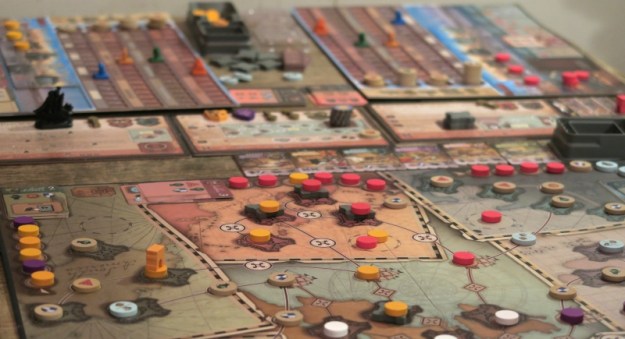
Sage was next to arrive, quickly followed by Purple and Black.  Expecting a quiet night (with lots of people away for half term) we were just deciding who was going to play what, when Lime arrived, so we split into two groups, a three and a four, with the larger group playing the “Feature Game“, PARKS.  The Nightfall expansion includes the seventeen National Parks cards that were omitted from the original base game, so these were added to the deck, though none of the other features were included in the game this time.  This is a game that Burgundy wanted to play, but sadly never quite managed to, so it we wanted to play it in his memory.

PARKS
– Image by boardGOATS

During the game, players take on the role of two hikers as they trek through the countryside over four rounds, or “hikes”.  Whilst on the trail, the hikers take actions and collect memories of the places they visit.  At the end of each hike, players can trade them in for a visit to a National Park.  Each round is set up with six basic trail tiles (five with fewer players) and one advanced trail tile shuffled together and laid out to make a path from the trail head to the trail end.  Players can move either of their hikers towards along the trail to any unoccupied space and then carry out the action on that space.
PARKS
– Image by boardGOATS

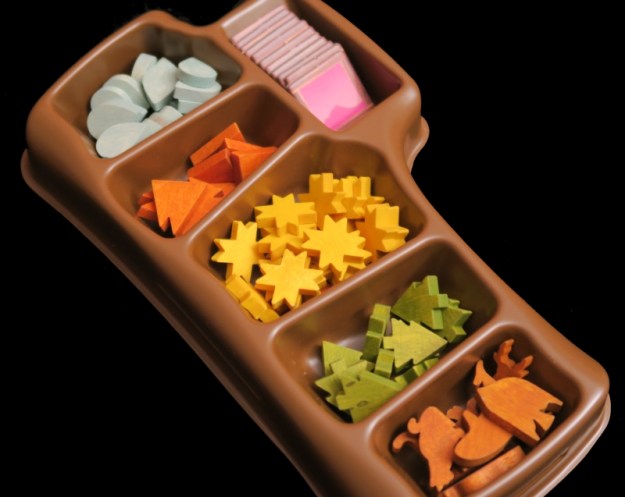
The basic locations are the mountains, forest, the valley, the sea, and a waterfall, visiting these give players wooden mountain, tree, sun or water tokens that can be exchanged for National Park cards at when their hiker reaches the end of the trek.  At the start of the round, the trail tiles are also seeded with additional tokens giving the first person to visit each one a bonus. The final basic location is the vista, which allows players to either take a new canteen card, or take the Camera token.  Canteen cards are special cards that players have that enable them to convert water into other resources or actions, once per round.
PARKS
– Image by boardGOATS

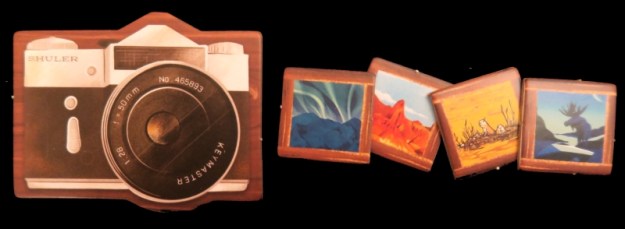
The Camera allows people to take photos, which are worth a point each at the end of the game.  When initially taking the Camera, a photo costs two wooden tokens, but thereafter, photos only cost the holder of the Camera one token, and the player holding the camera at the end of the round gains an additional photo opportunity. There are a couple of other “rule-breaking” rules, for example, each player has a single opportunity per round (or “hike”) to join another hiker at a location by putting out their campfire (turning the token over).  Additionally, players can also buy camping gear cards which alter actions or provide discounts when buying National Park cards at the end of the round.
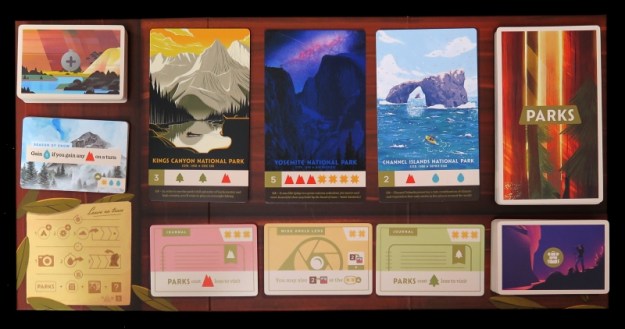
PARKS
– Image by boardGOATS

There are additionally “Year Cards” which provide players with personal objectives, however, the group did not use these this time as Blue wasn’t making a great job of the rules explanation and it had taken quite long enough without adding more.  The round end is triggered when the penultimate hiker reaches the end of the trail.  The last hiker then moves directly to the trail end and, as usual can: reserve a National Park card from the market (and, if they are the first hiker to do so, take the First Hiker Marker); buy camping gear cards, or claim a National Park card (either from the market, or one reserved earlier in the game).  The game ends after four hikes, and players sum the total of their Parks points and photos to determine the winner.

PARKS
– Image by boardGOATS

The game started slowly as somehow it felt a little unintuitive.  Although play seemed very simple, it wasn’t immediately obvious how to excel and score lots of points.  Although they aren’t the only source, most points come from National Park cards.  As each player has two hikers and Parks cards are acquired at the end of each round, players have only eight opportunities to buy them.  With such a limited number of cards available, players have to try to maximise their takings by going for the most valuable cards.  If these are not reserved, however, there is a risk that someone else will take a desired/planned for card.  This is particularly perilous, as it can leave a player without a possible option and unable to take one of their very limited opportunities to take a Park card.

PARKS
– Image by boardGOATS

Pink started by asking what colour he was, and Blue pointed to the light purple campfire in front of him and explained it was the closest to pink.  Pointing to Lime’s “peach-coloured” pieces, he replied “Apart from the actual pink ones…”  And then there followed a heated debate as to which colour was “more pink”.  Eventually, Pine started tentatively, followed by Lime and then Pink (with his purple pieces) and finally Blue.  As the group felt their way, they realised that mountain tokens were valuable and difficult to come by.  So, after Lime had been unable to afford the camping gear card that gives a mountain discount, Blue snapped it up.  It took a while to understand the value of the Canteen cards, and some were definitely more useful than others.
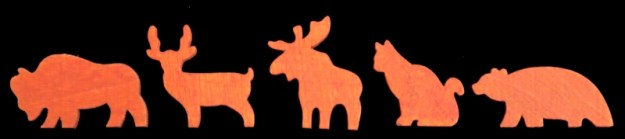
PARKS
– Image by boardGOATS

Pink had a Canteen that gave him mountain tokens, which meant joining the battle for the mountain space wasn’t quite as necessary.  Lime had a canteen that allowed him to reserve Parks cards which was useful in terms of planning.  It also had the additional advantage of messing up other people’s plans, in particular, Pine’s who got caught several times.  During the second round, everyone started to get the hang of things, and began to work out what they were trying to do while keeping an eye on what everyone else was doing.  But then the “hand limit” of twelve tokens began to bite.  Some of the most valuable Parks cards need six or more tokens, so targeting these while keeping the ability to be flexible became increasingly difficult.
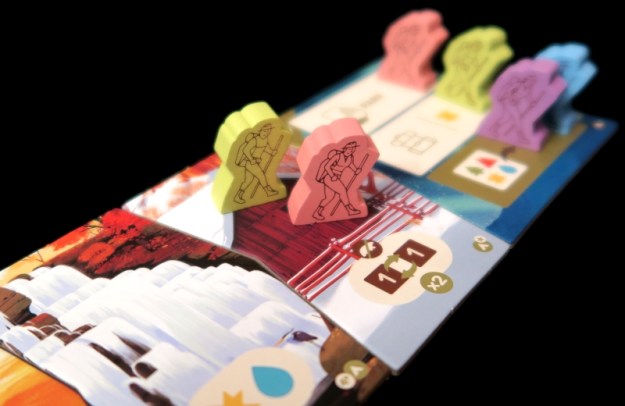
PARKS
– Image by boardGOATS

By the third round, Pink was questioning how Blue had managed to get “so many” cards, implying she was doing something that the others, in particular Pink, weren’t.  She had just managed to take every opportunity though, where others had been less fortunate.  Lime had a canteen that allowed him to reserve cards, which was a good use for excess water tokens.  Unfortunately, didn’t quite get the rest of his tokens right to make the most of it, and finished with lots of reserved, but unfulfilled National Parks cards.  Pine was unlucky and had Parks cards he was targeting taken at the last moment.  Still he managed to get a card with a nice picture of a wolf on it, which delighted him at the time.
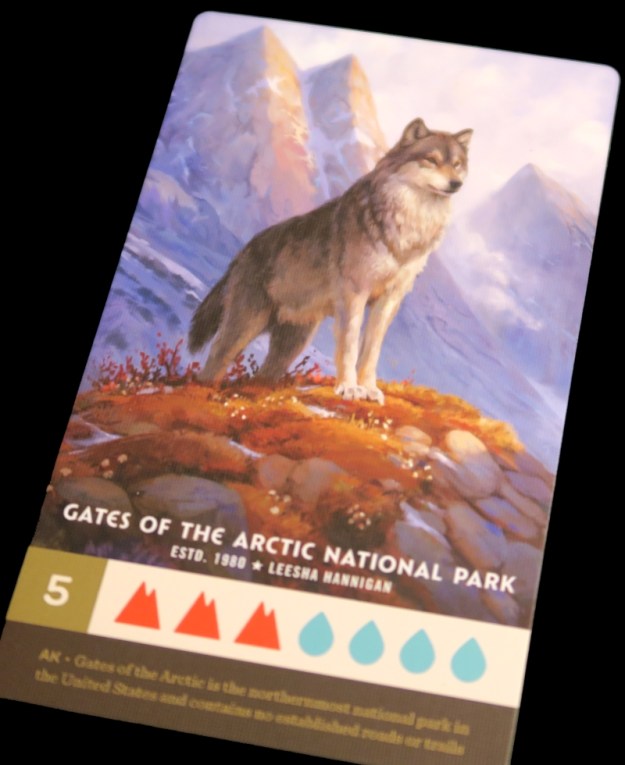
PARKS
– Image by boardGOATS

It was close for second place with just two points separating three players—Pine, tied for second place with Pink, decreed that his lovely wolf card was the tie-breaker and gave him the edge.  There was no question that Blue was the winner though, with thirty-two points, eight more than Pine.  Meanwhile, on the next table, Sage, Purple and Black had been playing Puerto Rico.  This is a much older game, once ranked the best game on the BoardGameGeek website, but now often forgotten.  We’ve played it a few times, but not since the global pandemic hit, and Sage was keen to play it again.

Puerto Rico
– Image by boardGOATS

In many ways, Puerto Rico is the archetypal Euro game.  The idea of the game is quite simple in that on their turn, the active player chooses a “role” then everyone takes it in turns to carry out the action associated with that role.  Each role has a “privilege” which the active player gets which gives them a little bonus (as well as the opportunity to take the action first.  Once everyone has chosen a role, the remaining role cards are “improved” by the addition of money, the used role cards are returned to the pool and the start player (The Governor) moves one player to the left before the new Governor starts the next round.
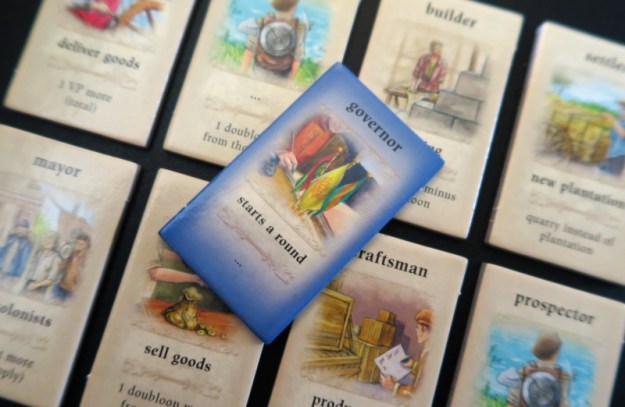
Puerto Rico
– Image by boardGOATS

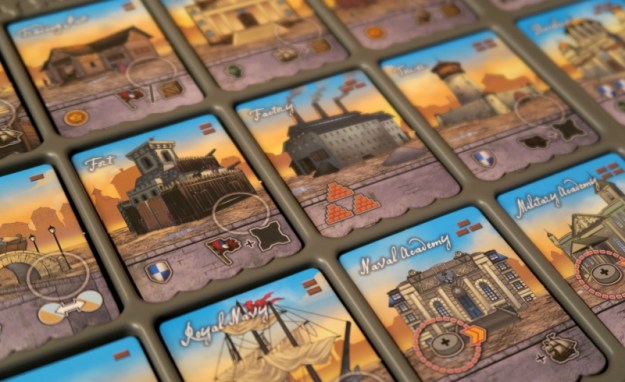
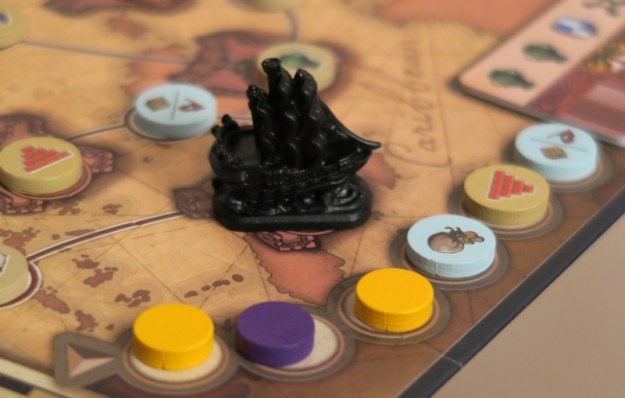
The aim of the game is to get victory points which are awarded for buildings and for shipping goods. However, to build, players need money, and before they can ship goods, players need to be able to produce the goods with a plantation (and where necessary process them in the appropriate building).  Each building/plantation has a special bonus, but for a player to receive this, the building needs to be occupied by a “colonist”. All these activities are carried out through the role cards. For example, the Builder enables players to construct a building, but the player who chooses the role gets the privilege of paying one doubloon less than they would have done otherwise.

Puerto Rico
– Image by boardGOATS

Other roles include the Craftsman (enables players to produce); the Captain (enables players to ship goods); the Trader (allows players to sell goods for money); the Settler (players can take a plantation tile and add it to their island); the Mayor (the ship of “colonists” arrives and they are divided amongst the players), and the Prospector (everyone does nothing except the person with the privilege who takes a doubloon from the bank).  The game ends when there are not enough colonists to fill the colonist ship, the supply of victory points is exhausted, or a player fills their twelfth building space in their city.
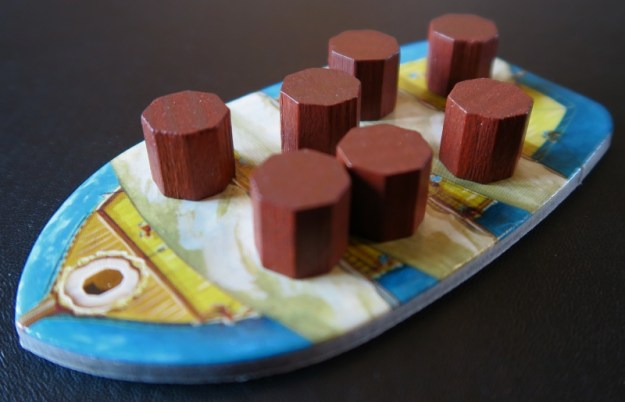
Puerto Rico
– Image by boardGOATS

Black was clearly an early front-runner, but while Sage was slightly slower to get his engine going, he was coming up fast on the inside rail when the game came to an end.  As a result, the end-game building scoring was critical.  Purple had built the Guild Hall giving her extra points for her production buildings while Sage built the Residence providing additional points for the plantations and quarries he had placed on his island.  Black had built and occupied a two large civic buildings:  a City Hall giving him points for his civic buildings, and a Customs House which increased his the victory points he had acquired during the game by twenty percent.

Puerto Rico
– Image by boardGOATS

Unfortunately for Sage, it turned out that the game had ended a few rounds too early for him to overtake Black who finished with sixty points, five more than Sage in second place.  It had been fun though, and demonstrated that while some older games show their age, others still have it.  Puerto Rico and PARKS finished at much the same time, and although Lime left to make sure he got across the river before the drawbridge was lifted (commenting he’d like to give PARKS another go some time), everyone else was keen to play something light and quick.

Puerto Rico
– Image by boardGOATS

Despite Blue’s inevitable enthusiasm, Pine ruled out Bohnanza as too long, and with six players, 6 Nimmt! was the obvious choice.  We played this loads online, but it doesn’t seem to have dampened our enthusiasm for it, though we’ve mostly played the simple version in person since.  The idea is that players simultaneously choose cards from their hand which are then added in sequence to the four rows on the table.  In the original version, cards are added to the end of the row with the highest card that is lower than the card played.  In the professional version, cards can also be played on the low end of rows, upsetting other players’ plans (if players can claim to have plans in this game).
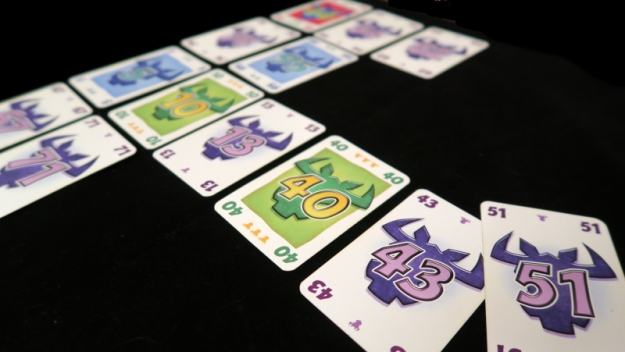
6 Nimmt!
– Image by boardGOATS

Although we all decided that it was too late for the complex maths that comes with the professional version.  Pine and Blue immediately commented that they regretted that decision when they looked at their hands.  It seemed most people struggled a bit in that round as everyone picked up points.  Blue and Pine were high scorers, but Pink managed twenty-seven nimmts off just nine cards, albeit very colourful ones.  Pink did better in the second half with a clear round, but the damage had already been done.  Purple and Blue top scored overall, with thirty-seven and thirty-nine respectively, but the winner was the very constant Black with just five from each round.
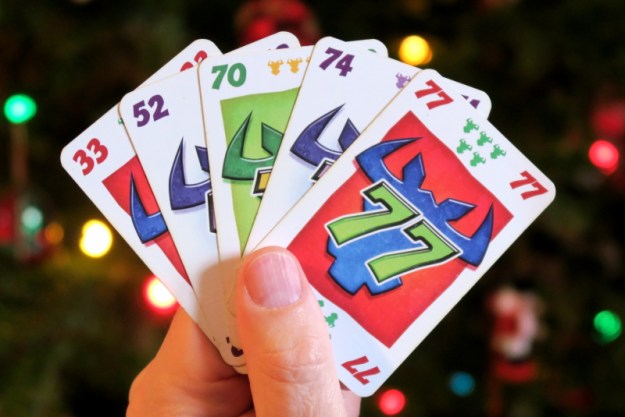
6 Nimmt!
– Image by boardGOATS

Learning outcome:  Not all games are a walk in the PARK.
10th February 2022

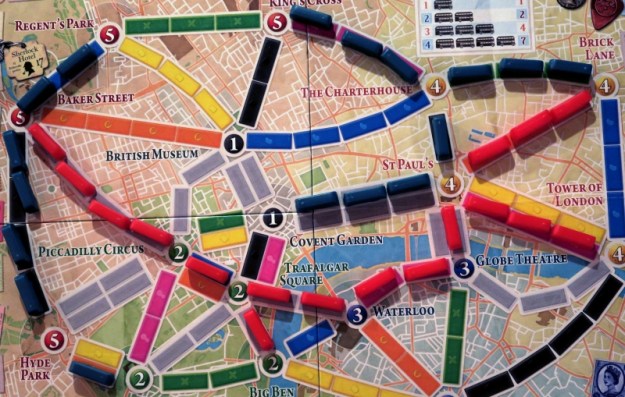
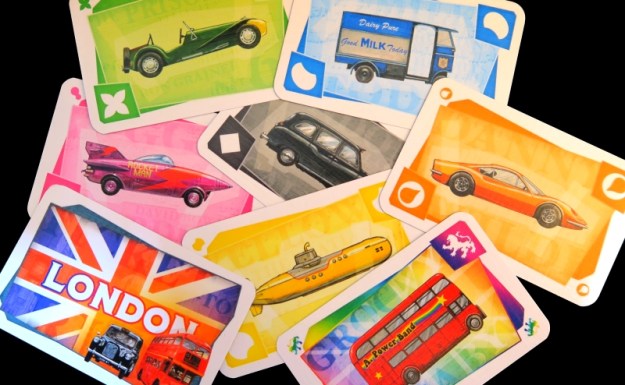
It was just Blue and Pink for food, so while they waited, they killed time with a very quick game of Ticket to Ride: London.  The little, city versions of Ticket to Ride make great appetisers, and this one is no exception.  The game play is essentially the same as in the full-sized versions (collect coloured cards and play them to buy routes), except they have fewer pieces, a much smaller map and take a lot less time to play.  In terms of strategy, there usually isn’t really time to do much, so it’s typically a case of doing one thing and doing it well.
Ticket to Ride: London
– Image by boardGOATS

This time, Blue decided to really challenge herself.  The London game gives bonus points for connect for players that collect certain locations together.  Blue worked out that if she managed to complete her longer ticket (Buckingham Palace to Brick Lane), going via the “ring road”, she could also complete her shorter ticket (Hyde Park to St Paul’s), and pick up lots of bonus points too, with just one bus left over.  Unfortunately for her, Pink managed to end the game just one turn too soon, leaving her with a gap between Regent’s Park and King’s Cross, no bonuses, no tickets and almost no points.  When it came to sparing her blushes, food couldn’t arrive too soon.

Ticket to Ride: London
– Image by boardGOATS

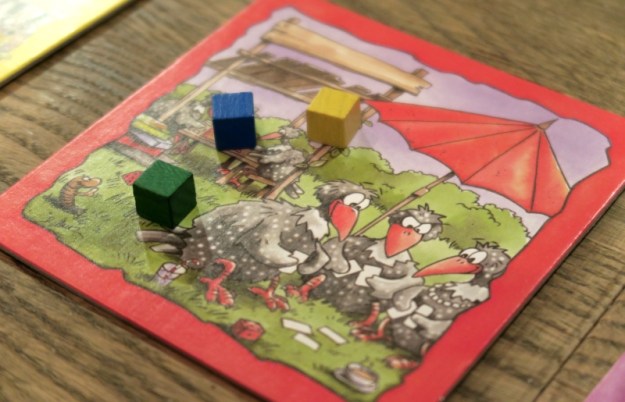
With Green bringing his parents (Saffron & Sapphire), the “Feature Game” was a light, hand-management, double-think fox and chickens game that we’ve played a few times before, called Pick Picknic.  It looked like three games were going to be needed, so Pink suggested Altiplano (in lieu of Orléans which didn’t quite make it last time), and took it to the other side of the room along with Ivory, Sage and Teal.  Pick Picknic plays six, but with eight foxes to fight over the chickens, two games of four seemed the best way to set things up.  Green suggested breaking up his family unit, so Blue instigated a trade and swapped Lilac and Sapphire for Lime and Purple.

Pick Picknic
– Image by boardGOATS

So, after a quick game of Musical Chairs, Green, Saffron, Lime and Purple settled down to play Pick Picknic.  At the start of each round, the six coloured farm yards are seeded with a random corn (worth one, two or three points).  Players then simultaneously choose a card from their hand and play it.  If their card is the only card of that colour and is a chicken, it gets all the corn.  If there is more than one chicken of that colour, they can either come to an agreement to share the corn, or fight for it.  If there is a fox amongst the chickens, the fox has a good feed and the corn remains till the next round.  If someone plays a fox card and there are no chickens, the fox goes hungry.

Pick Picknic
– Image by boardGOATS

The game started in an amicable manner sharing out the corn instead of fighting for it when the need arose, until half way through when Lime decided he no longer wanted to share. He won, but the scene was now set and squabbles broke out over corn more often.  In the meantime, Lime’s foxes were getting fat from eating everyone else’s birds and corn was building up, uneaten.  The others’ foxes were usually not so lucky, and Purple’s foxes were hungriest of all.  Towards the end of the game peace finally broke out once again and sharing was order of the day once more.  In the final tally, Lime proved the wiliest of us finishing first with fifty points and Saffron and Green close behind with forty-four and forty-five respectively.

Pick Picknic
– Image by boardGOATS

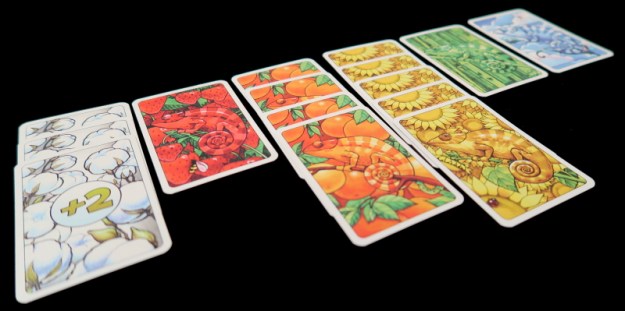
On the neighbouring table, Blue, Lilac, Black and Sapphire were a little slower to get going as they had to choose a game, but eventually decided on Coloretto.  While we’ve played it a lot, it was new to both Lilac and Sapphire so there was a recap of the rules first.  Blue explained that on their turn players have a simple decision:  turn over the top card in the deck and choose a “cart” to add it to, or take the cards from one of the carts.  Lilac commented that it was similar to Zooloretto, which of course it is, as Coloretto was it’s predecessor and they share the same basic mechanism.

Coloretto
– Image by boardGOATS

Players are trying to collect sets of the coloured chameleon cards, but there are two clever features.  Firstly, the largest three sets score positively and scores for the others are subtracted from a player’s total.  Secondly, for each set, the first card is worth a single point, but the second is worth two, the third is worth three and so on (up to a maximum of six cards).  Thus, it is better to get six cards of one colour, rather three in each of two suits.  Sapphire, took this to heart, focusing solely on red and green, and often taking nearly empty trucks as a result.

Coloretto
– Image by boardGOATS

Lilac was more adventurous and pushed her luck a bit, ending up with a bit of a rainbow, but with a couple of strong suits and a few bonus point cards.  Blue commented that, although players need to avoid negative points, players who don’t take cards generally don’t do well, and promptly took lots of cards and ended up with lots of negative points as a result.  Black, very experienced at this game, played smart and took an early lead which he held right until the last round when Blue got lucky and drew cards in her longest suit and with it, took victory, pushing Black into second.  Lilac and Sapphire were not far behind and separated by a single point.

Coloretto
– Image by boardGOATS

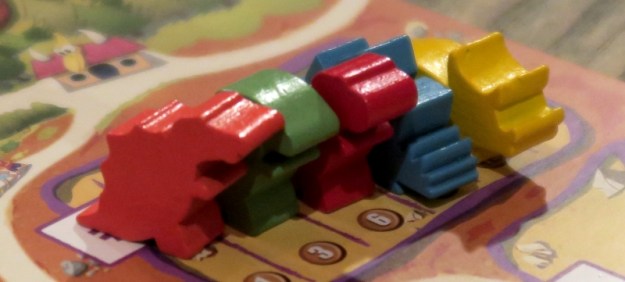
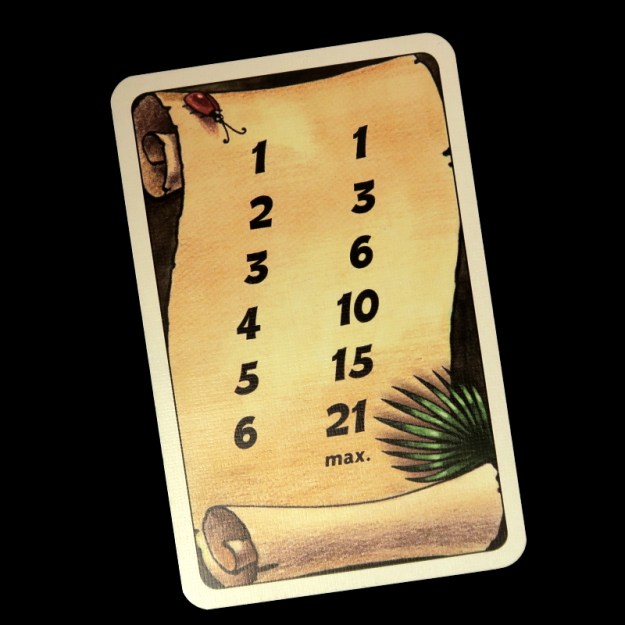
Pick Picknic and Coloretto finished at much the same time.  Purple then requested a game of Azul, so we preceded it with another quick game of Musical Chairs as Blue swapped places with Green.  Then, after a little discussion, Green, Lilac, Black and Sapphire chose to play Draftosaurus.  This is a fun little drafting game like Sushi Go!, but instead of drafting cards, players are drafting little wooden dinosaurs.  The dinomeeples are placed on the player’s board with different areas on the board scoring points in different ways.  For example, the “Meadow of Differences” can only hold one of each type of dinosaur, but will score twenty-one points if it contains all six (using the same scoring scheme as Coloretto).

Draftosaurus
– Image by boardGOATS

The game is played over two rounds (drafting clockwise and then anti-clocwise), before all the parks are scored.  Players also score an extra point for each Tyrannosaurus rex they have in their park, as well as extra points if they have if they have the most dinosaurs of the type they put in their “King of the Jungle” pen.  Everyone knows there is only one King of Jurassic Park and Black was looking like the winner with his T-rex strategy. He not only got several bonus points for pens with T-rex’s he also got seven points for having the most T-rexes too.  However it was Green’s more general approach to his dinosaur park that pipped Black to the post.

Draftosaurus
– Image by boardGOATS

All the scores were close though: Green finished with thirty-seven with Black in second with thirty four, and Lilac and Sapphire were just behind.  As everyone else was still playing, the group carried on together and moved on to the fun little push-your-luck game, Port Royal.  This (like its little cousin “Unterwegs“) is a very simple game: on their turn, the active player chooses to “twist” and turn over the top card of the deck, or “stick” and keep the current card set.  The deck of cards consist of coloured ship cards and character cards.  The first decision is to decide whether to risk a “twist” because if second ship card of a colour is drawn the player goes bust and their turn ends.

Port Royal
– Image by boardGOATS

If a player “sticks” they can take a ship and add its treasure to their stash, or they can use their gold to buy the support of characters.  These give players victory points and special powers, but also can be used to claim contracts and give more points.  The cards are double-sided like those in San Juan or Bohnanza, so in the same way, keeping an eye on the discard pile and the money in players’ hoard is key.  Once the active player has taken a card, players round the table can take a card too, but they must pay the active player for the privilege.  The game ends when one player has twelve points or more, that triggers the end of the game and the winner is the player with the most points.

Port Royal
– Image by boardGOATS

Black, once again, got off to a fighting start, collecting arms to help him ward off the pirates while Lilac had her eye on the contract symbols. Sapphire went for the Admiral, which gave him a bonus for drawing at least five cards and would give others an increased chance to buy and pay him even more.  Green started out with Green Trader bonus, but then got consistently hit by the black pirates before he could barely draw any cards, so his game was hampered from the very start.  With his fighting force at strength, Black was able to haul the cards out and start raking in the points.  Lilac managed to convert high value contracts before anyone else, gaining her more coins to buy more cards.

Port Royal Unterwegs
– Image by boardGOATS

Sapphire built up a “Jack of all Trades” hand, but it only steadily gained him points.  Green managed to finally rid himself of the scourge of the black pirates by stopping draws early, and started collecting symbols, but it was too late as Black reached the twelve points before anyone else. Everyone had one more turn, and Lilac was able to convert her final contract to also reach twelve. Both Lilac and Black managed one more purchase to finish on thirteen points each, but Lilac won took the tie break by virtue of having one more coin left than Black.  Sapphire and Green were also tied on points (on nine-points), but Sapphire completed the podium places with four coins more.

Port Royal
– Image by boardGOATS

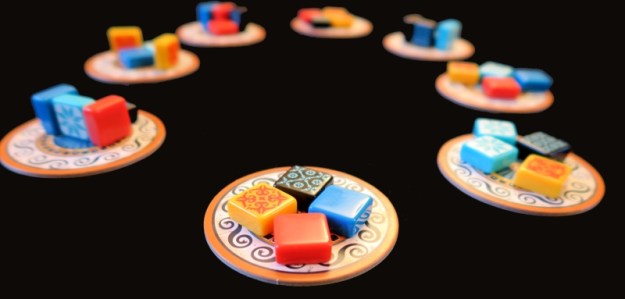
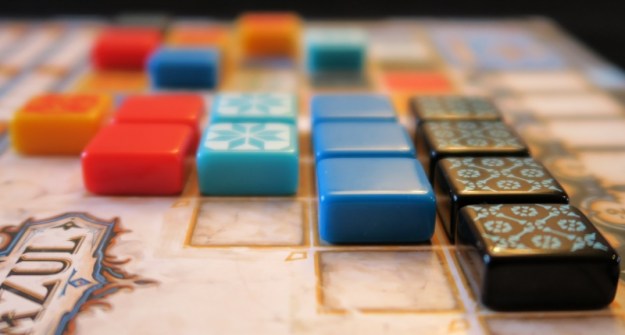
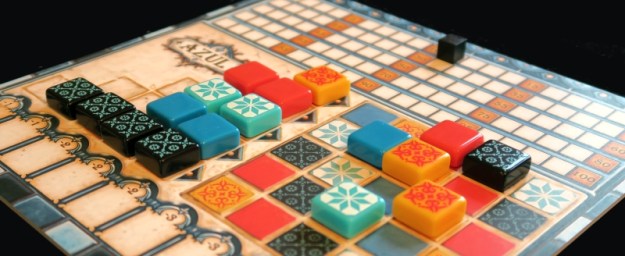
Meanwhile, Blue, Saffron, Purple and Lime were playing Azul.  We’ve enjoyed the recent versions of these (Stained Glass of Sintra and Summer Pavillion), but this time the original was the game of choice.  All three use the same market mechanism where players either take tiles of one colour from one of the small markets and put the rest in the central pool, or take all the tiles of one colour from the central pool.  In this original version of Azul, players add these tiles to the channels on the left of player board, and at the end of the round if any of these are full, they move one tile to their mosaic and recycle the rest.

Azul
– Image by boardGOATS

Players score points for placing tiles such that they are part of a row and/or a column in the mosaic and at the end of the game, players score bonus points for completed rows and columns and also for placing all five tiles of any one colour.  There is a catch, however.  When a player takes tiles, all the tiles must go into a single tile channel, and must be of the same colour as any that are already there.  Any left overs score negative points and, as the more left over tiles a player has, the more negative points each one will score.  This has the potential to leave one player picking up lots of tiles and scoring lots of negative points.

Azul
– Image by boardGOATS

This time, that player was Lime.  Having scored a few points during the first round, he was unimpressed when all his negative points at the end of that round pushed him straight back to zero.  This wasn’t the only time that happened though, to the point that it became a bit of a running joke, especially as he made it a point every round to take the first player token (which counts as another negative tile).  One of the key tactics of the game is to try to complete tile channels at the end of the round because these are then emptied leaving the maximum amount of flexibility for the next round.

Azul
– Image by boardGOATS

And this is exactly what Saffron did.  Despite never having played the game before, by focusing on completing her tile channels she was always able to dig herself out of any difficulties.  Although the game was longer than Draftosaurus, it didn’t seem like very long before Purple triggered the end of the game by completing a row, the only one to do so.  It was quite close, but Blue just edged it from Saffron who took an excellent second.  With that, Lime headed off (before the drawbridge was raised) and Blue left Purple and Saffron chatting while she went to watch the last few rounds of Altiplano on the other side of the room.

Azul
– Image by boardGOATS

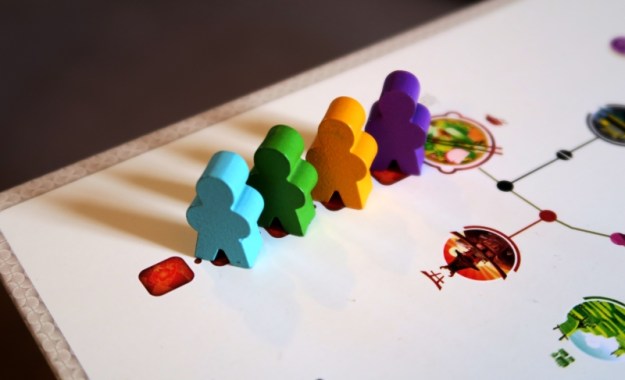
Altiplano is a much longer game and one that we are very fond of in the group.  Indeed, it was the first winner of the Golden GOAT award (in 2018), though we haven’t really been able to get it to the table since then.  For a while, it had been in the plan to play The Traveler expansion, however, we wanted to play the base game again first and with both Teal and Sage new to the game only the Sunny Days mini expansion was included.  The basic mechanism of the game is quite simple:  on their turn, players carry out the action based in the location their meeple is in, and optionally, moves their meeple either before or after, if they can.

Altiplano
– Image by boardGOATS

The game is a “bag building” game, so a bit like its predecessor, Orléans, or even deck builders like Dominion, players need the correct resources to be available when they carry out the actions.  So, at the start of each round, players draw resource disks out of their bag and place them on their player board to be used in the locations they plan to visit.  Mostly the game trots along quite merrily as this stage of the game is carried out simultaneously and everyone does their planning at the same time so the action phase is quite rapid.  Pink explained what all the different locations did and that there were two main sources of points:  Contracts and Resources.

Altiplano
– Image by boardGOATS

At the end of the game, the resources give points with the amount depending on what it is: primary resources score one point (wood, stone, fish etc.) while advanced processed materials (like cloth and glass) can score up to three or four points.  These will score even more points if they are stored in the Warehouse.  When a resource is used it is places into the players recycling box and goes back into their bag when their bag is empty.  In this way, instead of relying on probability/luck as in Orléans where used resources are returned straight to the bag, all resources are used before they are recycled.

Altiplano
– Image by boardGOATS

Players can leave unwanted resources on their player board, but this can obstruct their plans, so another option is to move them to the Warehouse.  Once in the Warehouse, they cannot be removed, but each full shelf (which can only store one type of resource), gives more points at the end of the game.  Only completely full shelves score in this way, which cost Pink some valuable points when he realised Ivory had pinched the last available fish just before he got there.

Altiplano
– Image by boardGOATS

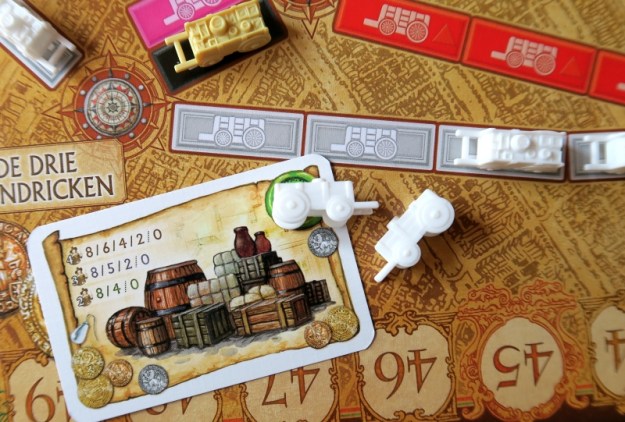
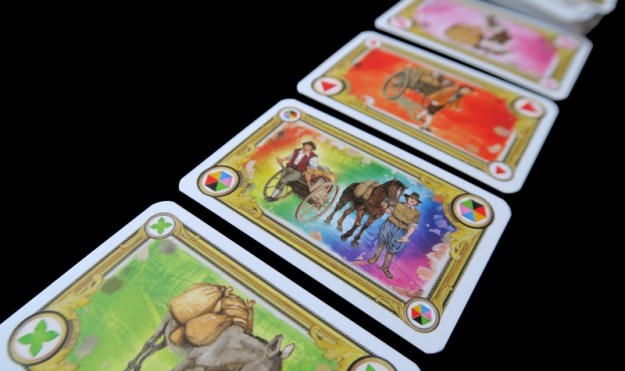
The other main route to scoring points is through completing Contracts.  Players can only have one on the go at any one time, but when complete, they are worth points and also provide the player with a corn which goes straight in the warehouse and can act as a space-filler too.  As well as getting resources from the Wood, Mines, Seafront etc., players can also buy Contracts, build Carts (to provide them with additional travel options), build Boats or Huts (which provide resources and increase their resource scoring), or buy Board Extensions which give them enhanced abilities.  These Extensions also act as a timer triggering the game end.

Altiplano
– Image by boardGOATS

The game was really tight and despite the fact that all four protagonists employed different strategies, a postage stamp would have covered the final scores.  Pink, despite having carefully explained the importance of Contracts as a means to get points, decided to see how he could do by avoiding them completely—the only one to do so.  He concentrated instead on getting resources, especially high value ones, and storing them in his Warehouse.  Teal’s strategy was driven by the fact he started with the Woodcutter which allowed him to turn food into wood, so he concentrated on building Canoes, lots of Canoes.  This was not a strategy anyone had seen before, but it provided him with a lot of resources.

Altiplano
– Image by boardGOATS

Ivory went for Contracts in a big way, taking a massive fifty-five points for them alone.  Since resources on Contracts don’t score in and of themselves, however, this meant he scored fewer points elsewhere.  Sage went for a more “all round” strategy, picking up a lot of points for his contracts too, but also building a lot of Huts to enhance his resource score.  As the game came to a close there was the inevitable checking what the final Extension tiles and then everyone took their shoes and socks off for the complex final scoring.  The winner, on his first time out was Teal, his unconventional Canoe strategy netting him eighty-six points.  Pink finished second with eighty-three and Ivory was just one point behind that, in what had been a very tight game.

Altiplano
– Image by boardGOATS

Learning outcome: Teach a man to fish, and he’ll swap them for a pile of stones.

27th January 2022 – In Memory of Burgundy

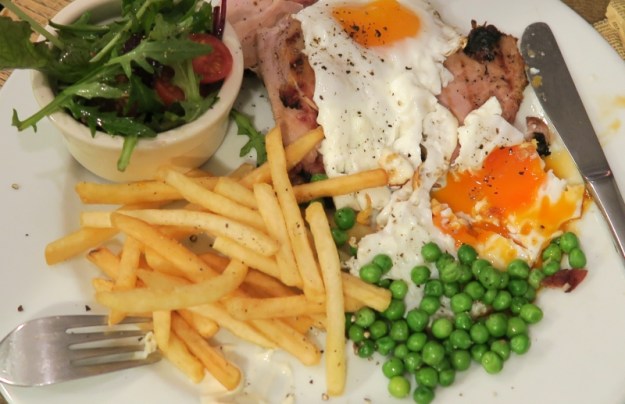
Following the very sad passing of Mike Parker (known on this site as Burgundy), we decided to dedicate this meeting to his memory.  We decided to forgo the usual “Feature Game” and replace it with “Burgundy’s Favourites”, including games as diverse as Concordia, Orléans, Wingspan, Killer Bunnies and the Quest for the Magic Carrot and Dominion. Burgundy had supper at the pub before every games night. Because he always had the same thing, he was known as “Ham, Egg & Chips Man” by the staff at The Jockey.  So we decided to gathering early to reminisce and celebrate his gaming life, and share his favourite supper.

Ham, Egg & Chips
– Image by boardGOATS

Burgundy’s cousins joined us for dinner and we took it in turns to chat and learn things we didn’t know about him. We also had a couple of special guests from elsewhere in the county who fancied joining us to do a bit of gaming in Burgundy’s memory. Chatting to people who knew him in slightly different spheres, one of the first things we found out was that, a creature of habit, Burgundy was known known for having Lasagne when he went to Gweeples, setting up his game while he waited for his molten supper to cool to a point where he could eat it.  There was lots of chatter over dinner and Lime joined us online, but technology difficulties meant he hopped in and out and then, after several rounds of the Hokey-Cokey, eventually gave up.

Mike Parker
– Image by Daniel Monticelli

Black also briefly joined us from Malta—he’d been to a Greek restaurant for dinner, but we all agreed our Ham, Egg & Chips was better.  After a toast to Burgundy, who will never be forgotten, people eventually settled down to play games.  First up was Ivory, Pink, Lilac and Teal who chose Ticket to Ride with the UK map.  Ticket to Ride was one of Burgundy’s favourite games and is popular with the whole group so everyone knows the basics of how to play:  on their turn, the active player can choose two coloured cards from the market to add to their hand, place trains paying with cards, or draw tickets which give extra points at the end of the game if completed.

Ticket to Ride Demo
– Image by boardGOATS

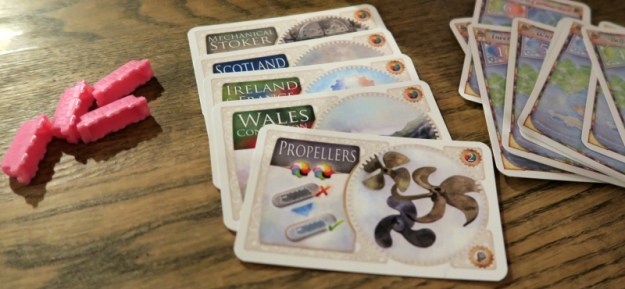
Every expansion set comes with a slight rules twist.  In the case of the UK map, this is the addition of technologies and concessions.  At the start of the game, players can build only one and two train routes and only in England.  By spending wild cards, players can buy technologies which enable them to build routes consisting of three trains or more, build ferries, and build train routes in Scotland, Wales and Ireland. Players can also buy bonus cards that allow them to score extra points for taking certain actions during play.  As usual, the game ends when one player only has two of their plastic trains left and the winner is the player with the most points.

Ticket to Ride Map Collection: Volume 5 – United Kingdom & Pennsylvania
– Image by boardGOATS

Pink (playing with his special pink trains for the first time) started off with a “Home Nations” strategy, eschewing the chance to visit France.  Lilac, on the other hand, explored the Dawlish coast and the area around Dundalk.  Teal took the East Coast Mainline north, and explored Scotland as far north as Wick and Ivory took the West Coast  Mainline and continued up to Stornaway.  The game was really tight, with Lilac, Pink and Ivory all completing nine tickets, and that seemed to be the strategy with Pink the eventual winner thanks to being slightly luckier than the others, finishing just three points ahead of Lilac.

Ticket to Ride Map Collection: Volume 5 – United Kingdom & Pennsylvania
– Image by boardGOATS

Meanwhile, on the next table, Green, and Magenta were joined by visitors from Oxford and Gweeples, Sage and Jade in a game of Splendor.  Splendor is a simple game, but one at which  Burgundy was a true expert, and at one point went unbeaten for two years.  The idea is that players use poker chips to buy cards which can, in turn be used to buy more cards of a higher value which eventually give points.  When a player reaches fifteen points, that triggers the end of the game and the player with the most points wins.  Game-play is very simple: on their turn players can take three different coloured chips, take two chips of the same colour, buy a card from the display, or reserve a card taking a gold token (which is wild) at the same time.

Splendor
– Image by boardGOATS

As is usual, the game started slowly with Magenta eventually opening the scoring. The others followed with low scoring cards, but Magenta remained one step ahead until everyone else started claiming the higher scoring cards and eventually Nobles.  Green pulled ahead and looked like he might pull off a true Burgundy style victory, but Sage was closing in.  Sage obstructed Green with a tactical reservation, but that just put off the inevitable for another turn. When Green reached fifteen points, the game ended immediately as he was the last player in the round.

Splendor
– Image by boardGOATS

Sage was a close second with the early leader, Magenta, in third. There wasn’t a high score, a resounding win, as there no doubt would have been had Burgundy had been playing, so victory did not feel fully deserved in his absence.  Blue and Purple had been chatting to the family, who were enjoying talking and, after a long day, were reluctant to play anything.  So, when they left to get an early night, Blue and Purple played a quick filler game of NMBR 9 while they waited for something else to finish.  Burgundy played NMBR 9 a lot over the years and, like everything else he was always very good competition, winning more than he lost.

NMBR 9
– Image by boardGOATS

The game has almost zero set up time, and doesn’t take long to play or put away either.  There are twenty cards (zero to nine), which have matching tokens.  Each round, one card is revealed and players take a matching tile and add it to their tableau.  A player’s tableau consists of layers of tiles.  When placing tiles, they must be placed alongside other tiles, or on top.  If placing on top of other tiles, they must overlap more than one, be placed adjacent to others, and next to at least one other on the same layer.  Neither Blue or Purple were focused entirely on the game which Blue edged, as they were too busy gossiping and watching what was happening on the next table.

NMBR 9
– Image by boardGOATS

The game of Splendor and NMBR 9 finished pretty much at the same time, and the group joined up for a game of 6 Nimmt!.  6 Nimmt! is another game that Burgundy really enjoyed playing with the group and indeed, played a lot.  This was especially true online over the last couple of years, where he played forty-three times with us, winning over one in four of the games.  Jade had only played online, so the group introduced him, and indeed Sage as well, to the variant we usually play.  We play the game in two halves, dealing half the deck out for the first round and then the other half for the second round.

6 Nimmt!
– Image by boardGOATS

Everyone was familiar with the basic game play:  simultaneously choose a card which is added in turn, starting with the lowest, to one of the four rows in the play area.  Each card is added to the row that ends with the highest card that is lower than the card played.  If it is the sixth card, the player “wins” all five cards in the row, and their card becomes the new first card.  In contrast to the online version on Board Game Arena, where players start with sixty-six points and count-down to zero, players start at zero and the player who “wins” the most points is the loser.

6 Nimmt!
– Image by boardGOATS

This time, Green “won” the first round, top-scoring with twenty, while Sage managed to keep a clean sheet.  As Burgundy was always the exemplar though, performance in the first round is often no indication of how the second round will go, which is one of the reasons why we love this variant.  So it was all to play for, especially for everyone who’s first score was in single figures.  This time it was not to be, however, and although Sage picked up thirteen “nimmts” in the second round, everyone else’s total was more.  It was close at the other end and with lots of pretty coloured cards, Purple and Jade high-scored with twenty-nine.

6 Nimmt!
– Image by boardGOATS

Ticket to Ride was still going and with six players, and time marching on, there was only really one option, the option Burgundy would have chosen: Bohnanza.  Jade had never played it before, so, after a quick rules summary, as is often customary in this group, he went last so he could see how things work and get a feel for the game.  In this game, although we generally play “friendly”, it is particularly important as it is a trading game and it is important to be able to get a feel for the value of any advice offered.

Bohnanza
– Image by boardGOATS

As Purple pointed out, the most important thing about Bohnanza is not to sort your cards because players play cards from the front of their hand and add cards to the back forming a sort of conveyor-belt.  On their turn, the active player plants the first bean card in their hand into one of their two bean fields, and may plant the second if they choose.  Two cards are then revealed and these can be planted by the active player or traded.  This leads to another key rule: what is on the table must stay on the table so anything traded must be planted.

Bohnanza
– Image by boardGOATS

Fields can be harvested at any point, with some of the cards being turned over and stored as coins.  However, beans can only go in empty fields or share fields with beans of the same type.  Players only have two fields (or three if they buy a third), so if players are unable to trade a card away, they may have to harvest fields before they are ready.  In this sense, we generally play “friendly” and rather than forcing players to plant something they don’t want, we have a culture of giving cards away.  This extends to players taking cards in free trades from someone’s hand to further their game too.  As a result, the game sometimes the player who is best able to make the most of these freebies is the winner.

Bohnanza
– Image by boardGOATS

Unusually, and to the accompaniment of a lot of sucking of teeth from everyone else round the table, Sage ponied up his two coins for a third bean field—the only one to do so, and especially risky in the second round.  He wanted to plant a couple of Red Beans though, so at worst it was probably revenue neutral and certainly worth the risk.  Blue benefited from a lot of Coffee bean donations while Purple, Green, Jade and Magenta all planted the highly lucrative, but quite scarce, Black-eyed Beans.  The first round took an age, but in contrast, the last was really short, so short, Sage sadly commented that although he had the perfect hand, he wasn’t going to be able to play it. 

Bohnanza
– Image by boardGOATS

It was a close game though, and an extra turn or two could have made all the difference.  As it was, Blue was the eventual victor with sixteen “Bohnentaler”, three more than Jade.  Time was pressing and that was the last game for that group, but in the meantime, on the next table, Ticket to Ride had finished and the quartet had moved onto what was arguably the game of the night, Splendor.  This time, the game started with a shortage of blue, sapphires, then green emeralds became hard to get.  It was nice to note that everyone played according to Burgundy’s maxim, “Always take a free one.”

Splendor
– Image by boardGOATS

In the end, Pink ended the game, and although Ivory managed to score in his final turn, he wasn’t able to catch up.  As the games came to an end and everyone chatted, the mood was sombre, perhaps with half a mind to the following day.  In spite of that, it has been a good evening making new friends, and playing games.  All evening Burgundy was never far from our thoughts, but that was particularly true during the two games of Splendor.  And he always will be whenever we play Splendor from now on.

Mike Parker
– Image by Pushpendra Rishi

Learning outcome:  Mike, Burgundy, was THE GOAT, and we all miss him.

13th January 2022

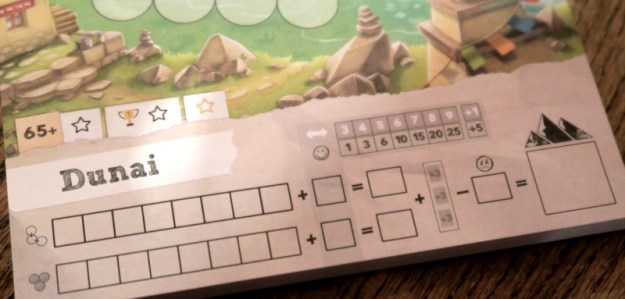
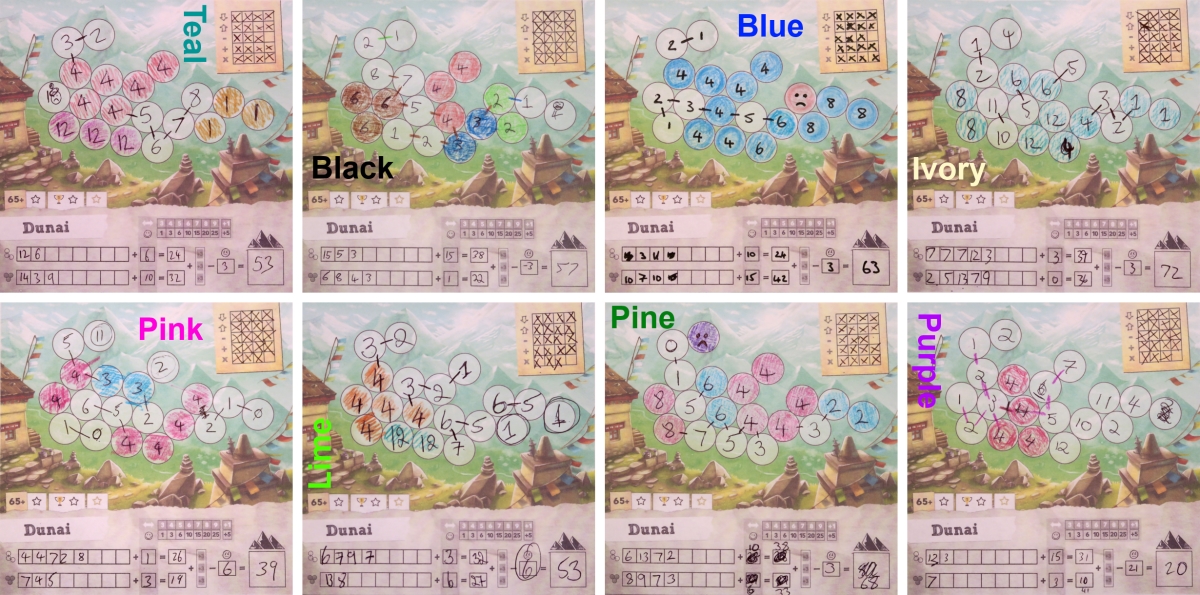
Blue and Pink were the first to arrive, soon joined by Black and Purple.  Others quickly rolled up and before long, everyone was discussing what they’d been doing over the holiday.  Teal produced a new “Roll and Write” game that everyone could play together, called Trek 12: Himalaya, a game where players are climbing a mountain.  He gave a quick summary and demonstrated how he’d raided the stationary cupboard so everyone quickly agreed to give it a go.

Trek 12: Himalaya
– Image by boardGOATS

The game has some prima facie similarities to On Tour which we played remotely a couple of times, in that two dice are rolled and their results combined.  In On Tour, the results are simply combined to make a two digit number, so a two and a three can make a twenty-three or a thirty-two.  In Trex 12, the numbers are combined by addition, subtraction or multiplication and additionally players can pick either the larger or the smaller individually, with each option available a total of four times during the game.

Trek 12: Himalaya
– Image by boardGOATS

Players are trying to make chains of consecutive numbers and groups of the same number—runs and melds, which represent ropes and camps respectively.  At the end of the game, players score for the highest number in the rope (or camp), plus one additional point for every other connected point (which must be connected when they are played).  Additionally, players score bonus points for the longest rope they make, and the largest camp, and penalties for any isolated numbers that are not part of a rope or a camp.

Trek 12: Himalaya
– Image by boardGOATS

It took a couple of turns to get going, but thereafter it was quite quick.  The game has a sort of legacy element with alternative maps and envelopes that can be opened once certain challenges have been met, but we played the Dunai map and without any complications.  Teal pointed out that although the first number can go anywhere, thereafter numbers must be written next to other numbers so it was wise to keep options open.  Pink therefore started at one end, immediately demonstrating how to make the game more challenging.

Trek 12: Himalaya
– Image by boardGOATS

Pine and Blue seemed to be working to very similar strategies with a long rope and a large “Four” camp in the middle, though Pine made a better fist of it and finished in second place with sixty-eight.  Ivory was the overall winner though, with lots and lots of short bits of rope of high value and a final score of seventy-two, well clear of the total needed to beat the game.  Trex 12 had been both quick and enjoyable, so after that aperitif everyone was ready to move on to something a little more filling, and the group split into two, the first playing the “Feature Game“, Streets.

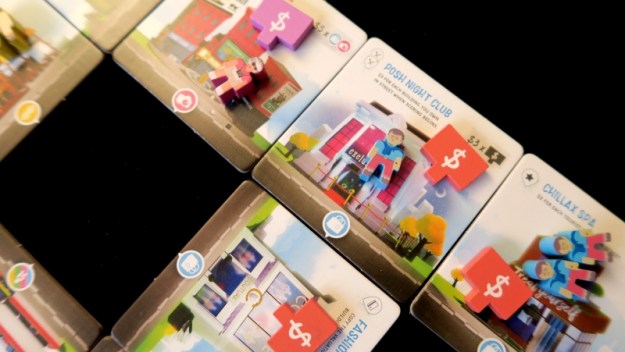
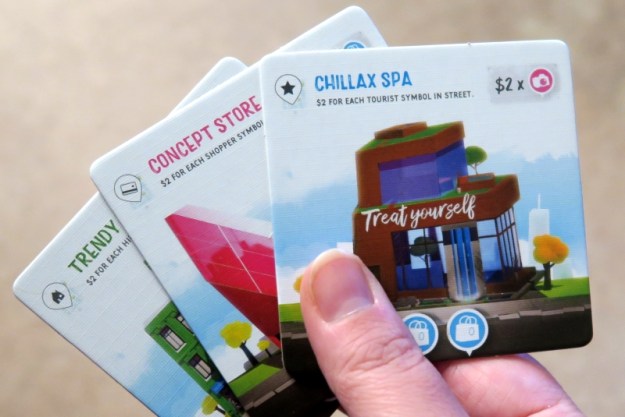
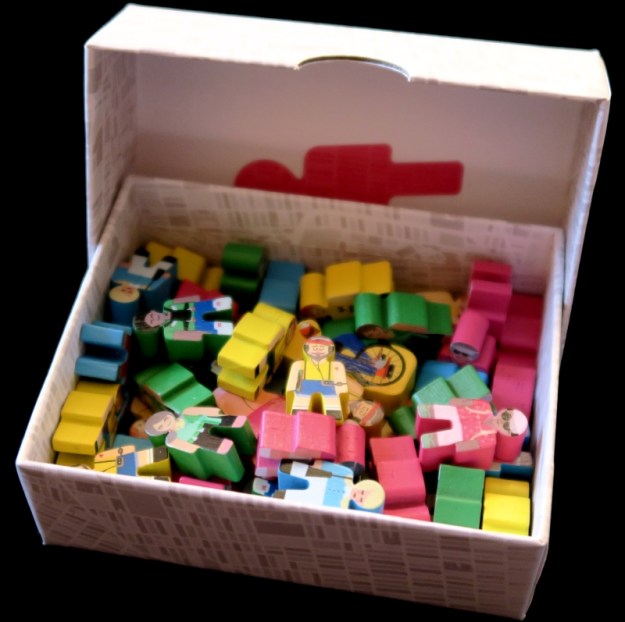
Streets
– Image by boardGOATS

Streets is a tile laying game by the same people as the very enjoyable Villagers.  It is, perhaps, a little lighter and, rather than developing the occupants of a village, players are building a city, transforming it street by street, from a small town into a centre of culture and commerce.  The turn structure is similar to more familiar games like Carcassonne: On their turn, the active player chooses a building tile, adds it to the town, places an ownership marker on it and then scores any completed features, in this case, Streets.

Streets
– Image by boardGOATS

Although there are similarities, there are a lot of differences: players have a hand of three tiles all of which represent buildings; as well as ownership tokens, the active player also places people on the building, then there are the tile placement and scoring rules.  The building tiles have a road at the bottom and sky at the top and can be placed such that a Street, a row of houses, is extended by adding the tile to it in the same orientation, or terminated so that the road is perpendicular forming a junction.  When both ends of a Street finish in a junction, the Street is closed and scored.

Streets
– Image by boardGOATS

Different buildings score in different ways, for example some tiles give points for people in the Street and others for the number of building symbols in the Street.  There are a few little niggly little rules.  For example, when scoring a Street players include the symbols on the street itself, but also any on a tile that terminates the Street and points towards it.  There are other ways of scoring buildings as well, for the number of adjacent tiles or copying another building of choice in the Street for example.  In addition to the money won for the building itself, players also score for the number of people on the tile scored.

Streets
– Image by boardGOATS

When a building is scored, the active player moves the people on to different building in another, open Street.  This encourages players to terminate Streets even though they might not score themselves, because they can move people onto their own buildings elsewhere which means they will score more later in the game.  There are a few other things that contribute to the decision making dilemmas.  For example, players only have five ownership tokens, and if they run out, they have to take them from another building without scoring it.

Streets
– Image by boardGOATS

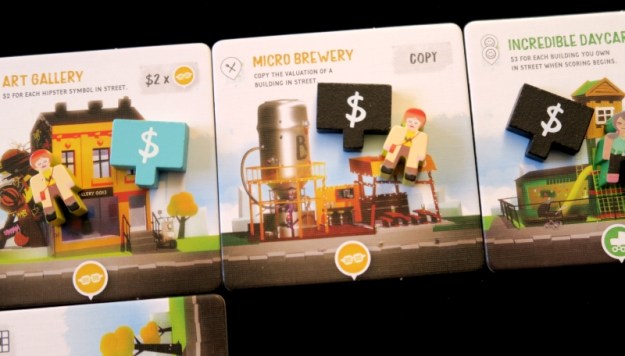
The game ends when all the tiles have been played and any remaining Streets are scored, but for half points (similar to Carcassonne).  The basic game is quite straight forward, but although most people got to grips with it, the combination of small text, symbols, a little confusion of terminology and general tiredness meant others struggled with planning effective moves.  Black took what was obviously an early march when he played his micro-brewery tile to “copy” another high-scoring tile in the same street, but Purple, Blue and Pine had their moments too.

Streets
– Image by boardGOATS

In the end, Black won with a cricket score of a hundred and twenty (well, a score that would have beaten England in the recent Ashes series anyhow).  Blue, Purple and Black quite enjoyed the game and could see the its potential for adding expansions too.  Definitely one to be played again, though Pine might need some persuading.  Meanwhile, on the next table, Ivory, Pink and Teal were getting to grips with a game of Key Flow (Lime having taken an early night after another very early morning).

Key Flow
– Image by boardGOATS

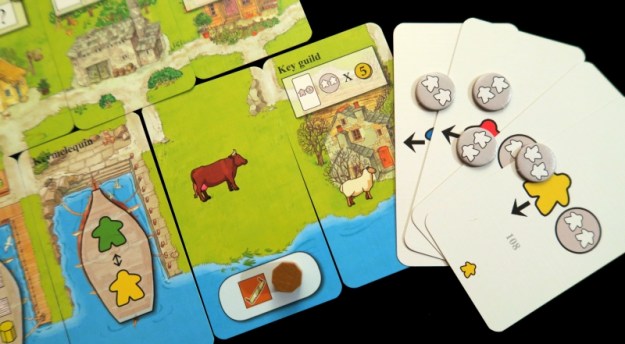
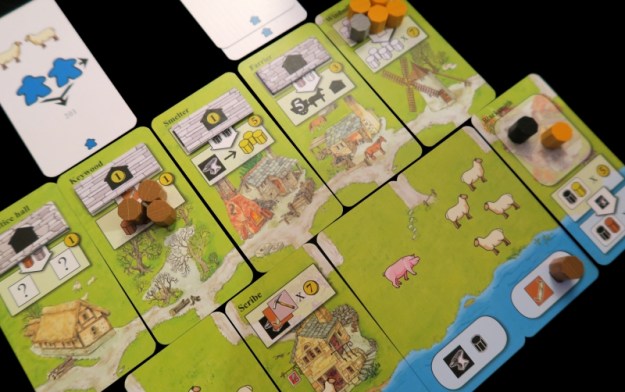
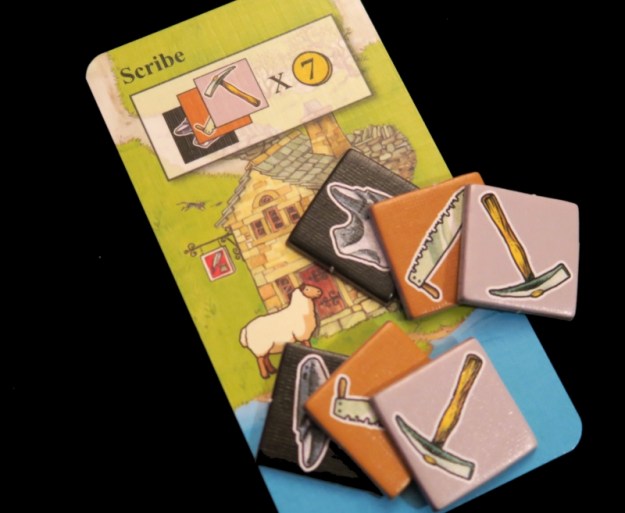
Ivory and Pink have played Key Flow and its big brother, Keyflower, many times before (including relatively recently in October), but Teal was new to the game though he’d heard good things.  In both games, players are building villages and activating the buildings in their villages by playing meeples (or rather Keyples) to generate resources and score points.  The games have a lot in common including the artwork, the iconography and the fact both take place over four rounds or seasons, but the underlying game mechanism is different.  In Keyflower, players acquire tiles by auction where in Key flow players gain cards by drafting.

Key Flow
– Image by boardGOATS

Key Flow is surprisingly straightforward to play, though doing well is a completely different matter.  Players who start with a hand of cards, choose one and pass the rest on, adding their chosen card to their village before they get their next, slightly smaller hand.  There are three types of card:  Village cards, Riverside cards and “Keyple” cards.  Village cards are buildings that can be activated by playing Keyples above them, while Riverside cards provide instant resources and skill tiles.

Key Flow
– Image by boardGOATS

The cards have to be “connected” together and location can be important. Buildings for example are more productive if they have been upgraded, but upgrading needs resources and the resources need to be moved to the building being upgraded. Similarly, in autumn there are some buildings which score points for resources they are holding. Therefore, it is helpful if the building producing the resources is near to the one being upgraded or used for scoring as moving resources can be expensive and sometimes difficult.

Key Flow
– Image by boardGOATS

Simlar to the Keyples in Keyflower, the Keyple cards are used to activate buildings and produce resources.  Some can be played either in a neighbour’s village or the player’s own village.  Other cards can only be played in the village one side or cannot be played in one’s own village.  This is why three players is arguably the sweet-spot for Key Flow—with more players there is at least one village players cannot use, adding a level of randomness that it is difficult to deal with.  With three however, everything in play is accessible, though perhaps at a cost.

Key Flow
– Image by boardGOATS

At the start of the game players get some winter cards which can act as objectives to guide players’ strategies; at the start of the final round players get to keep one of these with the rest going into the draft.  At the end of the game, players score for any autumn cards, any buildings with upgrades as appropriate, any winter cards and finally one point for any otherwise unused gold.

Key Flow
– Image by boardGOATS

This time, Pink went for a “Scholar Strategy”, but changed his mind at the last minute to go for the Ranch instead.  Teal went for a gold strategy with the Jeweller to double his score, and picking up both the Gold Mine and the Smelter, the latter of which he upgraded so he could exchange one skill tile for three gold.  Unfortunately, Pink found that useful too and therefore got in his way somewhat.  Ivory didn’t appear to have a strategy early on, but made sure he had plenty of resources he hoped would be useful later in the game.

Key Flow
– Image by boardGOATS

In the final round, Pink got his Scholar anyhow then lucked out and got the Trader too, while Teal’s flotilla of boats gave him a lot of options, but somehow he struggled to convert them into points.  Ivory who had been keeping all his options open with a scatter-gun approach, managed to finish with a smorgasbord of points from pigs, Keyples, travel, and of course resources.

Key Flow
– Image by boardGOATS

It was not a surprise Ivory won as he always does well in this game, but Pink was very pleased to have run him close finishing just five points behind.  With that, people started to drift off, a few people hung about for a while, just chatting, amongst other things, discussing what “Cotton Clouds and White Cashmere” smells like and whether the new soap in the Ladies really did smell of it…

Key Flow
– Image by boardGOATS

Learning Outcome:  “Roll and Write” games aren’t only the preserve of “Remote Gaming”.

30th December 2021

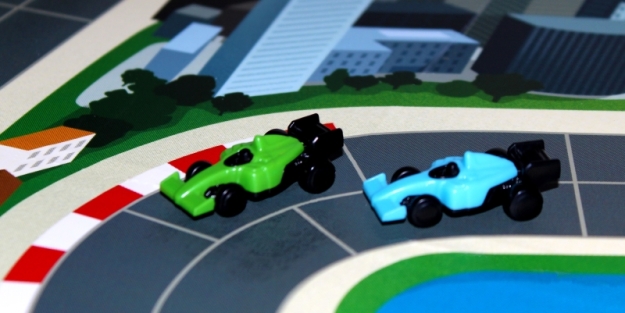
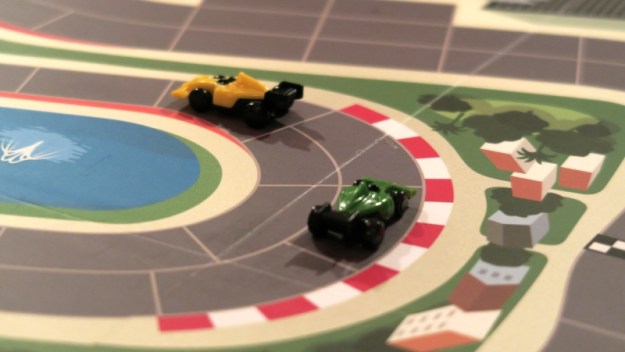
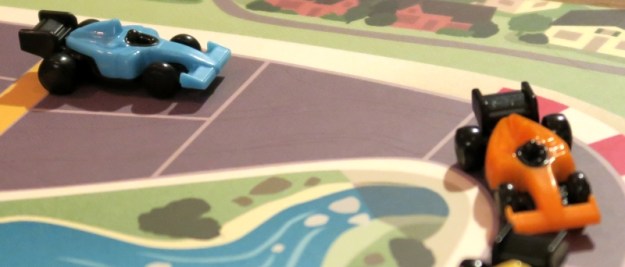
It was a quiet night, but nonetheless very enjoyable.  Blue and Pink were just finishing their dinner when Lime arrived, and after some chit-chat, they were joined by Pine.  In previous years, we’ve held a New Year Party where we play the gorgeous puck-flicking, racing game, PitchCar, so in the absence of this, the “Feature Game” was another classic car racing game, Downforce.

Downforce
– Adapted from image by BGG contributor kalchio

We played this at New Year last year, but that was remotely (through Board Game Arena).  The online rendering of the game is really very good with lots of brilliant sweary graphics when a driver finds their way blocked and we all enjoyed playing it.  Although playing online is infinitely better than not playing at all, it is a poor substitute for the real thing.  So, Pink in particular, was really looking forward to giving an outing to his brand-spanking new Christmas copy, courtesy of the Board Game Geek Secret Santa (great choice Santa—thanks!).

Downforce on Board Game Arena
– Image by boardGOATS from boardgamearena.com

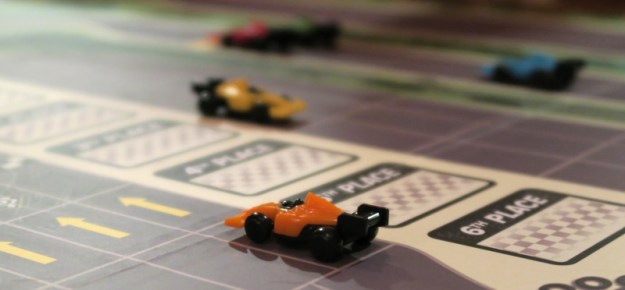
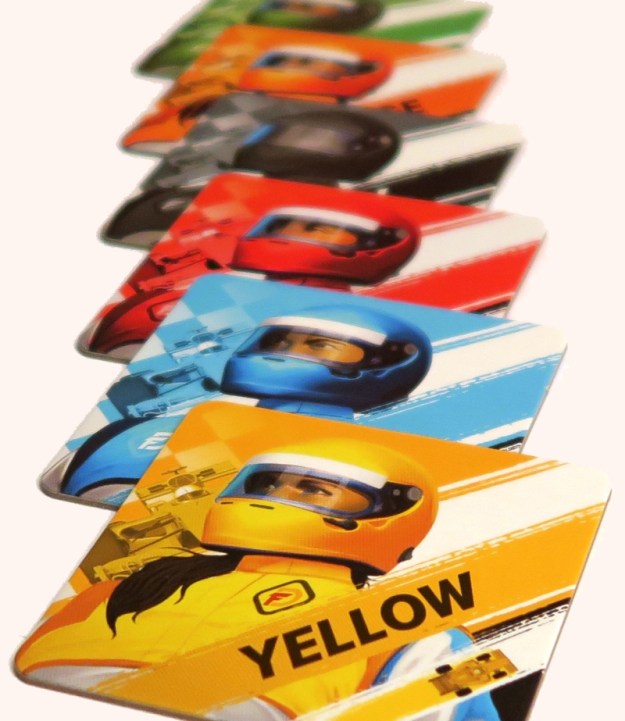
Game play is quite simple, but also very clever.  Players have a hand of cards and on their turn play one and move the cars shown.  The game begins with a car auction, so the card may show their own car, but more than likely shows several and may or may not include their own.  Starting with the fastest card (the one at the top) players then move the cars one at a time.  The player with the winning car wins money, but players also have three opportunities to bet during the race.  The player with the most money at the end of the game is the winner.

Downforce
– Image by boardGOATS

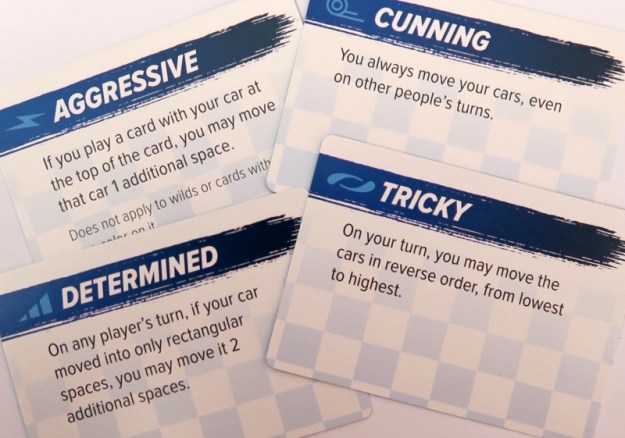
There are a lot of variants and “House Rules” for Downforce, including substituting the auction for random (secret) draw, changing or omitting the betting, and including special power cards (either drawn at random or included in the car auction).  There are also several maps available, two in the base game and two in each of the Danger Circuit and Wild Ride expansions (which also have special rules).  This time we played essentially with the “Rules as Written”, and included the special power cards (auctioned with the cars at the start) and began with the River Station track from the base game.

Downforce
– Image by boardGOATS

The first hurdle was everyone trying to think up a name for their team—there was a strong feline element with Nikki Meowda, David Cat-tard and Stirling Meowss all being suggested.  Dick Dastardly, Penelope Pitstop and Pat Pending came up as people reminisced about Wacky Races and Pine-erton Fittipaldi, the Green Cross Code Man and Staying Alive all raced too during the evening.  Blue and Pine put their paws in their respective pockets and bought themselves two cars with a choice of special powers, and hoped to dominate the race.

Downforce
– Image by boardGOATS

Blue had the Cunning power and made good use of it during the game, though in truth it was rare that she really had a meaningful decision to make.  Pink made better use of his Tricky power which enabled him to move cars in reverse order on his turn—he only used it a couple of times, but made them count.  Lime’s Determined power was also really helpful enabling him to move an extra couple of spaces when he finished on a straight.  Pine, however, was less fortunate and despite winning two auctions was left with an uninspiring special power.

Downforce
– Image by boardGOATS

Crossing the first betting line in front encourages people to bet on your car and then, invested in its outcome, they tend to help it along for the rest of the race.  This is a game where a little help goes a long way so a good start is really important.  Lime’s single car and one of Blue’s two cars got away well and competed for that all important early lead.  Blue led across the first betting line, but Lime was only just behind leaving it all to race for.  And they continued to battle for the lead, leaving the others to fight it out in their wake.  Lime was the first to the all important finish line, but Blue took both the remaining podium places with her two cars, which meant it was all down to the betting and initial expenditure.

Downforce
– Image by boardGOATS

Despite professing to have failed to understand the betting rules, Lime took the magnum of champagne and twenty million, just two million more than Blue.  Pink played a blinder to take the final place on the podium with seventeen million despite his car coming in last, a total helped by his minimal initial outlay and betting on the eventual winner at every opportunity.  It had been fun, and when Lime suggested playing again, everyone was quite happy to oblige, so the map was flipped over to give the Marina Bay track a go.

Downforce
– Image by boardGOATS

Pine again picked up two cars in the auction, but this time Lime joined him with Pink again taking the last car and getting the Determined special power.  Lime once again took an early lead and used his Tricky special power to great effect at key moments.  It was clear in spite of the hidden betting that Lime was likely to be the one to beat.  There was some discussion about whether he should be helped or hindered, but eventually he crossed the line first.  Pink’s solitary, but very Determined car made it home in second and with him betting on himself that left them both of them with a final purse of twenty million and a tie for first place.

Downforce
– Image by boardGOATS

Pine’s second car was still cruising round the final corner while a steward’s inquiry established that Lime was the winner by virtue of his higher placing in the race.  It had been a lot of fun, but undoubtedly, a car that takes an early lead has a big advantage.  There are lots of “House Rules” available to try to mitigate this effect (modifying the betting, blind dealing of cars, and restrictions on when players can play their super-speed card for example), so we might try some of those next time to mix things up.  That said, the expansion maps will change things as well, so we will see.  It is certainly a game that will come out again and again for some time to come.

Downforce
– Image by boardGOATS

Time was marching on and Lime was concerned that the drawbridge over the Thames might be raised if he left too late, but there was just time for a quick game of Ticket to Ride: Amsterdam.  Everyone in the group loves Ticket to Ride and the little city versions are great in that they capture all the flavour of the full versions, but in a smaller, quicker package.  As in every other edition, on their turn, players can take cards, play cards to place pieces (in this case carts), or take new tickets.  Players score points for placing carts and for completing the routes depicted on their tickets (with any unfulfilled tickets giving negative points).

Ticket to Ride: Amsterdam
– Image by boardGOATS

Each map has its own special little feature and in the Amsterdam version has extra goods cards awarded for completing specific sections of track; these give bonus points for players with more of these at the end of the game.  Pink, Lime and Pine started hard, but Blue soon caught up making for a tight game.  Blue skirted round the north leaving the others to fight over the city centre and particularly Lime and Pine to curse when Pink grabbed a singleton and obstructed their plans from the very first turn.

Ticket to Ride: Amsterdam
– Image by boardGOATS

Towards the end of the game, Pink started picking up tickets and was quickly followed by everyone else except Lime who stuck with his starting hand and concentrated on completing them.  Pine debated whether or not to pick up tickets and in the end went for it only for Blue to promptly trigger the end of the game.  Blue had a significant lead, but as always, tickets would be critical and everyone was in with a shout.  Sadly it was not to be:  Blue had completed all hers and also finished with the most goods cards giving her the bonus for that too and with it a total of forty-five points, eight more than Pink in second place.

Ticket to Ride: Amsterdam
– Image by boardGOATS

Learning Outcome:  Santa is Awesome.

16th December 2021

Ivory, always excitable when it comes to Christmas, was first to arrive, shortly followed by Blue and Pink, with armfuls of crackers, parcels, party poppers and Golden GOAT voting forms. It was our first visit to The Jockey since the retirement of the Charles and Anna, but Michelle and John made us very welcome on their first full day, and were very understanding of the noise mess we inevitably made.

"Un-Christmas Party" 2021
– Image by boardGOATS

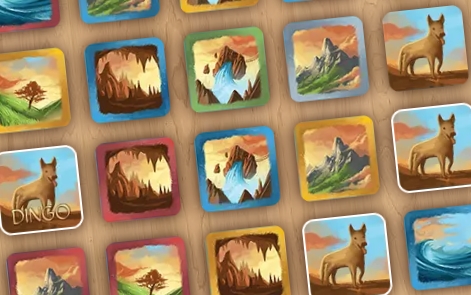
We started with the crackers, frantically chasing dice, chocolates, and meeples all over the place, and then suffering the flock of appalling goaty jokes with which they were filled. As people munched the chocolates from their crackers they filled in their Golden GOAT voting forms, then Pine and Pink collated the results.  There were lots of nominations for GOAT Poo, but the runaway winner was Dingo’s Dreams.  This is probably quite a clever game that we would normally enjoy, but we played it online with lots of people, none of whom had any idea what they were trying to do.  As a result, the complete chaos made for a very un-fun experience all round.

Dingo's Dreams
– Image by boardGOATS from boardgamearena.com

Discussion surrounding the Moment of the Year included reminiscences of the time Lime accidentally joined an online game of 6 Nimmt! with a bunch of Frenchmen, but that was last year and therefore not eligible this time round.  Pine and Pink fondly remembered the pasting they gave to Burgundy and Blue when they played Ticket to Ride: Heart of Africa, but the winner was the online game of Niagara when Pink won by stealing gems from everyone else—an event that still lingers in the the memory of those who were robbed and are even now dreaming of revenge.

Niagara
– Adapted by boardGOATS from image by
BGG Contributor El_Comandante

With all the online gaming, there was less competition than usual for the Golden GOAT award.  Indeed, the 2019 winner, Wingspan, was very nearly the first game to win the Golden GOAT award twice, but much to Green’s obvious delight, it was just pipped to victory by Praga Caput Regni – quite an achievement given that only four people in the group had even played it.  We spent our winnings from the quiz on appetizers and with some having a full three-course dinner, we weren’t finished till quite late.  There was just time for a game or two though…

Golden GOAT - 2021
– Image by boardGOATS

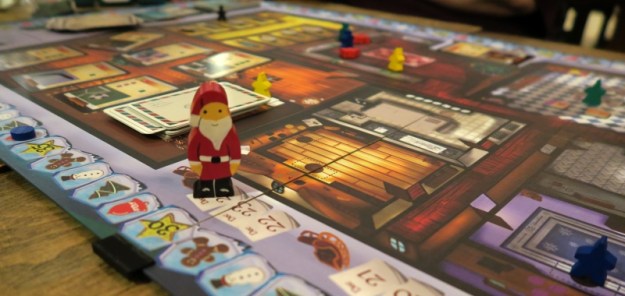
Pine was keen to play Ticket to Ride: Nordic Countries, but after the Heart of Africa experience nobody else was enthusiastic to join him.  Ivory was keen to play  the “Feature Game” which was Santa’s Workshop, so Pink, Blue and Burgundy joined him.  This is a medium-light weight worker placement game, similar to Stone Age, Lords of Waterdeep or Viticulture, but with a festive theme.  Players operate teams of elves making presents for Santa to deliver on Christmas Eve.

Santa's Workshop
– Image by boardGOATS

On their turn, players can send elves to collect wish-list items, mine for coal, visit the metal, wood, fabric, plastic and assembly workshops, or train their elves so they work more efficiently.  Players earn Cookies for every gift they make, and every three days, Santa carries out an inspection and the teams that have made the most gifts get more Cookies.  The elves can also visit the Reindeer Stables to get help and more Cookies—the player whose team of elves has earned the most Cookies by the end of Christmas Eve is the winner.

Santa's Workshop
– Image by boardGOATS

The game is played over the nine days before Christmas, appropriately from 16th December (the date of our “Un-Christmas Dinner”) up to and including Christmas Eve.  Each gift card shows what it is made of and how much assembly it will need, as well as how many Cookies it will earn when it is completed.  One of the things that makes this game a little different to other worker placement games is that players are unable to store resources:  elves must first acquire the gift card, then the materials to make the gift (wood, plastic, fabric and metal), and only then can the elves assemble the gift.

Santa's Workshop
– Image by boardGOATS

The idea is that the elf is taking the pieces to the assembly room and making it there, so timing is everything.  If a player visits receives five pieces of wood, but can only use three, the other two go to waste. Players can improve their situation by getting some of their elves trained—this costs a turn, but a visit to the School Room means they can use this additional skill to produce more material or assemble things more efficiently.  The question is whether this is worth the effort as the game is played over just nine days with only three turns per day (or four at lower player counts).

Santa's Workshop
– Image by boardGOATS

Blue and Burgundy started fast and took the bonus Cookies for the most productive team at the end of the 18th December, but by the end of the Christmas Eve, Ivory and Pink were getting the most Cookies for being the most productive while Blue and Burgundy’s attentions were elsewhere. Ivory started out making a lovely wooden music box, but then moved rapidly into making plastic tat.  Selling coal to Santa was also highly lucrative (Santa always needs coal to give to naughty children).

Santa's Workshop
– Image by boardGOATS

Blue did the reverse, starting by making Lego bricks with lots of plastic and then moving on to making dressing up clothes and a lovely teddy bear which she failed to assemble.  Burgundy also struggled with his assembly and spent quite a lot of time visiting the stable and petting Comet (to take the first player marker) or Donna (to obtain the assistance of Zelf to get extra material).  Pink similarly struggled and felt it was important to prioritise being the first player at certain points during the game.

Santa's Workshop
– Image by boardGOATS

It was a very close game and the final few turns were really critical as players tried to make sure they completed everything they could and most realised they couldn’t finish  what they wanted to.  Ivory thought he might just make it and gambled on getting enough visits to the assembly room to do what he needed.  In contrast, Blue pragmatically took the Cookies from Dasher’s stable and gave up all hope that she might be able to assemble her gifts.  And that made the difference, giving Blue victory, finishing ten Cookies ahead of Ivory, with Pink just behind in third.

Santa's Workshop
– Image by boardGOATS

Although not an exceptional game, Santa’s Workshop is unquestionably one of the best festive games we’ve played—all the more so as it has a genuine Christmas theme rather than simply being “snowy”.  Sadly, the pieces lack a little something, especially Santa, but we made up for that by stealing the bits from Christmas Penguins, which we played a couple of years ago and had great bits, but lacked something in the game-play.  The game itself was purchased in a couple of years ago and sent on by a friend in Australia, but first got caught in the bush fires there and then playing it was delayed by Covid when last year’s Christmas Event was online; the verdict was that it was worth the wait though.

Santa's Workshop
– Image by boardGOATS

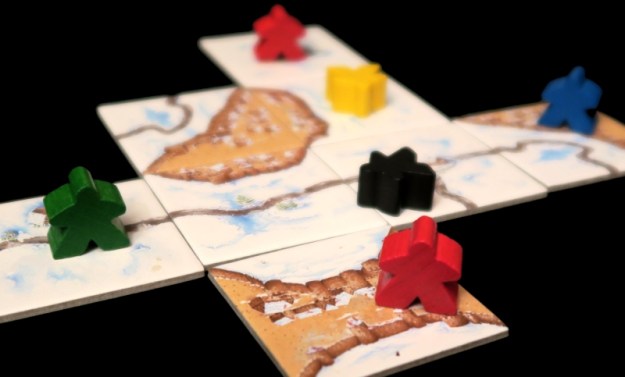
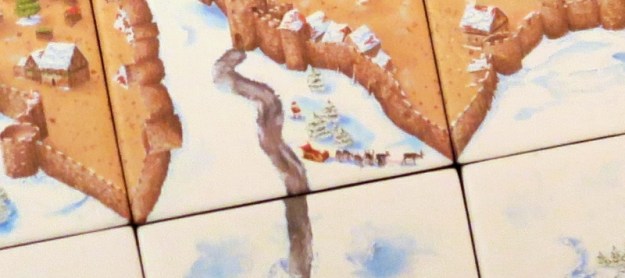
On the next table, the rest of the group settled down to play Carcassonne: Winter Edition.  This is essentially the same as the original “blue box version” of the tile playing game, Carcassonne, but with a pretty snowy scheme, which everyone agreed they preferred to the usual version.  So, as with the original, the game play is very simple:  on their turn, the active player plays a tile, adding it to the map (ensuring all the edges agree) and then optionally place a meeple on the tile before scoring any completed features.

Carcassonne: Winter Edition
– Image by boardGOATS

The features on the tiles include city segments, roads and cloisters.  Players score two points for each tile in a city or road they own if it is completed during the game, or one point at the end if incomplete.  Similarly, Cloisters score nine points when completely surrounded or one point for the central tiles and each surrounding it at the end of the game.  The clever part of the game is that while players cannot add a meeple to a feature that is already owned by another player, these can be joined together and then shared so that both players score.

Carcassonne: Winter Edition
– Image by boardGOATS

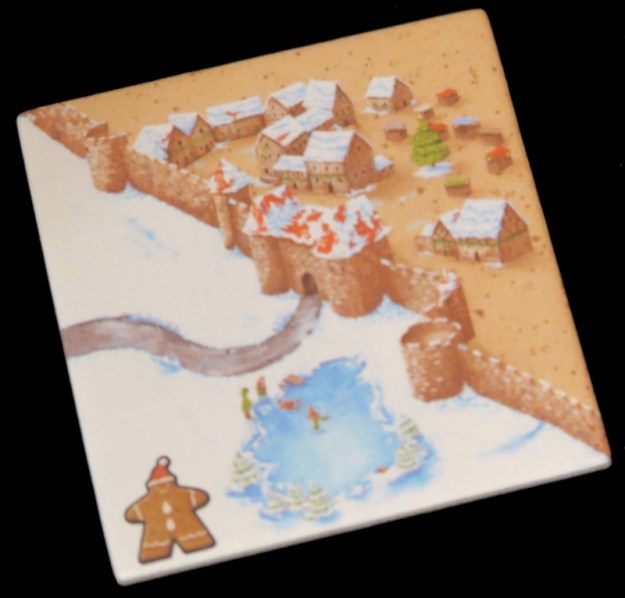
This time, the group also included the the Lebkuchenmann expansion.  This consists of additional Gingerbread Man tiles mixed in with the base game; when drawn, the player moves the brown Gingerbread Meeple to an unfinished city of their choice.  Before he is moved, however, the current city containing the Gingerbread Man is scored.   Each player receives points for the number of meeples they have in the city multiplied by the number of tiles in the city.  Thus, even players that only one meeple in the city when their opponents have more get a few points.

Carcassonne: Winter Edition
– Image by boardGOATS

The Gingerbread Man also leaves the current city when someone adds the tile that completes it and the Gingerbread Man is scored just before the normal scoring.  This means it is sometimes desirable to finish someone else’s city, in order to move the Gingerbread Man or to make them earn fewer points for it.  The clever part about the Lebkuchenmann expansion is that it can be played in both a friendly and a spiteful way.

Carcassonne: Winter Edition
– Image by boardGOATS

Very early in the game, Green, Purple and Lilac all found themselves with cities which looked all but impossible to close out.  Black went for an early “Farmer”, making snow angels and Green followed suit.  “Farmers” only score at the end of the game, giving points for the number of cities the field supplies, but they tie up the meeples for the rest of the game and, if placed early can end up being cut off yielding a poor score.  So, only time would tell whether this would prove to be a master move or a waste of a good meeple.

Carcassonne: Winter Edition
– Image by boardGOATS

Lilac was building herself a nice big city, obtained the first Gingerbread Man and placed it into her growing metropolis.  This attracted the attention of Pine who set up camp in a small city across the open divide.  On his next turn he got exactly the tile he needed (a city tile with two opposite open ends), and joined the two together.  When the city was completed shortly after, both Pine and Lilac scored, not just for the city, but for the Gingerbread Man too. This put them both out into a commanding lead on the score board, with Pine half a dozen points ahead—a lead he would not relinquish for the rest of the game.

Carcassonne: Winter Edition
– Image by boardGOATS

In the meantime, the rest of the group kept drawing road tiles.  The Gingerbread Meeple was very handy to get some of the awkward, incomplete cities to score at least something, as he hopped around the board giving out gifts.  As the snowy scene expanded and grew, more farmers were placed, more cities were completed, and roads wiggled their way round the landscape joining areas previously separated.  As one of his last moves, Green found the one tile that would fit into the gap next to his first city to complete it. This did something else, too, that would have a game-changing impact, though nobody realised it until scoring.

Carcassonne: Winter Edition
– Image by boardGOATS

With the last tile placed everyone scored their uncompleted cities, roads and cloisters.  At this point Pine was still in front, with Lilac not too far behind in second—the Farmers were going to be key.  Black and Green had managed to maneuver two Farmers each into the same massive field, but sadly Purple’s lone farmer got booted out.  Lilac had a couple of farmers on the other side of the board, one gave her two cities and the other gave her three, just enough to push her ahead of Pine (who had eschewed the whole farming in the snow business as being too cold for him).

Carcassonne: Winter Edition
– Image by boardGOATS

Green’s and Black’s Farmers had amassed a total of huge total of ten cities for their shared field, which brought them right into contention.  Scores were just about to be added to the board when Black pointed out that his (and Green’s) field went further round and actually swallowed Lilac’s farmer with three cities due to the tile placed by Green to complete that city.  So Lilac lost nine of her points and Green’s and Black’s new field total was for thirteen cities giving them thirty-nine points each.  This leapfrogged both of them ahead of Pine and Lilac, with Green coming out a few points on top.  A close game, everyone enjoyed.  This edition is a worthy edition with the Lebkuchenmann expansion a perfect little festive addition too.

"Un-Christmas Party" 2021
– Image by boardGOATS

Learning Outcome:  ‘Elf and Safety is everyone’s business.

1st December 2021

It was a relatively quiet night with no Burgundy, Lilac or Teal.  However, that was slightly offset by the arrival of Lime who had missed the last few and Beige, who is much cuter in real life than on Teams.  The first game of the evening, as Blue and Pink finished their supper, was No Thanks!.  A very simple game where players take a card or pay a chip to pass the problem on, it is easy to play when attention is elsewhere.

No Thanks!
– Image by boardGOATS

At the end of the game, players sum the face value of the cards they collect and the player with the lowest score wins.  The clever part is that if players have a run of cards, they only score the lowest, and the fact that some cards are missing encourages players to gamble.  This time, Blue “top scored” with a massive sixty-six having tried and failed to make a run out of high scoring cards.  Green won with a careful game that gave him thirty points and Pink was took second place, four points behind.

No Thanks!
– Image by boardGOATS

As people arrived, the group split into two with the one group playing the “Feature Game“, Draftosaurus.  This is a very light drafting game, a bit like Sushi Go!, but with dinosaurs (because everyone, especially Beige, likes dinosaurs).  We have played this quite a bit, but mostly online over the last year or so, but the tactile wooden dino-meeples add a lot to the experience.  The basic idea is that players start with a handful of wooden dinosaurs, pick one to keep and then pass the rest on.

Draftosaurus
– Image by boardGOATS

Players then choose which pen to place the dinosaur in obeying the restrictions the pens have for example, each dinosaur placed in the Meadow of Differences must be different.  Players also take it in turns to roll the Placement Die and have to additionally follow the conditions imposed it (e.g placing the dinosaur in an empty pen or a pen that does not contain a Tyrannosaurus rex).  The game is played over two rounds and at the end of the game, when all the dino-meeples have been placed, players add up their scores.

Draftosaurus
– Image by boardGOATS

Each pen scores according to its specialism, with players scoring an extra point for each Tyrannosaurus rex they have have.  Draftosaurus is a very quick and light game, but is also very enjoyable, and this time the scoring was very tight too with just five pints separating first and last places.  Blue just managed to edge it though finishing one point ahead of Pine with Purple and Lime tied in third.

Draftosaurus
– Image by boardGOATS

With five players the options were a little limited, but Pink effectively made the decision as he was keen to play Fabled Fruit, a game we last played two and a half years ago.  This is a game he’s very fond of because he likes the cute animal artwork and bright primary colours.  It is a light card game, with the unusual feature that the game evolves and changes each time it is played.  This “Legacy” style was made popular by Rob Daviau and Matt Leacock with Pandemic Legacy, a game that divided gamers as it required them to destroy components and write over the board, an anathema to people who are accustomed to looking after their games, sometimes to an extreme degree.

Pandemic Legacy: Season 1
– Adapted from image by BGG contributor Muse23PT

Once Pandemic Legacy has been played out, the end product is a personalised copy of Pandemic which embodies the memories of the campaign.  This further irritates some gamers because they feel they are left with a comparatively unplayable copy of the game or at least one that is less well be unbalanced and may have design flaws.  Fabled Fruit is different from the Legacy games as the changes are not destructive, so the game can be reset and played again from the beginning, in this case by simply sorting the cards.

Fabled Fruit
– Image by boardGOATS

The game is quite simple—it starts with six decks of four cards in the central play area and on their turn players move their worker from one pile to another and either carry out the action associated with the cards, or buy a card.  Each card has a cost in fruit and, when bought represents a fruit smoothy.  When a player buys their third card (in the five player game) they trigger the end of the game and the player with the most smoothies at the end of the round wins.

Fabled Fruit
– Image by boardGOATS

The starting decks include simple actions like “take two fruit cards from the deck” and “give one banana to any other player and get two fruits in exchange”.  As the game evolves though, the actions become more interesting with the introduction of a fruit card market and more complex interactions.  This time Blue got out of the blocks quickest and was the first to three with Pine and Purple tied for second.  It was a very enjoyable game and people were just starting to get interested in how the actions were changing and what animal would be introduced next, so the group decided to play it a second time and see what happened.

Fabled Fruit
– Image by boardGOATS

By the second round there was lots of talk about how the some fruit looked like hemorrhoids and from there the conversation deteriorated into a discussion of bum grapes and hairy nuts.  This time, Lime was the victor with Pine taking second place.  As it was packed away and Pink sorted the cards to reset it, the group lamented the “problem” with “Legacy-type” games.  Sadly, they really shine with a small group like a family or household that play together frequently.  The problem with a group like boardGOATS is that people play in different groups each time, so it isn’t really possible to work through a campaign properly.

Fabled Fruit
– Image by boardGOATS

With that, Lime took his leave and there was just time for the remaining foursome (plus Beige) to play a quick game of Coloretto. This distills the essence of the, arguably, better known board game, Zooloretto, into a simple yet clever little card game.  We’ve all played it a lot, so it needed little introduction:  on their turn, players either turn a card and add it to a truck, or take one of the trucks.  The aim is to collect sets, but only the three score positively, the others all score negative points with the player with the most winning.  This time, Blue picked up a couple of full sets and won by a bit of a landslide with Pink in second.

Coloretto
– Image by boardGOATS

Meanwhile, on the next table, Black, Green and Ivory were playing Brass: Birmingham, the Sequel to Brass (Lancashire).  It is an economic strategy game that tells the story of competing entrepreneurs in Birmingham during the industrial revolution, 1770-1870.  Each round, players take turns according to the turn order track, receiving two action points to perform any of the actions:  Build, Network, Develop, Sell, Loan and Scout.  The game is played over two halves: the canal era (years 1770-1830) and the rail era (years 1830-1870).

Brass: Birmingham
– Image by boardGOATS

The game is quite complex so Ivory’s explanation took a little while.  Black had previously read the rules, but Green came in with no prior knowledge, so it was typical that the Start Player application chose Green to go first.  He started the first, Canal part of the game building in the North West, while Ivory went for the Midlands and Black the Mid-South. Black and Ivory were soon linking their routes and connected up to the board edge trading towns. Ivory’s experience of the game meant he was first to use it and collect the Beer barrel.

Brass: Birmingham
– Image by boardGOATS

Green’s routes remained separate from the other two for a while, and although that gave him relatively uninterrupted growth in the region, he found himself limited to only one trade. Thus he pushed south to join up with the other two.  At the halfway point, Ivory was narrowly in the lead over a surprised Green, with Black a few points behind. The board was then cleared and reset. Everyone had managed to build at least a couple of stage two buildings.

Brass: Birmingham
– Image by boardGOATS

As the second, Rail part of the game went on it became clear that everyone had switched places.  Green was building up in the South East, and Ivory was working in the North and Black even further South.  It took much longer to join up the routes so it wasn’t until the very end that players started to build and use resources that others had planned for.  By the end of the game and after the final scoring, Ivory had romped away to a comfortable win, with Black leapfrogging Green into a comfortable second place.

Brass: Birmingham
– Image by boardGOATS

It had been enjoyable, though it was a bit of a rush at the end as time was pressing.  Brass is an unusual game in the way that players can each use the others resources, which is an interesting twist.  With many different options to planning, this makes for quite a thinky game which leaves players feeling they can do so much better the next time.

Brass: Birmingham
– Image by boardGOATS

Learning Outcome:  Beige is a lot smaller in real life.

18th Movember 2021

The evening began with news—the landlord of our beloved Horse and Jockey , Charles, and his wife Anna, who have been trying to retire for years, are finally succeeding.  This time next month, the pub will be under new management.  In due course, we will find out what this means for our little group, but in the meantime, we Keep Calm and Carry On Gaming.  And Blue and Pink, who were first to arrive started off with a quick game of NMBR 9, with Pink aiming to get his revenge for last time (before the Quiz).

NMBR 9
– Image by boardGOATS

NMBR 9 is a very simple tile laying game, but the pieces cleverly fit together, except when they don’t.  The idea is that tiles must be placed in layers with pieces placed on higher levels worth more.  Each tile is a stylised number and the number multiplied by the “storey” is its score.  Each numeral, zero to nine appears twice in the deck of cards, so players can place each twice during the game, with the order dictated by the order the cards are drawn.  This time, Pink scored more than last time and Blue scored less, but sadly for Pink, even with Burgundy’s assistance, he was unable to beat Blue’s score of eighty-eight.

NMBR 9
– Image by boardGOATS

Blue, Pink and Burgundy were joined by Pine who’d had a particularly tiring week, and was therefore delighted to be able to avoid cooking.  As they finished, Green popped up and started setting up Praga Caput Regni.  In this game, players take the role of wealthy citizens who are organizing various building projects in medieval Prague. By expanding their wealth and joining in the construction, they gain favour with the king. Players choose from six actions on the game board, the “action crane”.  The actions are always available, but are weighted with a constantly shifting array of costs and benefits. By using these actions, players can increase their resources, improve the strength of chosen actions, build “New Prague City”, the Charles Bridge, the city walls, or participate in the construction of St. Vitus Cathedral.

Praga Caput Regni
– Image by BGG contributor PZS69

Praga is one of those games with lots of pieces and takes a little while to set up.  Green had agreed to play it with Ivory and Lilac in advance, but were one person down and there was less enthusiasm to play it from the others, so in the end there were just three with Black joining in.  There was quite a lot to explain:  Green had played a few times and Ivory had watched a video, but Black came into it completely cold.  When the game finally started, random selection gave the first turn to the least experienced player, Black.  Although there a lot of things that can be done in this game, each turn usually only provides a small choice (unless you want to pay for the chance to do something specific that isn’t available for free).  With a little advice Black was able to make his choice reasonably quickly and the game was underway.

Praga Caput Regni
– Image by BGG contributor PZS69

Black’s game was a tactical one, trying to do the best that he could each turn rather than following a recognised strategy.  With only one upgrade to his actions tile (building The Kings Road), he ended up with four wall tiles and made it to the top step of the City Walls.  Although he had upgraded his Kings Road tile it was late in the game and he only managed the third step along the road, not quite reaching the Charles Bridge. He did not try for the education tracks, but his mines progressed reasonably well.  Green tried to go for a City Walls/Cathedral strategy, but didn’t manage it very well, reaching only the second tier of the Cathedral and only one step on the City Walls.

Praga Caput Regni
– Image by BGG contributor PZS69

As that strategy just wasn’t working Green switched to completing the King’s Road and managed to get his piece onto the final step of the Bridge.  He upgraded a couple of actions, stone mine and (much later) Town tile actions, but could only manage two walls (rather surprising considering he built his first wall early on). Green did manage to reach the top of the University track and half way up the Knowledge path though.  In contrast, Ivory went very quickly for the Kings Road strategy, which he completed as well.  Like Black he ignored the Learning tracks, but did manage to get his Gold mine to the top, although (strangely) never managed to unlock his six gold bonus cube.  He also only did one Upgrade (the Gold mine action), but completed three walls.

Praga Caput Regni
– Image by boardGOATS

Ivory also concentrated on the City Walls and manage to climb to the top tier, but completely ignored the St. Vitus Cathedral.  Within the Town, Green placed most tiles, but only two plaza’s were ever completed, and no one built on the Old Town section North of the Road.  Ivory won the game, with Green a second on a tiebreaker.  Everyone kept forgetting the extra point bonuses from the Upgrades and Books, but it was clear that Ivory was the victor.

Praga Caput Regni
– Image by BGG contributor PZS69

Everyone enjoyed the game, Black in particular liked it much more than he thought he would. Ivory also liked it as did Green though the fact that players seem unable to do very much through the game frustrates him.  Overall it appealed to the group’s idea of strategy planning. Although it seems complex with lots that can be done, it is actually relatively straight-forward to play, with the complexity coming from working out what they want to do and which route will provide the best outcomes later in the game.  It is possible that the key is getting the Golden Arches and therefore extra free actions, but they seemed very lacking this time.

Praga Caput Regni
– Image by boardGOATS

The prior arrangement to play Praga meant there weren’t enough people to play the “Feature Game” (Nusfjord), particularly as neither Pine nor Purple fancied it.  Unfortunately, there was no alternative mid-weight game that everyone felt up to playing, so, after half an hour of debate, Pine insisted on sitting out leaving the rest to play what is now a bit of an old favourite, Wingspan.  We’ve played this a lot as a group since it was released two years ago, but Pink and Blue had not yet had the opportunity to play the newest, colourful birds expansion, Oceania.

Wingspan: Oceania Expansion
– Image by boardGOATS

Wingspan is a fairly straight forward, card driven engine-builder with players collecting bird cards and playing them into their reserve.  To play bird cards in their reserve, players need to encourage them to stay by providing the right food as payment.  Thus there are four actions that players can take on their turn:  Play a card; Collect food, Lay eggs and Pick up cards.  The last three of these are associated with habitats.  Each card has a special power, some come into force when they are first played, some when the habitat is activated, and others when another player carries out an action.

Wingspan
– Image by boardGOATS

In addition to special powers, each bird card also gives points and holds eggs.  At the end of the game players receive a smorgasbord of points for each bird, for “tucked cards” (those placed under their bird cards as part of an action), for food stored by birds on cards (also as part of an action), for eggs laid on cards, all added to any end of round bonuses achieved and any bonus points from character cards.  The first expansion, with European birds, additionally adds cards which take effect at the end of each round, some of which are very powerful, and the new Oceania Expansion adds a new food type—Nectar.

Wingspan: Oceania Expansion
– Image by boardGOATS

Nectar can be used as a substitute of any other food type, but it is used in a different way and cannot be carried over from one round to the next.  There was no need to go through all the rules because everyone was familiar with the game, it just needed a summary of how Nectar worked and how the game changed, including the scoring with players who use it the most picking up bonus points at the end.  The expansions mostly add more cards, and although these change the flavour of the game they don’t significantly add to the complexity, so both expansions were included this time along with the cards from the Swift-Start Promo Pack.

Wingspan: Oceania Expansion
– Image by boardGOATS

This time, there were almost no birds of prey cards in the game, which was unfortunate for Pink because his Black-Billed Magpie went hungry.  He had the help of Pine, however, who stayed long enough to see his favourite bird, the Black Woodpecker put in an appearance, landing in Blue’s reserve.  Pink went on to concentrate on using Nectar and Character cards, the Omnivore Expert and Fishery Manager, both of which give points for the type of food birds eat.  Burgundy also focused strongly on his bonuses from Character cards (Citizen Scientist and Bird Counter) and both he and Pink scored more than twice Purple’s and Blue’s bonuses.

Wingspan: Oceania Expansion
– Image by boardGOATS

This is a relatively small part of the scoring, however.  Purple concentrated on making sure she had plenty of eggs at the end of the game and the purpleness of her reserve with all it’s purple eggs was a sight to behold.  Everyone made good use of Nectar, but Pink cleaned up winning two of the three categories and coming second in the third.  Burgundy took a lot of points for his tucked cards and had lots of his scoring birds in his reserve.  Blue had more birds and more valuable ones too, nearly filling her reserve.  The question was whether her huge pile of eggs was enough to offset the points others had taken elsewhere.  In the event it was, and she finished with just enough to knock Burgundy into second place, slightly ahead of Pink.  And with that, it was home time.

Wingspan: Oceania Expansion
– Image by boardGOATS

Learning Outcome:  Don’t put all your eggs in one nest.

3rd Movember 2021

Blue and Pink were, unexpectedly, joined by Green and Lilac thanks to a clock-reading malfunction.  So while Blue and Pink were dealing with their dinner, Green introduced Lilac to Tsuro.  This is a very accessible game that we actually managed to play a little over a year ago from home, but is much better played in person.  Each player starts with a stone lined up on the edge of the board and a hand of three tiles.  On their turn, they place one of their tiles on the board next to their stone, and move their stone along the path on the tile, then replenish their hand.

Tsuro
– Image by boardGOATS

The aim of the game is to stay on the board the longest, with the last player remaining, the winner.  It wasn’t long before Lilac had Green on the ropes and Blue and Pink urged her to take her chance and finish him off.  It’s not in Lilac’s nature to go for the jugular, however, and despite the encouragement, she didn’t make the most of her opportunity.  Inevitably, Green wriggled free and it wasn’t long before he was edging Lilac off the board himself.  With the first game over, and Blue and Pink finishing their dinner, there was a little chatter before others arrived and players were deciding what to play.

Tsuro
– Image by boardGOATS

The “Feature Game” was to be Modern Art, which is an auction game where players are buying and selling art trying to make a profit with paintings valued by the number of artworks of that type that were sold.  It is an older game, nearly thirty years old, and several people had played it before, albeit some years ago.  When Green admitted that he hadn’t really enjoyed it, Pink was shocked and suggested that not liking Modern Art was akin to not liking puppies, at which point Green, much to Pink’s horror, admitted he wasn’t that keen on them either…

Modern Art
– Image by boardGOATS

Needless to say, when settling on games, Green took himself away from the slightly offended Pink and his copy of Modern Art leaving him (with his brick and sack comments), to play the “Feature Game” with Ivory, Blue and Teal.  The game is a simple, yet clever auction game, and therein lies the problem—the group has had mixed responses to auction games.  For example, the highly regarded Ra (like Modern Art designed by Reiner Knizia) received mixed responses when that was played, however, one of the all-time favourites, Keyflower, is an auction game at its heart (though to be fair it doesn’t really feel like one).

Modern Art
– Image by boardGOATS

The group (aside from Pink) was therefore slightly reticent, but went for it positively, and in the event, really enjoyed it.  Each round consists of several auctions, each of which is conducted by a player.  The auctioneer chooses one card from their hand which is auctioned according to the indicator on the card.  There are five possible auction types:  Open, Fixed Price, Sealed Bid, Once Round the Table, and Double (where two pieces by the same artist are offered at the same time).

Modern Art
– Image by boardGOATS

We were playing with the new Oink Games version, which features real modernist artwork from the likes of Mondrian, Kaminski and Ivory (who obviously has talent we were hitherto unaware of).  When the fifth work by an artist is offered for sale, the round ends (without the final auction), and the works valued.  The value depends on how many paintings were sold by that artist in the round, with the value increasing by $30,000 for the most popular.  Players then sell their art to the bank, but here there is a catch.  Players only get a return on art by the three most popular artists in that round—everything else is worthless.  The value of the art that is sold, however, is the cumulative total including increases over all the previous rounds.

Modern Art
– Image by boardGOATS

Thus, players sell their art giving them money to buy more, and more expensive art in the next round. Although the mechanics are clever, what makes the game fun is the auctioneer’s pitch as they try to describe the work they are selling and draw the other players’ attention to its clear and obvious assets and up-sell it.  One notable lot by Kaminski was initially described as “a cat’s pencil sharpener” and then to much hilarity as “a charming number depicting someone bending over picking up a fiver.”  The game ends after four rounds and the player with the most money at the end wins.

Modern Art
– Image by boardGOATS

This time, players clearly had a bit of a fixation with Kaminski with his works being the most popular in the first round, with Hick and Mondrian making a distant second and third.  The initial popularity of Kaminski inflated the perceived value of his work in the second round and, although fewer works were offered for sale, it still scored, though the Mondrian age was upon us.  The third round was dominated by the works of Okamoto, putting in a brief, but valuable appearance for those that made purchases, as it provided funds for the all-important final round.  This led to a resurgence of Hick as the most popular together with poor Ivory, who’s work had hitherto only had a brief period in the limelight in the second round.

Modern Art
– Image by boardGOATS

The eternal popularity of Kaminski continued until Blue brought the game to an end with a double auction ensuring Kaminski’s works gave a return again, and having scored in every round, they were very lucrative.  Despite the game feeling like there was a lot of ebb and flow, the final scores were remarkably close with a mere twenty grand between first and third—fine margins indeed in a game where the scores were measured in hundreds of thousands and players reserves fluctuated wildly during rounds.  It was Blue though, who made the most, finishing with $392,000, just ahead of Ivory (the gamer rather than the artist).

Modern Art
– Image by boardGOATS

Meanwhile, at the other table, Green, Lilac, Purple and Black (who also expressed a dislike of Modern Art, though not of puppies), were playing the puppy related game, Snow Tails.  This is a fun race game where players are racing dog sleds along a winding track of varying complexity.  The idea is that players have a hand of cards, which they play to adjust the dogs’ speed or apply the brake.  When they play cards, they can play up to three (one for each dog and one for the brake), but they must all have the same value.  The sled speed (how many spaces it moves) is then the sum of the dogs’ speed minus the value on the brake.

Snow Tails
– Image by boardGOATS

Additionally, the sled will drift left or right by the amount by which the two dogs’ speeds differ.  Players have to use this to negotiate corners and slalom round pine trees to get to the finish line.  The cards come from their own personal decks, and this is where the game gets clever because players have to manage the cards they play to make best use of them.  If a player crashes or goes into a corner with too much speed and exceeds the limit, they pick up a dent card.  These occupy space in the player’s hand which means they have less choice.

Snow Tails
– Image by boardGOATS

The first player to cross the line (or, in the case of a tie cross it and travel the furthest), is the winner.  The group spent far too long debating which track to use. Lilac had not played Snow Tails before so the group did not want to make it too extreme, but also not too trivial for everyone else.  In the end the group decided on a variation of “Treemendous” (chosen as it would fit on the “narrower than we would like” pub table) and swapping the first set of trees for a narrow canyon.  Through random selection, Lilac was chosen as start player, but as she wasn’t sure how the game would play she took a gentle start so Purple, Green and Black shot past her at speed.

Snow Tails
– Image by boardGOATS

Through the first corner and approaching the Canyon, Purple hit the side of the track and slowed up, while Green and Black raced forward. Lilac took her foot off the break and caught Purple, who was struggling to get her head around which side of the sled needed the higher number to move to the right to get around the corner.  With the bend successfully negotiated Black slowed for the canyon, but Green decided to let rip through it. He made it in one go without hitting anything, but was on the outside for the next corner.  Black took a steadier run through the canyon and came out on the inside of the corner behind Green.

Snow Tails
– Image by boardGOATS

Lilac also maintained a steady pace taking a couple of turns for the Canyon, while Purple continued to dally at the back, hampered somewhat by her reduced hand size from her earlier crash. Black and Green raced to the forest, with Black reaching it just before Green. He “dropped an anchor” and came to an almost complete stop at the entrance right in front of Green, causing him to slow up sharply and swerve to the left instead of taking the route ahead he had planned.

Snow Tails
– Image by boardGOATS

Black managed to clear the forest first but found himself drifting towards the outside of the long hairpin bend. Green was close behind, but his direction of travel sent him to the inside.  Lilac continued her steady progress, avoiding the hazards and came through the forest unscathed in the middle of the track.  Black and Green were racing hard:  Black had the speed, but was forced to the outside of the track and wasn’t able to make progress while Green going more slowly on the inside, manage to squeeze past to get just ahead.  Then it was a straight fight to the line.

Snow Tails
– Image by boardGOATS

Black was able to lift his break to a one, but could only manage a double four, so he positioned himself less advantageously to try and block Green. It didn’t work as Green came off the corner on another track, but he was a little heavier on his break, so still on a two, and also a double four, Black managed to just slide past for the win finishing just ahead.  Lilac continued her steady progress and finished the following round while Purple took a more leisurely ride through the forest, came out on the outside of the bend.  Struggling to stay on the track on the way round the corner, she finally found her speed down the final straight and came flying off the end of the track, unfortunately a couple of rounds too late to win.

Snow Tails
– Image by boardGOATS

Snow Tails was still going when Modern Art finished, but only just, so Tsuro got a second outing of the evening.  This time, Blue was out first by killing herself and taking her piece off the board, quickly followed by Pink who committed harakiri in a similar fashion.  That left them to cheer on Teal and Ivory.  It was close and they were down to the last few tiles, but in the end, Teal took victory when he pushed Ivory off the board.  As the huskies settled down for a well-earned nap, Pine arrived just in time for one last game of Bohnanza, replacing Green and Lilac who went home as they had an early start the next day.

Bohnanza
– Image by boardGOATS

Bohnanza is one of our old favourites, and barely even needs a reminder beyond the rules that are specific for the particular player count.  With six, players start with different numbers of cards, they plant one or two beans turn over two bean cards from the deck, plant and trade, then draw four cards to replenish their hand.  Buying a third bean field is cheaper as well with six, costing two Bohnentaler instead of three.  This is important because the game is shorter with more players and some players barely get a turn in the final round.

Bohnanza
– Image by boardGOATS

As a result, buying a third field is always a bit risky, and the general consensus is that it is rarely worth it. This time was the exception that proves the rule however, with lots of people deciding to buy a third field.  This had the unintended effect of shortening the game as more beans were left in fields at the ends of the rounds.  This didn’t stop the usual hilarity when people made the occasional silly trades and players got unfeasibly lucky with the draw of the cards.  This time the winner was Ivory, two Bohnentaler ahead of Pine, but in truth, we are all winners with a game that is so much fun.

Bohnanza
– Image by boardGOATS

Learning Outcome: It is amazing how much money people will spend on tat.

21st October 2021

The evening began with a little play-testing while people waited for their food to arrive.  The two-player game currently goes by the name of Brain Grabbers and, though simpler, has a mechanistic similarity to Sprawlopolis or Honshū.  The game was designed by one of Pink’s work colleagues, so Pink explained the rules, and then proceeded to lose, first to Blue, then to Pine, failing to take a single point to their combined total of fourteen.  The consensus was that it could be successful as a family-level game, but we weren’t fans of Cthulhu, so spent the next ten minutes coming up with exciting ways to re-theme it.

Sprawlopolis
– Image by boardGOATS

As people finished eating others began to arrive, though there was some question about whether Purple and Black would make it thanks to a serious accident on the A420.  We were discussing the treacherous nature of the A420 and its accident black spots when Purple and Black rocked up, and Purple surprised everyone by joining Green, Ivory and Burgundy to play  the “Feature Game“, Endeavor: Age of Sail with the extras from the new Age of Expansion.  Endeavor is a game we have played quite a bit over the years, initially in it’s original form and, more recently, in the new edition.  The expansion came out last year and, sadly, got lost in the mists of the endless “Roll and Write” games we were playing online.

Endeavor: Age of Expansion
– Image by boardGOATS

The original game is actually not terribly complicated and during play is almost completely luck-free—all the variation is in the set up.  The game is played over eight rounds, each consisting of four basic phases: Build, Populate, Payment and Action.  There are four technology tracks roughly corresponding to each phase, which dictate what a player can do during that phase.  For example, how far along the building track a player is dictates what they can build: the further along they are, the more buildings they have to choose from.

Endeavor: Age of Sail
– Image by boardGOATS

Similarly, a player who is further along the population (or culture) track, can move more people into their harbour for use in the Action phase.  Payment also increases the number of people available as it moves population markers from the action spaces into the harbour.  More importantly, however, it makes the action spaces available again for use later in the round.  The first phase consists of passing round the tray of buildings rather like a box of chocolates although in truth, at this point of the game players have very little choice.  Despite that, the decision is crucial to how players do.

Endeavor: Age of Sail
– Image by boardGOATS

After the Building phase, the second and third phases (Population and Payment) are more or less carried out simultaneously.  The guts of the game, however, is the Action phase, when players can place population markers on their buildings to activate them and carry out one of the five actions:  Colonise, Ship, Attack, Plunder Assets, and Pay Workers.  The actions are generally based round the central board which is divided up into seven regions representing the seven continents.  Each continent comprises several cities, a shipping route and a deck of cards.

Endeavor: Age of Sail
– Image by boardGOATS

At the start of the game there is a Trade token on each city and each shipping space, but also on many of the connections between cities (these are taken if a player occupies both cities either side).  Players cannot Colonise a city until they have a presence in a region, which they can do by Shipping.  In this case, they activate their building that provides the shipping action by placing one population marker on it, then place a second population marker on the shipping track.  Thus, players need to have two markers available to be able to Ship.

Endeavor: Age of Sail
– Image by boardGOATS

The second population marker is placed in the furthest unoccupied space from the deck of Asset cards in the region of their choice, and the player takes the Trade token on that space.  Most trade tokens add to one of the four technology tracks, though a small number provide one off actions instead.  Players also need two population markers to Colonise (one for the action and one to occupy the city) and three if they are going to attack an already occupied city (one is collateral damage).  Once a player has a presence in a region they can take an Asset card, so long as the number of the top card is not higher than the number of population markers that player has in the region.

Endeavor: Age of Sail
– Image by boardGOATS

After eight rounds, players add up scores for each track and for the cities they control and the player with the most points is the winner. The new Age of Expansion adds several new components that completely mix up the game.  First there is a completely new set of buildings, many of which have actions as well as boosting the players’ economies while others have more choice.  Similarly, the first, second and fifth cards in the region decks now have more powerful and unique cards.  These are now more desirable creating more competition for them.

Endeavor: Age of Expansion
– Image by boardGOATS

The new buildings also introduce three new concepts:  Trade, Fortify, and Conscription & Mobilisation.  Trade allows players to swap one Trade token from their play area with one on the central board, while Fortify allows players to increase the protection in a city they occupy causing others to lose an extra casualty should they decide to attack.  Conscription enables players to acquire extra population which can then only be Mobilised as part of an action that has been activated in the usual way (e.g. used as a casualty during an attack, or to Settle).

Endeavor: Age of Expansion
– Image by boardGOATS

Additionally, a single Prominence tile drawn at random can be added to the game.  These provide players with new ways to gain presence in a more-competitive Europe and each one provides difference benefits and ways to score.  This time the Prominence tile was “Changing Alliances” which allows players to set up an alliance, where players cannot attack each other within Europe, in exchange for points at the end of the game.

Endeavor: Age of Sail
– Image by boardGOATS

The game took a little while to set up, and although everyone had played it before, we needed a refresher of the rules and run down of the new expansions.  In addition to the new Age of Expansion updates, the group also included the Exploits from the original Age of Sail, the mini Charter Company buildings and two additional micro-expansions from Age of Expansion (Seize your Fate & Level 6 region cards), making it a mega-game.  Overall, it took about an hour for set-up and rules explanations.

Endeavor: Age of Sail - Charter Companies
– Image by boardGOATS

The Seize your Fate Expansion provides each player with a unique starting set-up.  Ivory was The Kingdom of France so started with a city in Europe; Purple was The Ottoman Empire, so started in the open sea of India; Green was The Kingdom of Spain so started with a city in South America; Burgundy was Great Britain and started in the open seas of North America and the Caribbean.  Coincidentally, each player was sat near the part of the board where their starting places were, so that set the stage for players’ strategies.

Endeavor: Age of Expansion
– Image by boardGOATS

Ivory quickly started taking cities in Europe and was open to a Prominence Alliance. Green was taking Fleets in Europe so joined him. No-one else wanted to form any alliances leaving Ivory to dominate Europe with and Green (to a lesser extent).  However, due to a rules malfunction, this was under the false impression that as part of the winning alliance they would score four points for each disc in the region when it was actually four points for each disc in the Alliance.  Since he was concentrating on becoming the power house in Europe Ivory left his Seize the Fate actions for much later in the game, and only expanded out of Europe to the Far East and later on Africa.

Endeavor: Age of Expansion
– Image by boardGOATS

He did however make good use of the Dutch East India Company exploit (once it was open) to upgrade his seaside buildings.  Meanwhile, Purple concentrated mostly on India and Africa, but suffered early on with not having enough population in her harbour or enough bricks to build better buildings.  The game was long though, and she managed to Seize her Fate (Round the Cape).  She also made use of the Dutch East India company in the latter rounds, and although scores weren’t calculated until the end of the game, she probably made up good ground with these latter stages.

Endeavor: Age of Expansion
– Image by boardGOATS

Elsewhere, Green was concentrating on the Caribbean, and making connections with his Fleets in Europe. He managed to amass a large population early on, but let it slip so that by the end of the game, Ivory and Burgundy had much more population to spare for attacks, even on fortified cities. Green kept an eye on Burgundy’s progress to keep a presence in South and North America. He was the first to Seize his Fate (Form the Great Armada) and used The Transit of Venus exploit, shipping up to Tahiti and using his money to increase his population.

Endeavor: Age of Expansion
– Image by boardGOATS

Burgundy concentrated on the America’s, and although he opened the Republic of the Pirates exploit, he never used it (and neither did Green who could also have done so). This was because he said he did not really understand it and it didn’t seem that useful. Which was a shame, as it meant the beautifully crafted big black plastic pirate ship didn’t make it onto the board. What Burgundy did do, however, was to make heavy use of Conscription buildings, which really helped him ship to almost everywhere.  Unfortunately for him, in the final round of the game there was no shipping left and he discovered that he didn’t have enough other actions to make use of the population he had.

Endeavor: Age of Expansion
– Image by boardGOATS

In the end, after a re-evaluation of the scores due to the Alliance misunderstanding, Ivory  was declared the winner with eighty-one.  Burgundy was the runner-up with seventy-three, three points ahead of Green in what turned out reasonably close game.  But what of all the expansions?  The exploits can always be relied on to add an interesting dynamic (with a couple of duds) and it is likely these will continue to feature.  The Charter companies seem to help in four and five-player games when Level five buildings have the potential to disappear quickly (especially with the Exploit we used this time), and apart from space around the board don’t intrude too much anyway.

Endeavor: Age of Expansion
– Image by boardGOATS

The Level six cards seem to be intended to be played with the Age of Expansion every time, as Slavery is Abolished on the Europe Level 6 card, whereas in the Age of Sail base game it is abolished on the Europe Level five card.  This time, none of the Level six cards actually got played.  Again, they don’t intrude, but give additional options, so are also worth playing with.  The benefits of the “Seize your Fate” was perhaps less clear. Having different starting positions certainly helped the start and gave players a steer as to strategy.  Remembering the actions were available was a problem and the extra scores were quite small (about four points for those who used them). Including this module would probably depend on the group.

Endeavor: Age of Expansion
– Image by boardGOATS

The new Conscription action seemed to open up more of the board, which counters a common complaint about the game, that in order to get a region open, players have to neglect a couple of other areas and can lose out if they made a start in them early in the game.  However, the danger seems to be in overusing Conscription.  In this game there was a lot of Fortification, and in many ways it seemed a little too much. The bonuses on the new cards were interesting and add variety to the main game, but the expansion certainly doesn’t make the Age of Sail options obsolete as they could be very valuable if a less competitive game was wanted.

Endeavor: Age of Expansion
– Image by boardGOATS

While Purple was exploring India and Africa, Black, Pine, Lime, Blue and Pink were exploring Japan with Tokaido. This is a highly tactical game, that straightens out the market mechanism at the heart of Glen More and makes it the centre of a set collecting game.  During the game, players are travelling from the ancient capital Kyoto, to Edo (now Tokyo) via the Tōkaidō road.  This was one of the five centrally administered routes, the Gokaidō, that connected the capital of Japan with the outer provinces during the Edo period (1603–1868).

Tokaido
– Image by boardGOATS

As players travel, they experience the wonders of Japan sampling food and scenery, talking to the colourful characters en route, buying souvenirs and giving thanks at the temples they pass.  The game board consists of a long track with locations marked—each location can only be visited by one player.  Players line up along the path and the player at the back goes first (in this case Pink).  They move their piece to an empty space and carry out the associated action, before the next player at the rear takes their turn.

Tokaido
– Image by boardGOATS

In each case, the primary decision is simple:  move to the space with the most interesting action to maximise points, or move to the first available space to get the most turns. In most cases, once that decision has been made, players simply take money or a card from the appropriate pile, the three panoramas, the hot springs, or Characters.  Panoramas and Hot Springs simply give points while Characters give other bonuses.  Stopping at a temple allows players to genuflect and pay tribute, while visiting a Village gives player the opportunity to buy souvenirs.  Both of these cost money, however.

Tokaido
– Image by boardGOATS

Money is really tight and there are few chances to get more, and an important source of points is sampling the varied food, but food can be expensive.  There are four stops to eat and players have to stop and wait at these.  The first person to arrive gets to choose their meal from a handful of cards—they do not have to buy food, if they choose not to or cannot afford it, but each meal is worth six points at the end of the game.  Food comes at different prices though, so arriving early means players get to choose a cheaper meal. Each meal a player takes must be different, however, so waiting to the end can end up being costly, either financially, or in points lost.

Tokaido
– Image by boardGOATS

At the end of the game, there are bonus points for almost everything:  the player who donated most to the temples, the player who spent the most on food, the player who completed each of the panoramas first, and the players who visited the most Hot Springs, met the most visitors and bought the most souvenirs.  The player with the most points at the end is deemed to have had the best journey and wins.

Tokaido
– Image by boardGOATS

Players start by choosing their character from a pair drawn at random.  Blue was Kinto, Lime was Hirotata, Pink was Zen-emon, Pine was Mitsukuni and Black was Umegae.  Each of these gave a special power, for example, picking Kinto meant Blue paid one Ryō less for food each time she stopped to eat.  Similarly, every time Lime stopped to pay tribute at a temple, he was able to donate an extra Ryō, taking it from the main supply scoring an extra point straight way, and putting him in pole position for picking up the ten point bonus for being the most devout.

Tokaido
– Image by boardGOATS

The special powers aren’t all financial though—Mitsukuni gives an extra point at the end of the game for every end-game bonus the player wins.  Most of them do involve money on some level though even if it is not directly.  Zen-emon’s special power, for example, activated when Pink visited a Village to buy souvenirs.  When buying souvenirs, the active player draws three souvenir cards and can choose to buy one, two or all three.  Whenever Pink bought one souvenir, Zen-emon enabled him to buy one souvenir for one Ryō (regardless of its marked price) and as many others as he wished at full price.

Tokaido
– Image by boardGOATS

Souvenirs are a great way to get points.  They come in different types and players are collecting mixed sets with the first card in a set being worth one point, but later being worth more—a full set gives sixteen points.  The special powers give players a steer as to which strategies might be beneficial.  To take advantage of Zen-emon’s special power, Pink needed to visit the Village as often as possible, however, there were two problems:  firstly, souvenirs are expensive, and secondly Pine kept getting there first.

Tokaido
– Image by boardGOATS

Pine got extremely lucky on his card draws when he visited the Villages too, picking up lots of cheap souvenirs and getting lots of points in return.  As if that wasn’t enough, Pine seemed to be able to harness his “inner Burgundy” and every time he visited the Hot Springs, he found monkeys and with them an extra point.  To rub salt in Pink’s wounds, he ran out of cash and found he couldn’t afford to eat, and thus he haemorrhaged points.

Tokaido
– Image by boardGOATS

Meanwhile, Black as Umegae, kept meeting people and every time he did so he gained an extra point and a Ryō.  This occasional top-up of cash meant he wasn’t as strapped as everyone else, but further, the New Encounter mini-expansion Cards were also included in the deck, and some of these are quite powerful.  Pine picked up Itamae, the especially powerful itinerant cook (who cooked him an extra meal for just one Ryō), but Black took Takuhatsuso, for example, the old priest who gave him four points in exchange for just one Ryō.

Tokaido
– Image by boardGOATS

As the players approached Edo, Pine was way out in front, though Black and Blue (thanks to spending a lot of time admiring the views) were not far behind.  There were a lot of points available from the bonuses though and it wasn’t a forgone conclusion by any means.  Lime took the ten point temple bonus, but it wasn’t really enough.  Black finished one point behind Blue, until the recount when Black finished one point ahead.  That was just enough to give Black second place, but Pine picked up enough bonuses and with the extras provided by Mitsukuni he finished seven points clear.

Tokaido
– Image by boardGOATS

Pine and Lime went for an early night, but Endeavor was still going so Black had to wait for Purple which meant a game of Azul with Blue and Pink.  We’ve played this a lot within the group, but having effectively had over a year off has rejuvenated many of our old favourites.  The series of games use a very simple, but very clever market mechanic where players take all the tiles of one colour from a market and put the rest into a the centre, or take all the tiles of one colour from the centre.  The three different games, Azul, Stained Glass of Sintra, and Summer Pavilion, all differ in what players do with the tiles once they’ve taken them.

Azul
– Image by boardGOATS

In the original Azul, as soon as they have taken the tiles, players add them to one of the rows on their player board.  At the end of the round, one tile in each full row is moved into their mosaic.  The game ends when one player completes one full row of their mosaic.  Players score points when they add tiles to their mosaic (one point for each tile in the row and column it forms), and receive bonuses for completed rows, columns and any completed sets in their mosaic.  The catch is that each feeder row can only contain one colour and and if there are left-overs when they add to it, these score negative points.  Further, each row in a player’s mosaic can only have one tile of each colour.

Azul
– Image by boardGOATS

And that was where Pink got caught, first with seven negative points taking him to zero and then a massive eleven negative points.  Black and Blue managed to avoid that pitfall though and the game was progressing well when suddenly, Blue brought it to an abrupt end by completing two rows.  Black failed to spot it was on the cards because Blue’s finished rows, were the second and third, rather than the easier first row.  Inevitably, having his game cut short stymied him somewhat, and Blue’s final score of a nice round hundred put her some way ahead of the others.

Azul
– Image by boardGOATS

Endeavor was coming to a close, but there was just time for one final quick game while they finished up.  The game the trio settled on was Coloretto, the cute chameleon collecting game that provides the core mechanism that underpins the better known game, Zooloretto.  This is really a really simple game:  on their turn, players either draw the top chameleon card from the deck and add it to a truck, or take a truck.  The aim of the game is to collect sets of one colour, but only the largest three sets give positive scores, while the others score negatively.  The clever part is the set scoring, which uses the Triangular Number Series.

Coloretto
– Image by boardGOATS

Each additional card in a set is worth one more than the last card added with the first worth a single point, but the card that completes the set is worth six points.  As usual, there was stiff competition for the multicoloured chameleon cards, but also for the bonus point cards.  Blue went from “Azul Hero” to “Coloretto Zero” picking up too many cards of in too many different colours early on.  It was closer between Pink and Black, though Pink’s large collection of orange cards made the difference giving him victory by eight points.  And with Endeavor finally packed away, the evening came to a close.

Coloretto
– Image by boardGOATS

Learning Outcome:  Don’t spend all your money in the souvenir shop – food is important too.