Tag Archives: Carcassonne

Spiel des Jahres Winners – 2017

The 2017 winner of the coveted German Game of the Year or Spiel des Jahres award is Kingdomino.  Kingdomino is a simple little tile laying game with elements borrowed from other games, in particular, Carcassonne and Dominoes.  These are combined to make a well presented family game where players taking it in turns to add to their kingdom by placing dominoes that depict different terrains types.  We have played Kingdomino several times on a Tuesday evening and everyone who has played it has enjoyed it.  Discussing it among the group, everyone has felt that it is a fun, light filler that is very accessible and is a worthy winner.  The Kennerspiel des Jahres was awarded at the same time.  This honours more challenging games and was first introduced in 2011 to make up for the fact that the main, Spiel des Jahres award had moved away from the slightly more involved fare (like El Grande and TIkal) towards lighter, more family friendly games (like Dixit and Qwirkle).

Kingdomino
– Image by boardGOATS

Unusually, this year the Kennerspiel des Jahres award went to a series of games:  EXIT: Das Spiel.  These are cooperative games that reproduce the experience of an escape room by providing a series of puzzles inside a game box.  There are currently five of these games, though the award is for the first three, The Abandoned Cabin, The Pharaoh’s Tomb, and The Secret Lab.  Unfortunately, as a group we rarely play cooperative games and are not huge fans of the modern trend for social deduction type games, which  means we are unlikely to play this soon on a Tuesday evening.  The Kinderspiel des Jahres award was announced last month and went to Ice Cool which is a beautiful dexterity race game with cool little “weeble” penguins and wooden fish pegs.

Ice Cool
– Image used with permission of punkin312

13th June 2017

Purple and Black were first to arrive and were finishing off their supper when Burgundy joined them.  While Burgundy waited for for his dinner to arrive, he joined Purple and Black in a quick game of Kingdomino.  This is a fairly light little game that has recently been nominated for this year’s Spiel des Jahres Award.  Kingdomino is a simple little tile laying game with elements borrowed from other games, in particular, Carcassonne and Dominoes.  These are combined to make a well presented family game that is in with a great chance of winning the award.  During the game, players taking it in turns to add to their kingdom by placing dominoes that depict different terrains types.

Kingdomino
– Image by boardGOATS

The dominoes comprise two squares each featuring one of six different terrain types: pasture, cornfield, woodland, sea, swamp and mountain.  Some tiles also depict one or more crowns.  When the dominoes are placed, one end must either connect to another domino matching at least one of its terrain types or connect to their starting tile (which can be considered to be “wild”).  All dominoes must fit in a five-by-five space and if one or more of dominoes cannot be placed according to these rules, then they are discarded.  At the end of the game, each player multiplies the number of tiles in each continuous region of terrain with the number of crowns on the tiles in that region and adds them up to give their score – the player with the highest score wins.
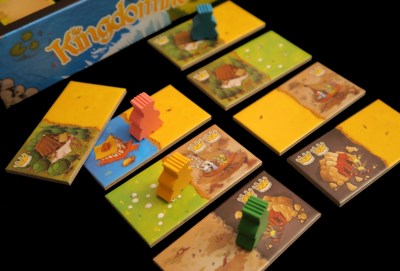
Kingdomino
– Image by boardGOATS

There are a couple of interesting little quirks.  Firstly, the dominoes are chosen by players in a very elegant way.  Each domino has a number on the reverse with the higher numbers roughly correlating to the more valuable ones.  At the start of the game four dominoes drawn at random are placed face up in ascending order and each player puts a coloured meeple on one of them.  These dominoes are played in ascending order, so the more valuable ones are played later.  At the beginning of round, another four dominoes are placed face up in number order creating a second row.  When a player carries out their turn, they take the domino under their meeple and add it to their kingdom and moving their meeple to the next row, choosing which domino to place it on.  In this way, players can choose a more valuable tile for the coming round but that is offset by having a later choice of tiles for the following round.
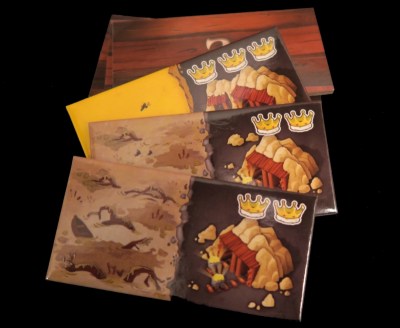
Kingdomino
– Image by boardGOATS

There is also matter of the distribution of the tiles.  Some terrains types, like cornfield, are quite common with few crowns available, however others (like mountain) are very scarce, but have most have more than one crown on them.  This is quite critical because a player could build up a very large area, which fails to score because it has no crowns.  Alternatively, a couple of squares of mountain (or marsh) can score relatively highly.  This effect was critical in this game as both Burgundy and Purple built up large areas of cornfield, but Burgundy managed to add four of the five crowns available to his which gave him substantial score. He had very little else though, and Black had built up areas of sea and woodland and Purple had added several small terrains to her large cornfield.  Largely thanks to his massive cornfield, Burgundy finished with a massive forty-two, almost twice that of Black in second place.  With Kingdomino over and Burgundy and Blue’s pizzas having arrived, the group split into three, with one group playing a new game, “London Meerkats”, one group playing the pizza making card game, Mamma Mia! and the last group eating pizzas (far too serious to be a game).
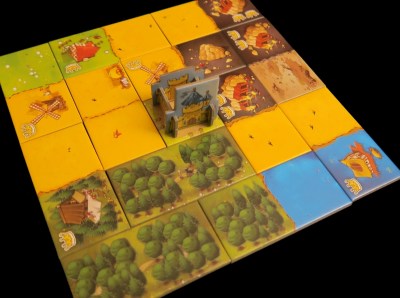
Kingdomino
– Image by boardGOATS

We first played Mamma Mia! about a month ago, and it went down so well, that Red fancied giving it another go this week prior to perhaps making a little purchase herself.  The idea is that players are trying to fulfill pizza orders by first putting topping cards in the “oven” and then sneaking their order cards in on top before another player does the same and claims the toppings for their order. So, each player has a deck of personal order cards and a random hand of toppings. On their turn, each player must place at least one topping card in the oven pile (all the same type) and may follow it with an order card if they choose.  The winner is the player who manages to complete the most orders.

Mamma Mia!
– Image by boardGOATS

Red and Pine had played Mamma Mia! last time (with the Double Ingredients mini expansion) and introduced Magenta and Turquoise to it.  Unfortunately, it is a slightly strange game and some of the rules didn’t quite make it somewhere along the line, not that it mattered though and Burgundy and Blue were thoroughly entertained by some of the snippets that drifted across the room. It seemed Pine in particular had strong opinions on what should go on a pizza, “How can you have four pineapples and one mushroom on a pizza?  That’s disgusting!”  On the other hand he was clearly less revolted by chili and  pineapple commenting, “That’s a nice combination!”  In the final round with Blue and Burgundy now spectating, Pine was clearly getting frustrated at being asked for the third time whether he had a card to add to his order, as he grunted, “No, I still don’t have one; why on earth would I want pepperoni – I’m a vegetarian!”

– Image by boardGOATS

With all the fun and a close game, the winner was almost a incidental, but once again, it was the Red, the “Pizzza Queen” who managed to complete all eight orders, one more than Magenta who finished with a highly creditable seven.  With pizzas cooked and eaten it was time for the “Feature Game”, Between Two Cities with the new Capitals expansion.  We’ve played Between Two Cities quite a bit, and when the expansion was available as a pre-release at the UK Games Expo at the start of the month, it was inevitable that we’d be keen to give it a go.  That said, Pine (clearly still suffering from a surfeit of pineapple and pepperoni), commented, “Here’s where an expansion takes a good game and makes it a worse.”  So it had a lot to live up to.
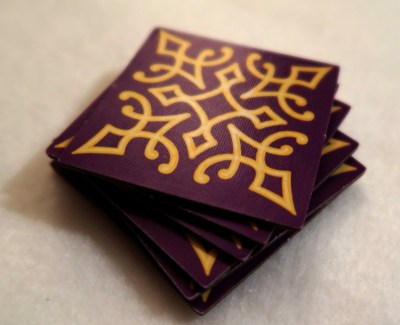
– Image by boardGOATS

Unfortunately, Turquoise had not played the base game before, however, of all games Between Two Cities is one game where a novice can get a lot of help due to its inherent nature.  The game is very simple as players draft buildings tiles, keeping two tiles each round and passing the rest on.  The novel part of the game is that instead of adding these tiles to one’s own city, the tiles are added to two cites, one on each side, each shared with a neighbour.  The winner is the player with the “best” second city (i.e. the player with whose lowest scoring city is the strongest). This peculiarity of the scoring means players are trying to balance their two cities and ensure the buildings they require a complementary.  The semi-cooperative nature meant that Red and Burgundy could help out Turquoise, and in fact, everyone could help eachother dealing with the complications of the expansion.
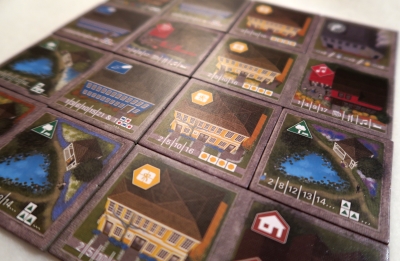
Between Two Cities
– Image by boardGOATS

There are three components to the Capitals expansion.  Firstly, each city now starts with a three-by-three starting tile with some pre-filled spaces and others that can  be filled by players.  This adds a tweak to the start of the round that we all agreed we liked, as well as making the game slightly longer as the cities occupied a slightly larger space.  The other two modules were slightly more controversial.  The new tile type, Civic buildings, might have been more popular if the icons hadn’t been so small that they were almost impossible to see in the slightly subdued lighting in the pub (which was worse than normal due to a blown bulb in exactly the wrong place).  Even those who could see them well though, were playing them in a very negative way.  These tiles give three points if placed near one specific type and six if next to two specific types, but one if not adjacent to either or if adjacent to a third specific type.  Unfortunately, the icons were too small to distinguish for anyone over about twenty.  Finally, there were district awards given to the largest districts i.e. contiguous areas of a pair of tile types.  Most people ignored these, largely due to the fact they were concentrating on trying to work out what to do with the Civic buildings.

Between Two Cities: Capitals
– Image by boardGOATS

One of the nicest parts of the Capitals expansion is that it includes a list of all the wooden monument meeples with their names, allowing players to identify better with their two structures.  Burgundy and Turquoise filled their shared city, the “Red Pagoda”, with lots of houses, parks and shops.  Since Burgundy was struggling to see the Civic buildings they completely eschewed them in favour of factories which they mostly managed to avoid placing next to any houses.  On Turquoise’s other side was the “World War Monument”, shared with Magenta.  This city scored less well, partly because it was competing with the “Red Pagoda” for park and factory tiles.  Magenta’s second city didn’t do much better, though at least it wasn’t in competition with her first city.  Sharing with Pine, the “Rialto Bridge” city combined offices with leisure and housing.
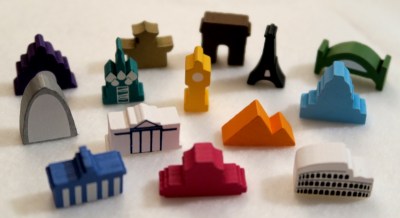
– Image by boardGOATS

Pine’s second city, the “Sydney Harbour Bridge” was shared with Red, and the profile almost exactly mirrored his first city.  It scored much better though partly thanks to the addition of a few Civic buildings and a couple of extra leisure facilities.  Red’s second city, “St. Basil’s Basilica” was shared with Blue and also featured several Civic buildings (as did Blue’s other city, well, someone was going to end up with them).  Despite completely missing out on shops which dented its housing score, “St. Basil’s” still scored quite well due to a lot of houses and parks.  The final city, the “Geekway to the West”, was shared by Blue and Burgundy and featured lots of shops, leisure buildings and houses as well as the Civic buildings, scoring well.
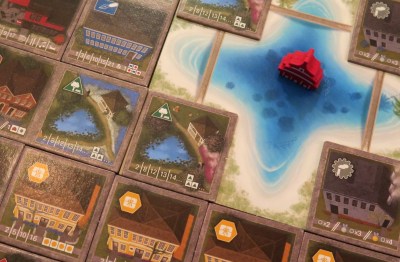
Between Two Cities: Capitals
– Image by boardGOATS

All the scores were a little moot, however, as the District Bonus scores were still to be allocated.  Only Blue had really paid attention to these at the start, and she had infected Burgundy and Red who she had been sharing cities with.  It was perhaps no surprise then that the “Red Pagoda”, the “Sydney Harbour Bridge”, the “Geekway to the West” and “St. Basil’s Basilica” all picked up bonus points which put them in first, second third and fourth place respectively.  That still left the winner to determine.  Blue, Burgundy and Red all had an interest in two of the top four cities.  Burgundy participated in the first and third placed cities giving him first place, and Red and Blue shared “St. Basil’s Basilica” in fourth so Red took second place on the tie-break.

Between Two Cities: Capitals
– Image by boardGOATS

Meanwhile, the next table had been playing London Markets (or “London Meerkats” as we  have taken to calling it).  This game was released at Essen last year following a KickStarter fund-raiser and is a re-themed revision of Dschunke, which was originally nominated for the Spiel des Jahres in 2002.  Green, Black and Purple had tried to play it at Didcot once before, but the set up and rules explanation had taken so long that they had only managed a few opening rounds before running out of time.  This meant they were all keen to try it properly, especially as it seemed to have an interesting and unusual mechanic.  In this, they were joined by Ivory who is always keen to try something new, especially the slightly more complex games.  Although “London Meerkats” is not actually that complicated, being a little different it takes a bit of time to understand how the components fit together.  At its heart, “London Meerkats” is an auction game, where players use goods to make a concealed bid for one of four options with the ultimate aim of having the most money at the end of the game.

London Markets
– Image by boardGOATS

In general, there are four items available in each auction, usually three giving a monetary reward and the fourth providing a special power card.  In a four player game, it is possible that each player bids for a different option and everyone moves onto the next round happy.  More often than not though, more than one person bids for one of the options, in which case at least one person is going to be disappointed and not just because they didn’t win, but also because all bids, even losing bids, go to the bank.  Worse, in the case of a tie, the winnings are split and rounded down, so when this is not possible, again, everyone involved comes out with nothing.  If there are items than nobody bid for, these are auctioned again, but it is even more risky this time as there are the same number of participants, but fewer targets.  They are also the items nobody bid for at the first attempt, so may be less desirable, leaving players with another difficult decision.  The interesting part of the game is how players acquire the goods to use in the bidding in the second part of the round.

London Markets
– Image by boardGOATS

The first part of each round is played on the board featuring London and five of her markets, Brixton, Borough, Portabello, Covent Garden and Petticoat Lane.  Each market exclusively provides textiles, soaps, coffee, porcelain apart from the last one which provides access to one of the others.  There are also three merchants who each start at one of the markets and two assistants who occupy locations on the banks of the river.  Players start by taking it in turns to select a merchant or one of the assistants and activating them, turning the token over so that only one person can carry out each action per round.  The merchants allow players to stack goods crates of their own colour in the market, collect goods cards (which are used for bidding) or collect money from the bank.  The latter number of cards or the amount of money depends on the number of crates visible when the action is used.  Since crates come in bars and are stacked, the number of crates visible changes throughout the game.

London Markets
– Image by boardGOATS

The merchants carry out the activity in the market they are in, whereas players who activate the the assistants can choose which of the two markets to carryout the action in with the action dictated by the assistant’s position on its riverside path.  Once everyone has carried out an action in the London Markets, players get two extra cards of their choice (or more if they have the right power cards) before the auction phase.  With almost everyone having recently played it (or at least a bit of it), the group relied largely on memory, which turned out to be a bit of a mistake, as part way through the game it became apparent that people had mis-remembered the rules in a number of small ways, which did distort the game in very unhelpful manner.
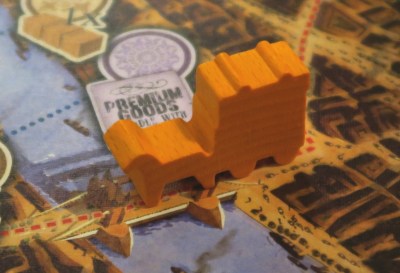
London Markets
– Image by boardGOATS

Black began by targeting the auctions for bonus cards, with Ivory going for the high value coffee, Green for low value cloth while Purple cornered the market in cheap lavender soap.  As the first few rounds went on, Ivory continued to pursue coffee and added a bonus card strategy too, claiming several extra pounds for having crates in a multiple markets. Green continued to do well in the auctions, Purple too, but with the lower value goods. Black seemed to miss out several times.  In round three, the first mistake reared its ugly head.  At several intervals during the game, there is an extra mini-action, the first of which is during round three.  We assumed the person who chose the first assistant would also get a bonus card on top of his action which Ivory used to great advantage. It was only after the half way mark that we realised the symbol on the board actually meant that everyone gets a bonus card that round.  Unable to fix this retrospectively with only one bonus card marker left we chose to continue as before. This would mean that Purple got the chance first and only Green didn’t get the bonus.
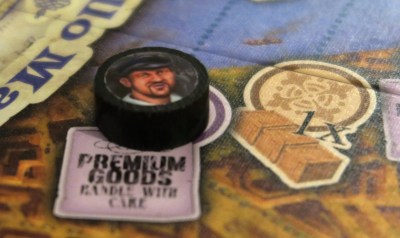
London Markets
– Image by boardGOATS

After round four, that we realised our second mistake. The two assistant actions are only supposed to be used in the two unoccupied markets, but we had played them as being available in all.  Since the first player marker had made one full rotation, we felt it had been fair and playing that rule properly hereafter would not penalise anyone unduly.  The game continued, Black managed to get the tie-breaker bonus card, meaning he would win any tied auctions and Ivory began to use his bonus cards to good effect.  Green was switching his auction goods quite well, winning several at high and low values, while Purple often found herself taking the short straw, losing a few.  By the half way money check mark, it was all very close with Green narrowly in the lead with £21 just £1 ahead of Ivory had £20 and Black and Purple just behind.

London Markets
– Image by boardGOATS

In the second half of the game, Black was finally able to start making good on his tie breaker, often to the demise of Green and Purple. Ivory was also able to really start building his position as he could now take four cards before each auction and exchange two more, meaning he could acquire a set of six of any type under almost any circumstances. It was about this that the third big mistake became apparent – some of the bonus cards could be held and cashed in later rather than having to be used as an immediate cash injection.  This meant players could work to get crates positioned in the appropriate market before cashing in a card, which would have helped those floundering quite a bit.
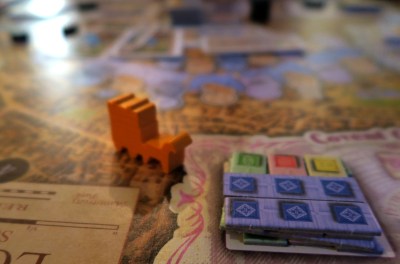
London Markets
– Image by boardGOATS

By about three quarters of the way through, it was obvious who the winner would be because he was raking in the cash and everyone else barely got a look-in.  Black had had a better second half, nearly doubling his score, while Green and Purple struggled, although Green fared worse of all as he barely managed a third of what he had taken in the first part of the game.  It was Ivory though that finished with £56, nearly £20 clear of Black in second, a huge margin of victory in what had seemed like a close game at half-time.  It was clear that the incorrect rules had a big impact on the outcome though, and as a result, and as we played it, it really meant that gaining an advantage would result in a increasing circle of benefit so maybe another try is in order, with all the correct rules.

London Markets
– Image by boardGOATS

Since “London Meerkats” finished before Between Two Cities, Purple and Black fancied another go at Kingdomino, this time with four players and Ivory and Green instead of Burgundy as the opposition.  There are also a couple of variants, in particular the option of adding a ten point bonus for finishing with the castle in the centre of the five-by-five grid as well as a five point bonus for players who successfully add all twelve dominos to their kingdom, so for a little variety, these were added to the final scoring.  This time Black’s Kingdom started out with a lot of woodland as he struggled to get anything very much, but kept his options open and managed to work in some other regions and get them scoring. He also managed to get his Castle in the middle and complete the whole set for a full fifteen point bonus.

Kingdomino
– Image by boardGOATS

Green started out with cornfields and meadows, soon adding woodland, swamp and water.  Although he kept it tidy with the castle in the middle, he was left with a terrible final double swamp tile that he just couldn’t place.  Purple was trying to play for the high value swamp and mountain tiles, but failed to maintain her five-by-five grid. She had misunderstood the rules and thought that she would score the bonus as long as the castle was surrounded by tiles. In the end her regions were generally small, but with lots of crowns.  Ivory, the “London Meerkats” Meister, went for a wet kingdom and produced a massive scoring lake and a couple of other regions, got his castle in the middle and completed the grid for a full set of bonuses and his second win of the evening.
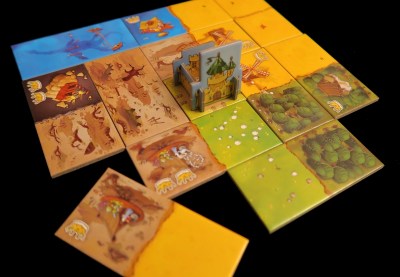
Kingdomino
– Image by boardGOATS

With time getting on and people beginning to leave, there was just still time for another game and with Burgundy, Blue and Pine left, Splendor was always a likely target.  Burgundy had had an unbeaten Tuesday night run since January 2015 – well over two years and at least eight games, during which time both Pine and Blue had made several attempts to beat him.  The game is a simple one of chip  collecting and engine-building with a very loose gemstone theme.  Basically, on their turn, players can take gemstone poker chips, or use chips to buy a card.  Some cards have points on them and all can be used like the poker chips to buy cards (but without having to return them).  The cards also give players access to “Noble tiles” which also give points.  The winner is the player with the most points after someone reaches fifteen points.

Splendor
– Image used with permission of boardgamephotos

This time the nobles required three each of sapphire, opal and diamond; three each of sapphire, emerald and diamond; three each of sapphire, emerald and ruby; and four each of diamond and opal.  Pine started, but Burgundy was quick out of the traps, collecting diamond cards as there were a lot about at the start and they featured on three of the four Noble cards.  Blue followed quickly and went for sapphire cards as they were also strongly represented on the Noble tiles.  Pine was a little slower, but not far behind picking up opal cards.  Burgundy was first to take a Noble taking the sapphire, emerald and diamond Noble, just beating Blue to it.  He was working on the sapphire, emerald and ruby Noble, but Blue had her eye on that and it with both layers having three sapphire and three emerald cards, it was all down to who would be first to get three ruby cards.

Splendor
– Image used with permission of boardgamephotos

It was neck-a-neck, and it was Blue’s turn.  She only needed the one ruby card and there was one in the display,but unfortunately, although Burgundy could afford it, she couldn’t.  Grudgingly, she reserved the card for herself, hoping that she wouldn’t turn over another ruby card.  Sadly, she did reveal a ruby card, and since Burgundy loads of cards and lots of chips, he could afford it.  It was Pine’s turn first though and he could also afford the ruby card so he decided to add it to his tableau.  It was with bated breath that Pine reveled the replacement card.  Unfortunately for Burgundy it was not a ruby card which left the road open for Blue to take the Noble on her next turn.  It wasn’t all over though, there were two Nobles still available, and Burgundy went for the next one, however, Pine had other ideas and took both in quick succession.

Splendor
– Image used with permission of boardgamephotos

During the game, both Blue and Burgundy had been picking up a few point bearing cards, however, Blue also had two high scoring cards reserved and was looking to play one of these, a four point card requiring seven sapphires.  Knowing Blue’s habit of spotting what other players want and reserving it to obstruct them, Burgundy reserved a four point level three card that he could play next turn.  Unfortunately for him, this revealed a five point card that Blue could afford.  As the last player in the round, taking the card gave her fifteen points which immediately ended the game, and with it, Burgundy’s unbeaten run, finally.

Splendor
– Image used with permission of boardgamephotos

There was still time for a quick game of that “nasty card game”, 3 Sind Eine Zu Viel!.  This game is very simple:  there are three rows of cards (zero to thirty, thirty to sixty and sixty to ninety) and on their turn, the active player chooses a numbered card and adds it to the appropriate row.  If there are five cards in the row the active player must pick up cards: if the card added is the highest card in the row, the active player takes the card with the lowest number, otherwise they take all cards higher than the card added by the active player.  The cards all have a colour as well as a number, and the aim of the game is to get as close as possible to two of each colour, while three is one too many…
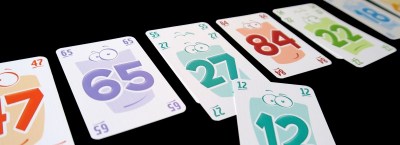
3 Sind Eine Zu Viel!
– Image by boardGOATS

About half way through the game, Pine asked whether the card marker was included in the five cards.  This prompted a quick rules check with the inevitable discovery that we had been playing it wrong.  We finished the game with our rules and although nobody managed a full set of seven cards, Blue and Pine both managed very creditable scores, with Blue five points clear.  Since the game is reasonably quick and we all wanted to know what difference the rules change made, we gave the game a second go.  We all felt it was different this time and maybe a little less prone to catastrophic card collections, not that that helped Burgundy.  For the second game on the trot he scored just seven, while Blue and Pine scored more but were even closer this time with Blue taking the second win, by just one point.

3 Sind Eine Zu Viel!
– Image by boardGOATS

Learning Outcome:  Games are generally better when everyone plays by the same rules, ideally the right ones…!

Game Plan: Rediscovering Boardgames at the V & A Museum of Childhood

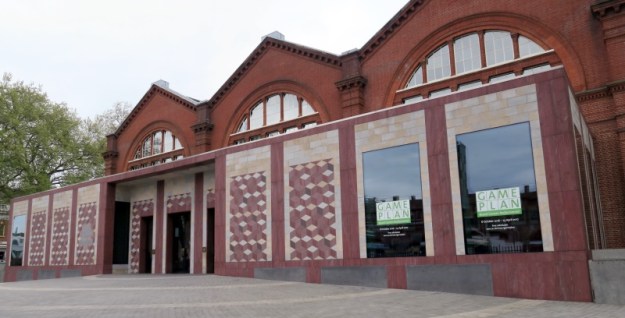
Inspired by the recent articles on Saturday Live and the Today Programme, on Easter Sunday, Pink and Blue decided to visit the V & A Museum of Childhood to see their “Game Plan: Board Games Rediscovered” exhibition.  Catching a train from Oxford Parkway and negotiating the London Underground, they arrived in Bethnal Green.  With its vaulted ceiling and exposed metal work, the Museum building looks for all the world like a re-purposed Victorian Civil building, a train station, swimming pool or maybe some sort of pumping station.  Much to their disappointment, however, after extensive discussion and investigation, it turned out that the building was designed for the purpose, albeit after relocation of parts from “Albertopolis” on Exhibition Road.

Game Plan: Board Games Rediscovered
– Image by boardGOATS

The exhibition itself was well presented and occupied a sizeable portion of the overall floor space.  Although it was located in one of the upstairs galleries, the exhibition was well advertised and, from entering the main hall, games were brought to the visitors’ attention with table space and signs offering the loan of games should people want to play.  It wasn’t an idle promise either, as there were several family groups making full use of the opportunity, albeit playing what might be called classic games rather than more modern, Euro games.

Senet
– Image by boardGOATS

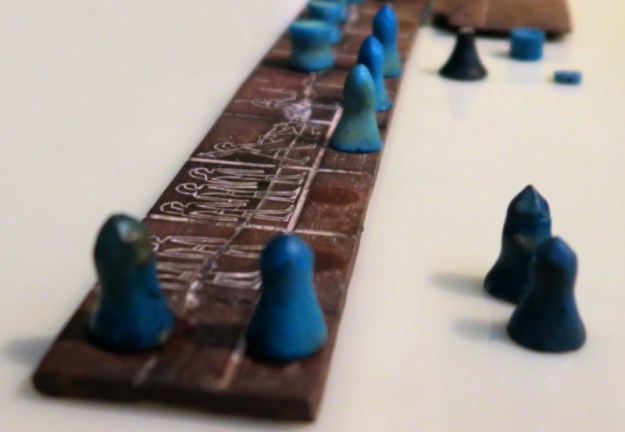
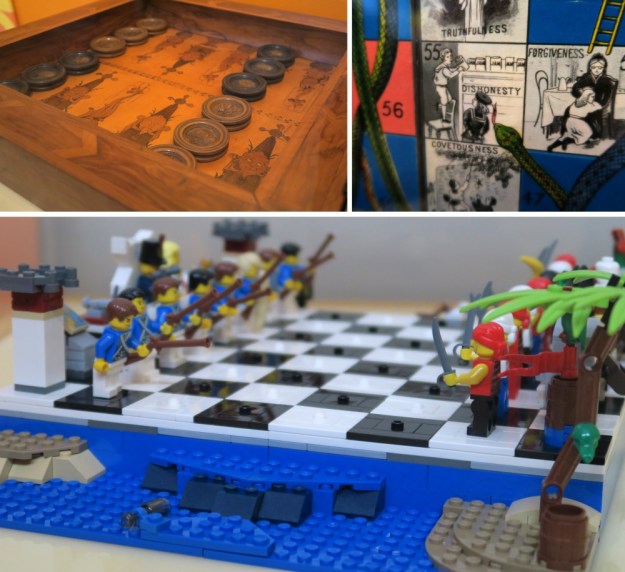
A quick look at the model train cabinet and brief spell side-tracked by one or two other exciting toys preceded entry to the exhibition which was shrouded by an eye-catching red screen.  The first exhibit was a copy of Senet, arguably one of the oldest games in the world – so old in fact that we’ve lost the rules and nobody knows how to play it.  This was followed by some traditional games including a beautiful wooden Backgammon set made in Germany in 1685 and decorated with sea monsters and a lot of fascinating Chess sets, old and new.  Next, there were some ancient copies of Pachisi (which evolved into Ludo) and Snakes and Ladders, both games that originated in India and were originally played seriously by adults.

Game Plan: Board Games Rediscovered
– Image by boardGOATS

Further round there were many other curious games, for example, The Noble Game of Swan from 1821, which was an educational game for children, itself developed from the much older, Game of the Goose.  Education was a bit of theme and there were a lot of games from the nineteenth and early twentieth century designed to teach geography in some form or another.  These included Round the Town, a game where players had to try to cross London via Charing Cross, and Coronation Scot, a game based on travelling from Glasgow to London inspired by the eponymous 1937 express train made to mark the coronation of George VI.

Game Plan: Board Games Rediscovered
– Image by boardGOATS

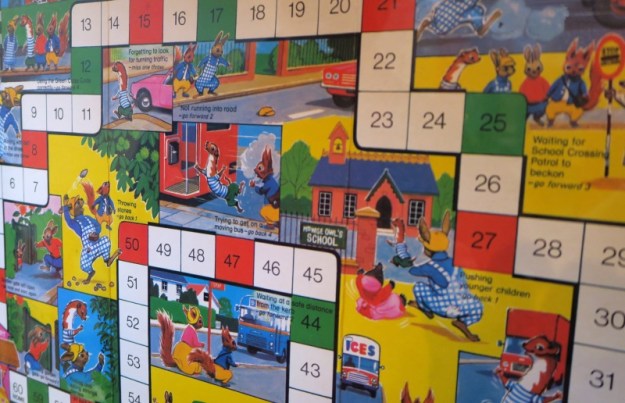
Education didn’t stop there either:  for those that had been members of RoSPA‘s “Tufty Club“, there was a game promoting road safety featuring Tufty the Squirrel and his mates Minnie Mole and the naughty Willy Weasel.  However, when designing this roll-and-move game, they clearly ran out of imaginative “adventures” with a road safety message, as they had to resort to “Picking and eating strange berries – Go back three spaces…”

Tufty Road Safety Game
– Image by boardGOATS

Progressing through the late twentieth century, there were the inevitable copies of the childhood classic games, including Game of Life, Risk, Cluedo, Mouse Trap, Trivial Pursuit, Connect 4, Scrabble and the inevitable Monopoly, all of which risked bringing a tear to the eye as visitors remembered playing them as children.  The exhibition eventually brought us up to date with modern Euro-style games, presenting copies of Ticket to Ride, Carcassonne and Settlers of Catan.

Pandemic
– Image by boardGOATS

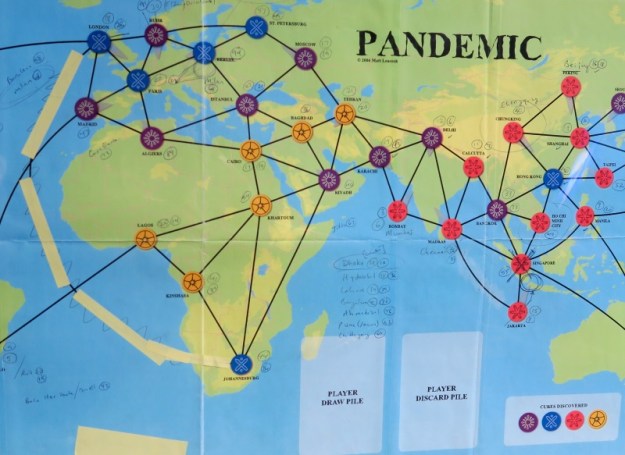
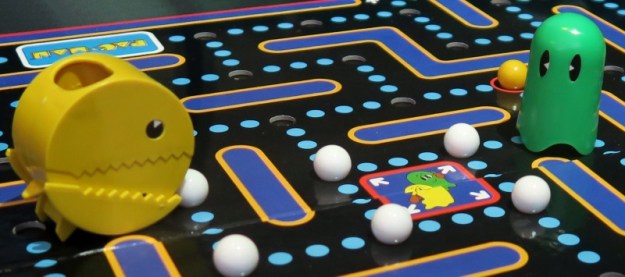
More interestingly, there was also an original prototype of Pandemic supplied by the designer, Matt Leacock, complete with his scribbles and bits of paper stuck over infection routes he decided to remove as the game developed.  One of the final display showed how the influence boardgames have had on the computer gaming industry is sometimes strangely reciprocated, with a copy of the Pac-Man game, including the title figure wrought in sunshine yellow plastic.

Pac Man
– Image by boardGOATS

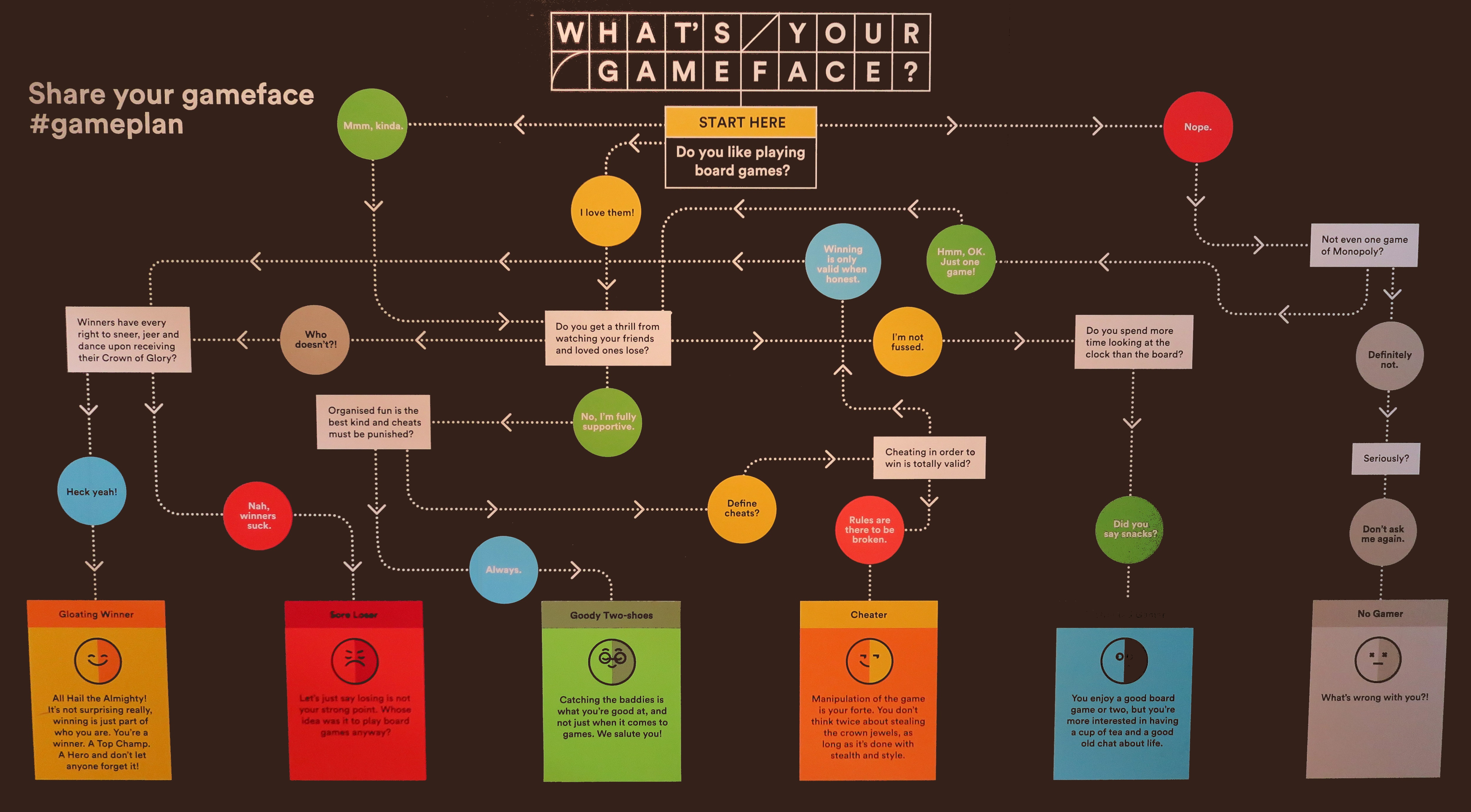
Leaving the exhibition, there was just one last game – “What’s Your Gameface?“.  This cute flow chart entertained Blue and Pink for far longer than is should have as they tested it out with all their friends, relatives and fellow gamers (nobody came out as “Cheater”).

Game Plan: Board Games Rediscovered
– Image by boardGOATS

With the exhibition done, there was still time for a wander round the rest of the museum and a quick cuppa in the cafe.  Reflecting on the exhibition, perhaps one of the best aspects had actually been the quotations that adorned the walls.  It seems luminaries from Plato to Roald Dahl have all had something to say on the subject of games.  Perhaps George Bernard Shaw supplied the most thought provoking comment though, when he said, “We don’t stop playing because we grow old; we grow old because we stop playing.”  With this in mind, we did what gamers do when they travel, so tea and cake was accompanied by two rounds of Mijnlieff, the super-cool noughts and crosses game.  With the museum closing, it was time to head home, but there was still time for a game or two of 3 Sind Eine Zu Viel! on the train back to Oxford…

Game Plan: Board Games Rediscovered
– Image by boardGOATS

The Exhibition is only open till 23rd April 2017, so there isn’t much time left and it is well worth a visit.

24th January 2017

Food was a little delayed, so as it was a relatively quick game (and one that we felt we could play while eating if necessary), we decided to begin with the “Feature Game”, Bohemian Villages.  This is a fairly simple tactical dice-rolling game.  The idea is that on their turn, the active player rolls four dice and uses them to assign their meeples to buildings in the villages of Bohemia.  The dice can be used as two sets of two, a group of three (with one forfeit) or in their entirety as a group of four.  These values correspond to the different types of buildings which appear with different frequency and give different rewards.  For example, if a player rolls a six, they can place their meeple on a Flour Mill.  When the last of the Flour Mills is occupied, everyone gets their meeples back, together with two coins for each one.  Similarly, rolling a seven allows the active player to place their meeple on a Glass Factory, however, when they get them back they get three coins instead of two.

Bohemian Villages
– Image by boardGOATS

Other buildings work differently though, for example rolling a two, three, four or five allows players to put their meeple on a Shop.  There are four different types of Shops and players are rewarded increasingly large amounts of money for the more different Shops they occupy at the end of the game.  A set of four is very valuable, but the snag is that the number of Shops available is very small.  So, once they are all occupied, if another player rolls the right number they can bump someone else off costing them a lot of money in the process.  Players rolling a twelve, place their meeples on Manor Houses which give an immediate reward whereas inns (nine) give a regular income at the start of the active players turn, so long as they remember to claim it!  Farms also provide income during the game with the active player collecting one coin for each farm owned when they add a new one (i.e. roll another eight).  Churches and Town Halls (ten and eleven) provide money at the end of the game with players rewarded for occupying the most Churches or for occupying a Town Hall in a fully occupied village.

Bohemian Villages
– Image by boardGOATS

The game ends when a player runs out of meeples and the winner is the player with the most money.  We were just about to start a five-player game when Green and Ivory pitched up, so Red joined them, leaving Blue, Pine, Magenta and Burgundy to start.  With food arriving just as we started, Blue began by claiming the most lucrative Manor House with all four of her dice before turning her attention to her pizza.  Magenta started collecting Shops, but soon faced competition from Pine.  Meanwhile, Burgundy was sidetracked by his supper, Blue tried to get a regular income stream from a chain of Inns and Pine went into the church.  Somewhere along the line during her rules explanation, Blue had commented that Farms could be quite lucrative, so Magenta took the hint and before long she was engaged in a massive land-grab.  It took everyone else a while to notice, so it was very late before they attempted to reduce her income.   In what was a very close game it just played into Pine’s hands and he finished two coins ahead of Magenta when Burgundy brought the game to a slightly unexpected end.

Bohemian Villages
– Image by boardGOATS

On the next table, the absence of Burgundy meant that Red, Ivory and Green fancied their chances at a game of Splendor.  This engine building game is built on a simple set-collection mechanism.  Players collect gem tokens then use them to buy gem cards.  Gem cards can then be used to buy more cards.  Some gem cards are also worth points, and they also enable players to collect Nobles which are awarded to the first player collect certain combinations of gem cards.  Splendor is one of our group’s “go-to” light filler games and in recent months Burgundy has made the game his own.  With Burgundy otherwise engaged though, he was guaranteed not to win.  With Ivory and Red fighting for the same colours, Green made the fastest progress collecting opals and diamonds and building a valuable collection quickly.  Ivory came off best in the tussle between him and Red, and he was able to pick up two Nobles with his pickings.  It was Green that took the honours, however, taking a Noble himself to bring the game to a close.

Splendor
– Image used with permission of boardgamephotos

Bohemian Villages finished first, so after a trip to the bar, Blue, Magenta, Burgundy and Pine played a few hands of Love Letter to kill time.  We play this quite a bit, because with just sixteen cards, this is a great little game to play while chatting or doing other things (like eating).  Each player starts with a card and, on on their turn, draws a second and chooses one of them to play.  Each card has a number (one to eight) and an action; players use the actions to try to eliminated each other and the player with the highest card at the end, or the last player remaining is the winner.  This time, we managed five hands before Splendor finished and it ended in a tie between Blue and Magenta who won two each.  With nobody wanting a late night we fancied something we could play as a group that wasn’t going to run on.

LoveLetter
– Image by boardGOATS

After a bit of a discussion, we settled on a big game of Between Two Cities, involving everyone.  This is quite popular with our group as it is both competitive, and cooperative and, as such, is totally different to anything else we play.  The idea is that, instead of each player having a personal player board that they work on in isolation, each player sits between two boards which they share with their neighbours.  The game play is based on card drafting games like Sushi Go! and 7 Wonders with scoring taking elements from tile-laying games like Carcassonne and Alhambra.  The game is played over three rounds with players placing building tiles to construct cities consisting of sixteen tiles in a four by four array.  Each player starts the first round with six tiles, of which they secretly choose two and pass the rest to the left.  Once everyone has chosen their two, everyone reveals their choices and then negotiates with their neighbours to try to to ensure they get the tiles they want in the two cities they have a share in.

Between Two Cities
– Image by boardGOATS

Play continues with each player picking up the hand they were passed and choosing another pair of tiles etc. until there are no tiles left.  In the second round players get three double tiles of which they choose two and discard the third.  These double tiles contain two buildings in a vertical or horizontal arrangement.  This is where things can get difficult, as the final city must form a four by four square and the location of buildings can be critical to their scoring.  For example, a housing estate built in a city with lots of other different types of buildings is worth up to five points at the end of the game, unless it is next to a factory in which case it is only worth one point.  The third and final round is played the same way as the first, except that tiles are passed in the opposite direction.  The winner is the player with the highest scoring second city.

Between Two Cities
– Image by boardGOATS

As well as being a nice balance of cooperative and competitive, it also plays well at a wide range of player counts with little change to the overall game time.  With so many people involved, however, one of the down-sides is the fact that it is very difficult to see what players at the other end of the table are doing and near-impossible to influence their game-play.  Despite this, for the most part every city had it’s own distinct character, for example, Red and Magenta reproduced central London with offices surrounded by lots of pubs and entertainment venues while Blue and Burgundy built a flourishing industrial town and Pine and Ivory managed their own little recreation of Thatcher’s Britain.

Between Two Cities
– Image by boardGOATS

In Between Two Cities, the winner is the player who’s lowest scoring city is the scores most, with their other city used as a tie-breaker.  For this reason, it is usual that the player who finishes with two most closely matched cities that wins.  By rights then, the game should have gone to Green or Red who both finished with both their cities scoring exactly fifty-four points.  This was an unusually close game though, with all cities except one finishing within four points of each other.  In the end, Blue who took second place from Burgundy on the tie-break, but it was Pine, sharing cities with Burgundy and Ivory who finished two points clear giving him his second victory of the night.

Between Two Cities
– Image by boardGOATS

With that, Red, Magenta, Ivory and Green headed off for an early night, but Blue, Burgundy and Pine felt it wasn’t yet late and that there was time for something light before bed.  Since Splendor was still out Pine and Blue decided to have another go at Burgundy and see if together, they could finally dethrone him.  It all started well with Pine and Blue successfully inconveniencing Burgundy grabbing gem cards he wanted just before he could get them.  It wasn’t long, however, before Burgundy managed to collect a large number of diamonds which allowed him to just beat Blue to a couple of nobles.  She was still in the fight though, right until she miscounted how many sapphires Burgundy had, and with it handed him the game. Still, we are definitely getting closer to beating him…

Splendor
– Image used with permission of boardgamephotos

Learning outcome:  Competition is essential in games, but working together is fun too.

Boardgames in the News: Asmodee Take Over Canada

The Canadian company, F2Z Entertainment, own Filosofia Éditions (who bought Z-Man Games in 2011) and are also the parent of company of Pretzel Games and U.S. company Plaid Hat Games.  Given the rate that Asmodee have been gobbling up games companies, it seemed only a matter of time before they turned their attention to F2Z Entertainment.  It seems their enticing range of games, which include Pandemic, Dead of Winter and Carcassonne, was just too much and in July, Asmodee announced that it had entered into exclusive discussions to acquire F2Z Entertainment.  These discussions are now concluded and, as of today, F2Z Entertainment, will be known as Asmodée Canada.

Asmodee Canada
– Image from trictrac.net

So, who will be next? Rio Grande Games perhaps?  Or maybe Czech Games Edition or Pegasus Spiele will be their target following their recent successes in the Spiel des Jahres and Deutscher Spiele Preis?  Time will tell.

20th September 2016

Since the planned “Feature Game” (Cuba) was a long one and we didn’t want anyone to get stuck playing two-player games all evening, we decided to play a quick filler until everyone had arrived.  After a brief discussion, we decided to go for Between Two Cities.  This game is quite popular with our group as it is both competitive, and cooperative and, as such, is totally different to anything else we play.  The idea is that, instead of each player having a personal player board that they work on in isolation, each player sits between two boards which they share with their neighbours.  The game play is based on card drafting games like Sushi Go! and 7 Wonders with scoring taking elements from tile-laying games like Carcassonne and Alhambra.

Between Two Cities
– Image by boardGOATS

The game is played over three rounds with players placing building tiles to construct cities consisting of sixteen tiles in a four by four array.  Each player starts the first round with six tiles, of which they secretly choose two and pass the rest to the left.  Once everyone has chosen their two, everyone reveals their choices and then negotiates with their neighbours to try to to ensure they get the tiles they want in the two cities they have a share in.  Play continues with each player picking up the hand they were passed and choosing another pair of tiles etc. until there are no tiles left.  In the second round players get three double tiles of which they choose two and discard the third.  These double tiles contain two buildings in a vertical or horizontal arrangement.

Between Two Cities
– Image by boardGOATS

This is where things can get difficult, as the final city must form a four by four square and the location of buildings can be critical to their scoring.  For example, a housing estate built in a city with lots of other different types of buildings is worth up to five points at the end of the game, unless it is next to a factory in which case it is only worth one point.  Similarly, an isolated shop is worth two points, but a row of four is worth sixteen points.  The third and final round is played the same way as the first, except that tiles are passed in the opposite direction.  The winner is the player with the highest scoring second city.  We had just begun getting the game out and revising the game play when Black and Purple arrived, the last two expected.  So, in a quick switch, four jumped ship to play the “Feature Game” leaving Black and Purple to join Red, Magenta and Pine in Between Two Cities.

Between Two Cities
– Image by boardGOATS

The five cities all had very different characteristics, for example, Pine shared two contrasting cities with Magenta and Red.  The city he shared with Magenta had a pleasing arrangement of houses around a large central park with a couple of shops, bars, offices and a factory.  On his other side he shared the top scoring industrial town with Red which comprised a small housing estate buffered from factories by a row of office blocks.  Red shared her second city with Purple. This was built round a large park with lots of offices some bars, but only the one housing estate which cost it points.  Purple also shared a city with Black comprised two small parks surrounded by houses and bars with a couple of shops thrown in for good measure.  The fifth and final city was another industrial conurbation shared by Magenta and Black with lots of factories, and offices interspersed with bars and restaurants giving it a high score.

Between Two Cities
– Image by boardGOATS

The key to the game is to build two cities with similar scoring, but ideally using different components.  The other important factor, however, is the layout of the buildings and keeping them flexible for as long as possible.  The most successful in this regard was Pine, who was sat between the first and third highest scoring cities shared with Magenta and Red, who took second and third place respectively.  Filling in the log book was quite a pantomime, accompanied by photos and complicated diagrams before the group moved on to their next game, Pi mal Pfloumen, also known in our group as “Oh my Plums!”.  We’ve played this a couple of times, most recently last time, but on both occasions we struggled with the clarity of the rules.  This time, we finally managed to play it right (we think) and unsurprisingly, the game worked much better played correctly.

Pi Mal Pflaumen
– Image by boardGOATS

The game is one of set collecting built on a framework of trick taking.  Each card has a value, a “fruit suit” and, in many cases, a special action as well.  Players take it in turns to play a card, then, starting with the player who played the card with the highest face value, players then take it in turns to choose a card.  These are added to their tableau in front of them.  In general, any special actions are carried out when the card is taken, which can include taking “π cards” (which can be added to cards when they are played to increase their face value), taking cards from other players or claiming the Watchdog card (which protects from card theft).

Pi mal Pflaumen
– Image by boardGOATS

Some cards depict a “fruit mix” which lead to scoring opportunities, and can be claimed at any point when a player is taking cards at the end of the trick.  It all made a lot more sense this time though Red still didn’t have a clue what was going on.  It was quite a close game, but was finally decided when Red took a critical plum spoiling Black and Pine’s plans and with it taking the game, just ahead of Purple in second place. With Red and Magenta heading home for an early night and the game on the next table still going, Black, Purple and Pine were looking for something interesting to play.  Blue suggested Oh My Goods!, which is a little card game, but as none of the others had played it (and Blue was engaged elsewhere), they settled down to decipher the rules.  Meanwhile, the neighbouring table were just over halfway through their game of Cuba.

Pi mal Pflaumen
– Image by boardGOATS

Cuba is a fairly simple game mechanistically, but is deceptively complex thanks to the way actions interact and build on each other.  Each player has a player board featuring a four by four array of plantations and/or buildings and a lot for storage.  They also have a pack of five character cards each with an associated action.  In the first part of each round, players take it in turns to play a character card until they have each played four of them.  In the second part of the round, the remaining character provides the basis of each player’s votes in Parliament, with different characters providing different numbers of votes.  This part of the game is vaguely reminiscent of voting for Laws in Lancaster.  In Cuba, players can improve their position by buying more votes in a blind bidding phase with the winner choosing two which two bills Parliament will enact.  There are a number of little features that give the game teeth, for example, any money spent on buying votes goes to the bank, regardless of whether the player wins or loses.  Similarly, the start player (which decided based on the final character card played) can be critical as it is the tie breaker in the voting phase as well as giving priority in the next round.

Cuba
– Image by boardGOATS

Getting these wrong can mess up plans spectacularly, but far more critical are the character cards played, the order they are played in and how they are played.  For example, the Worker card allows a player to move their Worker to any plantation on their player board and then activate the plantation at its new location and all plantations orthogonal to it.  Plantations can generate resources (rock, wood or water) or produce (sugar, citrus fruit or tobacco), but as the game progresses may be replaced by buildings.  Buildings are placed over plantation spaces using the Architect card and exchanging them for resources.  Like plantations, they are activated by playing the Foreman card who activates all buildings orthogonal to the Worker, but does not move the worker as part of the action.  Thus, the relationship between playing the Worker card and playing Foreman card is very important.

 Cuba
– Image by boardGOATS

Furthermore, there is a significant distinction between resources (cubes), produce (octahedral blocks) and goods (rum and cigars created from sugar and tabacco):  while resources and goods can be stored in the lot, produce will rot if left out overnight and must be moved to the Warehouse before the end of the round if they are to be saved.  In order to move produce to the Warehouse, the Warehouse must be activated by the Foreman.  This could be because it is one of the buildings orthogonal to the Worker or because the player sacrifices his positional advantage and activates the warehouse as a single building anywhere on the board.  Thus, the position of the buildings is very important, not only because careful placement allows players to activate multiple buildings, but also because they are placed on top of plantations which are then no-longer usable.  Produce can also be saved from rotting by either using buildings to turn it into goods or by playing the Mayor to place items on a ship.  This last option can be difficult to rely on however as all merchandise must be placed on the same ship and spaces on each ship are limited.

Cuba
– Image by boardGOATS

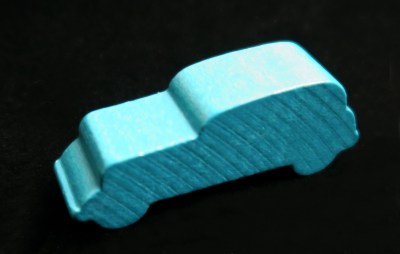
Thus, while Cuba relies on a good strategy, meticulous planning is also vital for success.  Although we could all see this up front, only Green had played it before (albeit some years ago), so he was the only with an idea of the possible strategies.  So, to give everyone else a few extra moments to familiarise themselves with their player board, Green was declared the start player and took the wooden blue sedan (pinched from the El Presidente expansion as a start player marker).  Green began by building the Dam to increase his board’s water supply, while everyone else started with what appeared to be a more flexible opening by using their Worker to collect resources and produce.  By the end of the first part of the first round, Burgundy had shipped a few goods, Green had collected a lot of water, and Ivory and Blue weren’t sure what they were doing, but had decided that collecting and storing produce seemed like a good base to start from.  Then came second part of the round:  bribing officials to decide which bills should be enacted.

Cuba
– Image by boardGOATS

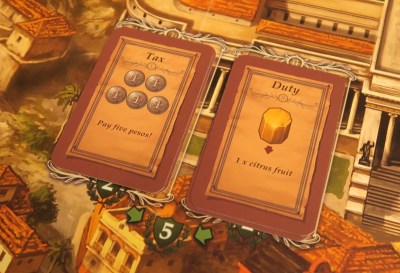
Since Burgundy had been the only one to ship goods he was the only one with fewer than five votes.  Everyone secretly chose an additional amount, but as Green really, really, really wanted this one, he bid four of his ten pesos, while everyone else wasn’t certain how to value the bills and therefore didn’t bid.  So Green chose his expensive laws for the round and in particular the water subsidy which would give him three points straight away.  The second round mirrored the first with everyone choosing their “Worker” until Green played his “Architect”, building the Golf Course (which converts water into victory points).  While everyone else could see what Green was doing, nobody else had worked out what was a good combination of buildings and therefore what strategy to play for. Blue made a mistake thinking the Bank she was would give victory points, but when she activated it she realised it gave her money.  Still, it did give her an advantage during the bribing and in the second round was able to choose the laws.  This time she changed the goods tax from citrus to sugar, and brought in the Harbour Act (this makes any fully loaded ships leave the harbour immediately with all remaining ships moving along accordingly).

Cuba
– Image by boardGOATS

After taxes had been paid and subsidies received (Green had already converted his water and so did not receive the subsidy this time) the scores were evenly spaced with Green at the front, building a solid lead.   Over the next few rounds everyone stumbled on, still not really sure what to do as Green developed quite a strong lead.  Burgundy was the only one who was really doing any shipping while Ivory had managed to build a Rum Factory and was converting lots of sugar into Rum, which he was hoping to ship.  Unfortunately, he really struggled since only the first ships seemed to required rum and the later ones all seemed to need cigars.  By the time Ivory had given up and sold his rum, ships that did want it finally started appearing, but it was largely too late.  It was at the end of round four when the game took a sudden turn though.  Burgundy had worked hard on shipping, which the rest of us had mostly ignored.  With the Harbour Law still in force, the ships moved on when full and nobody had noticed that Ivory had every piece of merchandise required for the top scoring ship.  So when it was his turn he loaded it completely taking fifteen points, and with it, the lead.  Suddenly everyone knew how important shipping could be.

Cuba
– Image by boardGOATS

With only two rounds to go, it was a bit late to change strategies and only Blue made any inroads using her stash of pesos to win the laws and ensuring she could gather the full five points for fulfilling the taxes while everyone else struggled to get two points. This together with the Rum Café she had built gave her a sudden flurry of points, but it was too, little too late.  In the final final scoring, Green was unable to catch Ivory who finished four points behind Ivory – not how anyone would have predicted from the early rounds where Green had been so dominant and everyone else had been learning.  We had all enjoyed it though, especially once we’d got to grips with the difference between resources, produce and goods.  The sudden change of fortunes as strategies clicked kept it interesting too, though in any future there may be more competition for shipping than there was in this one.  It’s highly likely we’ll play it again soon though.

Cuba
– Image by boardGOATS

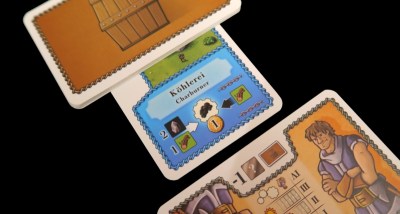
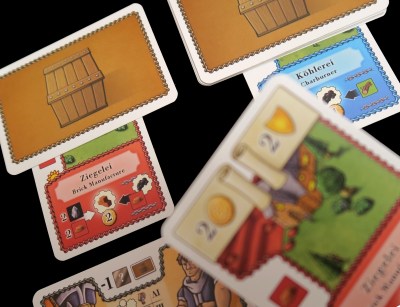
As Cuba was coming to an end, Black, Purple and Pine were still making a bit of a meal of Oh My Goods!, getting bogged down in the complexity of the theory of “chaining”.  Although this is the clever part of the game it is a complicated place to start in what is otherwise a simple game.  Players start with a hand of dual purpose cards which can act as resources or buildings.  They also start the  game with a single card face up in front of them, a charcoal burner stacked with face down cards:  charcoal.  The idea is that this charcoal can be used as money to spend on building, or as charcoal to use as an input to other processes.  At the start of each round players get an extra couple of cards before cards are turned over to make the morning market.  This can consist of as few as two cards or as many as eight or more.  The market provides input for buildings – there will be a second, evening market before the end of the round – but players have to use the morning market to provide a steer to decide which building they are going to activate and what they are going to build.

Oh My Goods!
– Image by boardGOATS

Each player has one worker and must be assigned to the building he is going to activate.  The worker can can work efficiently or lazily.  If he works efficiently, he will need the necessary resources in full and will provide two items of produce.  On the other hand, if he works lazily, he can manage with one less than the total necessary resources, but will only produce one item.  The resources can come from the market, but can also be topped up from the player’s hand.  Once each player has placed their worker, decided whether he will be efficient or lazy and chosen a card to build, the second market is revealed.  Once this evening market has been completed, players take it in turns to carryout their production and, if appropriate, build.

Oh My Goods!
– Image by boardGOATS

A building only produces if the necessary resources (on the bottom left corner of the card) can be provided either through the market or from a players hand.  If the worker is efficient, then he produces twice and two cards are taken from the draw deck and placed face down on the top of the card as produce.  If the worker is lazy, only he only produces once.  This is where the game gets slightly nasty:  if the player cannot supply the required input, then the turn is wasted, though if they have sufficient money, they can still use it to build.  If a building is activated, it can additionally be used to “chain” i.e. produce goods using input from other buildings (rather than the market) and it was this that was confusing people.  The problem is that this is only possible once a player has several building and although it is a key part of the game, the ability to build good working chains is highly dependent on the cards drawn.  As such, it is not something to worry about too much when learning to play.

Oh My Goods!
– Image by boardGOATS

Ivory and Green left, leaving Blue to try to explain to Pine, Black and Purple, and Burgundy to spectate.  Perhaps it was because it was late and people were tired, or perhaps it was because the players had confused themselves, but the game itself was still rather tortuous.  Pine’s concluding comment was that if Room 101 existed, he knew which game he would be sending there…  In this light the scores seemed rather irrelevant, though it was obvious that the player who understood best was going to win and that was Black who finished with twenty-two points.  He agreed that it was a clever game and he might be interested in giving it another go, though sadly it is probably beyond Blue’s powers of persuasion to encourage Purple or Pine to try again soon.

Oh My Goods!
– Image by boardGOATS

Learning outcome:  Sometimes, you don’t have to understand what’s going on, but it usually helps…!

6th September 2016

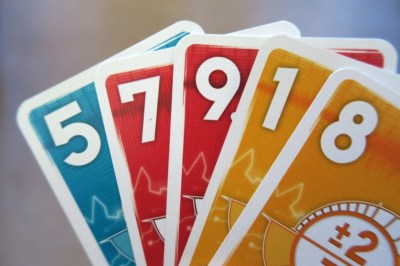
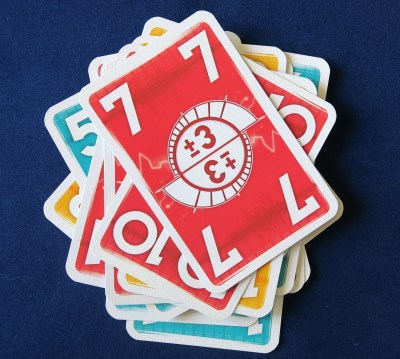
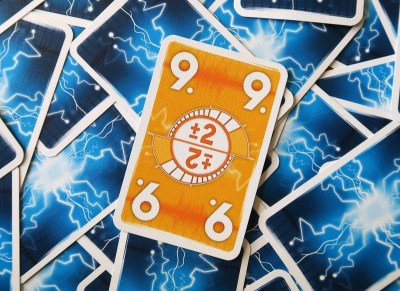
Pink (making one of his rare appearances) arrived first with Red and Magenta, closely followed by Blue and then Burgundy.  So, with the food order done, we scratched about for something quick to play when Red suggested a little card game called Unter Spannung (aka 7 Ate 9).  This was a game she had picked up in Germany a week earlier when she’d been travelling and had found herself unable to resist spending all her money in a toy shop.  Although the rules were in German, Red and Blue had managed to come up with a translation and had played it quite extensively when they had been away in Switzerland for work.  Neither Red nor Blue speak any German, so they weren’t certain that they were playing correctly, but they had found it to be fun all the same and taught everyone else the same way.

Unter Spannung
– Image by boardGOATS

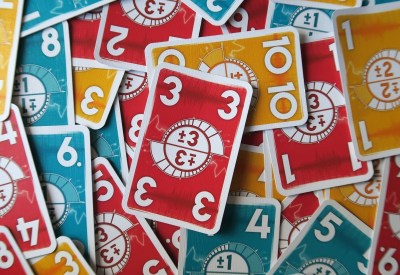
They described Unter Spannung as “Dobble with maths” and basically, the idea is that each player starts with a hand of four cards and a deck of cards that they must try to get rid of.  Each card has a number on the corner (the face value) and a modifier in the centre (of the form ±1, ±3 or ±3).  The game begins with a single face up card in the centre and simultaneously everyone tries to play a card where the face value matches the total for the centre card (i.e. the face value plus or minus the modifier).  Thus, if the card in the middle is 8±1, players can play any card with a face value of seven or nine.  The snag is that cards are only numbered one to ten, so the the maths gets a little more tricky.  For example, 8±3 is five or eleven, but since there is no eleven, it becomes one.  Simple enough, though at the lower end things become more difficult as negative numbers don’t simply become positive, rather, zero becomes ten and any negative must be subtracted from this.  So, 1±3 is four or minus two which in turn becomes eight…

Unter Spannung
– Image by boardGOATS

Like Dobble, cards are placed simultaneously in a frantic rush and the card then played becomes the new top card, which causes mayhem when someone has just got there first.  Unlike Dobble, players start with a hand of four cards but can add cards whenever they want, so as soon as there is a bit of a lull in placing cards everyone frantically draws cards from their deck.  The first player to get rid of all their cards (hand and deck) is the winner.  Although the game nominally only plays four, we added an extra and just played a slightly short round.  Red and Blue had an inevitable advantage having played before, and everyone else struggled to get their heads round it.  The first round went to Red who stomped her authority on the game early on.  Then Burgundy’s food arrived which he used as an excuse to duck out of the second round which Blue took having warmed up a little.

Unter Spannung
– Image by boardGOATS

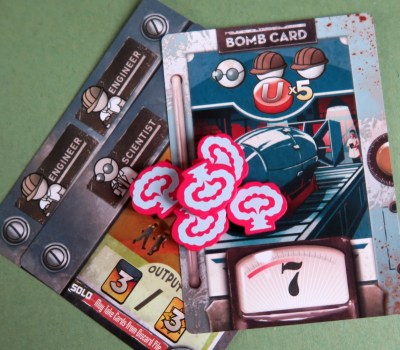
With food and gamers arriving thick and fast, there was a brief hiatus, before we split into three groups.  The first group (Black and Purple) began their belated supper while Red, Blue, Pink and Magenta began the “Feature Game”, which was The Manhattan Project: Chain Reaction.  This is a fairly short resource conversion card game based on The Manhattan Project boardgame.  In this simpler, card game version, players are firstly mining to create yellowcake, then purifying the yellowcake to get uranium which they can then use to make a bomb.  Players start with a hand of five cards, each of which is dual function, providing either an action or a people.  In order to get the yellowcake players need people to do the mining and then a mining card.  There are several different types of people:  labourers, engineers, scientists, etc.  These can be provided directly by cards, or using people and location cards to generate larger numbers or people with different skills. For example, a University can be used to create engineers or scientists.  Combining these with enrichment plant cards and yellowcake gives players uranium which in turn allows players to claim one of the face up bomb cards.  When acquired, these can be augmented by the addition of a bomb-loading card which also comes at a price.

The Manhattan Project: Chain Reaction
– Image by boardGOATS

All the cards come in a range of input requirements and outputs, but in general, the more expensive cards give richer rewards.  There are always several bomb cards available and the game end is triggered when one player achieves a total of ten megatonnes of bomb (including any bomb-loading cards).  The rules were a little bit difficult to disentangle somehow so it took us a while to really get to grips with what should have been a fairly simple game and there was a high chance that the player who understood first would win.  In the event, luck played a fairly large part too as there are additional special cards.  These are important as the hand-limit of five cards is quite restrictive and the special cards can enable players to get extras. It was Pink who managed to get the first bomb card, although Red and Magenta both had substantial piles of uranium and yellowcake respectively.  Then from no-where, Blue suddenly built a seven megatonne bomb, quickly followed by Red and Magenta.  It was all too late though as Pink finished the game and with it comprehensively won.  In truth this isn’t really the sort of theme our group usually go for, and with a fairly heavy slice of luck and slightly rough roles we made heavy weather of it.  That said, we felt it was definitely worth playing again.

The Manhattan Project: Chain Reaction
– Image by boardGOATS

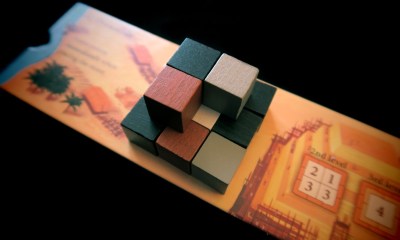
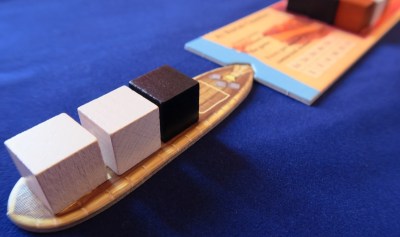
Meanwhile, Green, Ivory, Pine and Burgundy played Imhotep, one of the nominees for the Spiel des Jahres this year.  We played it a few weeks back in July and it went down quite well, so since Green wasn’t able to stay for long it was a good opportunity for a second outing.  In this game, players take the role of builders in Egypt who are trying to emulate Imhotep.  The premise of the game is very simple.  On their turn, the active player chooses one of four actions:  procure new stones (very large wooden blocks); load stones on a boat; sail a boat to a monument; or play an action card.  Players can only store a maximum of five stones and when they procure stones they can collect a maximum of three.  Stones are loaded onto ships one at a time, but which of the five possible destinations the boats end up at and the order they are unloaded in is vital, so timing and planning is everything and, as we discovered last time, other players have the ability to screw up even the best laid plans.  Thus, the challenge is to work out how to accomplish strategies when the boats rarely go where you want them to.  There were two players who were new to the game this time, but it is easy to explain and play, although it is much much harder to work out where to place cubes in the boats and when to move things.  It usually takes a couple of rounds for the game to settle in and for patterns to emerge, and this time was no different.

Imhotep
– Image by boardGOATS

Once the dust from the early quarry blocks had settled, Green had a one block lead in the obelisk (he had used the Obelisk to good effect last time out and narrowly won that game), Pine already had a good area in the Burial Chamber, Burgundy was big in the pyramid and Ivory had a smattering of cubes in most places.  When a boat with a single cube space appeared, Green decided to take a punt on it and see where he ended up. Surprisingly it stayed put until all the other boats had been docked, leaving it with just two choices: the Pyramid for four points or the obelisk to extend Green’s lead there to two cubes. Pine was first to have to make that decision, and chose to defer it by cutting more blocks from the quarry, Ivory and Burgundy followed and did likewise leaving Green with a free choice.  His supply of blocks was looking a bit thin though compared to the others and so he also chose to re-stock leaving Pine no choice since his sled was full.  After deliberation between the others (no-one wanted Green’s advice) he chose the obelisk and Green was pleased with two cube lead as he thought it would be quite easy to maintain.

Imhotep
– Image by boardGOATS

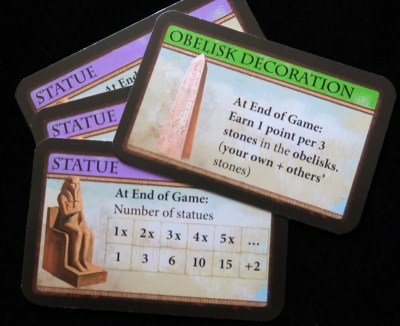
As the game progressed everyone became more wily at positioning stones on the boats, and Pine was prevented from increasing the size of his Burial Chamber group and no-one else could get a larger grouping than two either!  The ‘Wall’ received a number of cubes this game, including quite a few of Ivory’s, and eventually it reached the third level.  Burgundy continued to dominate the Pyramid, while the the obelisk continued to grow and Burgundy was began to make inroads to Green’s lead, while Pine kept a watching brief in third.  By the latter part of the game everyone was so focused on their own strategies that they often failed to notice Burgundy attempting to dominate one particular boat.  The first time he did this he managed to collect two purple statue cards in one turn and the second time he got two cubes into the obelisk (although Green jumped aboard at the last minute to limit the damage). In the penultimate round, Burgundy had got three stones on a four stone ship.

Imhotep
– Image by boardGOATS

Green was next and a quick count suggested that if this were to go to the obelisk it would lose him the lead.  So, he felt he had no choice; that boat had to dock somewhere else and he chose the Pyramid as the least damage, though it still netted Burgundy six points.  That gave Pine an opening to get a couple of his stones to the obelisk so that he overtook Burgundy, pushing him into second.  Going into the final round, the writing was on the wall.  Burgundy could no longer win the Obelisk win, and as long as Green placed a stone on the same boat as Pine, he was guaranteed the full fifteen points for first place (as last time).  Otherwise it was mostly just a mopping up exercise to get the most points possible with the last stones.  Both Burgundy and Ivory had managed two or three purple statue cards and so the final scoring was tight.  Despite being the only one without a green bonus scoring card (which gives points for the total number of cubes in the different areas), Green still finished a couple of points ahead of Pine in what was another close and enjoyable game.

Imhotep
– Image by boardGOATS

With both games finishing, Black and Purple having consumed their supper and Green heading off, it looked like it was change.  However, in the event, Green was directly replaced by Black and Purple and the other group began another game of Imhotep.  The game has an in-built expansion as each location board has a second side with slightly more involved building options.  For example, while Side A has just one large Pyramid, Side B has three smaller Pyramids and players choose which one to add their cube to.  Pink, who had played Side A at the UK Games Expo, was keen to give the alternative options a try.  It turned out that these actually add quite a bit to the complexity as they add another layer to the decision making.  This is because instead of just considering what everyone would get at each location, players have to consider what everyone will do at each location and what this will give them.

Imhotep
– Image by boardGOATS

So for example, instead of just looking at where all the cubes will go in the Pyramid and what they will score, the active player now has to consider which Pyramid each player will pick and what that leaves for everyone else.  For this reason, it possibly wasn’t the best choice for a first game.  As a result, as they had not played it before, both Red and Magenta struggled with trying to work out what they were trying to do and what strategies would work best.  In the early stages, it was all very tentative.  Instead of just building the highest, on Side B, points are awarded throughout the game for “mini-obelisks” containing just three blocks, though the early mini-obelisks are worth more.  Blue got an early start with Pink following in second place.  Meanwhile, Red and Magenta scooped up some of the early Market cards, correctly thinking they were important, hoping that it would allow them to learn what else might be a good strategy.

Imhotep
– Image by boardGOATS

It was in the third round it became apparent that we had a problem on our hands as Pink had taken a bit of a run-away lead in the Temple.  When playing with Side A players add cubes to a row of five blocks, with additional blocks going into the second and eventually third rows.  Points are scored at the end of the round for each stone delivered that is visible from above.  With Side B, blocks are added in  the same way, but the bonus are different.  Thus, the first “space” on the alter will give one point or two extra wooden blocks.  Other spaces give Market cards and even two points making it quite lucrative.  Unfortunately, for the rest of us, Pink had somehow managed to steal a march on the rest of us.  He then made a point of sending a small boats there which meant his early blocks continued to work for him well beyond their usual lifetime.  This was not helped by the fact that Pink also contrived to ensure that the little boats contained his blocks, so any that were covered were covered by his own blocks so he continued to benefit. Blue, having played the game before could see the problem and managed to muscle in a little, but it was slow and Pink stormed into the lead with nothing anyone else could do about it.

Imhotep
– Image by boardGOATS

Eventually, Blue and Magenta managed to break Pink’s strangle-hold on the Temple, while Red began to fall behind but continued to collect purple Statue cards stacking up points for the end of the game.  Magenta gradually began to dominate in the Burial Chamber too.  With Side A, the blocks are placed in position in strict rotation and the each player scores points for their largest contiguous area according to the Triangular Number Series.  With Side B, however, each row of blocks is evaluated independently and eight points awarded to the person with the most blocks in the row, with four points for second place and two for third.  With three rows, a player who goes into this heavily can pick up a lot of points which is exactly what Magenta did, winning two and coming placing on the third as well.

Imhotep
– Image by boardGOATS

With the game coming to a close, we all thought Pink had it in the bag, but we still had the end game scoring cards to count up.  Sadly, Red’s Statues didn’t get her quite as many as we thought, but it was very close with both Pink and Magenta finishing with forty-two points.  Blue just managed to squeak ahead though finishing with forty-three in what turned out to be yet another tight game.  So that was three out of three as it had been close first time we played as well when Green had won, taking the Obelisk.  This led some of us to speculate whether the Obelisk is perhaps a little too powerful.  Although it has featured heavily in all three games, the games have all been exceptionally close so the jury is still out.  Now that we know it is a potential game changer though, next time there might be more blocks placed there and a greater battle for supremacy. In turn that could let someone else slip through and score heavily elsewhere which could make it interesting.  It’ll probably get another outing soon as we can’t let Green remain unbeaten.

Imhotep
– Image by boardGOATS

While the second game of Imhotep was going on, at Blue’s suggestion, the other group got on with Isle of Skye: From Chieftain to King.  This won the Kennerspiel des Jahres this year and has proved very popular with our group as there is quite a bit of variability in the set up ensuring the games remain interesting.  Despite the fact that she wasn’t playing, it was Blue’s suggestion as she knew that Black, Burgundy and Pine liked it a lot and thought that Ivory might appreciate it too.  Borrowing heavily from tile-laying games like Carcassonne, Isle of Skye is a much deeper game without adding an awful lot to the rules.  The idea is that players draw three tiles from a bag and and then secretly choose one to discard and set prices for the other two.  This is done by placing the tiles in front of a screen and a discard token and money for the player’s stash behind.  The money remains in place for the duration of the round, unless the corresponding tile is purchased by another player.

Isle of Skye: From Chieftain to King
– Image by boardGOATS

This mechanism is very clever as if nobody else wants the tile, then the player uses the money to purchase it themselves.  Thus, it is critically important to correctly evaluate the worth of the tile, depending on whether it is most desirable to sell it or keep it.  The other clever part of the game is the scoring:  This is mostly carried out at the end of each of the six rounds.  At the start of the game, four scoring tiles are drawn at random and these are used in different combinations at the end of the rounds in such a way that each appears a total of three times, but only one is used in the first round while three are used in the final round.  This time, the first two scoring tiles drawn both rewarded mountain ranges, so although this could have made for an interesting, competitive game, in the interests of balance, we decided to chuck them back and start again.

Isle of Skye: From Chieftain to King
– Image by boardGOATS

The four scoring tiles were: five points for the player with the most money and two for the player with the next most (A); two points for each cow on the road connected to the castle (B); three points for each vertical row with more than three tiles (C) and one point for each completed terrain (D).  Burgundy started collecting cattle while Black went for sheep.  Maybe it was because Black got there first, or perhaps it was because someone misheard, but Pine (who can usually be counted on to go for a woolly fleece) tried to use ships to build his score.  Purple isn’t a great whiskey drinker, but as usual, she built her strategy on a foundation of barrels.  This didn’t leave much for Ivory, but there is always someone who struggles with a lack of cash and someone else who seems unnecessarily flush.  This time it was Ivory who made a killing on his tiles and with money in the scoring tiles it guaranteed him a solid number of points to build on.  It was a another close game  with only five points between first and third.  It was Burgundy who just pipped Black to finish in front however, with Pine a close third.

Unter Spannung
– Image by boardGOATS

Red and Magenta were about to make a move, but with Isle of Skye still going, they stuck about for a couple more rounds of Unter Spannung, which Red and Blue took again, though it was a bit closer this time.  As the other group finished and Ivory headed off too, the rump were left to play one last game.  Black had been keen to play Pi mal Pflaumen, but had missed out when it was the “Feature Game” a few weeks back, so he was very keen to give it a go.  This game is a relatively simple little card game, but one that we struggled with the rules for last time and contrived to make a bit of a mess of this time too. Pi mal Pflaumen (or “Oh my Plums!” as we call it in a sideways reference to another little card game, Oh My Goods!), is a trick taking game with elements of set collecting and lovely artwork.  The idea is that each card features a fruit, a number and most also have some sort of special action.  Each player begins with a hand of cards and, starting with the start player, everyone takes it in turns to play one card.  Then, the player who played the highest value card chooses one of the cards which they place face up in a tableau in front of them, before they carry out the action associated with the card.

Pi Mal Pflaumen
– Image by boardGOATS

There are several different special actions, it could be steal a card from another player; take the “watchdog” card (which guards against other players stealing cards), or take three “pi” cards.  Instead of an action, some cards indicate a scoring condition and the points awarded for achieving it.  These are of the form of, for example, ABC or AAA, indicating three different fruit or three identical fruit respectively.  The more fruit involved and the more similar the fruit, the more points they are worth.  When a player owns both the scoring card and the matching Fruit cards, they are all removed from their display and put to one side to score at the end of the game.  The game is played over three rounds and winner is the player with the most points at the end.

Pi mal Pflaumen
– Image by boardGOATS

Last time we played, we had a fairly extensive discussion about the rules.  The rules are a little unclear:  they clearly state that “when a card is taken you must immediately carryout its action”, but they don’t make it clear whether this applies to claiming points on “Fruit Mix” cards as well.  We couldn’t remember how we played last time, but this time we played that points could only be claimed when the card was taken (with cards in the player’s tableau used to fulfill the condition).  In an added complication, we also had to decide what implications this had for cards that players have stolen.  The rules state that “you can immediately use a stolen card to create a Fruit Mix”.  Initially we presumed that this applied only to the fruit mix cards, but a little doubt began to set in.  Checking the rules fora online after the event suggested that Fruit Mix cards from the tableau could also be claimed, and the key phrase in the rules stated that “one or more Fruit Mixes” can be claimed when a card is taken, which is only possible if cards in the tableau are used, but this only became apparent some time after the game.

Pi mal Pflaumen
– Image by boardGOATS

It was another tight game with everyone claiming some low scoring Fruit Mixes in the first round, but Burgundy took a slight lead making him a target for the rest of the game.  In the second and third round, the value of the fruit mixes on the cards increases adding a bit of all or nothing element to the game.  For example, Blue had spent much of the game with low cards and, as a result had ended up taking the last card more than her fair share.  The last card comes with a bonus “Plum” card though, so if she had managed to pick up the twenty-five, she could have claimed a massive twelve points for a total of four Plum cards.  Purple did her best to help Blue out, but Black had a large pile of π cards and with Burgundy and Pink’s help was able to control things.  In the end it was Pink who finished with the most points, just three clear of Blue with Black in third place.

Pi mal Pflaumen
– Image by boardGOATS

Learning outcome:  Well balanced games also make for tight results.

Boardgames in the News: Asmodee on the March Again?

It’s been quite quiet recently, but summer is now here and with it, the silly-season of take-overs and mergers, which inevitably means Asmodee are at it again.  Asmodee, (originally known as Siroz), started out as a small French game publishing and distribution company, specialising in the family market.  Their best-known product was probably Dobble, though there were others too.  In 2007, the investment firm, Montefiore acquired 60% of the company and invested €120 million to finance Asmodee’s international growth.  Their expansion history began a bit like this:

Meanwhile, the Canadian F2Z Entertainment, the parent of company of Pretzel Games, also own Filosofia Éditions (who bought Z-Man Games in 2011) and bought the U.S. company Plaid Hat Games last year.  Then, in January 2014, the private equity company Eurazeo bought 83.5% of Asmodee and the mad expansion began all over again, but this time in earnest:

Last summer we speculated how long it would be before Asmodee turned their attention to F2Z Entertainment with their enticing range of games including Pandemic and  Carcassonne.  Well, last week, Asmodee announced that it has entered into exclusive discussions to acquire F2Z Entertainment with closure of the acquisition expected to take place in the coming months.  Who will be next, Rio Grande Games perhaps?

Asmodee Logo
– Image from escapistmagazine.com

3rd May 2016

Pine, Magenta, Red and Burgundy were all keen to give the “Feature Game”,  Cheesonomics a go, especially when they saw the eye-catching truckle shaped box.  Pine was especially enthusiastic when he realised that it featured both cheese and goats!  The game itself is a fairly simple, set-collecting and hand management card game based on controlling and manipulating supply and demand of various types of cheese, all seasoned with a sprinkling of dreadful puns.  Players have a hand of five “wedge-shaped” cheese cards each with a colour suit (corresponding to country) and an animal suit (milk type).  On their turn, the active player can carry-out one of three possible actions:  churn, produce or sell.  Churning is a way a player can improve their hand.  First they declare a suit (colour or animal) and everyone else has to pass a matching card to the active player.  Once all the cards are in, the active player chooses five to keep and hands one card back to each player.

Cheesonomics
– Image by boardGOATS

Players can then place a matching set of cards in front of them to produce cheese; the cards must either have the same colour or the same animal.  The last possible action is to sell cheese:  a maximum of three cheese wedges can be sold at any one time and they must all be the same country (colour).  The cheese is valued at the market rate which is calculated from the number of wedges of that colour displayed in the market.  These wedges are different on both sides, so once a sale has been made, one market “share” is turned over (the market is “mooved”), which reduces the value for the next sale.  The clever part of the game is the scoring:  in addition to money made from selling cheese, players also get bonus points at the end of the game.  The players who sold the most of each cheese type (i.e. animal) get extra points equivalent to the number of wedges sold.  So, cheese is sold by colour, but bonus points are awarded for animals.

Cheesonomics
– Image by boardGOATS

Only Blue had played Cheesonomics before and that was a two-player game, so nobody really had a feel for how it would play.  Red went first and churned, followed by Pine who asked for goats.  Burgundy got a good starting hand and was able to produce a large batch of German cheese on his first turn, but otherwise we all got carried away churning cheese.  The problem was that since everyone was churning cards furiously, we were all disrupting each other’s hands which meant we ended up having to churn again on the next turn too.  Eventually, this seemed to dawn on us collectively and we all started producing what we had rather than trying to get the perfect hand first.  With a couple of good hands early on Burgundy was also the first to sell and everyone else struggled to catch up.

Cheesonomics
– Image by boardGOATS

Pine eventually managed to sell some of his goats and Blue, the last to convert cheese to cash, shifted a large batch of Scandinavian (yellow) cheese and take a massive fifteen curds.  It was all way too little and much too late though:  the game suddenly ended and Burgundy’s excellent start coupled with the fact that he’d managed to focus almost solely on both reindeer and yak yielded huge bonuses at the end.  Pine and Red had eventually spotted this and made a concerted effort to catch him, but Burgundy had just got too far ahead and won by two points with Pine in second.

Mijnlieff
– Image used with permission of BGG contributor thepackrat

Black and Purple had eschewed the opportunity to play Cheesonomics and settled down instead to play Mijnlieff (pronounced Mine-Leaf).  This “fancy noughts and crosses” game is played with beautiful little wooden tiles on a four by four wooden board.  the aim of the game is to form lines of three, but since there are different types of pieces and your opponent controlling where you can play it is much more strategic.  Each Player has eight pieces with two each of four different symbols where the different pieces dictate where the other player can put their next piece.  For example, when a Greek cross (or “+” symbol) is played, the next player must place his piece on an empty square in an orthogonal line from the piece just played.  Similarly, playing a saltire (or “×” symbol) forces the next player to place his piece in a diagonal line from the piece just played.

Mijnlieff
– Image used with permission of BGG contributor thepackrat

Black managed to get a line of three, but Purple took the game with two lines of three and one of four giving her a total of four points to Black’s one.  Since the supposedly quick little “Feature Game” was still going, Black and Purple moved onto another game we know quite well, Splendor.  This is a game of chip-collecting and card development where players collect chips to buy gem cards which can then be used in lieu of chips.  More expensive cards are also worth points and the game end is triggered when one player reaches fifteen points and the round is completed to give everyone the same number of turns.  Points are also awarded for “nobles” which go to the first player to get a specific combination of gem cards and the player with the most points at the end is the winner.

Splendor
– Image used with permission of BGG contributor henk.rolleman

The game was incredibly tight, but when Black was declared the winner, Purple looked slightly crest-fallen.  On closer inspection, they realised that they’d missed scoring one of her nobles.  Purple had managed to take two of the three available picking up both Isabel of Castille (awarded for four each of opals and diamonds) and Anne of Brittany (awarded for three each of emeralds, sapphires and diamonds).  This left them on sixteen all and a draw, though on closer inspection there is a tie-breaker, so arguably Black took it as he had the fewest cards in his display.

Splendor
– Image used with permission of BGG contributor henk.rolleman

Since Cheesonomics had finally come to an end as well, we had a lot of options on what to play next.  Half the group weren’t staying late, so we decided to play something short as a group before splitting up again into two groups (one of “light-weights” and one of “dirty late-night stop-outs”).  Looking for something to play seven, our choices were limited, and as is often the case in our group, we settled on our old favourite, 6 Nimmt!.  In the first round Black and Magenta were vying for the wooden spoon taking a total of twenty-four nimmts each.  Unusually, Burgundy, though high scoring, was some way behind the race for the bottom, only taking fifteen points.  Both Red and Blue kept a clean sheet so the question was which of them were going to be able to keep their score down in the second round too.  In the end though, both quickly started picking up cards and it was Purple who took the glory, finishing with just three nimmts over the two rounds, her second win of the evening (and only robbed of a third by a tie-breaker nobody knew existed).

6 Nimmt
– Image by boardGOATS

With the fun filler over, the “light-weights” looked for a similarly light game to finish, but in the end, settled on Splendor, as it was still out and Magenta and Red were very familiar with it.  This game was a very difficult one as all the cards in the second row needed lots of sapphires which were scarce throughout.  Magenta tried to work round the problem by collecting nobles, but everyone struggled.  For several rounds, Red was very close to the fifteen points needed to end the game and Magenta had four points available on a reserved card, but could not get the last ruby to buy it.  In the end, but it was Pine, who was new to the game, who finally put everyone out of their misery, ending the game with seventeen points, three points clear of Red.

Splendor
– Image used with permission of BGG contributor henk.rolleman

On the neighbouring table, after a short debate, the “late-night stop-outs” settled on Isle of Skye: From Chieftain to King as their longer game.  We’ve played it a couple of times before and it is hugely popular with the group.  Borrowing heavily from tile-laying games like Carcassonne, Isle of Skye is a much deeper game without adding an awful lot to the rules.  The idea is that players draw three tiles from a bag and and then secretly choose one to discard and set prices for the other two.  This is done by placing the tiles in front of a screen and a discard token and money for the player’s stash behind.  The money remains in place for the duration of the round, unless the corresponding tile is purchased by another player.  This mechanism is very clever as if nobody else wants the tile, then the player uses the money to purchase it themselves.  Thus, it is critically important to correctly evaluate the worth of the tile, depending on whether it is most desirable to sell it or keep it.

Isle of Skye: From Chieftain to King
– Image used with permission of BGG contributor henk.rolleman

The other clever part of the game is the scoring:  This is mostly carried out at the end of each of the six rounds.  At the start of the game, four scoring tiles are drawn at random and these are used in different combinations at the end of the rounds in such a way that each appears a total of three times, but only one is used in the first round while three are used in the last.  We included the the extra tiles from the 2015 Brettspiel Advent Calendar in the draw mix and one of them  came up. The four tiles were:  points for animals next to farms (A), extra scroll scoring from the Advent Calendar (B), points for each tile with a road that is connected to a castle (C) and points for each enclosed region (D).  Inevitably, everyone started out desperate for animals and farms, but since these scored in rounds one, three and five, all of a sudden they fell out of favour.

Isle Of Skye: From Chieftain to King
– Image by boardGOATS

Despite having loads of cash, Burgundy really struggled to get the tiles he wanted particularly as everyone else kept buying them off him.  In contrast, Blue didn’t do too badly for tiles, but always seemed to be running out of money.  This was exacerbated by the fact that she didn’t get any of the “catch-up cash” given out from the start of round three.  It is only the number of players in front of them that dictates how much money players get (not how far behind they lag), but the amount can really add up: a player who is consistently at the back in a four player game will net an extra thirty sovereigns over the course of the game compared with a player who leads throughout.  Theoretically, the difference in position between the first and last player could remain just one point throughout, so there is an art to being “just behind”, in the same way as there is an art to being at the back in Colosseum (which was our “Feature Gamelast time).  Clearly this time Burgundy had the knack, and Blue didn’t.

Isle of Skye: From Chieftain to King
– Image used with permission of BGG contributor henk.rolleman

While Burgundy and Blue were struggling with their respective finance issues, Purple quietly plugged away collecting barrels and brochs, while Black ended up with ships and when the corresponding scrolls turned up, they looked to be well placed, until Black ran out of money and a critical tile was taken from him in the final round.  Despite her lack of money, however, Blue didn’t over-reach herself and managed to enclose her scrolls early giving her extra points at the end, but also for the Brettspiel Advent Calendar scoring tile during the game.  Nearly bankrupting herself in the early rounds for those animals now proved worth it as she raked in the points for the scrolls she had enclosed.  Enclosing scrolls was the key in this game as the other player to succeed in this area was Purple who finished a highly creditable second after a barn-storming evening.

Isle of Skye: From Chieftain to King
– Image used with permission of BGG contributor henk.rolleman

We had a little over half an hour left, so we decided we could fit in one last game.  We couldn’t afford to spend too long thinking about it.  Since Black expressed an interest in Karuba as he’d heard good things about it and Blue assured everyone that it wouldn’t take the forty minutes claimed on the box, we decided to give it a go.  This is a game that Blue and Pink bought at Essen last year and is very similar to Das Labyrinth des Pharao which they picked up at the same time on behalf of Black and Purple.  In the event, Karuba did take just about forty minutes, but that included setting up and teaching.  The game is a bit of a cross between bingo and a tile-laying solitaire.  The idea is that every player has the same number of numbered tiles which the players simultaneously place when the number is called.  Unlike Das Labyrinth des Pharao, the tiles the orientation is fixed, which narrows down the number of possibilities and helps to reduce “analysis paralysis”.  Both games are loosely themed with explorers, but in Karuba they are crossing the jungle to find treasure rather than exploring a pyramid.

Karuba
– Image used with permission of BGG contributor punkin312

Each player has set of four coloured explorer meeples and matching coloured pyramids, with the aim being to get the explorers to the corresponding pyramids by laying tiles to make a path.  Everyone begins with the same layout (chosen collectively) and players score points for getting their meeples to their matching temples first.  Everyone draws the tiles in the same order, since the “caller” (Blue, in this case), draws their tiles at random and calls out the number for everyone else to play too.  Once the number has been called, each player can either place the tile on the board or discard it and move an explorer along a path where the distance corresponds to the number of exits on the tile discarded (i.e. two, three or four squares).  Some tiles have crystals or gold nuggets next to the path and an explorer who stops on the tile gets to pick up the treasure which are worth points at the end of the game.

Karuba
– Image used with permission of BGG contributor henk.rolleman

Our explorers all ended up a long way from their pyramids, so sharing a common route was essential and it was just the logistics of how to do it that everyone had to work out.  With time at a bit of a premium, Blue didn’t hang about and kept the tile drawing moving quickly.  Burgundy got a bit carried away picking up crystals before getting his explorers in a tangle (the paths are too narrow for meeples to pass each other).  Purple, for whom spacial awareness does not come naturally, unfortunately managed to completely cut off one of her explorers and Black got into a bit of a tangle too before he managed to extricate himself from the mess and bring them home safely.  Blue, the only one to have experience with the game neglected picking up crystals and got three of her explorers home first netting an unassailable fifteen points, in a game that definitely benefits from experience of how to balance crystals and getting to temples.  While packing up, we discussed the game and the fact that it is likely to be one of the nominees for the Spiel des Jahres award this year given the lack of other good competition.

Karuba
– Image used with permission of
BGG contributor henk.rolleman

Learning Outcome:  GOATS like cheese, but they like whisky more…

Boardgames in the News: Record-breaking Carcassonne

Hans-im-Gluk recently announced a new record breaking game of Carcassonne.  Three Swedish players laid 10,007 tiles in just twenty-five hours smashing the previous, ten year old German record of 4,194 in forty-three hours.  Paul Sydby, Marie Sydby and Robert Wagman played competitively over two days with Mikaela Lincoln Börjesson acting as stand-in when one of the others needed a break.  The rules were slightly modified for simplicity (for examples, there were no farmers) and everyone played “nicely” to keep things moving along efficiently.  Paul won the epic game with a total of 11,886, a little over one thousand points ahead of Robert in second place.  The biggest city scored eight hundred and fifty-five points and was shared by all three players while Paul took the longest road which was thirty-five tiles long.  The layout covered a massive ninety-two by one hundred and eight rectangle without gaps, and it took Paul approximately two weeks (at about an hour per day) to sort all the tiles back into their original one hundred and thirty-nine boxes!

Carcassonne Record 2016
– Image from FaceBook.com